Hello 2024! Last year the art-fair spaceship landed in NYC during September, stealing thunder from the local galleries. Is January now the best month for solo exhibitions? Lots of our favorite local artists are having openings: Joan Snyder at Canada, Jane Swavely at Magenta Plains, Sharon Horvath at Lori Bookstein, Greg Drassler at Betty Cuningham, Bill Carroll at Elizabeth Harris, and Tamara Gonzales at Klaus von Nichtssagend. Former Bushwickers Julie Torres and Ellen Letcher are returning…
Author: Two Coats Staff
Eyal Danieli: Embracing history in abstraction
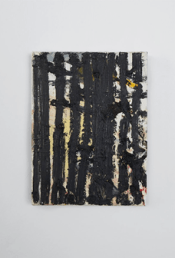
Contributed by Michael Brennan / Israeli-American artist Eyal Danieli passed away earlier this year. I met him a few times, but I didn’t know him. I was impressed by the force of his personality, or more specifically of his presence. It was not that he was intimidating. In fact, he struck me as a tender soul – a gentleman – but also a man weighted with a distinct and uncommon gravity. His painting, in its blunt sensitivity, is similar. Sadly, Danieli’s first exhibition with 57W57 Arts, solemnly called “Preoccupied,” is effectively a memorial show. But nothing can diminish the innate power of his small pieces.
Dana Schutz: Too big to fail?
Contributed by Peter Malone / The airplane-hangar dimensions of the top-tier commercial art gallery can be justified by the flexibility they offer both dealer and artist. In 2017, I watched David Zwirner adapt his Chelsea location on 19th Street to accommodate Alice Neel’s modestly sized portraits, then open it up to create the parking lot rug sale vibe that suited Josh Smith’s 2019 “Emo Jungle” bazaar. Those two events occupied my thoughts as I walked through the grandiose layout of Dana Schutz’s recent “Jupiter’s Lottery” exhibition.
Beyond time: Brice Marden’s last paintings
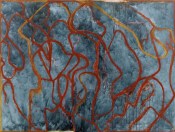
Contributed by Kim Uchiyama / The dreamtime, as understood in Aboriginal culture, is a fully integrated reality lived daily, a total experience that holds past, present, and future in balance. From this perspective, the late Brice Marden’s last paintings feel both old and new, evoking an ancient mindset while embodying a new sentience and haptic presence born of the vulnerability and fragile urgings that arose as he grappled with his aging body and the ravages of cancer. The show’s title, Let the painting make you, is apt. It is fundamental to Marden’s work that painting spoke through him from the inside out: although he always adhered to his own set of rules, he never imposed an intellectualized concept on his creations.
Patricia Satterlee and Fran Shalom: Heirs to Nozkowski
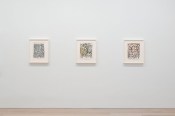
Contributed by Sharon Butler / Abstract painter Thomas Nozkowski was widely and deservedly recognized for making intimately scaled abstract paintings using an idiosyncratic visual language that was derived from the visual and emotional stimuli of everyday life. Since his death in 2019, I’ve often wondered who might be the next Nozkowski. Given the trend towards figuration, mixed-media surfaces, and massive scale, precious few painters seemed to be walking in his humble footsteps. Now we have Patricia Satterlee and Fran Shalom.
Elizabeth Gilfilen: De-defining the gesture
Contributed by Vittorio Colaizzi / “I vehemently reject the claim that mark making by itself harbors any potential.” This was Isabelle Graw in conversation in 2010 with Achim Hochdörfer. The previous year, the latter had published his essay, “A Hidden Reserve”, chronicling a persistent but transformed and inquisitive use of the gesture by artists such as Joan Snyder and Simon Hantaï, after the myth of its unrestricted access to the inner self had been thoroughly critiqued by virtue of the encaustic and enamel regimentations of Jasper Johns and Frank Stella. It is not certain, however, whether mark-making can ever be “by itself,” as Graw puts it. Certainly, it carries with it endless associations and ever-shifting positions. Upon her first encounter with Abstract Expressionism, a young Louise Fishman saw in it a queer language suitable to her own alienation, in contradiction to its macho orthodoxy, while Amy Sillman similarly emphasizes painting’s potential to transgress categories. Hochdörfer’s corollary thesis, relevant to this day, is the dialectic between “literalism and transcendence,” or the acknowledgement of art’s concrete materiality versus the expectation and oft-reported experience of transformation, metaphor, or perceptual intensification.
Brice Marden’s valedictory courage
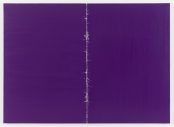
Contributed by David Rhodes / Brice Marden died at the age of 84 in August 2023. His first exhibition was in 1966 at the Bykert Gallery, located on East 81st Street, only a few blocks northeast of his current exhibition at Gagosian. A long life, years in the studio, immeasurable time spent with other artists’ work, travel, and an abundance of courage led to the paintings he made at the end of his life.
Coherent divergence at John Molloy Gallery
Contributed by Jonathan Stevenson / “Mutability,” a thoughtfully conceived and curated group show at John Molloy Gallery, by its title contemplates the elastic aesthetic capacities of painting, drawing, and sculpture. It further explores the compulsion of the three featured artists to segue from one form to another and thus to produce visually rich hybrids. While such formal nicety is interesting in itself, the work here also touches smartly on a range of more worldly concerns.
Books and Maps and Getting Lost: Doug Beube at The Argosy Bookstore
Contributed by Rebecca Chace / There are two places you can still get lost if you choose to: the streets of New York City and the pages of a book. You love art and books, isn’t that why you moved here in the first place? But you may have forgotten how to get lost.
Artist’s Notebook: Elisabeth Condon
Painter Elisabeth Condon divides her time between Manhattan and Florida, where she currently has new work on view in “Tempus Fugit,” a solo show at Emerson Dorsch Gallery. Two Coats of Paint invited Condon to share ten ideas and influences that shape her ebulliently expansive paintings and installations. The artist’s influences come from near and far, from her excessively designed childhood home in California to the Astor Chinese Garden Court at the Metropolitan Museum and the furniture Japanese designer Shiro Kuramata crafted from industrial materials. For Condon, kinetic and vigorous layering are crucial to her process.
Text and image: Laurie Fendrich and Peter Plagens
Contributed by Sharon Butler / I had some questions for Laurie Fendrich and Peter Plagens — artists, writers, spouses who have a two-person exhibition of abstract paintings on view at Texas Gallery in Houston through December 16. After they were evicted from their Tribeca loft a couple years ago, they decamped to Litchfield County, where they both have studios in their home — a beautifully converted auto body shop. In her seventies, Fendrich is a Professor Emerita of Fine Arts and Art History at Hofstra University and is represented by Louis Stern Fine Arts in West Hollywood. After writing regularly for The Chronicle of Higher Education for many years, she now writes fiction and contributes art reviews to Two Coats of Paint. Plagens, in his eighties, is the art critic at The Wall Street Journal and is represented by Nancy Hoffman Gallery in New York. My interrogation about the evolution of their painting lives over the course of some fifty years started during an early morning text exchange that became so rich and resonant I asked if Two Coats of Paint could publish an expanded version.
Louis Fratino’s happy equilibrium
Contributed by Margaret McCann / Louis Fratino’s paintings in “In bed and abroad” at Sikkema Jenkins depict varied social situations, from intimate scenes to foreign climes. Snapshots of memories, many from Italy, read like a travel diary. In Duomo, light seems to dissolve a church façade into a gossamer veil, like Monet’s series of Rouen. Milan’s iconic gothic cathedral is strikingly illuminated, as are most monuments in Italy at night. Silhouetted throngs of young people in front of it have gathered after their evening stroll to aid digestion, take in the sumptuous surroundings, and see what’s happening in the local piazza. This saunter or “passegiata” is also “a walk in the park,” and the painting’s mellifluous drama demonstrates Fratino’s impressive facility, as it captures the Italian relish of visual and other small pleasures, which Americans often mistake for sunny dispositions (see Fellini’s La Dolce Vita).
David Diao: Impeccable touch
Contributed by Adam Simon / Sometime in the early 1980s, a mural appeared on West Broadway between Spring and Broome streets in New York City, declaring in multi-colored capital letters, “I Am The Best Artist” signed, René. This, and other versions of the mural, were generally considered an embarrassment in the local artist community. I thought the mural, by René Moncada, was an interestingly unsubtle parody of artists’ competition and quest for uniqueness. I thought of this mural while viewing David Diao’s solo exhibition, On Barnett Newman, 1991-2023, on view at Greene Naftali. The exhibition comprises twelve paintings dedicated to the work of another painter, including works that look like an archivist’s inventory.
Afire: Christian Petzold’s combustible feast
Contributed by Jonathan Stevenson / Instability hovers on several fronts – environmental, political, economic – and German filmmaker Christian Petzold manifests his concern about it with remarkable astuteness. For the haunting Transit (2018), he filmed characters with new-fangled accessories in black-and-white as they sought escape from a port in a nameless fascist state, seamlessly casting the shadow of Second World War trauma over the present day. In his new film Afire, which won the Silver Bear Grand Jury Prize at the Berlin Film Festival, he zeroes in on narcissism in a time that demands community.
NYC Selected Gallery Guide: Dec 2023
Hey galleries and artists! If you have enjoyed being included in our NYC Selected Gallery Guide and find it a helpful way to get the word out to promote your exhibitions, please consider making a tax deductible contribution to Two Coats of Paint. Kick in a few bucks to support the project in 2024. If you have already contributed, thanks for your support — you’re helping to keep the conversation going.
Colin Brant’s communion with the inconstant
Contributed by Natasha Sweeten / You might consider the title of Colin Brant’s quietly inspiring exhibition “Mountains Like Rivers,” currently on view at Platform Project Space, an invitation to a world flipped on its end: what’s inherently solid becomes liquid, what’s up is now down. You would not be entirely wrong. Indeed, in Lake Louise/Poppies, the eponymous body of water mirrors the snowy, majestic range that anchors the painting. Red and yellow poppies in the foreground form a joyous tassel punctuating the band of blue, their stems waving like the arms of children eager to be called on.
Emilio Vedova: Venice’s Abstract Expressionist
Contributed by David Carrier / Emilio Vedova (1919–2006), who lived and worked in Venice, was once aptly dubbed the Jackson Pollock of the barricades. Employing that American painter’s gestural technique, Vedova made political art. “Rivoluzione Vedova” – “Revolution Vedova” – is an appreciative retrospective of his work on the third floor of the spacious M9 Museum of the 20th Century in Mestre, a very short train ride from Venice.
Charles LeDray: Securing memory
Contributed by Barbara A. MacAdam / In his solo show “Shiner” at Peter Freeman, Inc., Charles LeDray continues to frolic in his own past, fixing memories and cultural landmarks in tightly condensed, shrunken garments sewn up and assembled into sculptures, and in self-constructed objects turned on a potter’s wheel. He thus creates a home in which he is master and exercises total control over how the artifacts of his life are perceived. He draws our attention to miniscule objects, thereby empowering them. Welcome, then, to a Lilliputian jamboree, in which little people are at once quarries and intriguers.
Hannah Antalek’s crystal ball: Magical and disconcerting
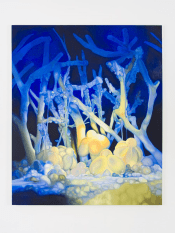
Contributed by Heather Drayzen / “Superseed,” Hannah Antalek’s debut NYC solo exhibition at 5-50 gallery in Long Island City, draws on our species’ overall apathy about the environment. A surreal, dream-like sensibility informs a bio-luminescent vision of nature, cumulatively derived from dioramas she constructs from recyclable materials. She pulls us into a magical but also disconcerting world. Seminal Landing, the largest work, projects a haze of cobalt blue and violet that feels both subterranean and post-apocalyptic. Antalek’s signature “daisy dupe” swollen flowers are clustered together – glowing pearl yellows, tinged with pastel pink, in lilac shadows – as they reach towards twisting branches, dripping goo, and unexplained crystalline forms nestled around them.
Nancy Davidson’s wandering carnival
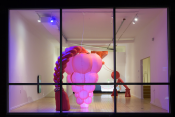
Contributed by Fintan Boyle / A sense of serious satire has pervaded Nancy Davidson’s work for years, and it is on prominent display in her show “Braids Eggs and Legs: A Wandering,” installed in two large galleries at Catskill Art Space alongside Matt Nolen’s work. Davidson has long been a fan of morselized language and sundered bodies, which in theory would make her work fertile ground for the psychoanalytically inclined. Yet here she elides the sexual menace and violence that, say, Melanie Klein offers. Instead, she wanders, as her title announces.