
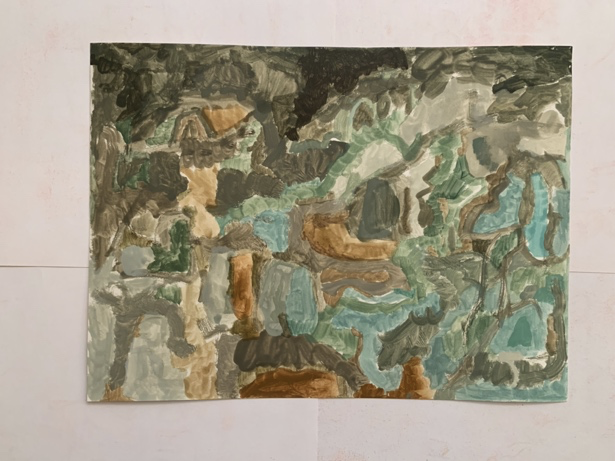
Cathy Lebowitz, Dark Skies, Rocks XXIII, 2023, gouache on paper, 9 x 12 inches
Contributed by Michael Brennan / In Cathy Lebowitz’s “Dark Skies, Rocks,” her second solo exhibition at Skoto Gallery, about two dozen themed works on paper wrap around the walls of the cinderblock space. Many are washy gouache paintings, others are dash-marked drawings. Her paintings are painterly and her drawings graphic, exemplifying soundly medium-specific discipline. The works are refreshingly small, about the size of a writing tablet or an iPad, inviting closer inspection. I felt an unusually direct connection to the artist through what can be described as microcosmic meta landscapes, extending from her hand through her studio, as if directly sourced in real life.
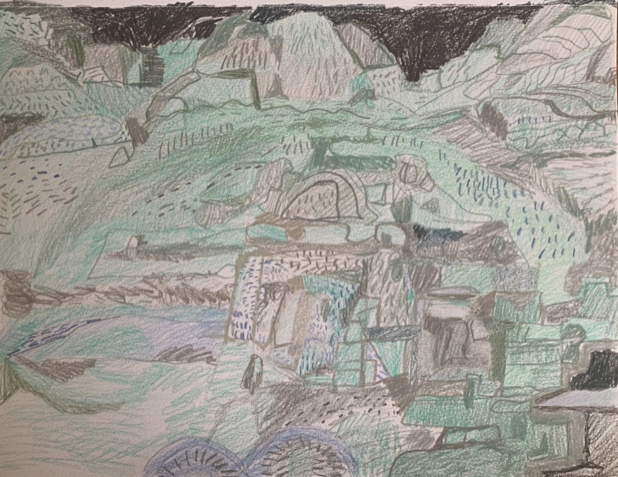
Cathy Lebowtiz, Dark Skies, Rocks XII, 2023, colored pencil on paper, 9 x 12 inches
Gouache, a water-based paint similar to watercolor, is opaque rather than transparent. Many artists, including Jacob Lawrence and Ben Shahn, have made great art with gouache, but because manufacturers sometimes market it as “poster paint” it has often been mistakenly regarded as an inferior medium. Even so, gouache made a trendy comeback at the turn of this century, in the wake of the contemporary Faux Naïf and the corresponding popularity of Henry Darger. Gouache has many unique properties. Traditional as opposed to acrylic gouache can be “re-wet” – that is, reworked – because the medium remains soluble in water even after it has dried. Unlike oil or acrylic, thicker patches of gouache can be chipped away with a thumbnail. Gouache also dries flatly and uniformly. Lebowitz successfully employs most of these qualities throughout this grouping.
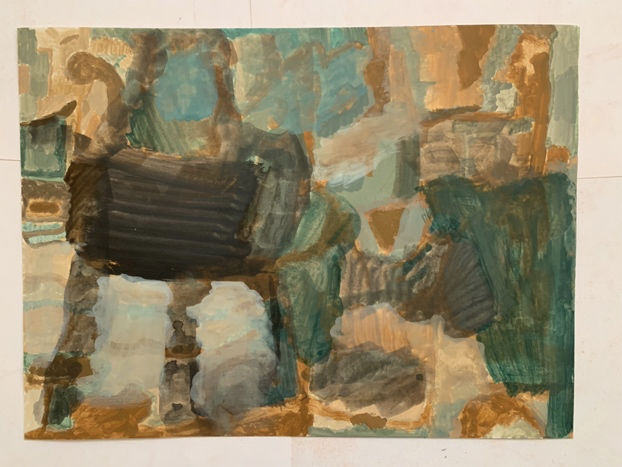
Cathy Lebowtiz, Dark Skies, Rocks VII, 2023, gouache on paper, 9 x 12 inches
She is especially gifted at depicting collapsing and stacked strata: each work on paper is like a geological road cut. Her work may be diminutive, but it has formidable implicit weight, suggesting something larger at work behind the facade of nature, not unlike Cezanne’s Bibemus Quarry paintings, or the heavy, similarly high-horizon work of Marsden Hartley.
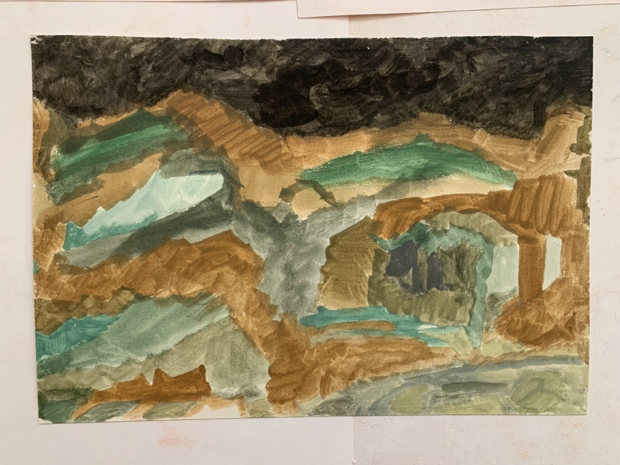
Cathy Lebowitz, Dark Skies, Rocks XX, 2023, gouache on paper, 7 x 10 inches
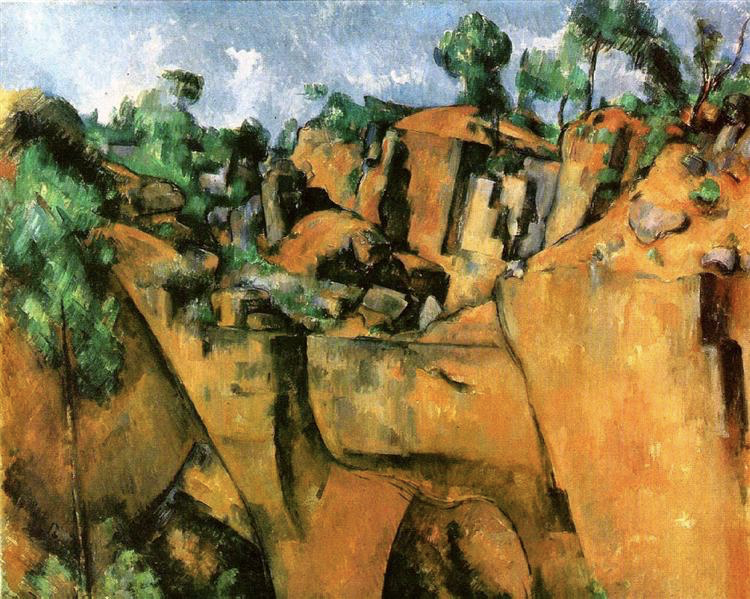
Paul Cezanne, Bibemus Quarry, 1900, Folkwang Museum, Essen, Germany
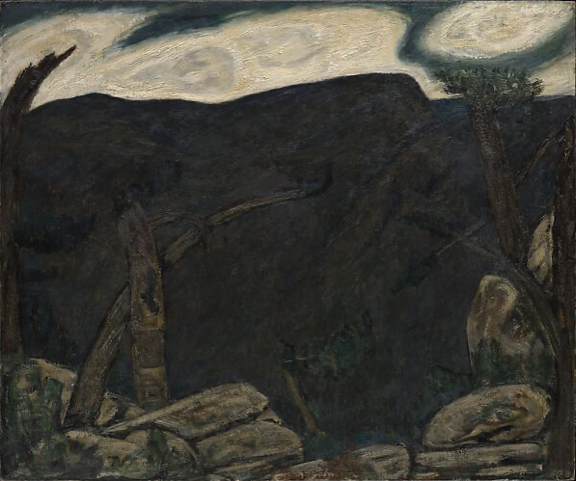
Marsden Hartley, The Dark Mountain #2, 1909, Metropolitan Museum of Art
Lebowitz’s drawing style is another matter altogether. She employs a method involving dots and dashes akin to Morse Code, not unlike the deceptively simple mark-making of Van Gogh.
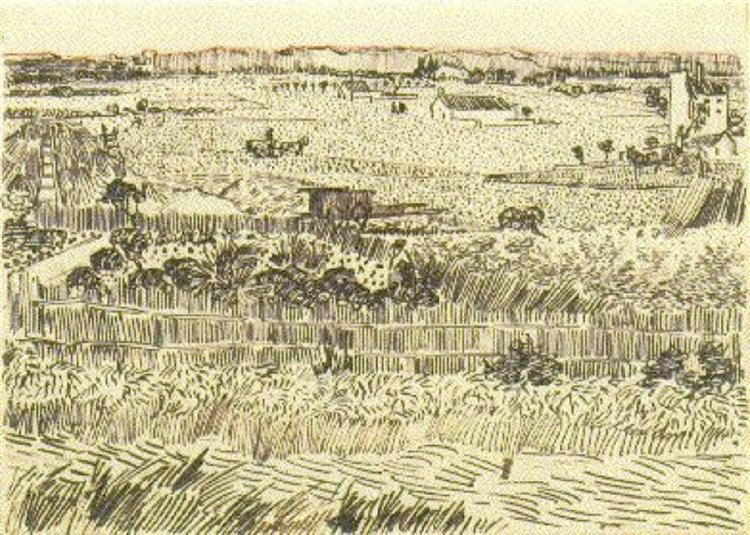
Vincent Van Gogh, Harvest Landscape, 1888, Kupferstichkabinett Berlin, Germany
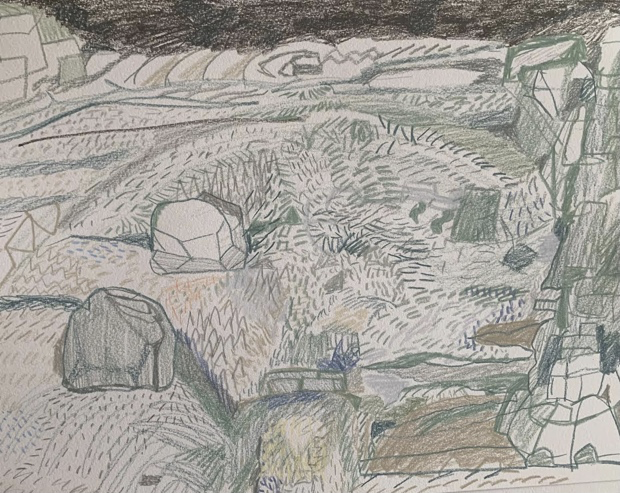
Lebowitz’s color is moody, dark, and mysterious. She sometimes indulges patches of cool green that lighten up an image, offering some interior relief.
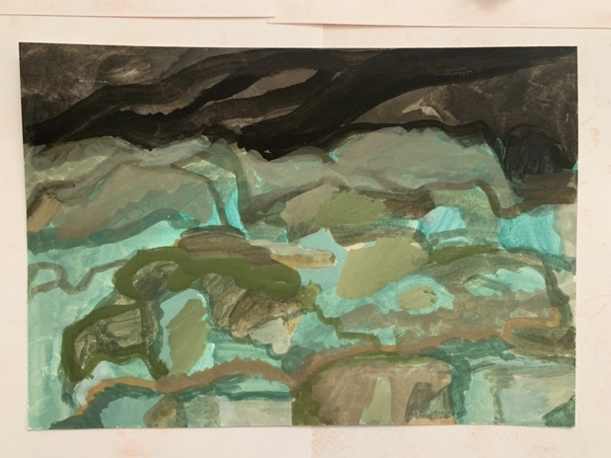
Cathy Lebowtiz, Dark Skies, Rocks I, 2023, gouache on paper, 7 x 10 inches
Lebowitz’s project might seem an improbable one for the twenty-first century, but it’s significant in that her work is free of any oppressive and too-familiar doomsday narrative. Her investigation runs deeper than that, to more personal and hence more rewarding environs. It’s remarkable that landscape painting, in line with a tradition elevated by Patinir in the sixteenth century, can still suggest something greater than its subject, and that an urban artist can have such a profound understanding of art and nature. Lebowitz might just be the artist who rehabilitates the landscape in the postmodern world, the way that Morandi re-established the still life in the Nuclear Age.
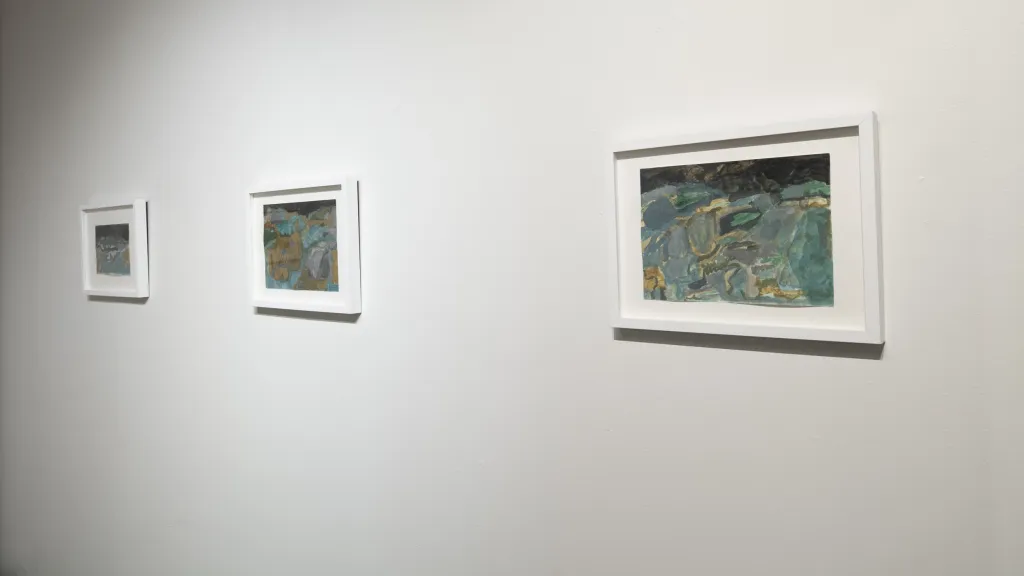
“Cathy Lebowitz: Dark Skies, Rocks,” Skoto Gallery, 529 West 20th Street, 5th floor, New York, NY. Through March 9, 2024.
About the author: Michael Brennan is a Brooklyn-based painter who writes on art.








Thank you Michael for bringing this work to my attention. Landscape can be difficult to update but these works seem to relate in a deeper way. It’s refreshing to see a depth of feeling in this world of chaos. But dark sky’s remind us of that backround conversation.
not interesting work
Felt right away the touch of Philip Guston,too
Again, another thoughtful review where you bring in historical and technical references to expand our view of this current exhibition. Thank you!
Thank you for this nice review. The connection with Cezanne, Hartley and Van Gogh was particularly relevant.