

Contributed by David Whelan / I first saw a Lois Dodd painting in 2004. View through Elliot’s Shack Looking South was part of a group show at our college gallery when I was a freshman. The painting absolutely stunned me and served as a touchstone throughout my education and early adulthood. Dodd’s solo show “A Radiant Simplicity” at The Art Gallery at Brooklyn College might have done the same for others.
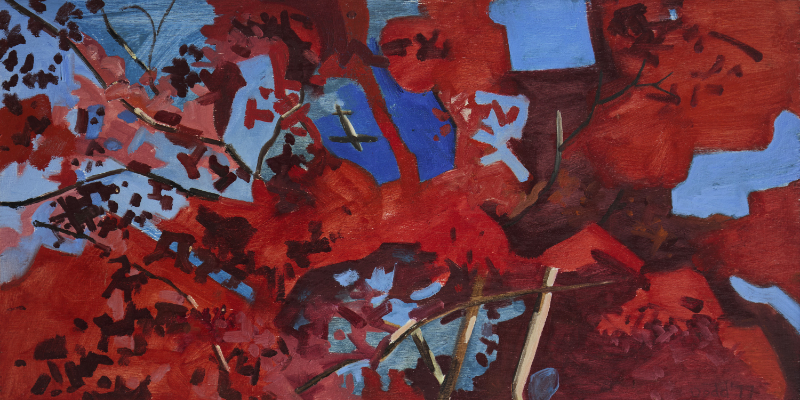
The exhibition began with a burst of bright red and blue in Red Maple and Airplane. The painting is a profoundly abstract image. Jigsaw-like shapes and plumes of red clouds fill the picture plane. Looking closer, one realizes this is a view of a tree seen from below and, through exuberant branches and leaves, of an airplane flying through the sky. Dodd excels at painting moments when the natural world meets the manmade. Like the airplane, Dodd’s brush draws lines through the air, dividing and shaping space in order to make sense of it.
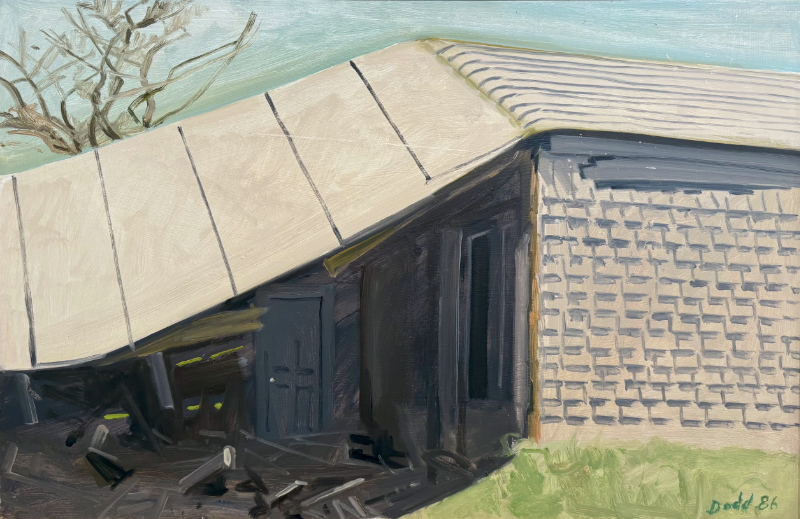
My favorite paintings of Dodd’s are her collapsed buildings. They are delightful playgrounds for the eye, but also metaphors for modern times. Things constantly change and often fall apart. This exhibition presents several variations on the theme. Most striking is Collapsing Shed, which depicts a squat structure, its left side falling down. The sunken roof is sharp and bright, like a blade cutting through the picture. Below in a dark space loose abstract notations suggest fallen beams and debris. The eye wants to go inside. Above the collapsed roof is a loosely painted tree that serves as a formal counterweight but also has an anthropomorphic feel. It’s a passerby, peering over the site, admiring the distressed tableau.
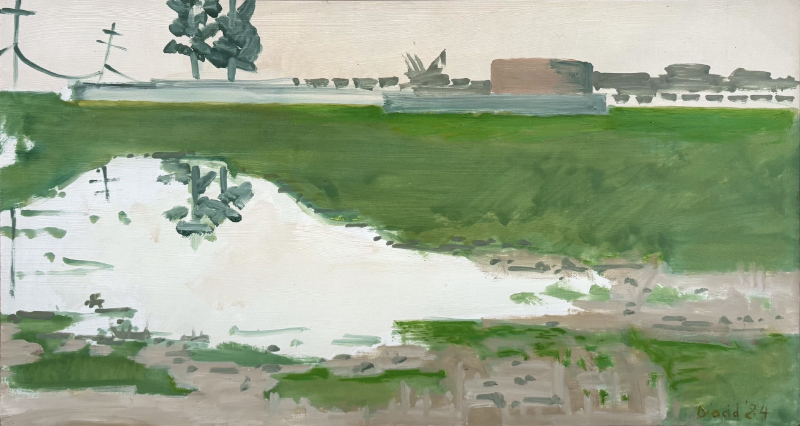
Not every painting in the show was so topsy-turvy. Dodd also paints quiet moments. Water in Field offers a view of a large puddle of water surrounded by a green field. A series of oil tanks sit on the horizon, painted with a loaded brush. To the side, a lone tree casts its reflection onto the puddle, compressing the space and sticking out a little. Without it, the scene would be lovely but placid. Dodd knows when to add a bit of mischief, a small element to complicate the picture and get our attention.
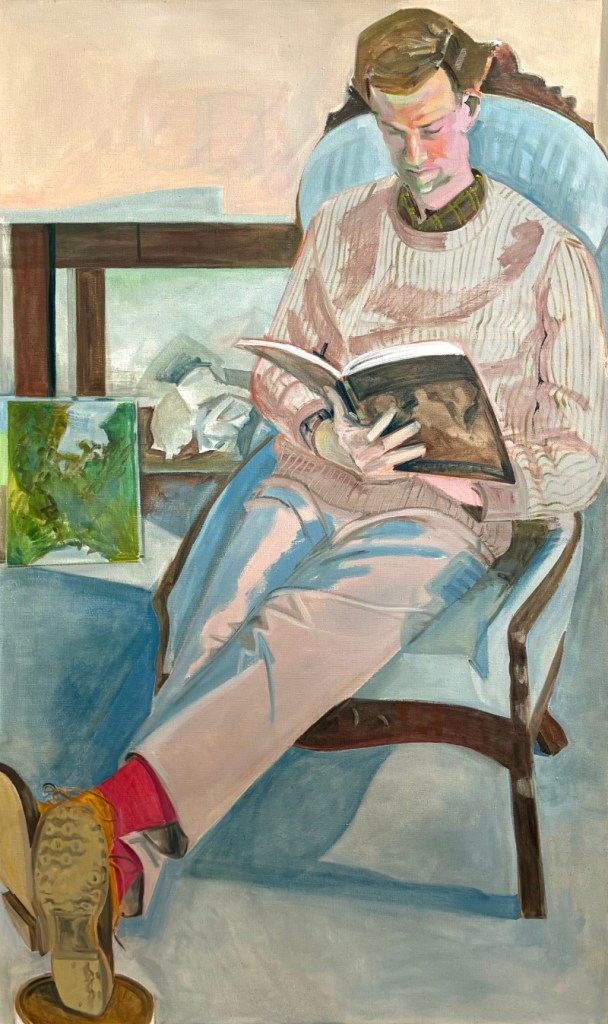
Dodd’s portraits of friends and family are seldom exhibited, so it was privilege to view Portrait of Eli Reading, depicting the artist’s son. He is handsome and well-dressed, sitting on a wingback chair as he looks down at his book. His socks are bright red and his shoes rest on a paint can. A landscape painting leans against the table behind him, playfully bringing the outdoors in. While these flourishes are delightful, Dodd never loses sight of the whole, imparting a great diagonal sweep to this composition, as if the figure needs to bend slightly in order to fit. Though she is an unsentimental painter, there is restrained tenderness in this portrait.
Turning 99 years old next month, Dodd has not stopped. Converging Roofs with Attic Window + Tree, made in 2025, is one of her finest recent works. One roof looks outward and the other faces away; they seem in silent conversation. In the charged space between them, three bare trees grow. The branches are scumbled, creating a brittle sensation. The brushwork is slower and more subdued than that in her earlier works, but the painting’s composure and psychological impact are strong as ever.
It is astonishing to see how much artwork Dodd has made during her lifetime. This show reflected her commitment to painting regardless of trends or acclaim and functioned as a balm against cynicism and irony – a celebration of looking and appreciating the little things, doing the work, and believing in the process. Dodd might have been encouraging the next generation of young painters to do as she has.
“Lois Dodd: A Radiant Simplicity,” The Art Gallery at Brooklyn College, 2502 Campus Road, Brooklyn, NY. February 3 through March 25, 2026.
About the author: David Whelan is an artist living in the Hudson Valley, New York. He has published art reviews in Artforum, The Brooklyn Rail, Effects Journal, and Two Coats of Paint, among other publications.










I would have loved to have seen this show– and wish this review had been posted BEFORE the show ended. Now just feeling chagrin and frustrated longing…
Beautiful insight into a really special show! Very sensitively observed. It’s heartening to see such a committed painter get her due.