

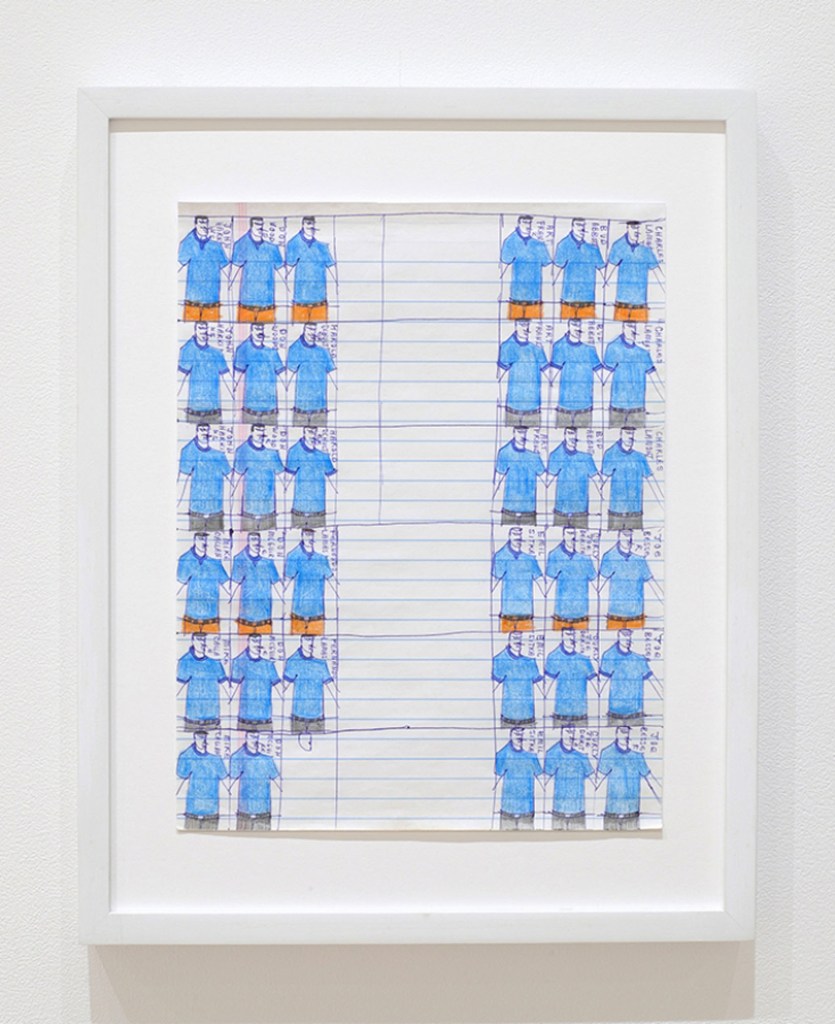
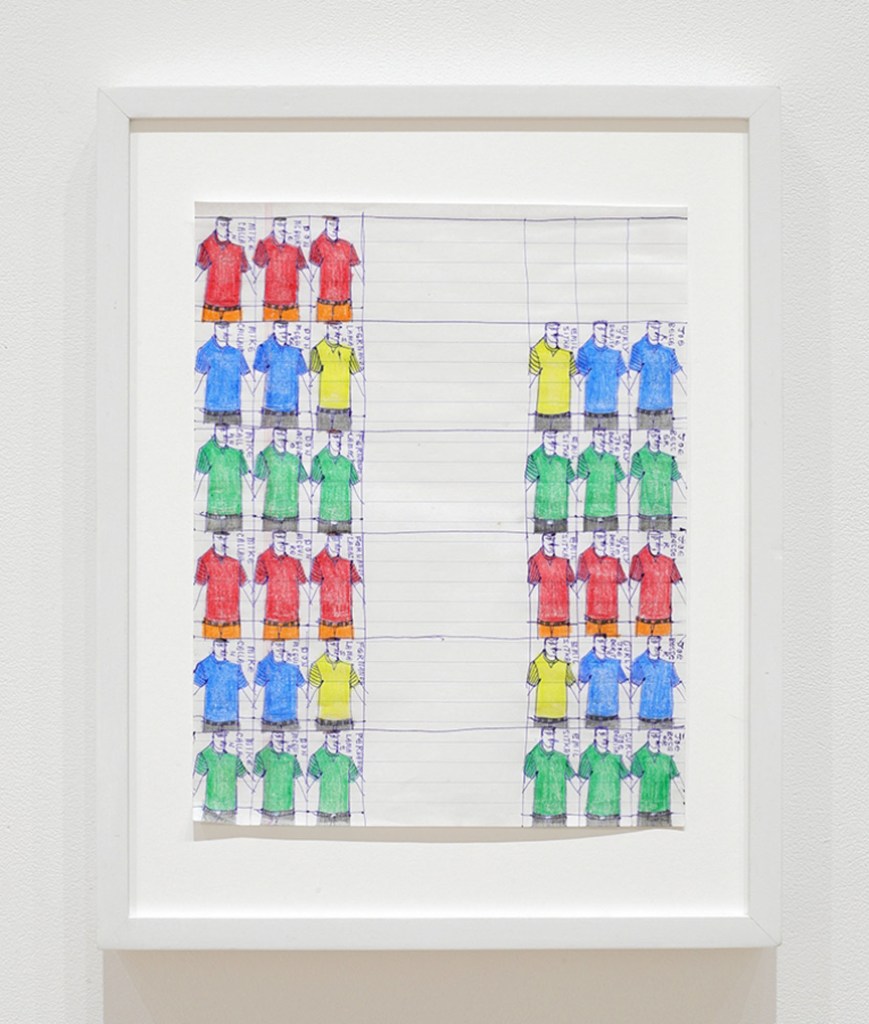
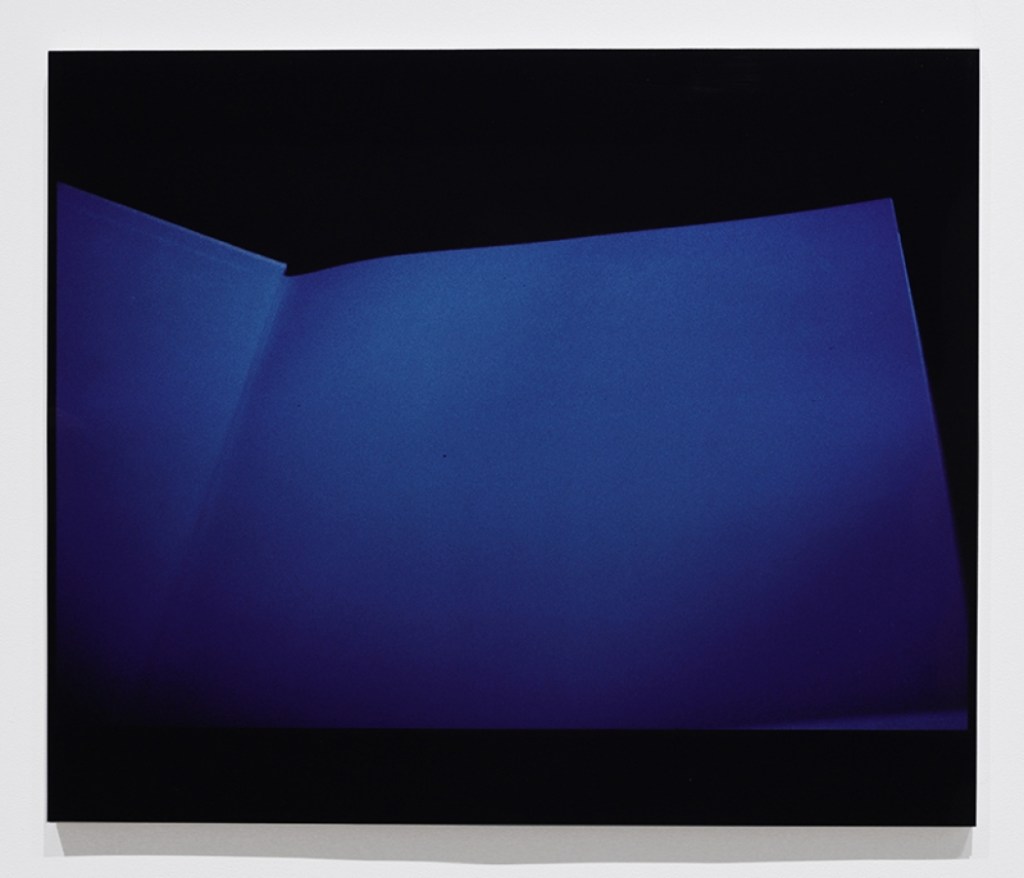
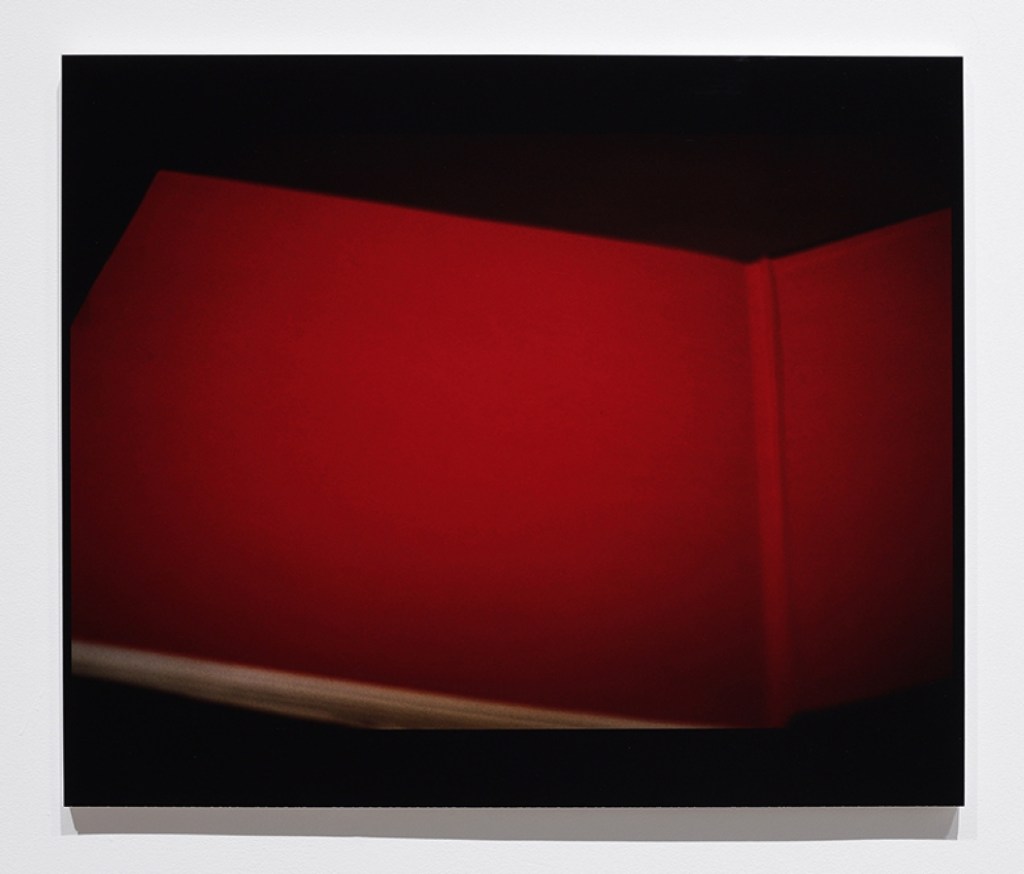
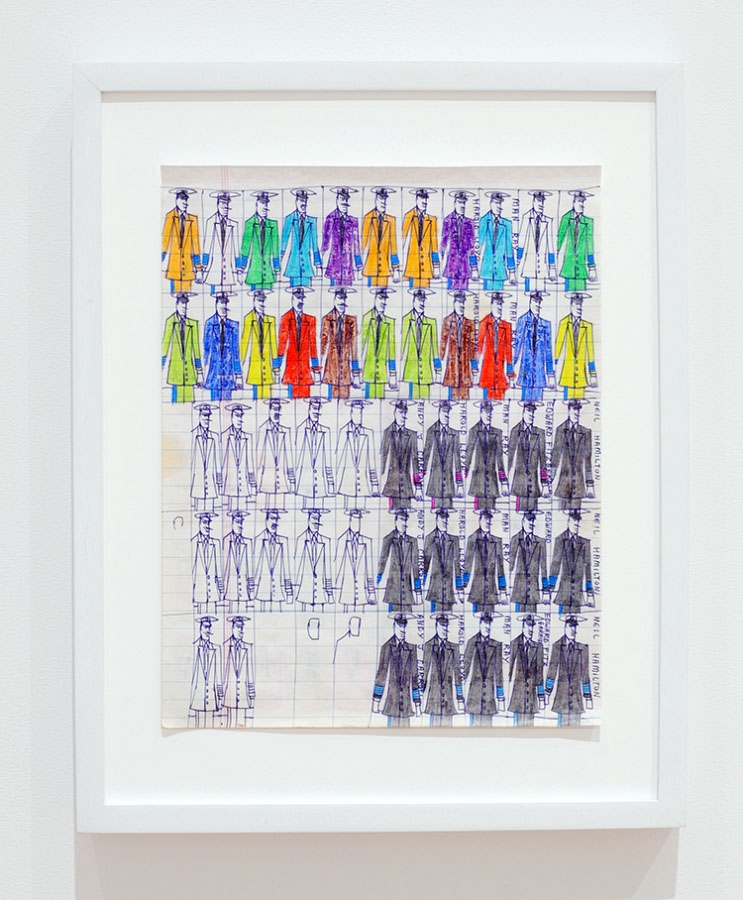
Contributed by Adam Simon / If I had walked into Kerry Schuss Gallery knowing nothing about the two artists on display, I would have thought the pairing unusual, elegant, and extremely interesting. One group of works consists of Michael Maul’s 11 x 8.5-inch ballpoint pen and colored pencil drawings on ledger paper depicting row after row of almost identical figures, rendered in a diagrammatic shorthand. Interspersed among these, are four 20 x 24-inch photographs of books taken by Tim Maul. The photographs are one of a kind Cibachromes, produced by printing directly from 35-millimeter slides; the method was discontinued in 2013. Cibachromes are long-lasting photographs of exceptionally vivid colors. All four of the photographs were shot in the 1990s but not printed until 2000. Two depict books open to what appear to be the blank pages preceding the title page. A third book is similarly splayed but face-down. The fourth photograph is of a shelf of books that appear to be journals or compiled records with dates on the spines ranging from 1859 to 1863, shot on commission at a library in Ireland.
I was struck by how much both bodies of work evoked states of mind. The photos manifest the kind of sustained focus on a quotidian object that renders the familiar strange. Viktor Shklovsky, the Russian theorist and critic, introduced the concept of defamiliarization in 1917 in an article titled “Art as Technique.” According to Shklovsky, art’s primary function is to get viewers or readers to slow down and truly see the world. The lighting in Maul’s photographs is dramatic. The shelf of books appears naturally lit, perhaps from a window to one side, creating an undulating rhythm as the light touches some spines and misses others. The intensity of the color in the other three photos made me think of experiences I had with mescaline many years ago. All four photographs are set against a black ground, giving them a forensic quality that accentuates the drama of nestled geometries mediated by an uneven cast light.

The drawings conjure the kind of dissociation that can be achieved through sustained repetition: standing in front of an Agnes Martin or Robert Ryman painting; reading Gertrude Stein’s poetry; or listening to the music of Charlemagne Palestine or Steve Reich, Gregorian chants, or Indian ragas. Repetition serves as a holding mechanism, like a mantra. Repetition can also explore permutations – slight variances that widen the scope of an image. For Gilles Deleuze, per his Difference and Repetition (1968), repetition is never a reoccurrence of the same thing; it is always something new. A repeated exploration of a single theme or subject is something we have come to expect from art. Think of Morandi’s bottles or Mondrian’s rectangles.
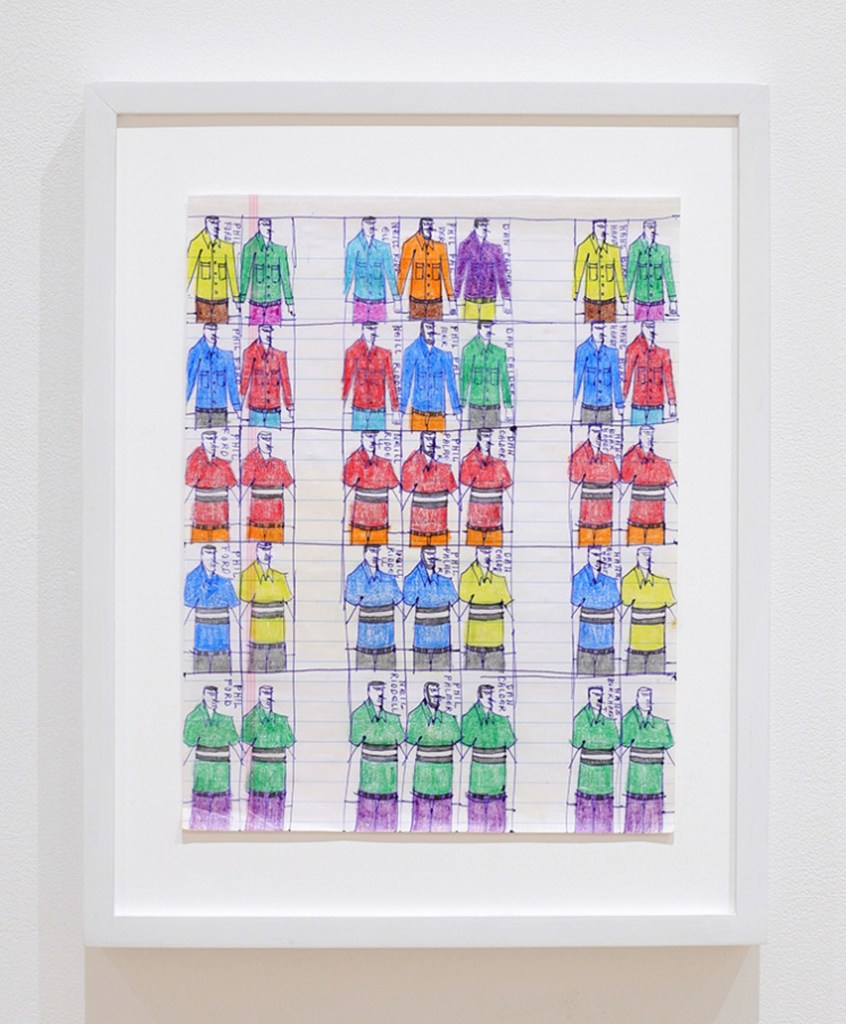
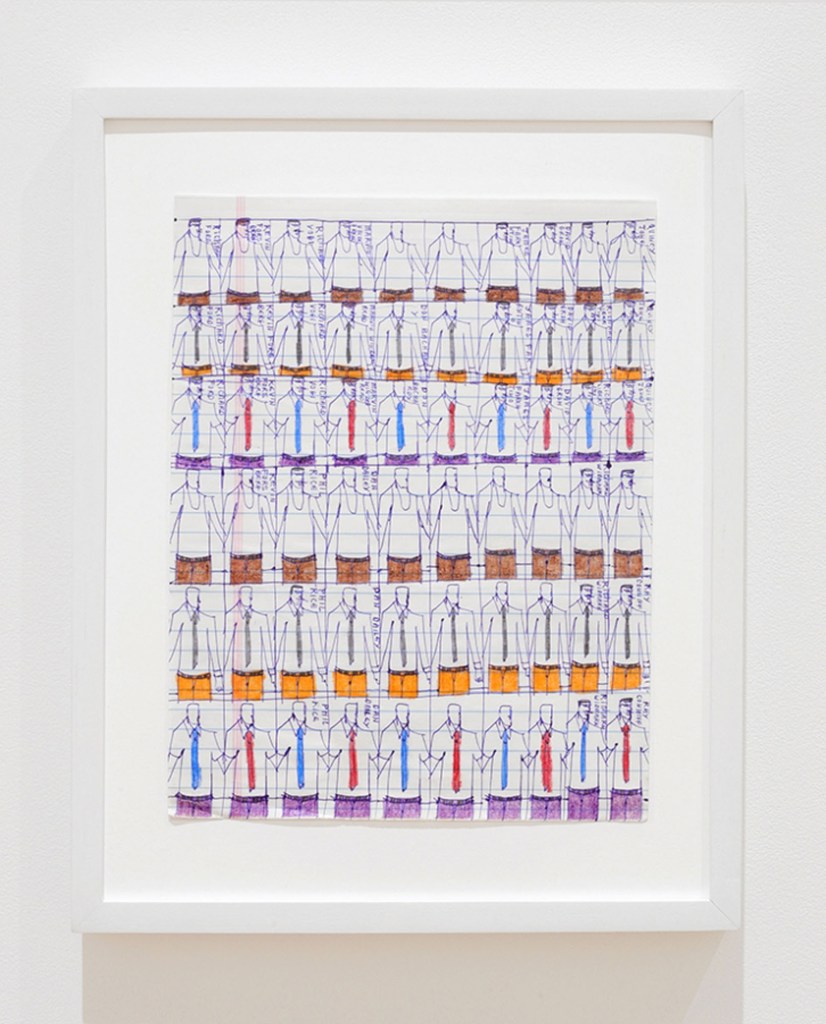
Each of Michael Maul’s repeated figures is confined to a section of a grid, taking up six lines of the ledger and identified by a name written vertically along the edges of the box. Some of the names – Man Ray, Harold Lloyd, Bing Crosby, Ed Sullivan – were familiar to me. Most were not. A few boxes incorporated female names, but the figures appeared male save for hair that looked like wigs and slight alterations in the clothing. It is the clothing that grabs the attention because it signifies a role: aviator, sailor, cowboy, magician. A single line indicates a mustache, and many of the figures are mustachioed. The color of each item, the placement of a tie, the four buttons on an overcoat, all seem precisely chosen and each attribute feels essential. Several of the drawings seem unfinished, revealing how each figure is assembled and then colored in.
In a sense, the two bodies of work could not be more different. The photographs display a mastery of the craft and sophistication in the matching of technology to subject. The planes established by the books’ contours animate the rectangle of each photograph with echoes of early Modernism. The drawings register as a series of maneuvers, lines drawn in sequence following an internal rhythm. The approach to language seems algorithmic, repetition and difference performing a dance without end. Yet both artists propose art as antidote and refuge and as a means of stopping time. They compel the viewer to enter a private world or an enhanced reality. There are formal correspondences. The dominant reds and blues in Tim’s Cibachromes echo those in Michael’s drawings, and the open books in the photos reflect the angularity of Michael’s figures and their outfits. Michael’s drawings filled books, or at least notebooks. Tim’s photographs focus on the thing itself. Michael’s repetitive drawings mirror that singular focus by extending, spatially and temporally, a singularity.
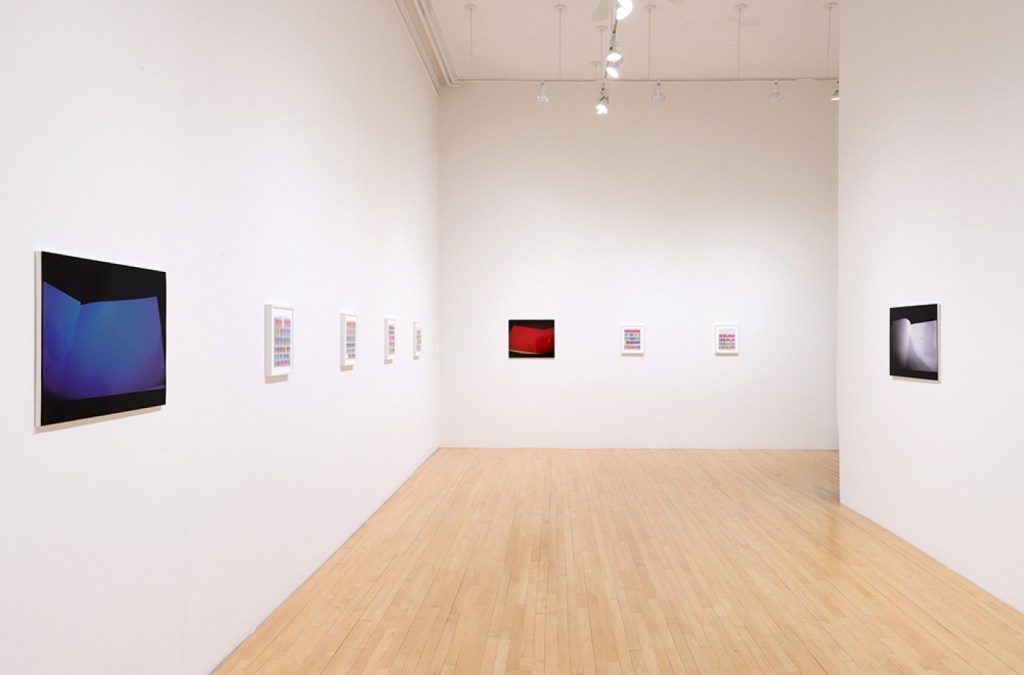
Tellingly, the two artists are brothers. Tim Maul is known here and in Europe primarily as a photographer and as an art writer. Michael Maul, who died in 2020, was diagnosed with autism at an early age, drew obsessively from well before he could speak, and was legally blind. They are connected through care and dependence and the need to make art.
“Michael Maul & Tim Maul,” Kerry Schuss Gallery, in collaboration with Leslie Tonkonow Art Works + Projects, 73 Leonard Street, New York, NY. Through April 25, 2026.
About the author: Adam Simon is a New York artist and writer. His most recent solo painting show was at OSMOS in 2024.






What a beautifully written piece, shaped with such care and restraint. In this rushing world with its ridiculous daily flood of email, I took care to read the whole thing – a tribute to this writer, and the originality of the pairing and the work itself. Thank you!