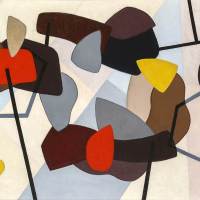
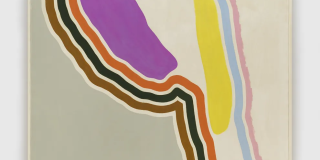
Contributed by Jacob Cartwright / In 1957, Clement Greenberg penned the essay “The Late Thirties in New York,” reflecting on years that were formative for both him and American art. He noted that during that decade “the big event, as I saw it, was the annual show of the American Abstract Artists group.” The artists who formed American Abstract Artists (AAA) first began meeting in 1936, in response to curators like MoMA director Alfred Barr, whose formulation of abstract art didn’t extend beyond the European continent. By 1937, AAA had begun organizing the regular New York City group shows that so impressed Greenberg.
Group Shows
AAA at 90: Keep on looking
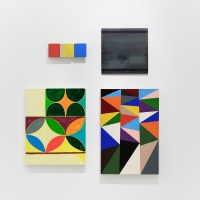
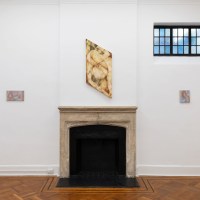
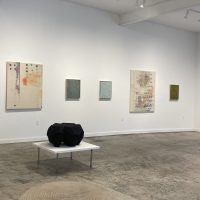
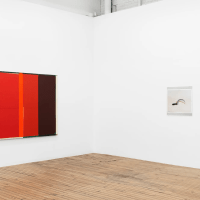
Contributed by Leslie Roberts / The exhibition “Abstract by Definition” at Art Cake celebrates the 90th anniversary of the American Abstract Artists (AAA). The show is subtitled “An Index,” but is not one in the usual sense – not, that is, an itemized set of categories, styles, intentions, or formal languages defining abstract art. Curator Saul Ostrow has instead organized groups of several works – usually four. This installation effectively highlights the particular qualities of each piece, and emphasizes the diversity of what we call contemporary abstraction.
Bodies of work: The human figure as cultural constant
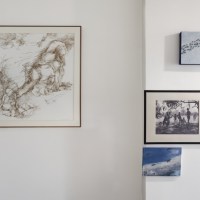
Contributed by Mary Sargent / There is something endearingly ambitious about an exhibition that takes the human body not as subject matter but as unifying argument. “Figurative as Concept,” at A Space Gallery, was curated by Alina Khalitova, an artist who trained in art history in St. Petersburg, Russia, and currently divides her time between the United Kingdom and the United States. She assembled sixteen artists whose origins spanned, from east to west, China, India, Russia, Germany, Italy, and the United States. The wide geographic sweep was integral to the show. Every tradition represented has its own history of what and how the figure represents.
Michael and Tim Maul: Art as antidote and refuge
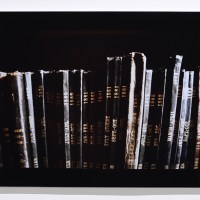
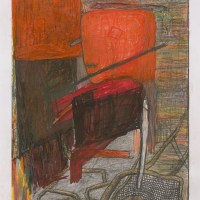
Contributed by Adam Simon / If I had walked into Kerry Schuss Gallery knowing nothing about the two artists on display, I would have thought the pairing unusual, elegant, and extremely interesting. One group of works consists of Michael Maul’s 11 x 8.5-inch ballpoint pen and colored pencil drawings on ledger paper depicting row after row of almost identical figures, rendered in a diagrammatic shorthand. Interspersed among these, are four 20 x 24-inch photographs of books taken by Tim Maul. The photographs are one of a kind Cibachromes, produced by printing directly from 35-millimeter slides; the method was discontinued in 2013. Cibachromes are long-lasting photographs of exceptionally vivid colors. All four of the photographs were shot in the 1990s but not printed until 2000. Two depict books open to what appear to be the blank pages preceding the title page. A third book is similarly splayed but face-down. The fourth photograph is of a shelf of books that appear to be journals or compiled records with dates on the spines ranging from 1859 to 1863, shot on commission at a library in Ireland.
Echo Yan and Cass Yao: An unsettled awareness
Contributed by Patrick Ryan Bell / Tucked away in a cul-de-sac on Attorney Street in the Lower East Side and committed to ambitious exhibitions, Frisson […]
Turn Gallery: The 1990s in collective memory
Contributed by Zach Seeger / Figuration, transformation, and materiality are on display at Turn Gallery in the group show “We Are Parts.” The work of Lily Rose Fine, Olivia Springberg, C Lucy Whitehead, and Caroline Zurmely nods gracefully to fragmentary bodies and mementos of the deceptively carefree 1990s aesthetic, vaulting dated, picayune fashion into collective memory and saving it from dissolution into the vast sea of pedestrian art.
Springs Projects: Concerted vibes
Contributed by Jonathan Stevenson / “Personal Space,” the group show now up at Springs Projects, is especially impressive for the steady, uninflected confidence it reflects in art as a part of life, devoid of commercial pandering or sheepish self-doubt. Considerable credit for this virtue goes to Tommy White, co-founder of the gallery. As he hung the work, all made by his adult students from the Art Students’ League, and forged the show’s overall coherence, White consulted the artists to ensure that each individual voice was preserved. His curatorial hand is masterful, harmonizing seeming divergence and distinguishing apparent similarity. For a group show to sing, of course, the artists themselves need to possess a sufficiency of talent and heart. This gang does.
Six artists meshing at Field Projects
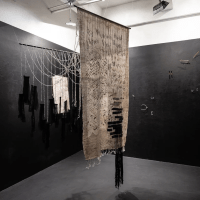
Contributed by Will Kaplan / At the opening of “A Partial Refusal” at Field Projects, simmering conversation turned to a reverent hush within the gallery’s black painted walls. In this stirring exhibition, curator Weihui Liu has arranged the work of six artists into an immersive labyrinth that fosters a slow meander and even slower meditation in counterpoint to the preachiness and digital freneticism that surrounds us.
“Sonorous” in Hackney: Stairway to heaven?
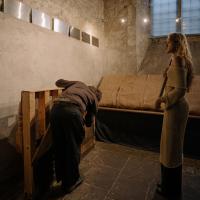
Contributed by Kenneth Greiner / St. Augustine’s Tower, Hackney’s oldest building, is a late-medieval stone structure once connected to a long demolished church. At times used as a mortuary and tool shed, it’s now a museum, open once a month in this recently gentrified corner of East London. Inside the Tower are four floors for immersive art, connected by an agonizingly narrow set of stairs. Earlier this month, this improbable venue presented the group exhibition “Sonorous,” which concerned vibration as a means of communication. And it worked. The weathered crypts and headstones at the base of the tower echoed a somber song that the sound of the Tower bell magnified, rustling the cobwebs that rested in its eaves.
Tappeto Volante’s rich conversations
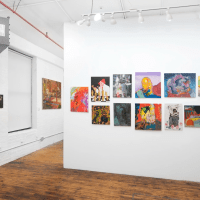
Contributed by Jonathan Agin / The fifth annual “La Banda” show at Tappeto Volante Projects in Gowanus features relatively new paintings, sculptures, and works on paper by over three dozen mostly local artists. Though no designated theme governs the show, it was forged in the pandemic era and celebrates New York’s creative and communal spirit. Populating a cozy space with such a density of art practices can’t help but generate new discourses across mediums, subjects, and generations.
Reaching back at Ruthann
Contributed by Natasha Sweeten / I thought of this quote as I viewed “Souvenir,” the current group show at Ruthann. Inspired by a poem of the same title by Edna St. Vincent Millay, the show brings together the work of 15 artists with a focus on moments “that touch on intimacy and affection, humor and sadness, absence, and memory.” That’s quite a bit of ground to cover, but for me – no doubt influenced by reading the poem posted on the gallery wall – the prevailing theme is memory and the emotional aftermath of happier times. As Joni Mitchell famously sang, you don’t know what you got ‘til it’s gone.
“Spot On,” at 68 Prince Street Gallery in Kingston
On Saturday, February 21, 2 pm. please join artist and Two Coats of Paint publisher Sharon Butler and artist Jason Travers for a conversation at 68 Prince Street Gallery in Kingston, NY. They will be discussing their new paintings, which are on viewat the gallery in “Spot On” through March 8, 2026. Free and open to the public.
Lucas Blalock and Julia Rommel’s well-oiled machine
Contributed by Jacob Patrick Brooks / Consider the hunk as a deliberate, usable form, as Julia Rommel does. Her paintings are hunks of color painted on linen – cut up, unstretched, and stapled into off-the-air color TV bars. They are as much about labor as color. Each painting feels as though it was sledgehammered into the wall just before you walked in the room, still ringing from the strike. Flanking Rommel through the show is Lucas Blalock, photographer. His photos operate similarly, offering an easy, even fun, seduction that segues into discovery as you find out how he’s tricked you. Images are cut and layered over one another, details are hidden. The viewer is rewarded for close, patient attention, as in an I Spy book.
Precision in play at Flinn Gallery
Contributed by Jacob Cartwright / True to its title, the group show “Precisely.” at Flinn Gallery is chockablock with precision-crafted paintings. There is an equal […]
palladium/Athena Project: Democratizing art
Contributed by Mary Shah / Greg Lindquist and Theresa Dadezzio, co-founders of palladium/Athena Project, just opened their inaugural show, “Works on Paper,” featuring an impressive 175+ artists at their new curatorial space in Greenpoint, Brooklyn. I sat down and talked with Theresa and Greg about the project.
Matthew Miller: Hand to a humble god
Contributed by Jonathan Stevenson / For over twenty years, Matthew Miller rendered arduously meticulous yet mysteriously otherworldly portraits, mainly of himself as subject and almost always against a maximally opaque black background betraying no brushstrokes, evidently free of human imperfection.
Summoning, Conjuring, Coaxing: A trend emerges in Bushwick
Contributed by Lucas Moran / Maybe death isn’t final but simply a door leading into another room. That feeling ran through “Often I am Permitted to Return to a Meadow,” an excellent group show at Active Space in Bushwick curated by Patrick Bower and Robert Zurer of Immaterial Projects. It tapped into whatever lies just beyond perception: the subconscious, the occult, the spirits, the talismans, the circus freaks. Everything half-seen or half-remembered was allowed to take shape. If contemporary painting has drifted away from figuration and identity, this show suggested we may be heading towards something more concealed – art that conjures rather than describes, call it hiddenist painting, embracing what is buried, invisible, or occulted, where death, memory, and imagination loop into one.
The enduring resonance of Supports/Surfaces
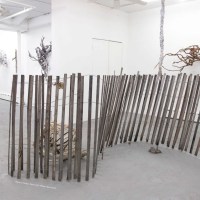
Contributed by Marjorie Welish / The group show “Fold, Drape, Repeat” now up at Ceysson & Bénétière does what it says. A select showing of work by the loosely aggregated French collective Supports/Surfaces, the exhibition embodies the very assembly involved in making art. Offbeat maneuver never succumbs to product or merchandise. Put another way, each individual artist emphasizes how the construction of art respects the commonplace materials at hand.
Spring Projects’ epic subway series
Contributed by Jonathan Stevenson / Most New Yorkers couldn’t live without the subway. It is their savior if occasionally their oppressor. They love it so much that they hate it when it lets them down, but the opprobrium is often oddly affectionate. Barroom arguments have fulminated and flourished over which subway line is worse – the F or the 7, the 2 or the L. Patronizing the subway can be a point of gritty cosmopolitan pride: real New Yorkers don’t use Uber. And it’s a great social equalizer, as reflected in Ralph Fasanella’s 1950 folk-art painting Subway Riders, now ensconced in the wall of 53rd Street/Fifth Avenue Station and as idealistic as ever. “Subway Riders” the group show is now up at Springs Projects. It keenly captures the subway’s pervasive, multivalent thrum through New York life with work by over 100 artists and a few eager amateurs (one is me).
Art history diagrammed at the Milton Resnick and Pat Passlof Foundation
Contributed by David Carrier / Anyone old enough to remember Claude Levi-Strauss’s books on structural anthropology or Rosalind Krauss’ famed structuralist account of sculpture, all richly suggestive sources of art theory, will likely appreciate “Building Models: The Shape of Painting,” currently up at the The Milton Resnick and Pat Passolf Foundation and curated by Saul Ostrow. The central question he poses is how you construct a painting. In the 1960s and 1970s, when painting was beleaguered and political experimentation was a related concern, tribes of New York artists were consumed with answering that question.