Contributed by Jonathan Stevenson / I first encountered Nora Griffin’s paintings on a blisteringly hot Saturday in the summer of 2022. David Fierman had just opened his rakish subway-tiled space on Pike Square, and it was unfinished as well as uncooled (though not, of course, uncool). The paintings in “Liquid Days” harmonized all the moody vibes vectoring into and radiating out of that vortex of LES attitude and history, rendering a sweaty refuge a sublime interlude. Her compositions were frenetic, with marks, cognizable images, and found objects wafting like crowd-wise insects all about the canvas, sometimes spilling over its edges. Yet this apparent disorder was incongruously fluent, exuding confidence and intent: there was no doubt that Griffin knew exactly what she was doing. In barely contained barrages of color, line, and content adding up to life worth living, she snatched New York from the jaws of 9/11, the financial crisis, COVID, and Trump, and proclaimed it unsinkable, herself its sonneteer, and her work a well-lit cardiogram of its beating heart.


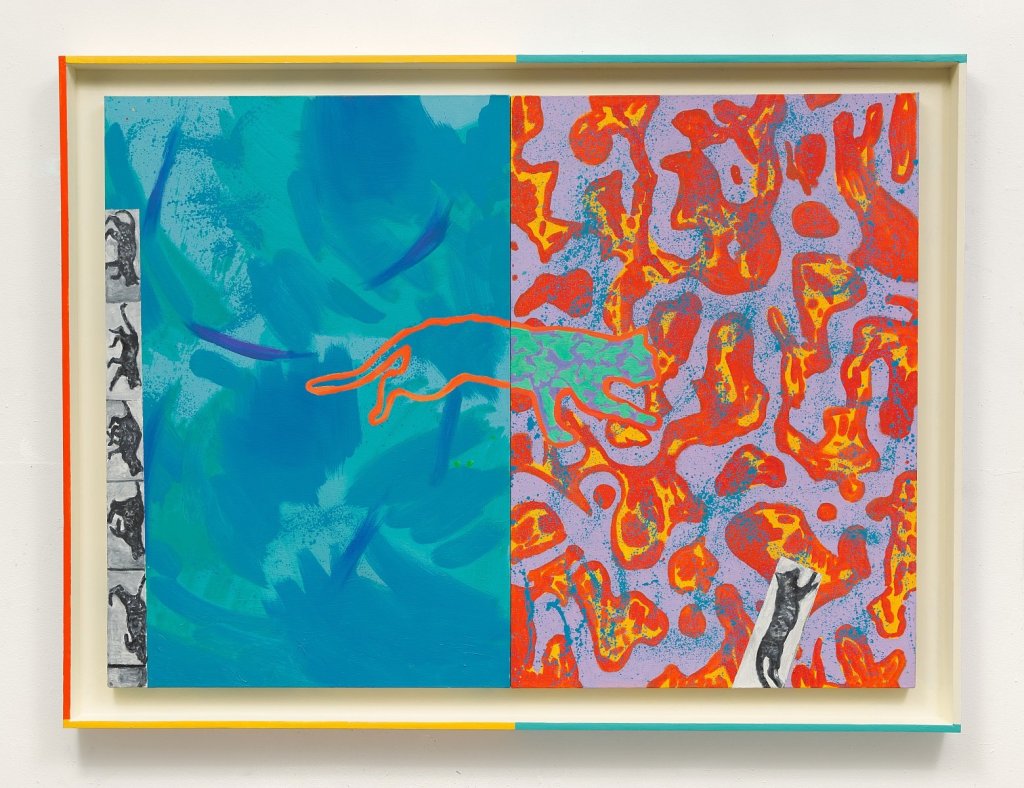
She is still pondering New York’s undying buoyancy, and her work has remained passionate and cohesive while gaining variety and scope. In “Moving Pictures,” her new show at Fierman, Griffin anchors her imagery more firmly in structural and overtly referential devices – checkerboard patterns that evoke the grid, simulated diptychs, figures of people and animals, urban vistas – but always to organically expansive effect. Moving Pictures, the title painting, has the silhouette of a cat straddling distinct halves of the canvas – one a blank, murky blue-green and the other a colorful array of living beings – as smaller, solid versions of the cat skirt the left edge and one infiltrates the inhabited segment from below. The painting, like a finished movie or a photograph as it develops, captures the emergence of a creature and its movement over space and time. A painting should also prompt, says Griffin, “the simultaneous rush of seeing and feeling” you get when peering out the window of a moving train. Shadow Puppets (rabbit) and Time Piece suggest a related tension between the ephemeral and the permanent.
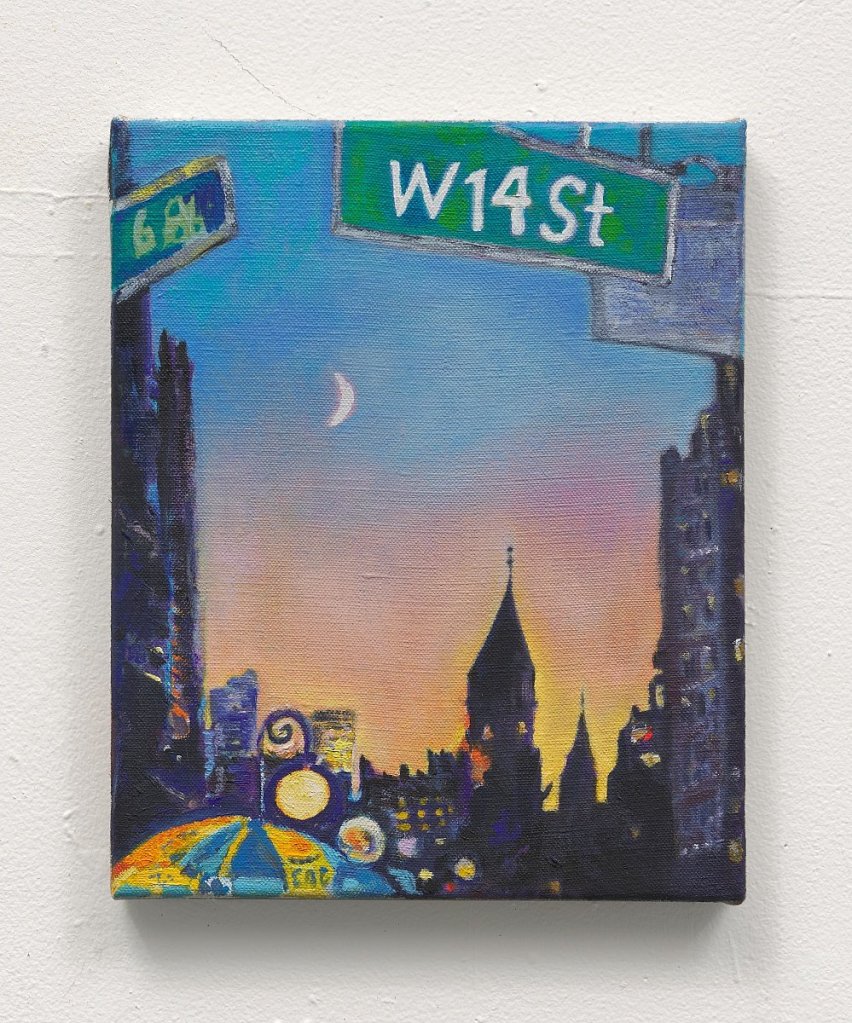
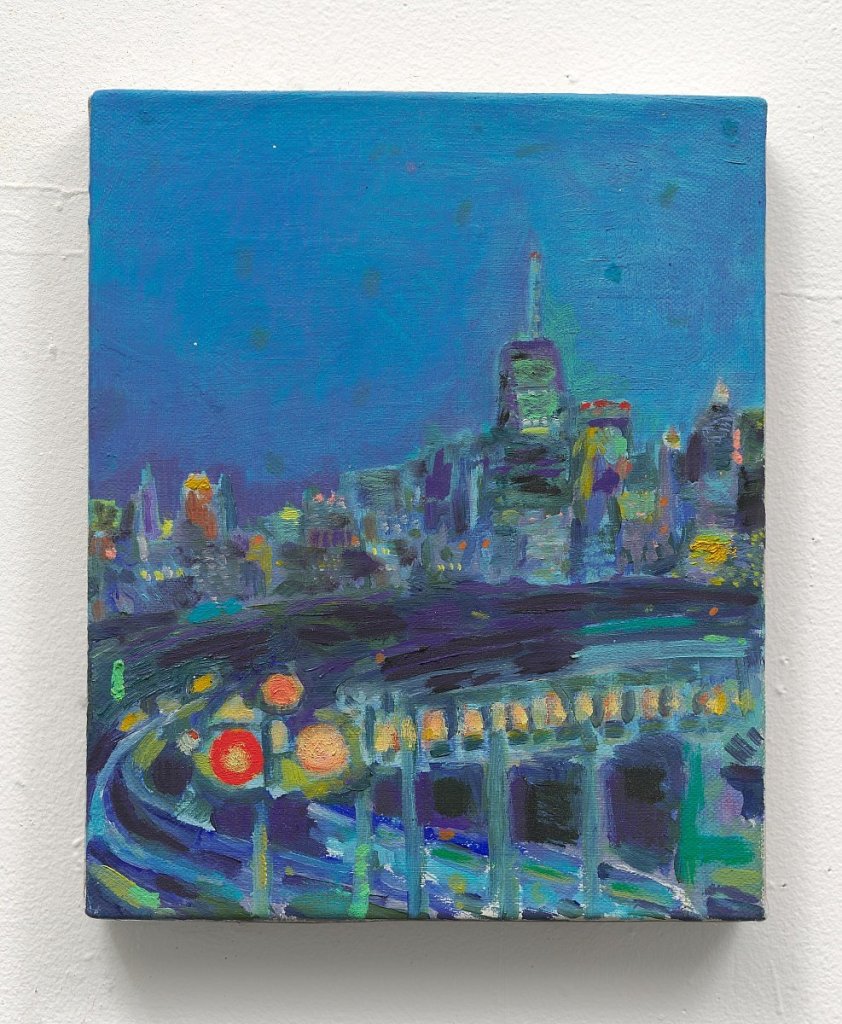
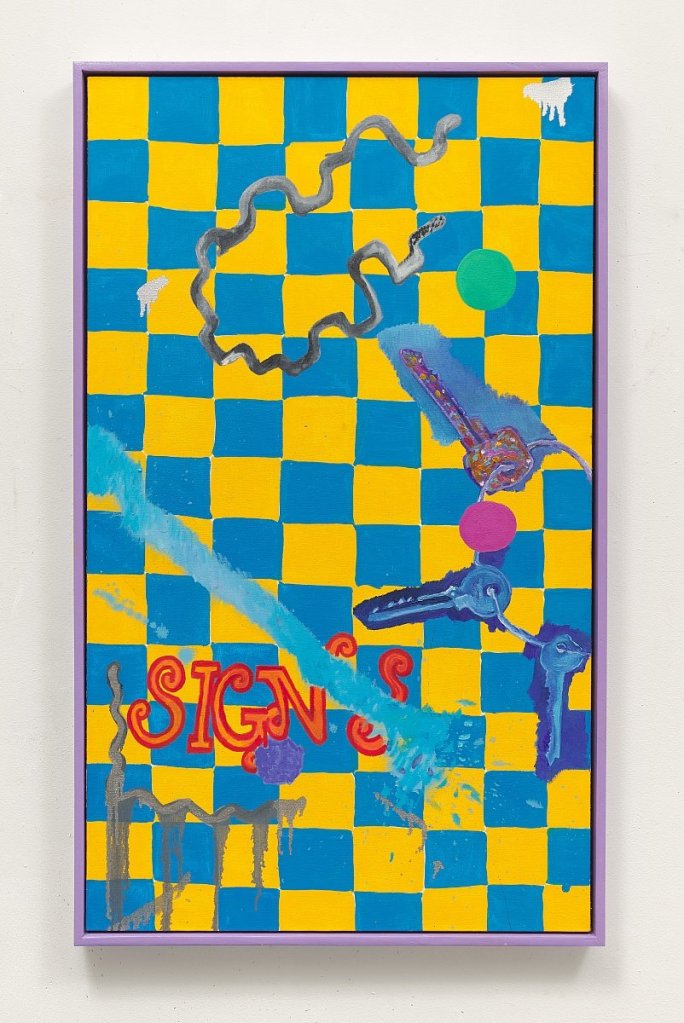
Memories of presumably cherished moments pulse through Griffin’s work. Moving Pictures (Shadow) seems to suspend the cat in the maelstrom it has entered, framing an intimate instant between viewer and viewed. Sometimes nostalgia is unabashed, as in the small, wistful painting Two Figures, featuring a mother and daughter on Ellis Island overseen by the Twin Towers; Smith-9th Street’s F/G train-foregrounding a cityscape at dawn; the duskily lit buildings in Sixth Avenue; or Griffin’s warmly knowing “1999 NYC Tees” show last summer. It is never cheap or saccharine. Griffin’s filter catches mottled ambivalence, not pristine fantasy; she eschews the earnest cliché. SIGNS, its neat blue and yellow rectangles occluded by the quotidian messiness of life, could read as Mondrian interrupted, Desert Mirage like a contemplation of contentment and stability as wishful human constructs, countered by Chameleon, whose eponymous subject is existentially under siege. The paintings depicting bonsai and bamboo trees and a swimming fish imply fleeting pastoral respite – humble paeans, perhaps, to pragmatic sanity.

Griffin’s currency is the gritty heritage of a roiling place with daunting problems and ghosts that still ought to be treasured because it can bring us joy and is all we have. Everything on the gallery wall acknowledges complexity and uncertainty while urging that they be embraced with at least some gratitude and optimism. Embedded in Griffin’s work is a profound appreciation for the inherent gravity and dynamism of time – qualities that yield grim solemnity and wry hope in counterpoint. In this vein, Blue Moon seems particularly introspective, even confessional. In the painting, a crescent moon hovers over what could be a palette near the center amid cryptic signals, dubiously calming colors, and spillage on the periphery of the artist’s putative zone of perception. That and a blue moon’s proverbial infrequency suggest that this quintessential downtown artist’s endeavor is not so easy: to capture, as she herself suggests, life’s “phosphorescent radiance before death.” Yet Griffin so often succeeds, and the Rodgers & Hart tune of the same name as the painting, covered by so many, starts sad but ends happy. Long may she run.
“Nora Griffin: Moving Pictures,” Fierman, 19 Pike Street, New York, NY. Through March 24, 2024.
About the author: Jonathan Stevenson is a New York-based policy analyst, editor, and writer, contributing to the New York Times, the New York Review of Books, and Politico, among other publications, and a regular contributor to Two Coats of Paint.