Contributed by Lucas Moran / “Always Were” is the title of Opal Mae Ong’s solo show at Plato Gallery. It’s a compact declaration – two words that look both forward and back. The work does the same. Old ways, rituals, medicines, and inherited knowledge blur into future or parallel worlds: gradient skies without brushstrokes, glowing plants, and figures who bathe, offer, watch, and mourn. Grief is a constant presence here – not as melodrama but as a condition with the same dignity and value as joy or love. Ong treats all of it as coexistent. Nothing replaces anything.
Like many Americans, Ong is many things – Irish, German, Cagayan de Oro, Chinese, and Spanish as well as Filipino, the ethnicity and culture in which she grew up. She doesn’t see her family often, yet the pull of her lineage is unmistakable. When figures began appearing in her work, she understood only gradually that they were speaking from an ancestral register. She thinks of them as shapeshifters occupying the no-longer and the hereafter at the same time. Philippine folklore, she told me, is threaded with disappearances – people unexplainably taken by mythic creatures. Expressing grief through monstrosity gave her a way to let them tell stories not just about her family but also about her own life.
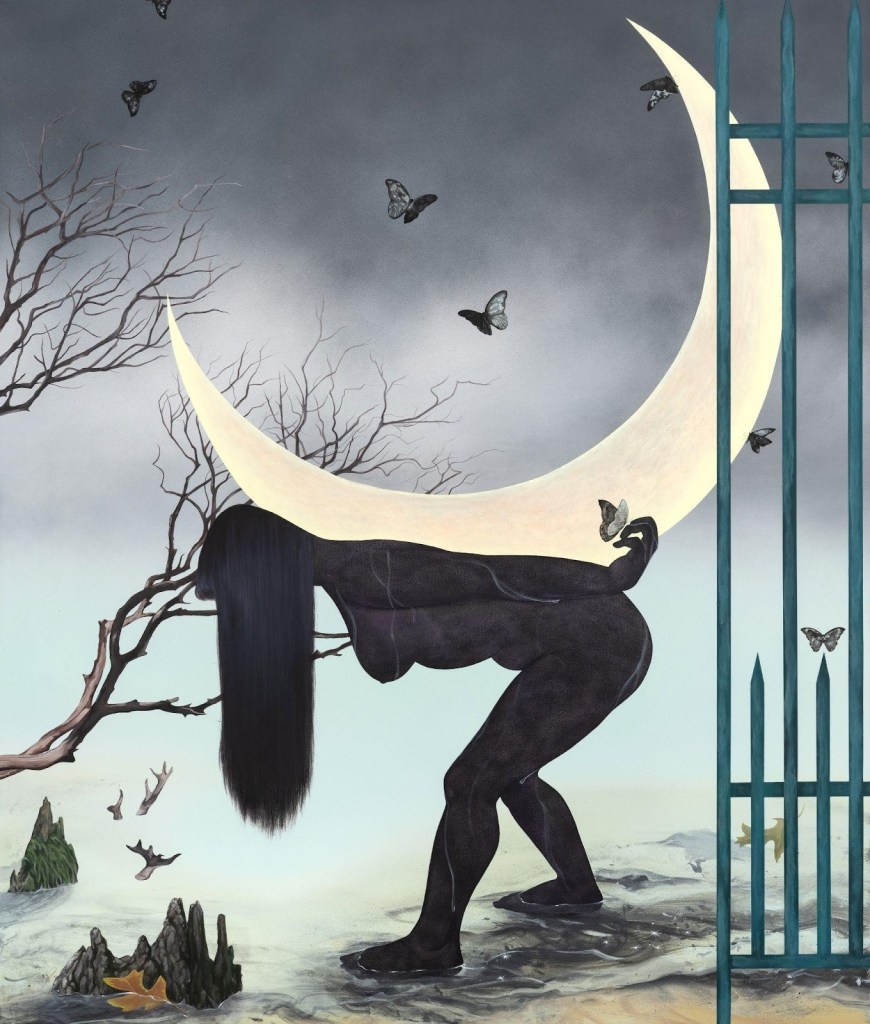
Ong works with acrylic and gouache, mixing liquid pigments with a matte binder. Many pigments she cherishes have been discontinued; gouache fills the need for fluorescent or otherwise unnatural hues. Her surfaces reveal a practiced slowness – masking tape lines, matte expanses, areas rubbed with alcohol until they feel weathered or ghosted, and points of luminosity in plants or moons. The Carrying centers a lone black silhouette bent under the weight of a pulsating sickle moon. A gate on the right acts like a stage prop, hinting that we’re seeing only one act of a larger production. The moon’s pull reads as weight – something tidal and inescapable. The butterfly-filled sky offers levity but not control. The figure has none.
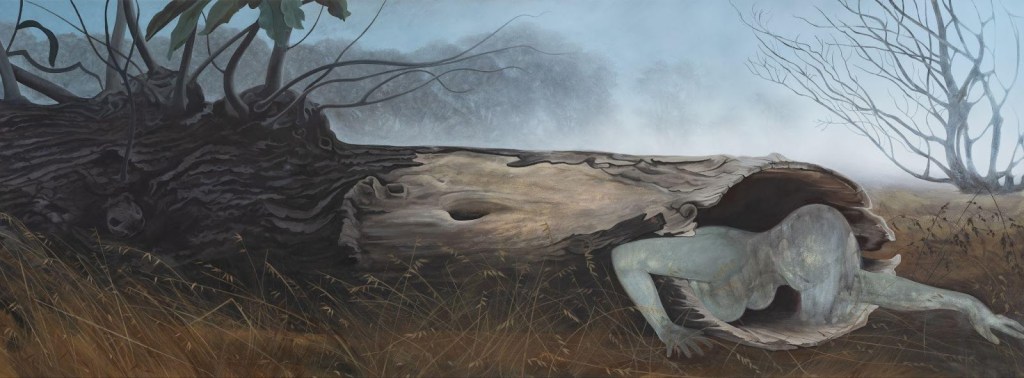
Demands Incarnation feels like winter giving way to spring. A figure crawls out from a hollow log, struggling, emerging, beginning. One arm pushes, one reaches. The ground is the gold of thawed leaves. The log’s holes suggest orifices or blowholes; the bark frills mimic lichens; a pale mist hangs behind it all like a threat or blessing. The painting has the tone of a season changing: fragile, inevitable, strange.
In Walls of Amnesia, a green figure reclines by an ivory wall, suspended by a vine that pierces her torso. She’s impaled and smiling. It reads as surrender but also as care on the part of something with healing, or at least stabilizing, capacity. It’s one of the show’s rare pockets of tranquility. Through the parted wall, more unknown awaits, but here, for a moment, she floats.

Ong’s work is in dialogue with Wangechi Mutu’s myth and Kara Walker’s silhouette. But the staged atmospheres, the charged stillness, and the sense that every element has been placed with theatrical intent made me think of Robert Wilson. Ong herself points to anime and manga, especially the Japanese illustrator Seiichi Hiyasi of Gold Pollen, who “was burned into my mind for a long time,” she said. The work also feels grounded in Ong’s own inherited world. Her paintings are shaped by those who came before her – their histories, burdens, rituals, and mysteries. The show isn’t about reconciling these things. It’s about holding them.
“Opal Mae Ong: Always Were,” Plato Gallery, 202 Bowery, New York, NY. Through April 19, 2026.
About the author: Lucas Moran is an artist and writer based in Brooklyn. Moran’s paintings have been included in many shows in the United States and Canada, and he has had several solo shows in New York City.