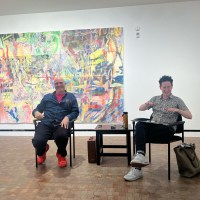
This wide-ranging conversation took place on April 27, 2026, between Kerry Downey and Julián Kreimer at Sarah Lawrence College Heimbolt Center for Visual Art during Kreimer’s exhibition, “Yuyo.” The exhibition was on view April 2-May 8, 2026.
 Award-winning NYC blogazine with a focus on painting
Friday, June 12, 2026
Award-winning NYC blogazine with a focus on painting
Friday, June 12, 2026
This wide-ranging conversation took place on April 27, 2026, between Kerry Downey and Julián Kreimer at Sarah Lawrence College Heimbolt Center for Visual Art during Kreimer’s exhibition, “Yuyo.” The exhibition was on view April 2-May 8, 2026.
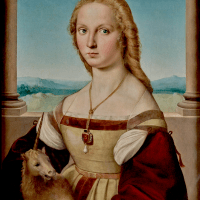
Contributed by Margarett McCann / The sophisticated visual storytelling of Raffaello Sanzio (1483-1520) is emphasized in the Metropolitan Museum of Art’s Raphael: Sublime Poetry. Figure and architectural drawings, collaborations in printmaking, tapestry, and a quarter of his painting oeuvre are accompanied by precedents he imitated and peers whose progress he surpassed. Portrait of a Young Woman with a Unicorn shows Raphael’s seamless meld of real and ideal, solid and delicate, old and new. Gothic simplicity, medieval symbolism, and Flemish detail elegantly cohere with luminous chiaroscuro, perspective, and neoclassical plasticity.
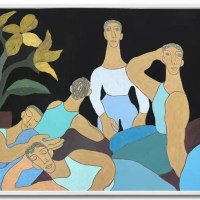
Contributed by Alessandrio Teoldi / Angelo Vasta’s exhibition “Luci Spente” (Lights Off) at Tappeto Volante in Tribeca centers on a simple gesture: turning down the light. Not removing it, not rejecting color, but softening its intensity. For an artist whose visual language has often featured bright, vibrant palettes, this is a bold shift of deliberate subtraction.
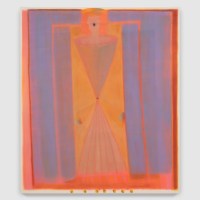
Contributed by William Corwin / Depictions of spirits and monsters are often combinations of the diagrammatic and the visceral: attributes packaged in an erotic or terrifying container. Amorelle Jacox’s luminous female presences in “Mothers of Time,” now on view at Management, are unassuming and recessive beings peering out between throbbing bands of color and eerie cones of light. She populates her large-scale canvases with measurement devices – rulers, color wheels, and sundry visual and geometric rubrics that guide the viewer’s interpretation of the powers invested in each of the goddesses or muses she has invented.
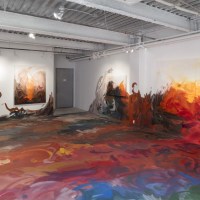
Contributed by Sharon Butler / In June, in the wake of an exhausting month of fairs, NYC galleries are again presenting a full slate of exhibitions. At Field of Play, look for a survey of paintings by Lee Sherry (1947–2012). She had close ties with the Language Poets and was part of an avant-garde painting circle in Soho but never gained wide recognition. If old reconfigured texts and quirky materials that subvert narratives…
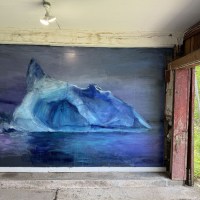
Contributed by Karlyn Benson / This month I am looking forward to the opening of Putting it Together: Transforming Collage at 68 Prince Street Gallery. This group exhibition features the work of over forty artists and is the first in a series of ten collage exhibitions taking place this summer in the Hudson Valley….

Contributed by Sharon Butler / Cora Cohen panel discussion; Two Coats Open Studio Jun 3; Twenty by Sixteen at Morgan Lehman; Zombie Formalism 12 years later; Last call for Abstract by Definition; more
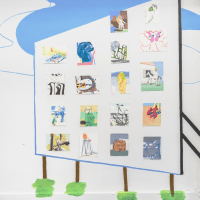
Contributed by Jonathan Stevenson / David Humphrey has accustomed his audience to acerbically penetrating representational paintings in which witty riffs resolve into considered pronouncements about the world. His 2022 painting Art Shipping – depicting a van about to bring a painting of a misogynistic act of torture from the artist’s serenely rustic home to a presumptively hermetic white-cube gallery – is a fine example of his unsparing fusion of introspection and worldly scrutiny. Whereas such trenchant paintings – and there are many – reflect Humphrey’s fully crystallized ideas, the work in “anecdote,” his current show mainly of drawings at Kate Werble Gallery, captures a number of them in intermediate stages, offering graphic insight into his thought processes.
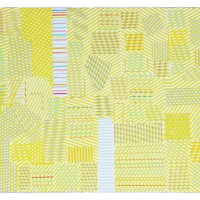
Contributed by Becky Brown / Living through a changing zeitgeist is a trip. Now into my forties, I see that conditions, styles and ideas that loomed as colossal in one moment can fade into obscurity in the next. My parents are octogenarians in the art world, and they’ve told me artistic and theoretical trends are always cycling; now I’m seeing it happen. When the essays on “Provisional Painting,” “New Casualism,” and “Zombie Formalism” emerged, I was in the throes and early aftermath of a graduate degree in painting from Hunter College. Like many, I thought they articulated something I was seeing and feeling but hadn’t yet named. I did not imagine that within a few years, abstraction would be on the margins of contemporary painting, with figuration taking center stage. Was this backlash related to those critiques or just part of a natural cycle?
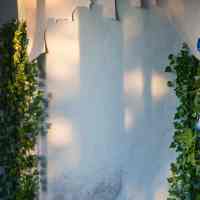
Contributed by Bill Arning / With the photographs of Los Angeles–based artist David Gilbert, whose show “Stationary” is now up at Klaus von Nichtssagend Gallery, one repeatedly asks: where exactly is the art occurring? He has found a way to destabilize the exact moment when ordinary objects shift into Fine Art with a capital A. At first glance, these works can appear almost incidental – serene accounts of light falling across a studio wall, with scraps of paper, drawings, and pinned objects casually arranged. They masquerade as found images, random moments merely “noticed” by a wandering photographer with a point-and-shoot camera. The spaces are shallow and flat; the compositions initially seem haphazard.

Contributed by Romy Marcus Cohen / Photographs offer a false promise of perfect preservation. In her new show “Don’t Be a Stranger” at Trotter&Sholer, Jessica Frances Grégoire Lancaster grapples with the loss of a close friend through her continued exploration of the instability of images and the memories they hold. Working from a personal archive of vernacular photography, Lancaster turns snapshots into back-painted oil paintings on glass, drawing emotional intensity from the tension between recognition and anonymity, intimacy and distance, presence and absence.
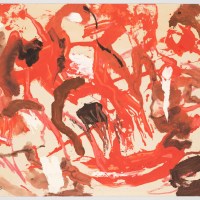
Peter Plagens has been a prominent voice in American art criticism for decades, providing trustworthy and eloquent guidance to the enigmatic and sometimes bewildering world of contemporary art. Plagens is also a practicing painter, which affords him special insight into art practices and sets him apart from other critics. He is drawn to undervalued work and has repeatedly demonstrated the rewards of looking carefully at what the klieg lights have ultimately passed over. On the occasion of Peter’s retirement as art critic for the Wall Street Journal, we are republishing this essay, which originally appeared in Art News in 2010. The piece starts with a look at Ralph Meeker, a half-forgotten movie actor, and opens into something larger: memory, family, and a life of paying attention to the things other people walk past. A pleasure to read, it’s the work of a critic who trusts his own eyes and his own words. –Sharon Butler
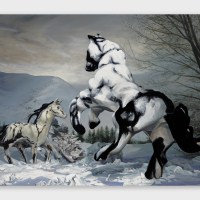
Contributed by Will Maddoxx / Last summer, the New York Times reported that someone impersonated Lady Gaga to buy a painting of Emma Webster’s. The piece highlighted the market for these paintings and coincided with an impressive show at Petzel displaying two huge canvases at once grand and sublime. Seeing that “Rues and Leaves Themselves Alone” was opening so soon after that last show, I wondered whether the work would be rushed and uninventive. In fact, the new paintings are very good.

Contributed by Laurence Hegarty / Daniel Wiener’s naming system for his own work is quite precise. On his website, he states of the piece titled Clutching: “Genre: Sculpture | Like: Bowl | Placed: On A Shelf. ” Most would recognize that it is, well, a sculpture like a bowl, wherever it is placed. Wiener’s work dallies on a threshold between aesthetic bliss and mundane function. Into his semi functional world Wiener has smuggled images of faces: toothy grins, mouths agape, and wide-awake eyes returning the viewer’s gaze. In his current show at Satchel Projects, “Out in Front of the Back of Beyond,” the faces have migrated and are now sculptural objects. The viewer is placed in a direct encounter with a face. For Wiener, this shift is vital and intentional, as “the space of intimacy” – “two beings face-to-face in close proximity” – is the subject of his work.
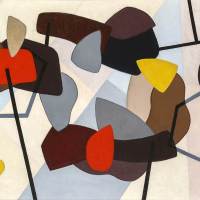
Contributed by Jacob Cartwright / In 1957, Clement Greenberg penned the essay “The Late Thirties in New York,” reflecting on years that were formative for both him and American art. He noted that during that decade “the big event, as I saw it, was the annual show of the American Abstract Artists group.” The artists who formed American Abstract Artists (AAA) first began meeting in 1936, in response to curators like MoMA director Alfred Barr, whose formulation of abstract art didn’t extend beyond the European continent. By 1937, AAA had begun organizing the regular New York City group shows that so impressed Greenberg.

Contributed by Jonathan Stevenson / In Mark Webber’s conceptual world, on display at Anita Rogers Gallery, trees gently but surely infiltrate the architecture humans have contrived in their space. They embrace it, disorient it, crack wise about it, and generally take manmade structures down a peg, reminding them – us – that they were here first and have survived the longest. Here there are at least remote echoes of Malcolm Peacock’s massive sculpture of a redwood at the Whitney Biennial and louder ones of Giuseppe Penone’s Arte Povera tree-based sculptures unifying art and nature.
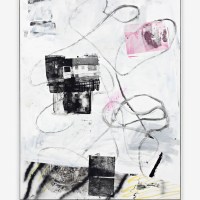
Contributed by Sharon Butler / In 2014, a single phrase reshaped the trajectory of contemporary abstract painting. When the late Walter Robinson – painter, critic, and veteran of the Pictures Generation – coined the derogatory term “zombie formalism” in an essay for Artspace, he set off a chain reaction that would stigmatize a generation of young abstract artists and cast a long shadow over abstraction in general. More than a decade later, the story of zombie formalism reads as a pungent example of aesthetic cynicism and jadedness – a case study in how criticism, commerce, and cultural anxiety can converge to distort and ultimately damage an entire movement.
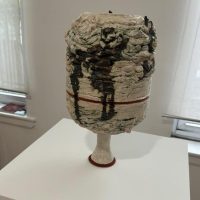
Contributed by Michael Brennan / Years ago, I took an art history class in Chinese landscape painting. It was broadening but almost farcically daunting, attempting to cover the art of 13 major Chinese dynasties in just 15 weeks. Nevertheless, it got me started. Asian art has long been a de facto independent study project for me. Most of the Chinese art that has attracted me was made not by celebrated official court painters but rather by former politicians who became poets in exile or, often, scholar monks. The latter reminded me of Herman Melville’s “isolatoes” – artists who rejected the “common continent of men,” living instead on “separate continents of their own.” Hilda Shen, whose solo sculpture show “Beyond This” is now up at Starr Suites, possesses the sensibilities of both her Chinese forebears and the isolatoes of the American Renaissance, who overlap by way of the Asian and Emersonian philosophies of nature.
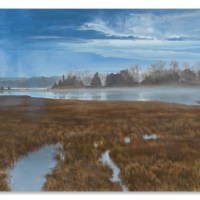
Contributed by Rebecca Allan / In “Liminal States,” Miles McEnery Gallery presented recent paintings by April Gornik, juxtaposing five of her familiar large-scaled canvases with seven much smaller paintings, depicting fragments of landscape against vast, roiling skies. Her unsettling work is based upon her observations of nature and the cosmos. Its mystery comes not from the replication of superficial appearances but rather from the fusion of precise draftsmanship and painterly rendering, which involves complex modulations in brushwork, texture, and chromatic layering.
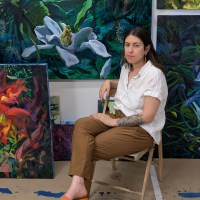
Contributed by Sharon Butler / In June, Two Coats of Paint welcomes Mirabel Wigon as our resident. She is a California-based artist and educator whose work draws together ecology, philosophy, and visual art. In her drawings and paintings, she constructs and dismantles plant forms to explore what she calls “messy entanglement” – the overlapping relationships that shape life on the planet. Her art moves well beyond botanical illustration, building a visual mythology in which flowers and plants become central characters in stories about disruption and resilience.

 Kerry Downey and Julián Kreimer conversation at the Sarah Lawrence College Heimbolt Center for Visual ArtRaphael’s innovations and influence
 Angelo Vasta: Comfort in darkness Amorelle Jacox’s spiritual scienceNYC Selected Gallery Guide, June 2026Hudson Valley (+ Vicinity) Selected Gallery Guide, June 2026Sharon’s Substack / June 1, 2026David Humphrey: The hikerZombie Formalism vs. Paul Brown’s abundant abstractionDavid Gilbert’s fugitive miraclesJessica Frances Grégoire Lancaster: Loss and memoryPlagens: Ralph Meeker, or why I like James Brooks as much as de Kooning
 NYC Selected Gallery Guide, June 2026
Contributed by Sharon Butler / In June, in the wake of an exhausting month of fairs, NYC galleries are again presenting a full slate of exhibitions. A...
NYC Selected Gallery Guide, June 2026
Contributed by Sharon Butler / In June, in the wake of an exhausting month of fairs, NYC galleries are again presenting a full slate of exhibitions. A...
 How the term “zombie formalism” killed the next generation
Contributed by Sharon Butler / In 2014, a single phrase reshaped the trajectory of contemporary abstract painting. When the late Walter Robinson – pai...
How the term “zombie formalism” killed the next generation
Contributed by Sharon Butler / In 2014, a single phrase reshaped the trajectory of contemporary abstract painting. When the late Walter Robinson – pai...
 April Gornik’s unsettled landscapes
Contributed by Rebecca Allan / In “Liminal States,” Miles McEnery Gallery presented recent paintings by April Gornik, juxtaposing five of her familiar...
April Gornik’s unsettled landscapes
Contributed by Rebecca Allan / In “Liminal States,” Miles McEnery Gallery presented recent paintings by April Gornik, juxtaposing five of her familiar...
 AAA at 90: Keep on looking
Contributed by Leslie Roberts / The exhibition “Abstract by Definition” at Art Cake celebrates the 90th anniversary of the American Abstract Artists (...
AAA at 90: Keep on looking
Contributed by Leslie Roberts / The exhibition “Abstract by Definition” at Art Cake celebrates the 90th anniversary of the American Abstract Artists (...
 American Abstract Artists in the 1930s
Contributed by Jacob Cartwright / In 1957, Clement Greenberg penned the essay “The Late Thirties in New York,” reflecting on years that were formative...
American Abstract Artists in the 1930s
Contributed by Jacob Cartwright / In 1957, Clement Greenberg penned the essay “The Late Thirties in New York,” reflecting on years that were formative...
 Hudson Valley (+ Vicinity) Selected Gallery Guide, June 2026
Contributed by Karlyn Benson / This month I am looking forward to the opening of Putting it Together: Transforming Collage at 68 Prince Street Gallery...
Hudson Valley (+ Vicinity) Selected Gallery Guide, June 2026
Contributed by Karlyn Benson / This month I am looking forward to the opening of Putting it Together: Transforming Collage at 68 Prince Street Gallery...