
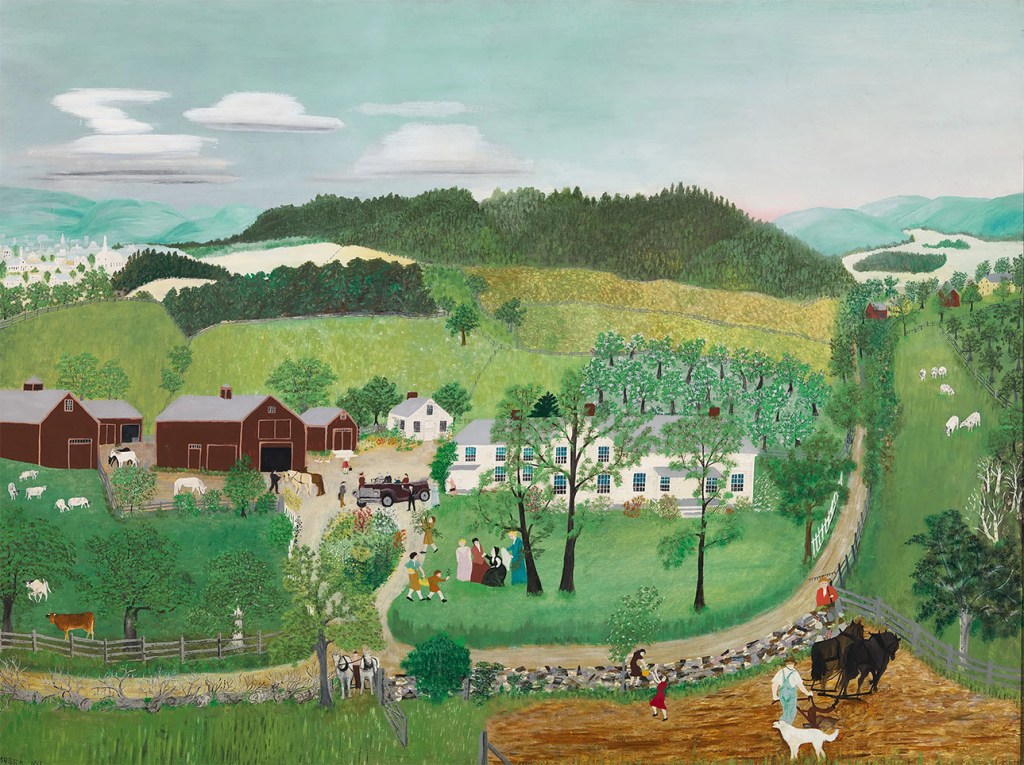
Smithsonian American Art Museum, gift of the Kallir family
Contributed by David Carrier / Anna Mary Robertson Moses (1860–1961), who was born in Washington County, New York, and spent much of her adult life in Virginia before returning to upstate New York, has long been famous. The first American celebrity artist, she appeared on the covers of Life and Time and was portrayed as a celebrity in Norman Rockwell’s painting Christmas Homecoming (1948), which is included in the exhibition of her work currently on view at the Smithsonian American Art Museum. Most people my age have seen reproductions of her artworks. Received in the White House by President Harry Truman, who told the press he strongly preferred her figurative pictures to Jackson Pollock’s abstractions, she depicts middle-class white men, women, and children at play and at work. No one is destitute and no grand scenes connoting Manifest Destiny are offered. Neither the city nor nature per se enters into her work. And although she lived through the Civil War and two world wars, her art was devoted, she repeatedly said, to pleasant things. The title of this show, “A Good Day’s Work,” references her idea that a successful painting is a gratifying, quotidian chore.
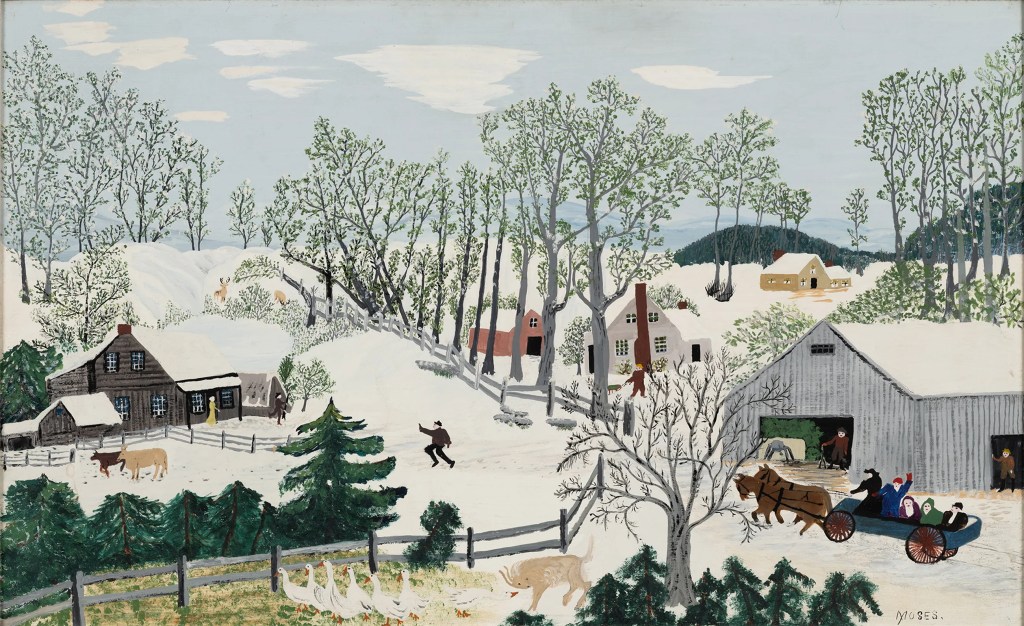
Smithsonian American Museum, gift from the Kallir family
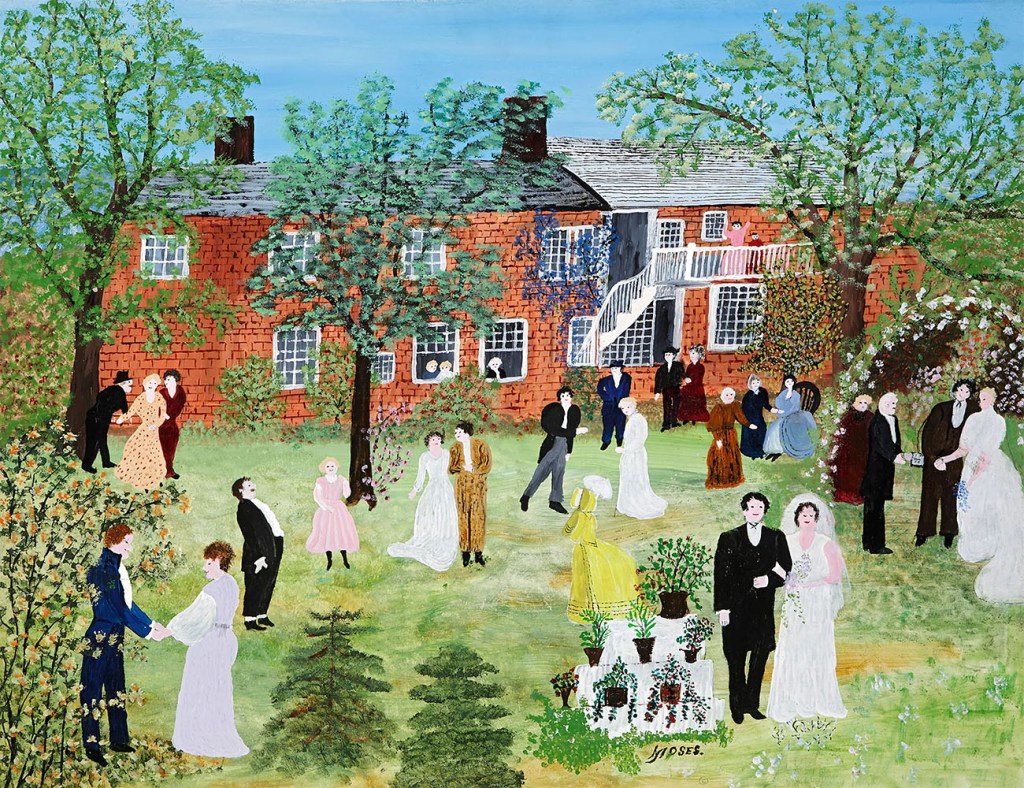
Writing about this exhibition made me uneasy. In the present political environment, there is something off-key about Grandma Moses’ benign visual sensibility. The catalogue features a page of paintings by William H. Johnson that reflect a much poorer rural world from a Black perspective; the implication is self-evident. His work feels truthful, while Grandma Moses’s relates a mythical tableau apparently devoid of political conflicts. After puzzling over what to write, I recalled “Lowry and the Painting of Modern Life” at the Tate Britain, a show I saw in London a dozen years ago. L.S. Lowry (1887–1976) was a lower-middle-class, politically conservative Northern provincial. His reputation has not carried far outside Britain. A solitary bachelor and a rent collector by trade, he was championed by John Berger, Kenneth Clark, and Ernst Gombrich, lionized by Labour prime minister Harold Wilson, and offered various official honors including a knighthood, which he declined. Incongruously, the curators of the show were T.J. Clark and his wife Anne Wagner, both Marxists. To understand the work, they said, I needed to calibrate my thoughts about his politics.
Moses’s subjects are remarkably varied. Her paintings depict stores, fires, blizzards, small and large houses, apple picking, apple butter making, moving day, tapping maple sugar, harvesting, a barn dance, dressed-up churchgoers, skating, Thanksgiving, a country wedding, picnics, Halloween, and Christmas trees. Her nickname tends to diminish her and too much fuss is made about her being “primitive,” or untrained – a folk artist. It is more resonant that she was an ambitious woman who started to paint in her late seventies and cherished farms, festive landscapes, and busy social lives in all the seasons. “Liberty is inconceivable in Camille Pissarro’s work,” it has been said, “without action and hard work.” Anna Moses painted in a different milieu, influenced, to be sure, by a sanitized socio-political understanding in a culture where Pissarro’s anarchist ideal seemed utopian. Her true subject is the farmed landscape, certainly a site of action and hard work, and it invariably dominates humans. Setting small stick figures in the countryside, she is the Brueghel of American modernism. Her paintings hold up magnificently, revealing how blinkered canonical art histories can be. She was an original, immensely challenging, surprisingly versatile painter. Why hesitate any further? She was a great painter.
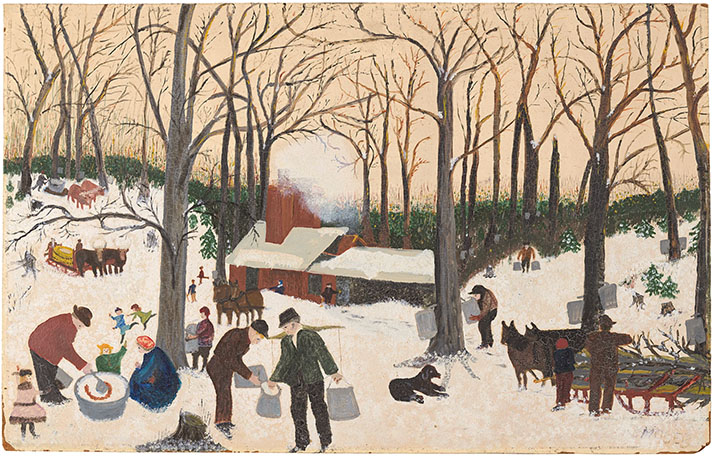
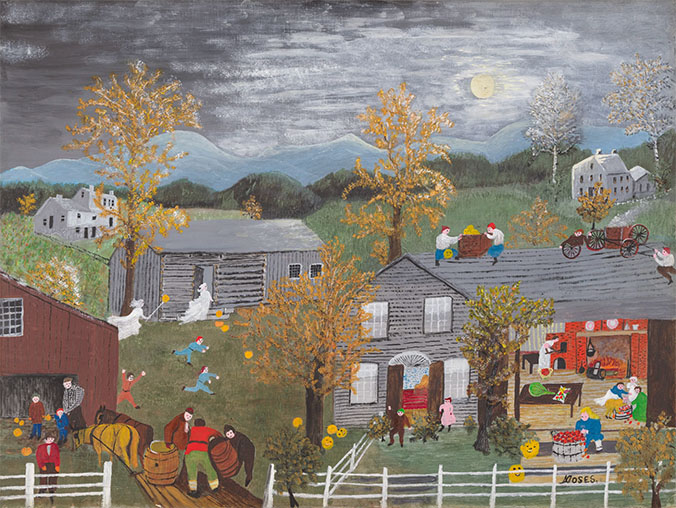

“Grandma Moses: A Good Day’s Work,” Smithsonian American Art Museum, 8th and G Streets, NW, Washington, DC. Through July 12, 2026.
About the author: David Carrier is a former professor at Carnegie Mellon University; Getty Scholar; and Clark Fellow. He has lectured in China, Europe, India, Japan, New Zealand, and North America. He has published catalogue essays for many museums and art criticism for Apollo, artcritical, Artforum, Artus, and Burlington Magazine. He has also been a guest editor for The Brooklyn Rail and is a regular contributor to Two Coats of Paint.














Grandma Moses is my first artist and yes she’s a great painter! I’m from Hoosick Falls (Eagle Bridge is a hamlet…. they are both Town of Hoosick) and we even lived for a time in an apartment over the storefront where her work was discovered. Her brushwork up close is loose and natural.
I don’t think the paintings are depicting middle-class people. These paintings depict a period prior to the development of an American middle-class. And I do think nature very much enters the work, especially with the changing seasons. Hoosick River in Winter is one of the best winter pictures. The Thunderstorm pictured here, which has always been a favorite, borders on the Sublime.
She could be considered a proto Appropriation and Pop artist in that many of the elements of her paintings were tracings from Currier and Ives prints that she repeated into multiple paintings with carbon paper. She would also repeat and make multiple variations of paintings that were most liked and in demand. And her paintings were merchandised on everything from curtains to plates to lampshades. I would even guess that the image she presented was a version of herself that she was savvy enough to lean into. A less intentional Artist as Brand that of course Warhol and Kusama Yayoi and everybody else were all aware of.
Somebody should make a murder mystery set in the NY artworld of the fifties, featuring Grandma Moses as the common-sense folksy granny navigating her way through it all and solving the crime.. .”Murder, She Painted”.