Author: Two Coats Staff

Museum Exhibitions

Howard Hodgkin’s Indian court collection: enigmatic or just good?

Contributed by David Carrier / Some very successful artists are also collectors, and the art that artists collect can reveal or confirm something about their own work and social attitudes. For example, Edgar Degas’ abundant holdings included works by Édouard Manet, which shows that Degas elevated aesthetic qualities over political beliefs. Unsurprisingly, Pablo Picasso traded art with Henri Matisse. Given Picasso’s obsessive rivalry with the Frenchman, he must have enjoyed keeping score with his frenemy as well as infiltrating Matisse’s collection with his own work. What then are we to make of British painter Howard Hodgkin’s trove of Indian court paintings, now on view at the Metropolitan Museum of Art?
Solo Shows

Allen-Golder Carpenter: Winter in America

Contributed by Mary Jones / Allen-Golder Carpenter’s debut NYC show, “To Dream of Smoke,” examines the aesthetics of hip-hop culture as a window into “masculinity, pride, posturing, incarceration, censorship and social programming.” A gender non-conforming interdisciplinary artist, activist, and poet born in Washington, DC, in 1999, Carpenter’s view is personal and close to home. Their work centers on rap music as a vibrant expression of Black culture, including the discomfiting relationship rap often has to violence as a statement of manhood, and the subsequent trap of prison. Carpenter explores the unrealistic expectations that many young Black people develop when drawn to an aesthetic that glamorizes violence, money, and fame. They deliver a complex message with the brutal declarations of an activist, but also the compassion of a poet.  

Screens

Movies of 2023: Barbenheimer and beyond

Contributed by Jonathan Stevenson / Last summer’s Barbenheimer phenomenon – the ballyhooed simultaneous release of Oppenheimer and Barbie, two expensive and well-acted films with sophisticated political messages rendered by leading auteurs – afforded 2023 the façade of audacity. But they came out during the writers’ strike, which signaled, if somewhat below the radar trained on the films, the uneasy and uncertain relationship between streaming and Hollywood.

Solo Shows

Diane Simpson’s elegant quirkiness

Contributed by Laurie Fendrich / While still in graduate school at the School of the Art Institute of Chicago in the late 1970s, the Chicago sculptor Diane Simpson (b. 1935) experienced a serendipitous moment. Through a store window, she caught sight of a child’s chair made from corrugated board. An array of little flutes connecting layers of liner board made the piece unbendable and weight-bearing while keeping it lightweight. Simpson went out and purchased some of the material and shifted from collagraph printmaking – a process that uses a plate with collaged materials – to sculpture. After learning to use a jigsaw to cut the board at a 45-degree angle, she made interlocking flat shapes of her own design, then assembled them into full-fledged sculptures. 

Solo Shows

Kosuke Kawahara: A heady stew of inspirations

Contributed by Michael Brennan / For a few years now I’ve been following Kosuke Kawahara’s art, which I’ve mostly seen in underground spaces such as Brian Leo Projects, Super Dutchess (now closed), and Culture Lab LIC. These presentations were uniformly fine and intriguing but also truncated and segmented, as was Kawahara’s previous on-line exhibition with RAINRAIN, which has now mounted “Exotic Star” – the artist’s and the gallery’s first true solo exhibition, and the gallery’s inaugural show at its new location on the edge of Chinatown. About a dozen paintings, works on paper, and small sculptures populate this rectangular space, occupying about a half-dozen distinctly crafted stations. It’s a revelation.

Out of Town Solo Shows

Nicole Wittenberg’s vacationland

Contributed by Katy Crowe / Upon entering Fernberger Gallery, a welcome transplant from New York, the faint smell of oil paint introduces Nicole Wittenberg’s “Jumpin’ at the Woodside,” the gallery’s inaugural show in Los Angeles. The title references a Count Basie composition, and the work does have the freewheeling feel of jazz. 

Studio Visit

Twofer: Patrick Neal and Zach Seeger

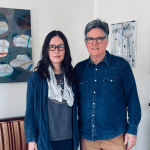
Contributed by Sharon Butler and Jonathan Stevenson / Last month we stopped by the LIC building where Patrick Neal and Zach Seeger, two formidable painters, have studios. Both write on occasion for Two Coats of Paint, and we hadn’t seen what they’d been up to since we saw their solo shows – Zach’s “Sports” at Gold Montclair and Patrick’s “Winter was Hard” at Platform Project Space in DUMBO.

Gallery shows

NYC Selected Gallery Guide: March 2024

Welcome to the March edition of the only painting-centric guide to art exhibitions in Manhattan, Brooklyn, and Queens. We’ll be updating next week, so if you have shows opening in the middle or at the end of the month, and you want us to consider them for inclusion, shoot us a note at staff@twocoatsofpaint.com. Please put “NYC Guide” in the subject line.

Gallery shows

Linda Griggs and Allen Hansen: Two for the show

Contributed by Riad Miah / Artists often become domestic partners. It’s an iteration of human nature. For one person to be attracted to another who has a similar creative sensibility and lifestyle is normal and sensible. Well-known examples include Robert and Sonia Delaunay, Dora Maar and Pablo Picasso, and Jasper Johns and Robert Rauschenberg. While coupledom can be exhilarating for both partners, it can also be tense, competitive, and destructive. Linda Griggs and Allen Hansen had never considered showing together until settling on their current show at Equity Gallery, aptly titled “Feedback Loop.” They appear to have struck a healthy balance between separation and synergy.

Solo Shows

Simon Hantaï: Canonical at last?

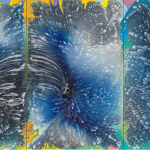
Contributed by David Carrier / What comes after Abstract Expressionism? A couple of generations ago, American art writers were intent on addressing that question. The American color field art of Morris Louis, Kenneth Nolan and Jules Olitski was one plausible answer. Then, of course, came Jasper Johns, Robert Rauschenberg, and much more. The French had a different answer. They were interested in the abstraction of Hungarian-born Simon Hantaï (1922–2008), who moved to France in 1948 and whose work seemed in line with the post-structuralist theory that had taken hold there. His inspirations were Marxism, Catholic tradition, Matisse, Picasso, and Jackson Pollock as seen in Paris exhibitions, and his bête noire was Surrealism. Given these rich and disparate interests and impulses, it goes almost without saying that Hantaï developed a highly distinctive aesthetic. Long famous in France, his paintings recently have been shown in several ambitious Manhattan galleries, notably Timothy Taylor.

Solo Shows

Martin Barré’s endless paintings

Contributed by David Rhodes / Matthew Marks’s current exhibition of Martin Barré’s paintings coincides with New York exhibitions of two other French painters: Alix Le Méléder at Zürcher Gallery and Simon Hantaï at Timothy Taylor Gallery. Together these shows furnish a good moment to consider the range and achievement of French postwar abstraction.

Solo Shows

Dana Frankfort: Braiding the senses

Contributed by Matt Phillips / Dana Frankfort’s exhibition “Life and Death” at Olympia presents eleven paintings that are by turns blunt and strikingly sensitive.These new works juxtapose the written word with gestural abstraction, the two languages simultaneously contradicting and supporting one another. Some paintings have legible text while in others the letters are all but gone, leaving the viewer to contemplate space where words have once been. The works are disparate, but each reaches toward a cohesive resolution.

Group Shows

An instructive ouroboros at Miguel Abreu

Contributed by Jacob Patrick Brooks / Images are everywhere. This simple (perhaps obvious) fact is driven home in various ways all the time. Most often in NPR bullet points indicating how many images the average person consumes daily. The number is often greeted with dull terror. Yet images are so prevalent that they disappear, coating the world in an invisible film. This dual quality of ubiquity and invisibility is what makes images such an attractive and important subject for artists to tackle. The current show at Miguel Abreu is kind of a who’s who of artists who study images and their rhythm. 

Solo Shows

David Hornung’s whispered secrets

Contributed by Natasha Sweeten / There should be a word for the glorious sensation you get when you realize the art in front of you is better than you’d expected, having initially seen it on a screen. You may scoff, “Isn’t everything better in person?,” but I beg to differ. These illuminated contraptions we carry around everywhere are remarkably good at turning life to 11. When I’m rewarded with this aforementioned word-I-don’t-yet-have, I chalk one up for being there.  So it was when I stepped into David Hornung’s “New Work,” the inaugural exhibition at JJ Murphy Gallery on the LES.