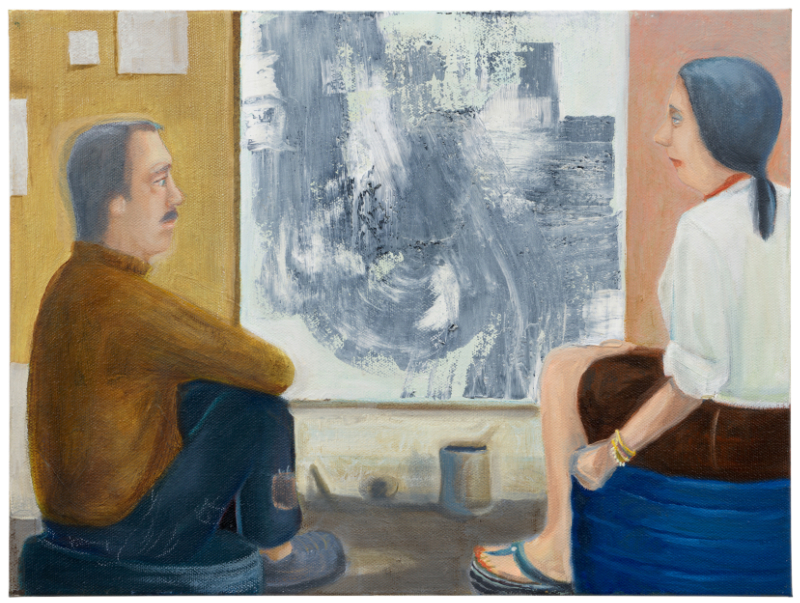
Contributed by Margaret McCann / In Bruce Tapola’s “Bad Tooth” at Post Times Gallery, ridicule and pathos are mediated by comic protagonists alone, in pairs, or in meager groups. Through two rows of small paintings, viewer identification and improvisational participation is compelled. In The Needle, the Haystack, two people behold an underwhelming painting centered within the conservatively hued, well-organized composition. Its unhinged gray textures look adventurous next to two blank surfaces, but austere against the warm ochre wall. The man is quietly attentive, possibly eager. The woman’s posture is stiffer, and her eyes look tired, but she’s not without earnestness. Either could be nervous or relaxed, trying to explain a new path of exploration, searching for meaning as the title implies. They could be student and teacher or professors discussing a student, friends having a routine studio visit, or strangers meeting at a residency. The two anchor the artwork and our view like stone lions guarding the entrance to a significant portal. Deadpan humor pokes fun at painting’s pretensions.
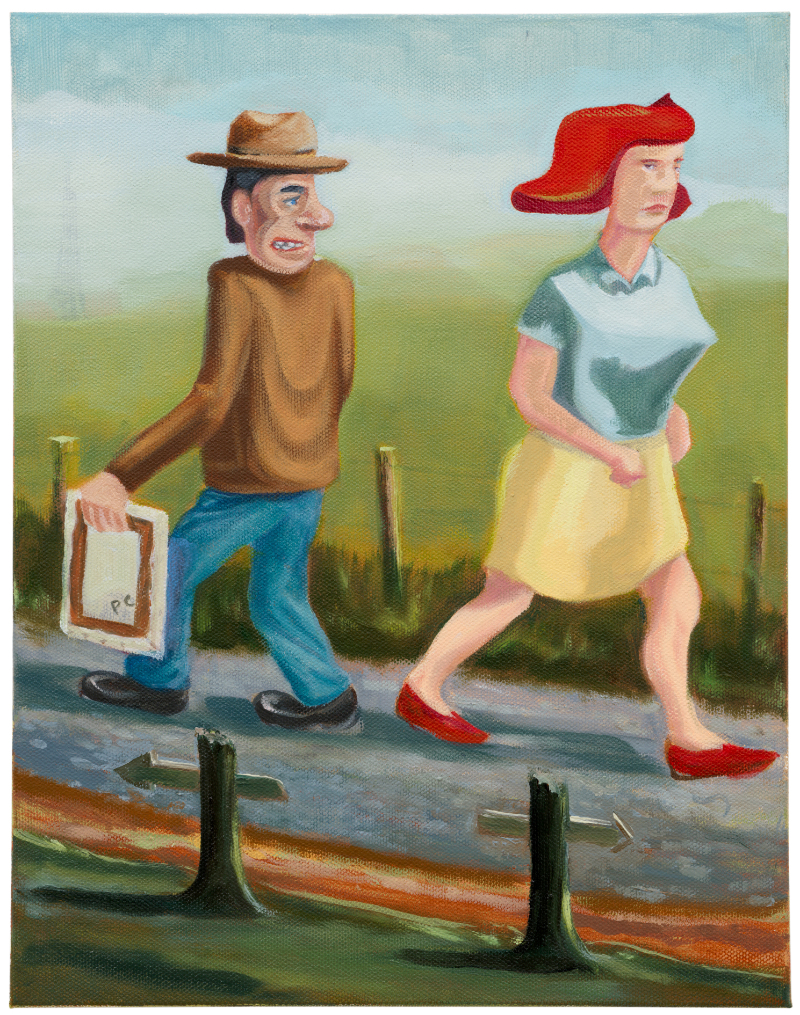
Hero worship is pilloried in the offhand Cezanne Annoying People (on the road to Paris). An original is degraded, as Rat Fink debased Mickey Mouse. The painting might also lampoon Courbet’s The Meeting, which depicts him as “the traveling apostle of realism” encountering fawning benefactor with manservant. Sporting his trademark hat, Cezanne, “personally shy to the point of being asocial,” is recast as an obnoxious creep. Tapola’s historical fiction may draw inferences from Cezanne’s violent early work or the unappealing Madame Cezanne, or have been applied jokingly after the fact. The lack of realism makes the culprit more inept than threatening, but deep, misty space conveys uncertainty, and signs resembling crosses sow division in this cynical mix of unsettling and whimsical.

Mastery on a larger scale is critiqued in Super Collider. Expansiveness evokes the sensibility of Peter Doig with none of his optimism. An Oz-like man operates an epic yet ramshackle machine, less particle accelerator than doomed Martin Kippenberger construction. Something rough and ungainly is growing, not unlike an artwork in progress. Reference to the unfinished laboratory that might have discovered the God Particle sooner than CERN did, had the “demon of bureaucratic chaos” not intervened, is implied. Babel-like, this behemoth could be a parable of that dark force, or of creative hubris.

Unlike the Venetian carnival setting of Pietro Longhi‘s costumed groups, The Reenactors bypasses the context key to historical purpose. A dynamic interplay of positive and negative shapes moving the eye up and down prevents easy visual cohesion. Not quite collaged, like Martin Mull fragmentations that evoke nostalgia, Tapola’s figures are characters in search of an author. Their saturated color gives them extroversion, and their cartoonishness invites the nihilism of lowbrow pop surrealism, as in Peter Saul, the Clayton Brothers, or Christian Schumann. But Tapola’s moody lighting and his evocative texture and surroundings, set up but don’t satisfy an expectation of authenticity, as in the work of Lisa Yuskavage. On the stage with no lines, these random types perhaps mock the American fixation on identity. Tapola’s caricature and fluid skill recalls Daumier but not his idealism; like R. Crumb, his brush takes aim at common and natural human foibles.

In the multi-colored Daily Driver, a vehicle resembling the Beverly Hillbillies’ jalopy lumbers across a thin dirt road opening onto a frontier. A weightless, happy-go-lucky drama like that of Saul is qualified by the heavy memorabilia of Guston or De Chirico. The “D. Stil” inscribed on the wood fender nods to a De Stijl utopia, defiled or simply worn down by the daily struggle, while the flag could be a defaced Malevich, or a red X canceling surrender. The delusional drive of the American Dream and compromised aesthetic ideals keep on trucking.

While Tapola’s swift, confident brushwork is impersonal to the degree it is stylized, it remains sensitively attuned to light; denial of landscape painting romanticism is evoked. In The Flood, delicate, melancholy light envelops a survivor gripping a pile of possessions atop a roof, under daybreak’s anxious yellow tinge. If the water continues to rise, things will probably fall apart, but for now he’s holding it together. He might even be reading as he waits for rescue or deluge, comfortably resigned like Huckleberry Finn on his raft. As with Guston, energized formal language softens sadness; as in the comic strip Nancy, disillusionment can amuse. While so much contemporary figurative painting justifies its lack of emotional depth with trendy subject matter, Tapola’s moves past illustration. Irony is deployed thoughtfully, as Rilke advised. Forlorn-feeling oil paint surfaces further hold humor in check.
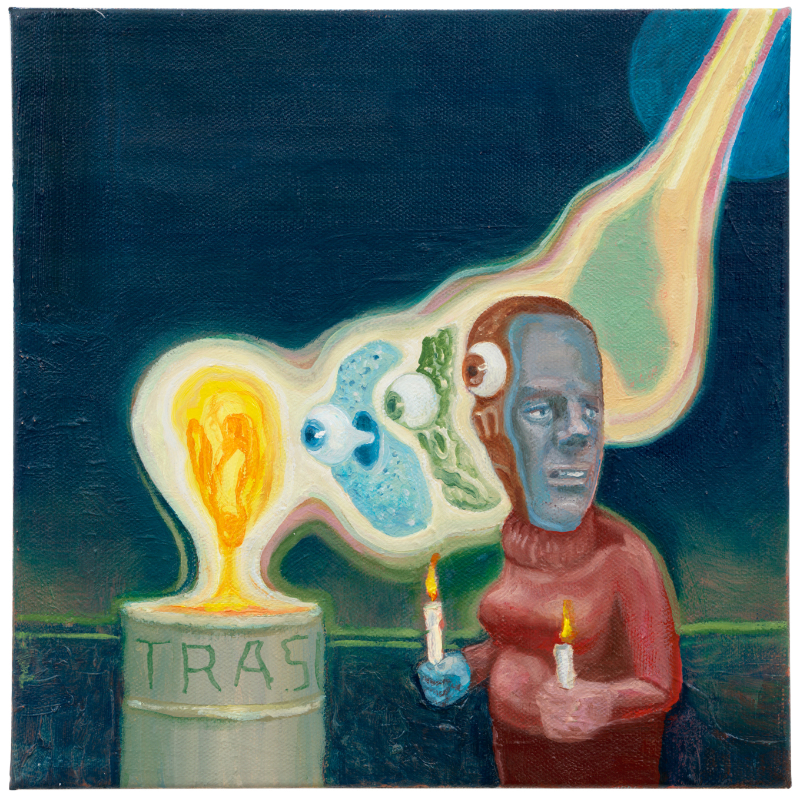
In the night scene Burner, a woman sagely burns two candles rather than one at both ends; something great could be heating up. Crumb-like anatomy is rendered with deft chiaroscuro; behind her clueless visage, an inspired mind’s eye bulges like a Basil Wolverton. The diagonal of glowing halo shapes bears amusing resemblance to Grunewald’s Resurrection; reading upward, a conceit is transfigured via hard work into a transcendent idea. But just as trash is more likely to burn than to rise from the ashes, the fiery epiphany droops and dwindles. Like a lava lamp or artist’s ego, potential and decay fluctuate in shifting line, shape, and volume, within soothing color harmonies and permeating good humor. Just as dental pain can motivate self-care, the uncomfortably funny tales “Bad Tooth” tells bring relief.
“Bruce Tapola: Bad Tooth,” Post Times, 29 Henry Street, New York, NY. Through February 25, 2024.
About the author: Painter and art writer Margaret McCann teaches at the Art Students League. She has shown her work at Antonia Jannone in Milan and been reviewed in La Repubblica, Corriere della Sera, and the Huffington Post. She edited The Figure (Skira/Rizzoli 2014) for the New York Academy of Art and has written reviews for Painters’ Table and Art New England as well as Two Coats of Paint.