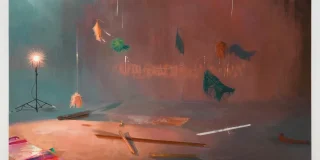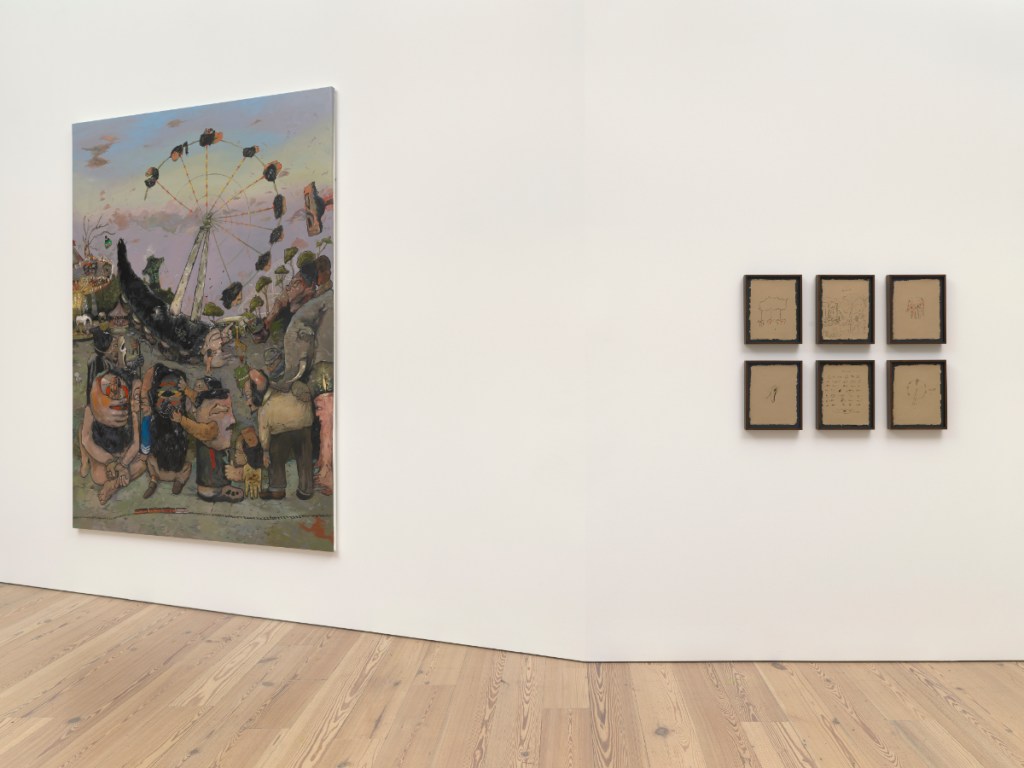
Contributed by Jonathan Stevenson / The 2026 Whitney Biennial is rightly dialed into the world’s abundant strife, most of the selected artists witnessing and declaring it through materials, context, or concept. Ali Eyal, with his knockout of an oil painting Look Where I Took You – arguably the jewel of the exhibition – takes an exceptionally straight-up approach via content. Composed from the memory of a Baghdad amusement park he and his sister visited before the US invasion of Iraq in 2003, when he was nine, the piece spans the strategic arc of the twenty-first century with improbable lyricism while bravely carrying its immense geopolitical freight.
The focus of the painting is a Ferris wheel, which customarily suggests urban whimsy, notably drawn on covers of The New Yorker. Jean-Michel Basquiat jauntily painted one of 1933 vintage for Luna Luna, the artists’ open-air museum and amusement park set to jazz installed in Hamburg in 1987 and resurrected in Los Angeles in 2023–24 and New York in 2024–25, alongside Keith Haring’s carousel and David Hockney’s “Enchanted Trees” pavilion, among other installations. That display was a celebration of life by way of playful refuge. Look Where I Took You, which shares the tagger’s flair for the absurd, shades that function, but a scabrous history inexorably comes with it, as Eyal synthesizes the likes of Bosch, Brueghel the Elder, Goya, Munch, Dali, Beksiński, and maybe Robert Crumb.
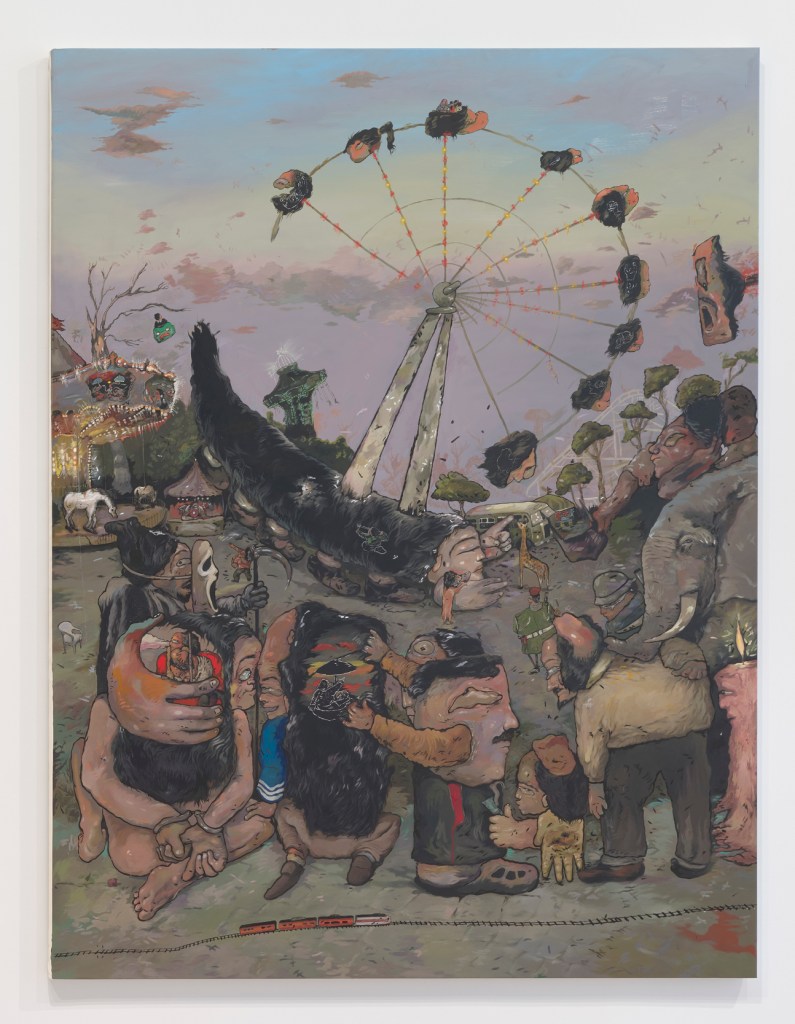

You are given only a fleeting moment of grace in Eyal’s aesthetic seduction before feeling the lash of embedded surreal horror. The nodes on the wheel, it transpires, are not compartments hosting cheerful patrons but the skewered heads and body parts of dead Iraqis. Denatured and flummoxed onlookers – one wears an outsize scalp like body armor, another is a deadpan child – are flanked by a would-be Grim Reaper and, presumably from the destroyed zoo, an elephant trampling a man and a lion gnawing the hand of a ten-legged monster impaled by the stanchions of the Ferris wheel. Cluttered and shrill as that may sound, so is the calamity of war. It’s as if Guston had allowed one of his grisly humanoids to fully articulate its reverie.
While many artists have ably depicted war’s surface tableau, fewer have effectively evoked the enduring psychological damage it imposes. Eyal, in this painting, gets there. Though he eventually decamped to relative safety in the United States, his father disappeared after the U.S. invasion. He can’t apprehend a Ferris wheel or a zoo with the frivolity or innocence that others can muster. Over 20 years ago, he came to understand the hard reality of terms more recently emitted by the Pentagon and the White House – “no quarter,” “no mercy,” “maximum destruction,” “living in Hell,” “a whole civilization will die” – as casually jingoistic accoutrements of another unnecessary war. And he is not amused.
“Whitney Biennial,” Whitney Museum of American Art, 99 Gansevoort Street, New York, NY. Through August 23, 2026.
About the author: Jonathan Stevenson is a New York-based policy analyst, editor, and writer, contributing to the New York Times, the New York Review of Books, and Politico, among other publications, and a regular contributor to Two Coats of Paint.