
Painters Ezra Johnson and Matt Bollinger work across painting and handcrafted animation, and both are drawn to the textures of everyday American life — houses, haircuts, the quiet weight of ordinary moments. Two Coats of Paint invited the two to have a conversation on the occasion of their 2026 exhibitions: Johnson’s “Home and Garden Show” at Freight + Volume in New York, and Bollinger’s “Dawn” at mother’s tankstation in Dublin. The two artists speak here as peers, moving between close readings of each other’s work and reflections on their own practices. They discuss the relationship between painting and animation, the question of when a painting is “done,” and how handmade roughness can carry more truth than technical finish.
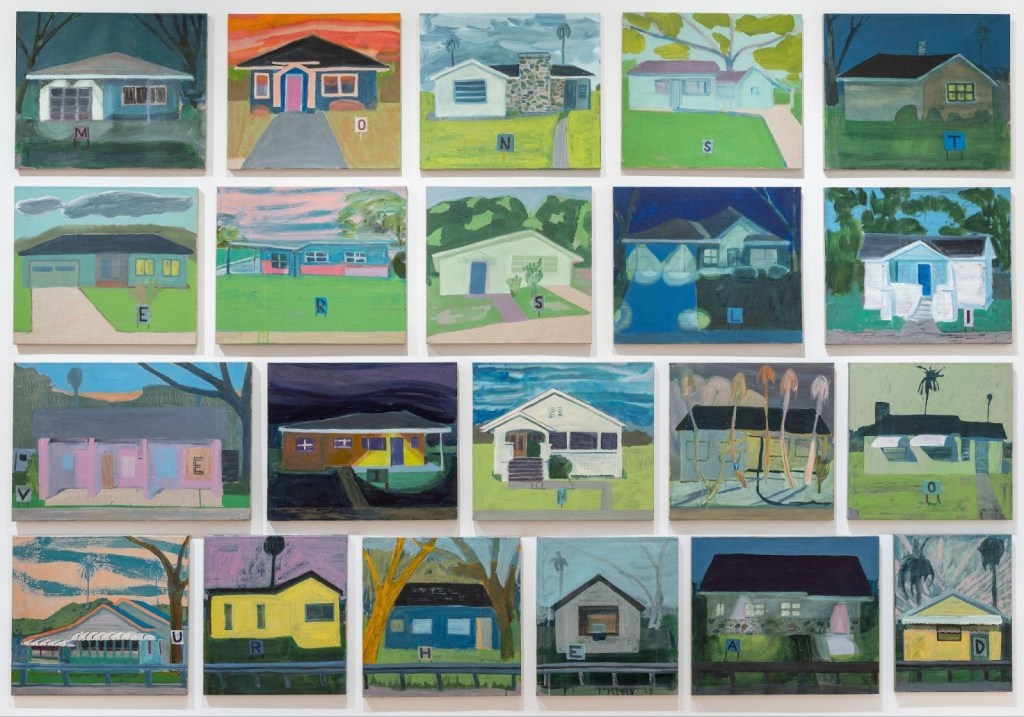
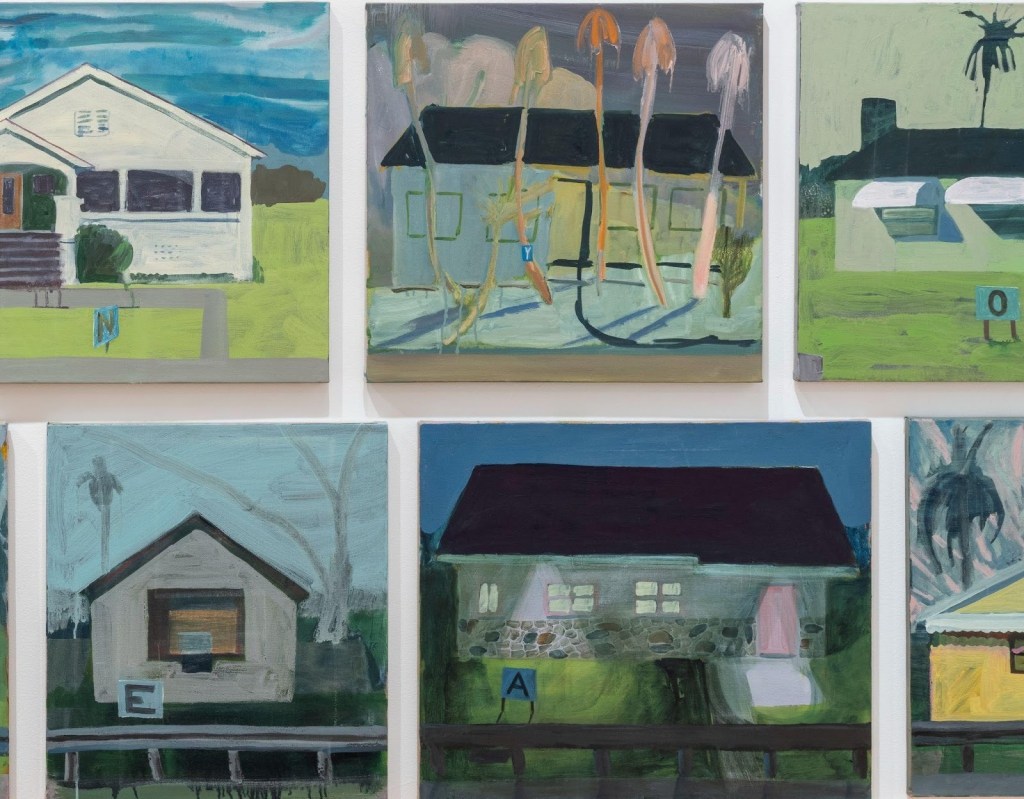
Matt Bollinger: Monsters Live in Your Head is made up of 21 canvases, each with the façade of a house and one or two letters painted into the scene. They collectively spell out the title of the painting. Could you talk about how you’re thinking about “home” or houses in this exhibition?
Ezra Johnson: Each house is centered like a frontal portrait. Homes are such an important part of identity, but you can only guess what’s inside. I arranged them in a grid to create density, like an apartment building with different units. I often think about how people are separated into their own living spaces and their own thoughts.
That piece kind of harks back to some of my early work. When I was an undergrad, some friends and I would go out and paint in the suburbs of San Francisco and Oakland.
MB: Like plein air.
EJ: Yes. But this group of houses started for an animation I’m working on. It’s a panning shot seen from a car, going from a rural countryside that slowly gets denser as you approach the city. I built a rig to move my camera horizontally through about fifteen continuous feet of paintings, including the houses. Each shot would begin and end on a large tree so I could edit them together. I haven’t made it to the city though—I’m still working on it. I animated the houses so that as you drive by, the perspective shifts—you first see one side, then the front, then the other side as you pass.
Then the paintings were kicking around my studio and I started arranging them in a grid. Eventually they became Monsters. For me it responds to how people isolate in their homes and lose connection with each other. Fear builds up and then gets exploited. It’s more complicated than that, but that’s the idea behind the title.
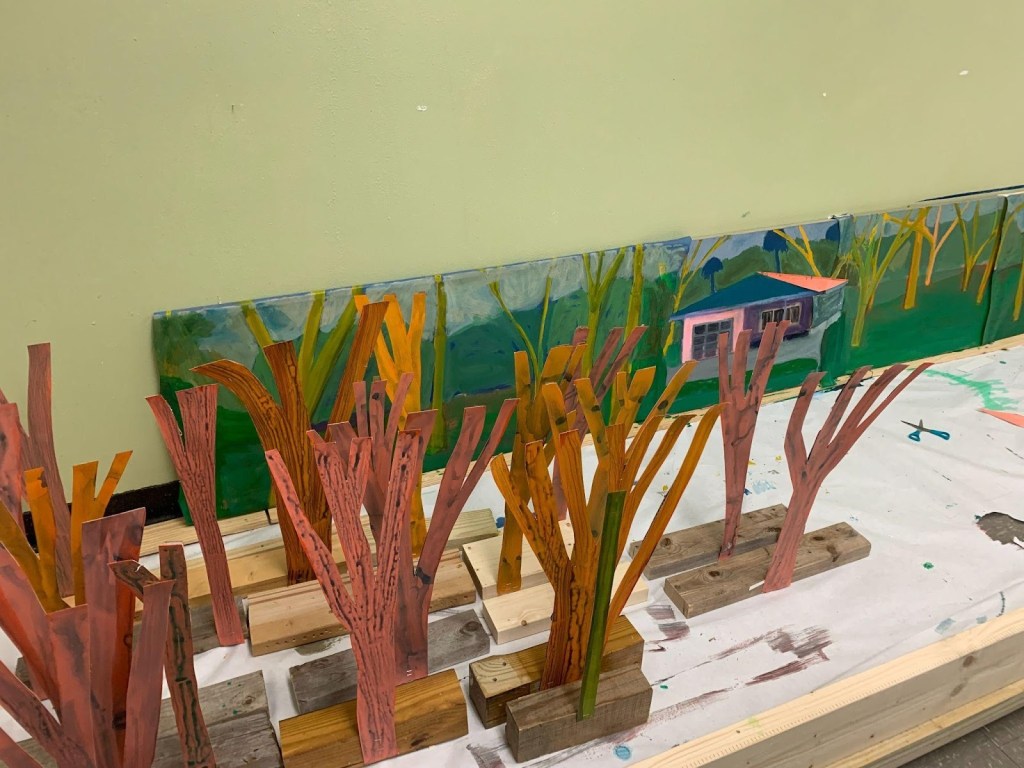
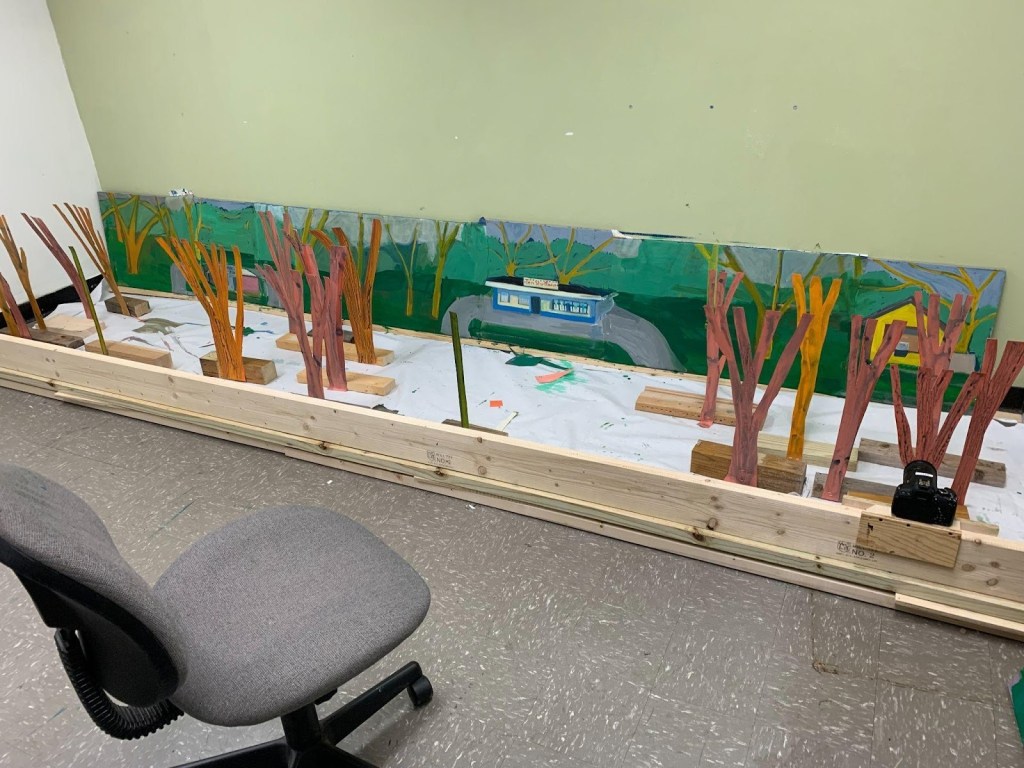
The Panning Rig with movable trees, paintings, and camera 2023
MB: How did the letters come about?
EJ: At first the letters were huge, taking up the entire painting. Then friends of mine here in Tampa—Mernet Larsen and Roger Palmer—came for a studio visit. Mernet said, “You’re totally ruining them,” and Roger suggested putting the letters on yard signs instead.
MB: That’s amazing. I love Larsen’s paintings. Were those houses physically animated?
EJ: Some were animated. I guess I’ll need to make more houses to finish the video.
MB: I’d love to see that. I have a long tracking shot in an animation I’m working on now. It’s the main street of a small town painted on one long sheet of paper, maybe seven or eight feet long but only about a foot tall. I filmed a tracking shot from a car and used that as reference. I didn’t try to shift the perspective like you did—I just tracked across the painting. But I like that in your work the shifting perspective becomes part of the character.
EJ: Honestly, it’s a little clunky in mine, but I like it that way.
MB: That leads to another question. The handmade aspect of your work is really pronounced. What relationship do you see between how you paint and the subjects you paint?
EJ: Something I’ve been thinking about—especially with the painting of Susanna—is when a painting is done? She volunteered to pose a few months ago and I painted her quickly.
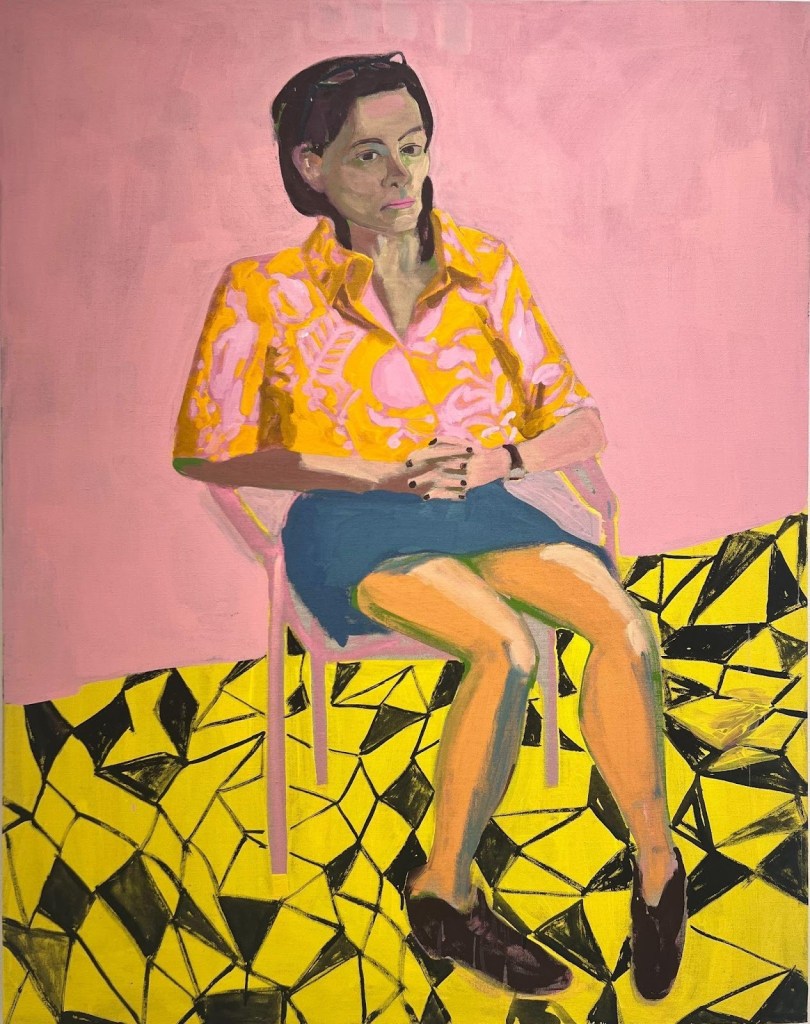
I stopped before overworking it. In the past I would have gone further and killed some of the energy. I think I’m best when I don’t work too long. I’m trying to embrace the roughness of my style instead of covering it up.
MB: When I think about your hand being so visible, it feels like the conversation between you and the sitter becomes part of the painting. The time spent together is embedded in it.
EJ: I agree with that. For me the energy in the paint as a material excites me more than anything.
MB: It’s the energy and also the touch that are so important—the audience is there looking at the painting and then the artist is there too, you see their fingerprints, and you share a space together.
EJ: It’s a balance of expression and detail. Both in the paint handling as well as the world created. This is something I really admire about your paintings, they are incredibly complicated and ambitious but never tight or fussy. You’re able to be bold as hell and still super detailed but not labored.
MB: That’s nice of you to say. I relate to the need for efficiency. Making a face with just a few brushstrokes, the nose a single stroke, but I can’t always get the character that way. I also need to get out the little nylon brush and just go. I want the painting to look back at me in some way. I have an almost animist belief in the power of painting to be more like a living thing than like fabric and wood.
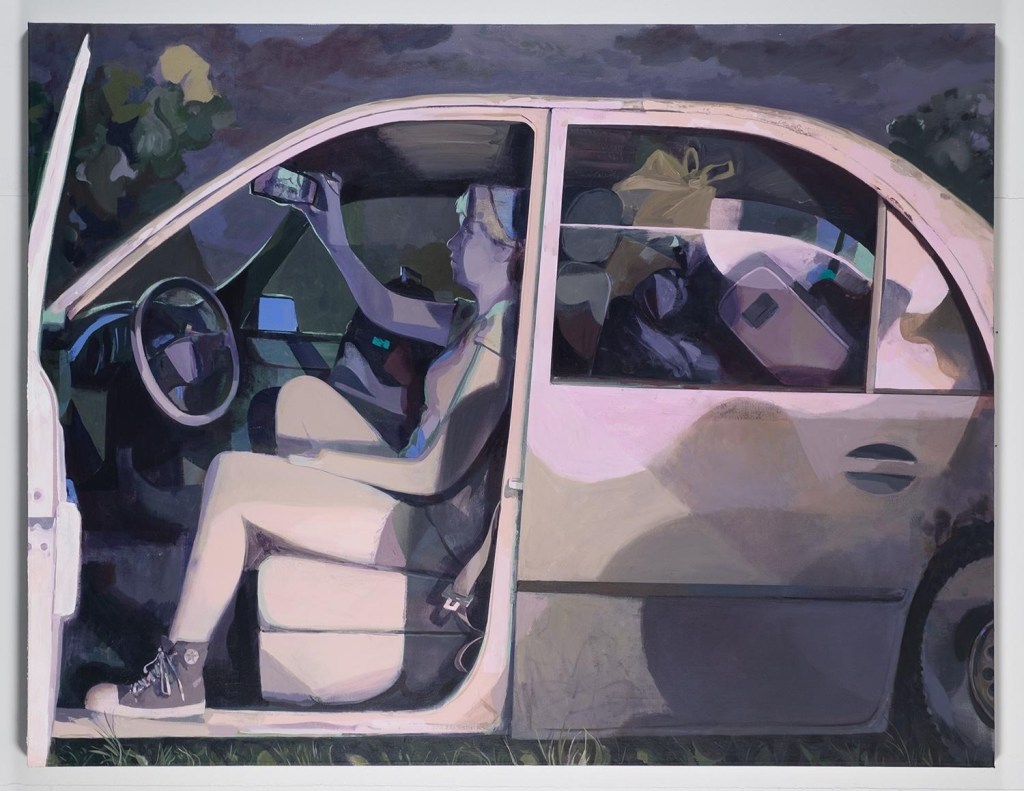
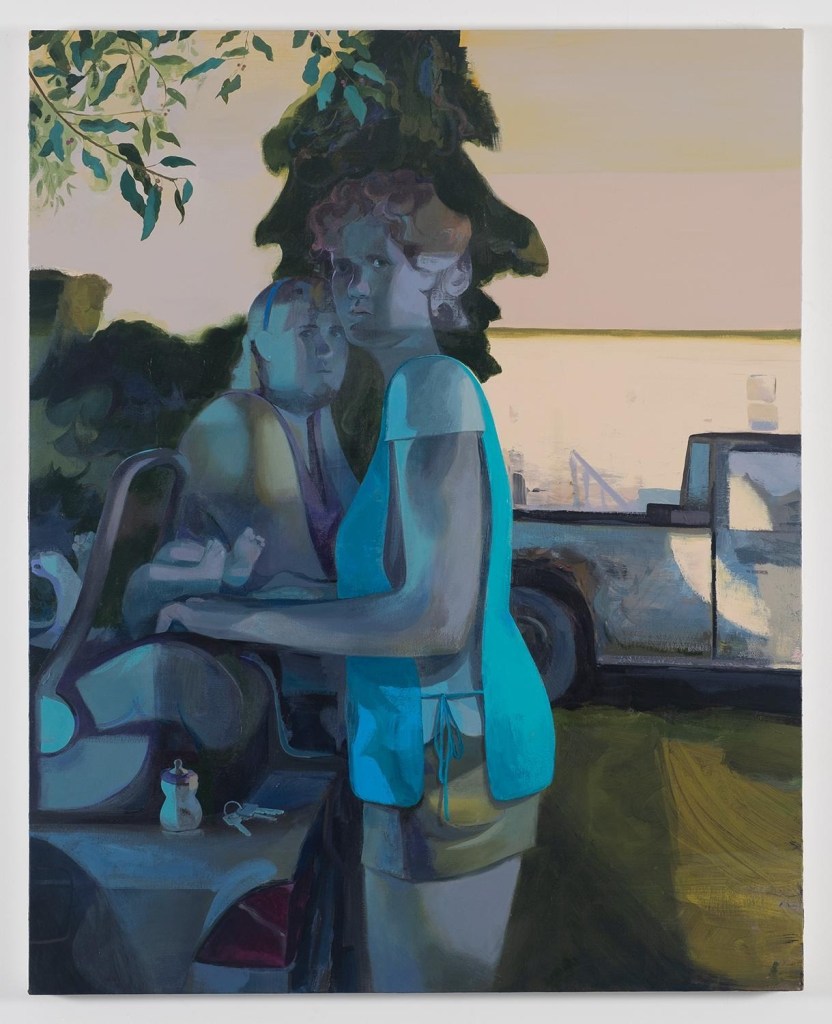
EJ: Your paintings and animations can really work in tandem to propel your work forward. I was thinking about your painting Before Work and your animation Dawn. She’s looking at herself in the car mirror and, in the animation, putting on makeup. We watch Dawn paint her eyeliner with a line, bringing in sharpness where all was mushy before. This sequence really demonstrates the power of painting to bring something to life. We watch her come into focus through actually drawing on her own face. It’s really powerful!
Which came first?
MB: That scene in Dawn came first. I love the way you’re reading it. Works often send me back and forth, or like you start in one mode and evolve into another. In this case, I wanted a painting that had a strong connection to the video since they were going to be shown together. The woman in Before Work isn’t Dawn, but they have a lot in common. I wanted to show her situation through the stack of her stuff in the back seat, which has an “everything she owns” feeling. Dawn took five years to make, and after all of that time living in her world, it made a painting like this possible.

MB: I think about your IKEA catalog animation all the time. It’s hilarious and it has your hand throughout. And then you also make things like the trash still lifes or the slumping mattress. It all feels connected by your hand even as you move across these different subjects and media.
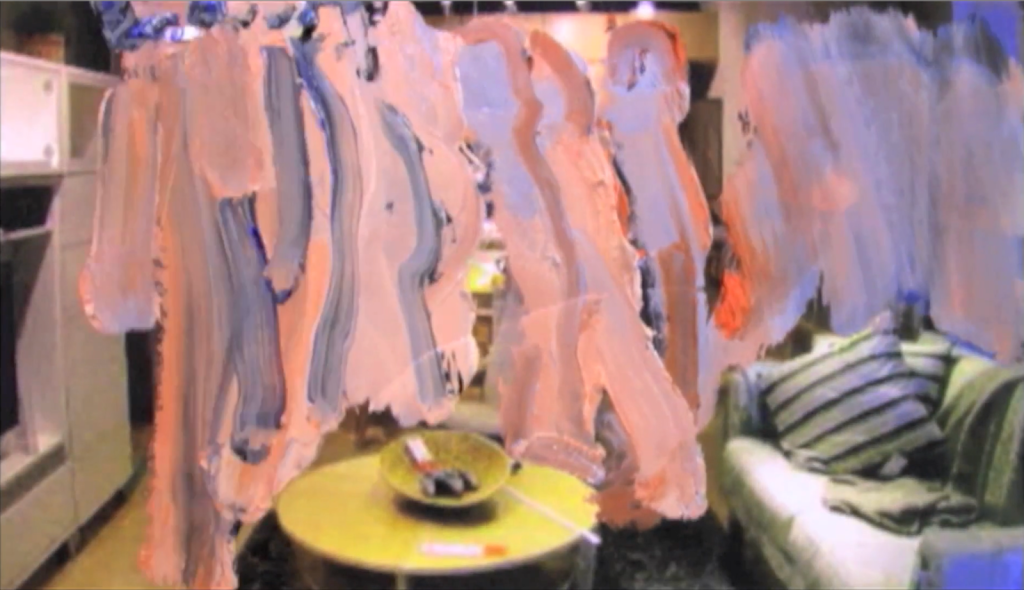
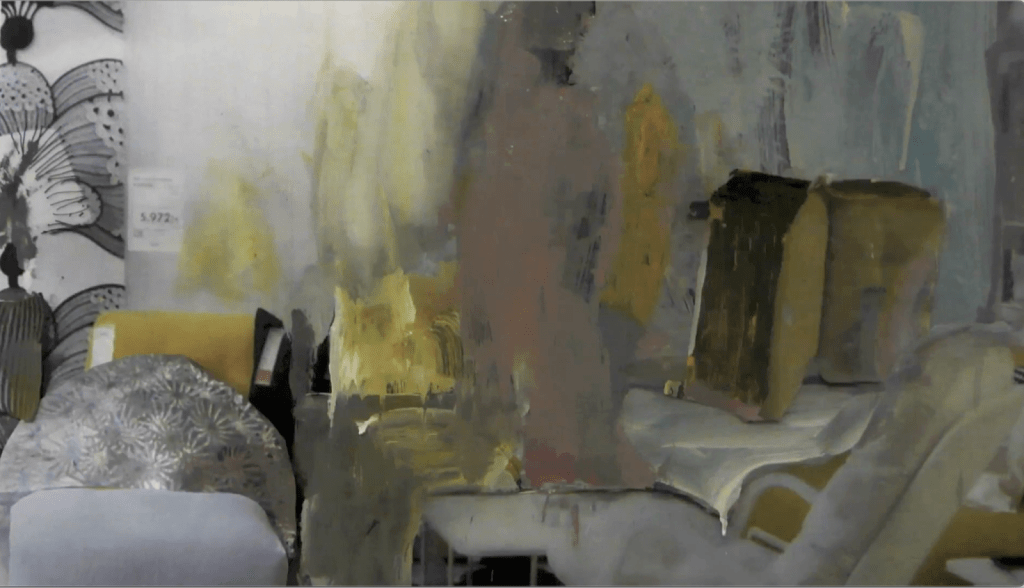
Ezra Johnson, Stranded in a House, 2017 stills from painted animation on Ikea catalogue pages 5:42
EJ: I started my first animation after seeing a William Kentridge show at MoMA. I wondered what that would look like in oil paint, so I went back to the studio and tried it. The first thing I animated was a black silhouette of a man in a ski mask climbing onto a couch and cutting a painting from its frame. That became part of a fourteen-minute animation. At the time I was making art-heist paintings; figures in ski masks carrying paintings through elegant spaces. So the animation came out of that narrative. It was crude but full of energy. I realized animation could hold many different things together. So it helped me accept how many different things I do.
MB: I saw Kentridge’s films in a printmaking class at the Kansas City Art Institute. I borrowed a camcorder with a single-frame button and made a charcoal animation of a landscape evolving. I didn’t pursue animation again for a long time because it felt too derivative of Kentridge’s work, though I continued working with video and painting from the stills.
EJ: For me a big part of animating is problem solving. Figuring out how to do it. I started animating because I couldn’t resolve paintings or didn’t like them resolved. Animation allowed each frame to be wild while still forming a coherent whole. Lately I’ve been more satisfied with painting, so maybe I feel less need to animate.
MB: One animation of yours shows the trash, the flotsam that you collect, drifting endlessly in water. It worked well in a gallery because it, you could enter at any point.
EJ: River Table works well as a loop. But longer narrative animations feel strange in gallery settings. How do you feel about people walking into the middle of a twenty-minute video?
MB: I usually anticipate that. Dawn, which I just showed in London, restarts differently every time, so the loop constantly changes. I’m drawn to slow moments, time spent in a space. Even though I try to keep them short, some projects end up around twenty minutes, which is about as long as people will sit.
EJ: It’s remarkable how your animations feel like an intimate way into your paintings. Your paintings are so powerfully composed and solid it’s remarkable to see in your animations a kind of frailty. There’s an extra level of intimacy or tenderness in them.
MB: That’s so nice to hear. It’s true, my paintings are more concerned with presence and stillness. It’s something I’m trying to renegotiate now—making paintings that suggest more movement. In a way both methods are durational. The animations unspool over the runtime of the video, while time in the paintings becomes dense and simultaneous, always there before you.
EJ: I relate a lot to your sensibility especially in how you elevate everyday moments in much of your work. Like in your painting Better Half which depicts a moment of care, using the back of a car as a table. Your sharp eye for details adds so many layers of meaning to the narrative. And I love the mostly blue and violet color palette.
MB: Thank you. I’m glad you brought up color because I wanted to talk about your painting, Haircut, which has a similar focus on a moment of care—it’s an everyday scene that becomes vivid and energized through color. How do you think about color in your work?
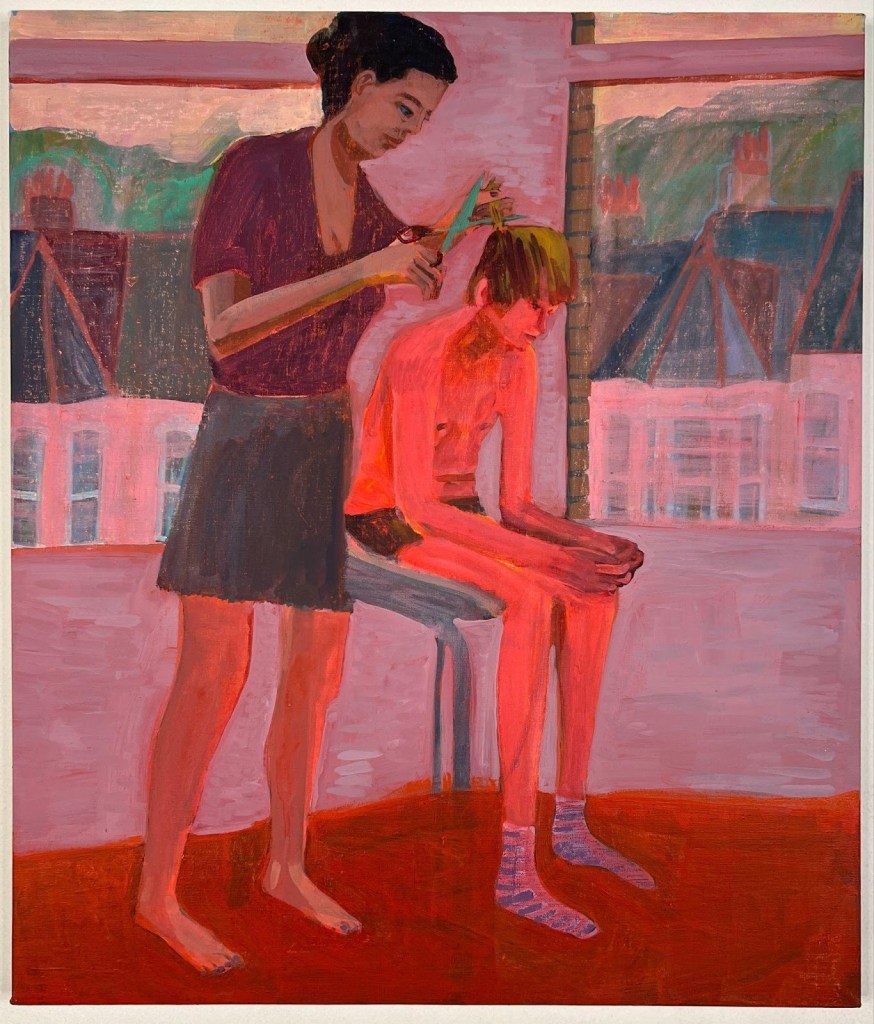
56 x 44 inches
EJ: I’ll usually start working then end up discontent with the painting, most often because it feels conventional. Color is the way I go at changing that. I’ll change the colors over and over until it feels more timeless, it’s hard to describe the goal. I remember hearing that Matisse’s red studio was once blue. That really impressed me and stuck with me.
You’ve talked about creating a fictional world in your paintings. Somewhere in Missouri like your own version of Springfield. They’re invented but so well composed and solid and full of convincing details. This combination of imagined and real, in my opinion leaves room for a sort of metaphysical space to enter into your paintings.
MB: I’m attracted to granular detail and everyday moments but at the same time, the art that I find most moving, that I hope to achieve, has an overall effect of transformation. We’re all the first audience of our own stuff and the thing that makes me feel less like I made it and more like I’m experiencing it is when I see moments of transformation. Where the everyday becomes somehow heightened or there’s something disruptive. There’s something that makes you pivot away and see it again as though you are seeing it for the first time. I think this is another version of what you were saying about how color can disrupt convention.
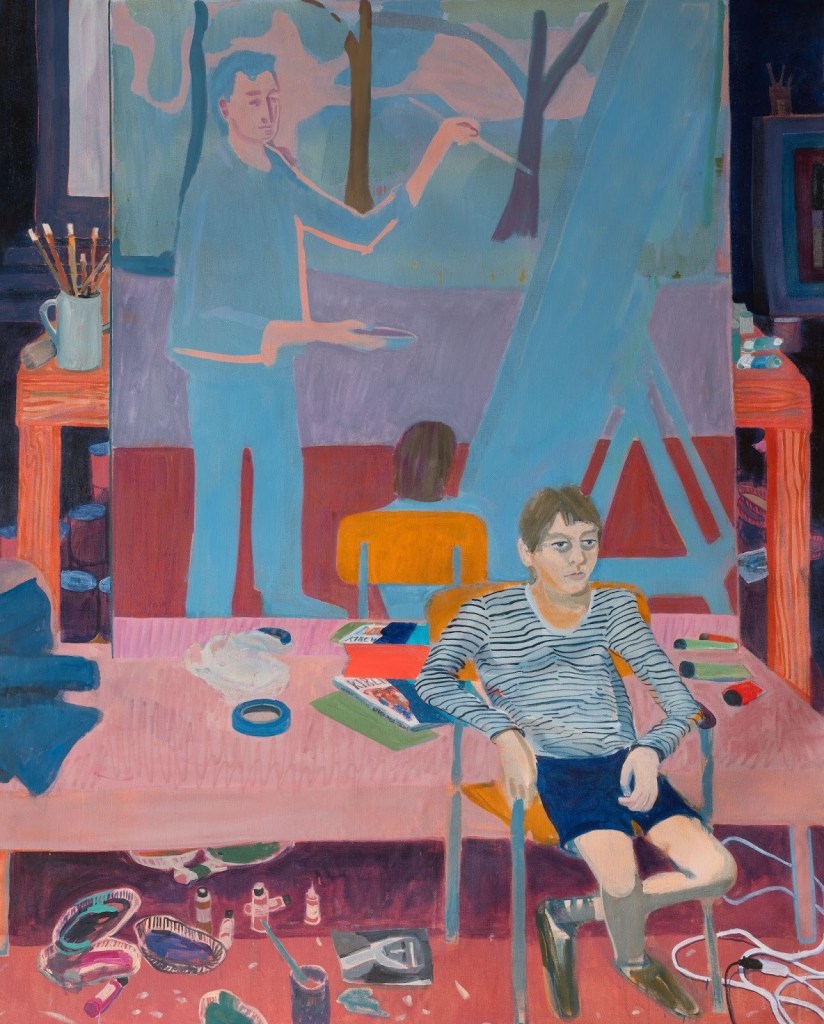
MB: How do you think about the figures in your work? I was thinking of your portrait of Ossian in the studio, which you said was an homage to that great Fairfield Porter [The Mirror, (1966)] in Kansas City. On one hand you’ve made a painting based on your life and on the other, like Porter, you’re communing with artists who inspire you.
EJ: This group of paintings is both personal and not, they are of my family and from my life. But I’m doing several things at once with them. I’m not trying to narrate my life, life overwhelms me, and painting is an investigation of how to show it. The painting of Me and Ossian involves balancing several modes of painting. The part of him is direct and observed from life and that brings one kind of direct energy, the rest of the painting is constructed. I wonder if the- communing with artists who inspire me, part, is a way of distancing myself. Like a historical mode. I don’t know. But painting is an activity where you are always bumping into these ghosts from past and present.
“Ezra Johnson: Ezra Johnson’s Home and Garden Show”: Freight + Volume, 39 Lispenard Street, New York, NY, 10013. January 1 through March 7, 2026.
“Matt Bollinger: Dawn”: Mother’s Tankstation, 48 Three Colts Ln, London E2 6GQ, January 17 through March 7, 2026.
About the artists: Ezra Johnson, based in Tampa, Florida, is represented by Freight + Volume in New York. Matt Bollinger, lives in New York State and is represented by mother’s tankstation limited and François Ghebaly Gallery.





wow – so wonderful to hear the exchange between u 2 and to see the work. love them still and in mid odd moments. truly enjoyed, thanks for the great share.