
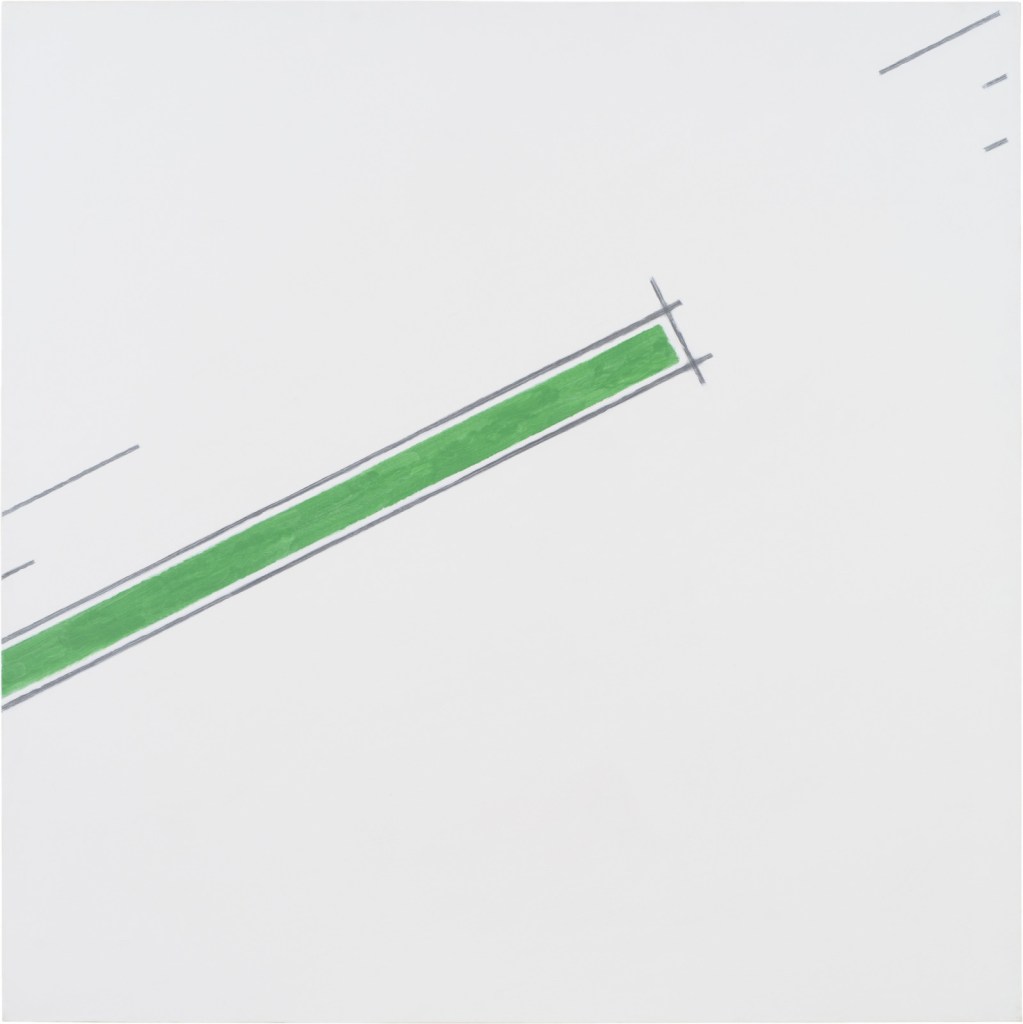
39¼ × 39½ inches; 100 × 100 cm
Contributed by David Rhodes / Matthew Marks’s current exhibition of Martin Barré’s paintings coincides with New York exhibitions of two other French painters: Alix Le Méléder at Zürcher Gallery and Simon Hantaï at Timothy Taylor Gallery. Together these shows furnish a good moment to consider the range and achievement of French postwar abstraction.
The Barré show presents his multi part-painting L’Indissociable / The Inseparable for the first time in the United States. Barré, who died in 1993 at the age of 69, established himself on the Paris scene in the early 1950s, distancing himself quickly from then-pervasive gestural abstraction in favor of imposed protocols that determined, to a large extent, both the compositions of his individual paintings and the sequences of his painting series. Barré’s work thus broadly aligns with the history of modernist serial painting, from Claude Monet’s haystacks through Josef Albers’ squares and Ad Reinhardt’s black paintings. An important difference, however, is Barré’s use of canvases of varying sizes and proportions. Their introduction, as Wladyslaw Strzeminski pointed out, re-established an arbitrary or subjective element that regular series had been intended to expunge. Barré’s undermining of an instrumental, rational approach was deliberate. He had always wanted to embrace the historicity of painting rather than break with tradition entirely.

32 × 32 inches; 81 × 81 cm

63¾ × 63¾ inches; 162 × 162 cm
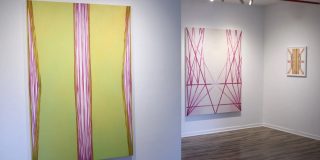
L’Indissociable remains a demanding work. It is very difficult to discover the governing principle underlying its 14-part form. The repeated diagonal lines lay at a shared, fixed angle in each canvas. Red, blue, green, and dark grey are the colors used for the diagonal lines. The height from the floor and distance from one canvas to another are determined ahead of each installation. The sequences of canvases are on three adjacent walls – from left to right, first seven, then five, then two. The relationship among the canvases’ topographical compositions appears to be simultaneously one of fragmentation and reuniting. Some seem to be based on sections of others, self-generating across the sequence as elements of a whole that is never to be seen. This fragmentary quality complicates his work’s relationship not only to contemporaneous painting but also to that of previous eras. As the work at Matthew Marks makes clear, Barré considered Hals and Vermeer as well as Picasso and Mondrian in making art, while many of his peers were seeking to leave pictorial art behind.
In each canvas, the lines reach some edges and not others, and the paint is applied over a ground color that has been repeatedly applied in discernible layers, always a pale grey-white. Wider lines of color – bands, one could say – are always accompanied by dark grey lines that function somewhat like drawing, echoing or guiding the color. Barré often used the word affleurement – “surfacing” – to describe the reality of painting, in the sense that a painting’s space is its surface, like an extension of the wall itself. Unsurprisingly, he trained as an architect before becoming a painter.

39½ × 24½ inches; 100 × 62 cm
Barré’s aims stand in interesting opposition to Clement Greenberg’s notion of flatness of surface, a rejection of figure-ground relationships typified by Jackson Pollock’s all-over web of dripped and flung line. Although the line in his painting is on the surface of a ground, it is also in the ground, forming one inseparable whole. Barré referred to this whole as the tableau, the familiar French term for a complete painting. Indeed, the 14 canvases of L’Indissociable are arguably parts of a much larger whole, each one “surfacing,” coming into view. Barré called this phenomenon “incompletion,” leading Yves-Alain Bois to write: “The enigmas of Barré’s painting ricochet endlessly, but ultimately what they abolish is the illusion the beholder or the critic might fleetingly entertain of ever being able to have the last word.”

“Martin Barré: L’Indissociable / The Inseparable,” Matthew Marks Gallery, 523 West 24th Street, New York, NY. Through March 2, 2024.
About the author: David Rhodes has exhibited internationally, including one-person exhibitions at Anthony Wilkinson Gallery (London), Centrum (Berlin), Palacete Viscondes de Balsemao (Porto), Galerie Katharina Krohn (Basel), Hionas Gallery (New York), and most recently, Tat Art (Barcelona) in 2017. His solo show is on view at High Noon Gallery in NYC through March 3, 2024.









The paintings may have a remarkable place inn the history of post-war Europe, but I find them boring. My last word.