
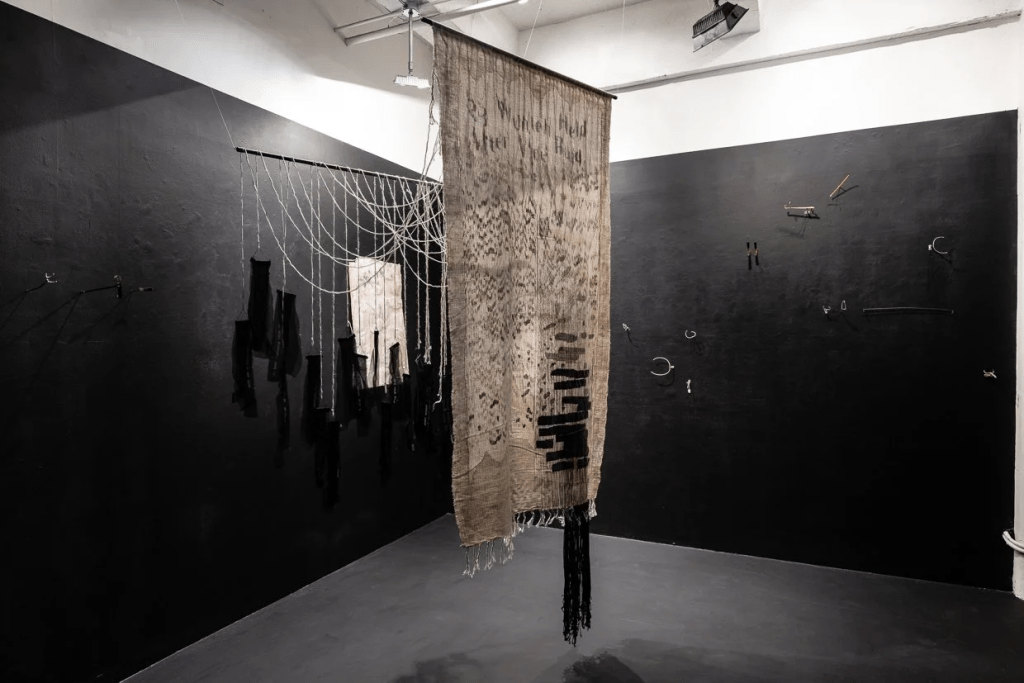
Contributed by Will Kaplan / At the opening of “A Partial Refusal” at Field Projects, simmering conversation turned to a reverent hush within the gallery’s black painted walls. In this stirring exhibition, curator Weihui Lu has arranged the work of six artists into an immersive labyrinth that fosters a slow meander and even slower meditation in counterpoint to the preachiness and digital freneticism that surrounds us.
Rowan Renee’s black textile FLIC Report: Redaction*, hanging in the middle of the room, makes a dramatic first impression. A few feet behind, its white counterpart 23 Women Held After Vice Raid, Miami Daily, News, July 31, 1960 lurks like a ghost. Varied thread-widths and different densities of stitching allow us to see both weavings at once and other artworks through them. They open a Z-shaped path through the gallery. The latter piece simulates an official document, with a stately font and redacted words. The artist printed the name, age, and occupation of each arrested woman on scraps of black fabric, which trail the document: the kidnapped haunting their abductor.
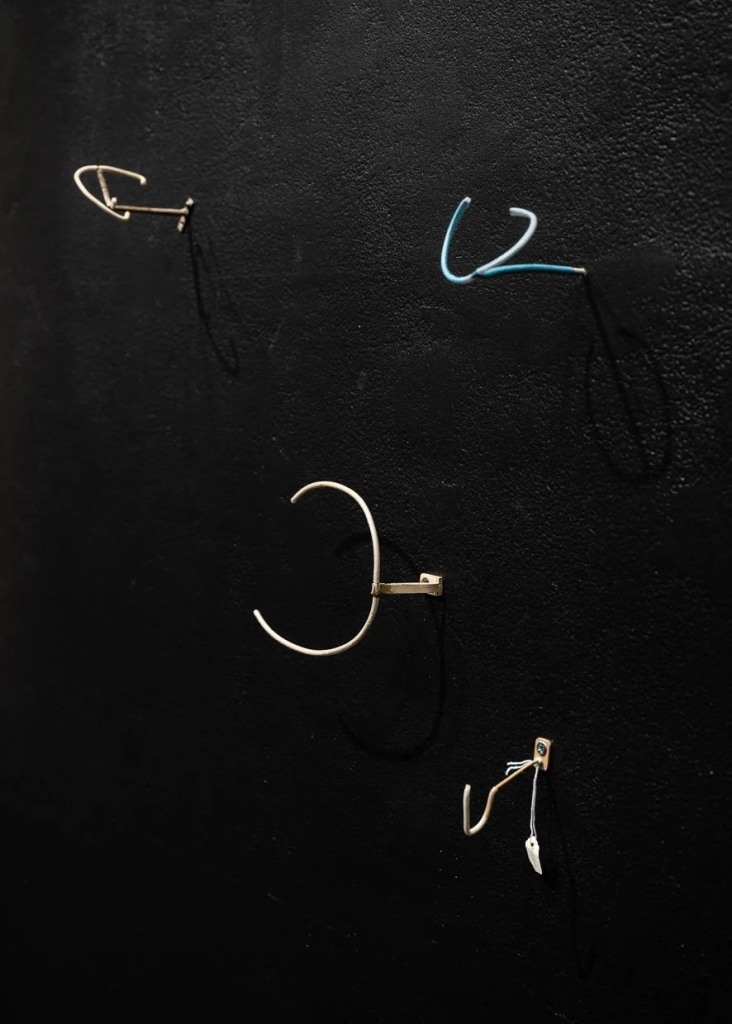
metal, suede, paint
Themes of labor and anonymity inform SaraNoa Mark’s Guarding Invisibility. Installed across perpendicular walls, this flock of wiry wall sculptures sounds a playful note into the show’s pensive atmosphere. Among the many curves, colors, and finishes – some painted a powdery blue, others rusted – no two objects are alike. In their purposeful and exacting forms, the figures embody both meanings of “character:” individual beings and typographical symbols. Mark salvaged these discarded components from their day job at an anthropological museum, designed and finished by specialist for one kind of display and now spotlit as unique works of art for another.
A pair of white works face each other in the corner. Maia Taber Ayerza’s Collage, from the series Tale of a City, swells with layers of the artist’s hand-mixed watercolor and fragments of past paintings. Pasted scraps and swaths of paint gnarl and twist the paper into a cratered strata resembling limestone extracted from a cave. Yet the paper’s ragged edges, cavalierly pinned to the wall, also evoke a bleached hide. Like Renee’s textiles hovering nearby, Collage sways with the movement of passersby, conveying a deep sense of time.
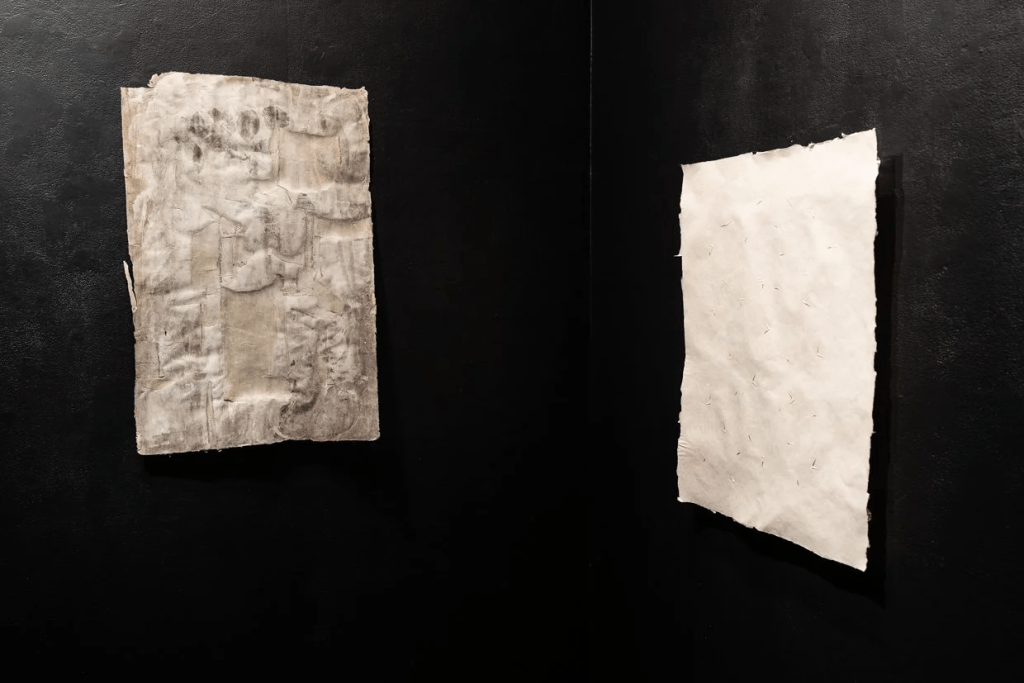
Perpendicularly situated, Mikayla Patton’s rigid yet delicate handmade paper sculpture Iyápi levitates off the wall. Embedded within the cast pulp, a cascade of porcupine quills vibrates in place. The gray ends of each boomerang shape zig-zag the eye across the frieze-like form, their random motion animating the show. The very kinship of these works heightens each artist’s unique approach to their material and form.
Across the room, Clare Hu’s ramp-shaped box Catalpa sits on the floor. The small opening cut into the slanted surface reveals a small stack of papers within the triangular container, suggesting a vitrine or museum display. To decipher the notes within, we must kneel to the ground, which in turn forces us to notice Hu’s meticulous stitchwork, following the traditional pattern of the Catalpa flower. The tiny papers are thrifted Chinese translation cards, the handwritten price tag still stuck to the packet. Five Chinese words with a phonetic pronunciations and English translations echo the systematic repetition of the stitching pattern. The selected card translates different uses of the base word shénme: “what / why / it’s nothing.”
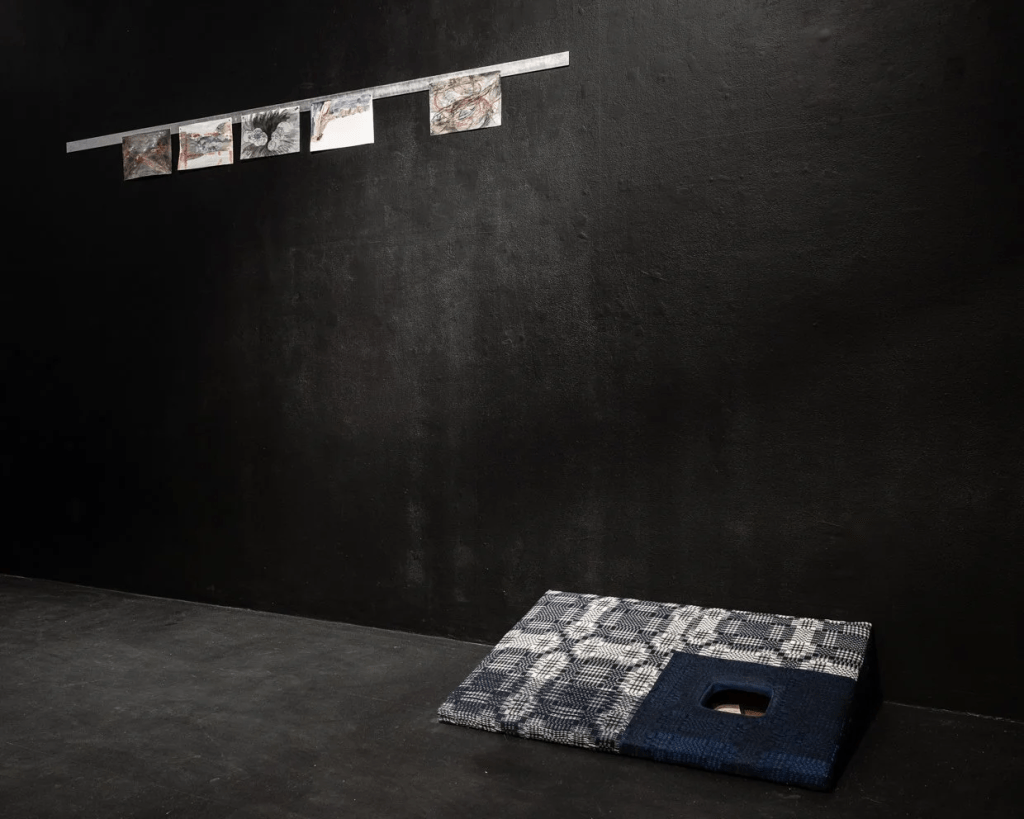
At eye level, gouache paintings from artist and translator Jenny Jisun Kim, collectively titled Say for be said, hang magnetized from an oblong aluminum strip that points back to the door. One sheet is separated from the preceding four, like the beginning of a new musical measure. While the mark-making within each piece seems listless, the glint of the aluminum rhymes with the pearlescent watercolors and enlivens the presentation. The center work is painted on translucent yupo paper, leaving the metal behind it hazily visible.
Circling back and forging new physical paths among works reveal additional connections between the six artists’ materials and methods, reflecting Lu’s deft curatorial integration. The proximity of certain works generates tight aesthetic conversations while sibling clusters on opposite walls open up the dialogue. Pedagogy and personhood crosses the earthen and the irregular. When we see one element, we sense others.
“A Partial Refusal,” Field Projects, 526 West 26th Street, #807, New York, NY. Artists: Clare Hu, Jenny Jisun Kim, Maia Taber Ayerza, Mikayla Patton, Rowan Renee, and SaraNoa Mark. Curated by Weihui Lu. Through March 20, 2026.
About the author: Will Kaplan is a Queens-based artist and writer. His work has been shown at D.D.D.D, Pete’s Candy Store, and on Governors Island. He has written for Artspiel, Tussle Projects, Copy, and Passing Notes.








Thanks for bringing my attention to this beautiful show.