
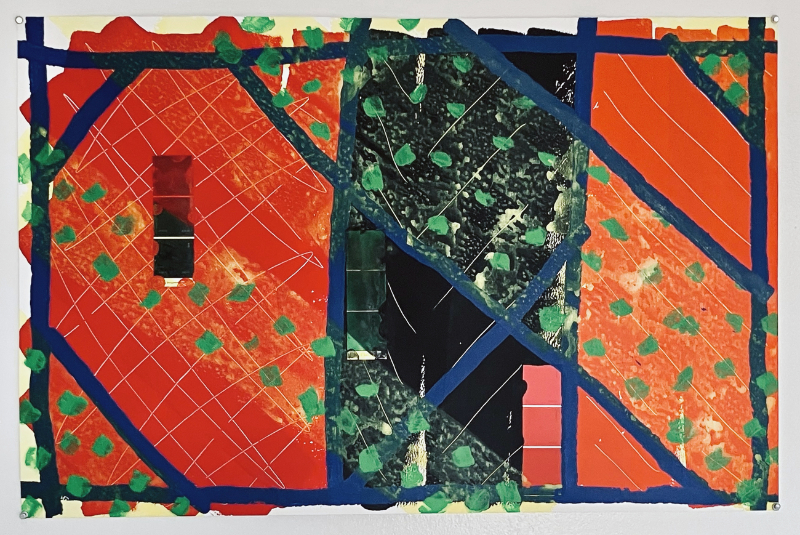
On March 15th, painters Natasha Sweeten and Rick Briggs sat down with Hearne Pardee to talk about their work, and about what it means to be painters who also write. The conversation took place on the last day of Project #5, their show in Hudson, which was also the final exhibition in Jean Feinberg’s “Project” series. The series brought together artists whose practices, she felt, were already in silent dialogue with one another. They talked about writing, looking, making, and the strange intimacy of being on both sides of criticism. This transcript has been edited for length and clarity.
HEARNE PARDEE: Since we’re painters who write, I ask, why do we do it? I remember I had a teacher who once who said, Painter: paint! Don’t talk, don’t write, don’t get into other people’s business.
So why don’t you stay in your own lane? (chuckle) How did you get started, and do you enjoy it?
NATASHA SWEETEN: Oh, I totally enjoy it. I love writing. It doesn’t hold the same place for me as painting, so in a way it’s easier. It’s a lot easier to write about someone else’s work than to write about mine. We’re all opinionated, we all go see shows, we all think about things. I’d go see shows and have conversations with artist friends and sometimes write them down. At one point I thought, That’s almost a review! Maybe I can do that? It became a fun thing to do, and Sharon was willing to publish me in Two Coats of Paint, which a little bit shocked me. It was a new identity for me.
HEARNE: Being a critic is social. You’re assuming a social role that you don’t have as a painter, as soon as your work is published.
NATASHA : We have this intimate relationship though, because we’ve been in the studio: we’ve painted, we’ve stretched those canvases, we’ve been on the other side. So I feel like there’s this very tender relationship, as a viewer. I’m not just — actually I don’t even feel like a critic. I’m just an artist who has some ideas and I like to share them. On the most basic level, that’s what it is.
RICK BRIGGS: For me, I think it was wanting to have a voice and not feeling like I had a voice in the art world, per se. I think if you’re not showing that much, if you’re not teaching, how do you get your foot in the door? And for me, I thought, I’ll start writing. Writing turns out to be this great way of clarifying your ideas. It really helps with my thinking and, consequently, my painting.
HEARNE: Yeah, I feel I’m speaking for the artists who aren’t good at articulating their thoughts. It’s hard to talk about your own work! In a way when you’re writing about somebody’s work, you’re sort of helping them. Do you have interactions with the artists afterwards? Do you have to worry about what they might think?
NATASHA: Well, I don’t really rip anybody apart. I’m not that kind of person. But I’ve gotten some good responses. I did one about Joe Bradley’s show, which I thought was fantastic, at Zwirner. When I was there, Francesco Clemente lay down in front of a painting, in praise of it, and one of his friends took a picture. I thought, this is so cool, and in the review I wrote that when I was there, this happened, with a famous artist I didn’t name. It was like a kiss to this painter’s work. Then Joe Bradley texted me and said he liked the review, thanks, and I I asked him if he wanted to know who it was. He said, oh yeah, he already knew. (laughs) It was a fun moment.
JEAN FEINBERG: What impresses me about all your writing is it’s so personal. It’s like you see a show you feel passionate about and you want to write about. You’re not so much writing in an intellectual or critical way – you’re writing about it very much with the painter’s eye. That personal connection to whatever you’re looking at feels more casual but also more interesting to me.
RICK: If I have a relationship with the person, I definitely mention that or put myself in there somehow. But the experience with the work is what’s really important.
JEAN: That really came through in the Kathy Bradford review that you did.
RICK: Because we’ve known each other for so long. I would say, mostly I’ve written about people whose work I’ve known for a very long time, that I’ve thought about for a long time and am passionate about.
HEARNE: Do you premeditate that? Do you go to the show with the idea you’re going to think about writing, or do you find shows where you walk in and say, wow, this is interesting. I didn’t know about it.
RICK: I wrote about Sarah Braman, who is one of the directors of Canada. She had a show at Mitchell Innes, and I’d seen her work before and didn’t think it was as fully formed. Then I walked into that show and it was a revelation. I thought she had made an enormous breakthrough, so I had to write about it. I was kind of blown away and flooded with ideas. But as far as premeditated, no, not too often. I want to have that experience. I did ask one publication in advance if I could write about someone. And they said, well, we need to know at least six weeks in advance. Well, six weeks in advance, the show hasn’t even opened. How can I even know if I’ll want to write about it?
HEARNE: I’ve read the critic’s job is to persuade. You’re not proving anything, you’re just trying to write as persuasively as you can. In both your cases, you describe the work and try and animate a description to make it sound dramatic or interesting somehow. Does that make sense?
RICK: I think you absolutely have to make a case. You have to build an argument for why this is interesting work, because otherwise, who’s going to come? I mean, you’ve got to add something to the discussion. You have to add something substantial, I think. People that I choose to write about, it’s like I’m claiming a kinship. That’s part of the whole idea of having a voice, to say: I believe in this person. I believe in that person.
NATASHA: I had a funny experience because the Jack Whitten show that was just at the Whitney blew my mind. I couldn’t not think about that show for many weeks after, and I really wanted to write about it. Usually I can just get going, especially if I’m inspired and loved something. But every time I started I realized this show did not deserve a straightforward review. It didn’t make sense. I thought, I’m not gonna be able to do this, I’ll just tell them I can’t do it. Instead, I did something that was kind of quirky. It was the hardest thing I’ve ever written — I’m embarrassed to tell you how many hours it took. But of my writing it’s my favorite.
AUDIENCE MEMBER: I’d like to know more about your process here. Rick, I’m always confused as to where you start in your pieces.
RICK: I really want to have an experience with the materials where I don’t know where it’s going to end up. There are two different bodies of work that are represented here. The paintings on that wall don’t use a brush. I’m putting the skins that form inside the paint can directly on the canvas. How that happened was a little bit of a breakthrough: I was using alkyd house paint and would carefully cut around the edge and get rid of this circle of paint, then throw it out so I could get to the paint. Then I thought, Why am I throwing it out? It’s a readymade circle! Slap it on the canvas and go from there. And then I would add other things like color swatches, stir sticks, things that had a relationship to house painting.
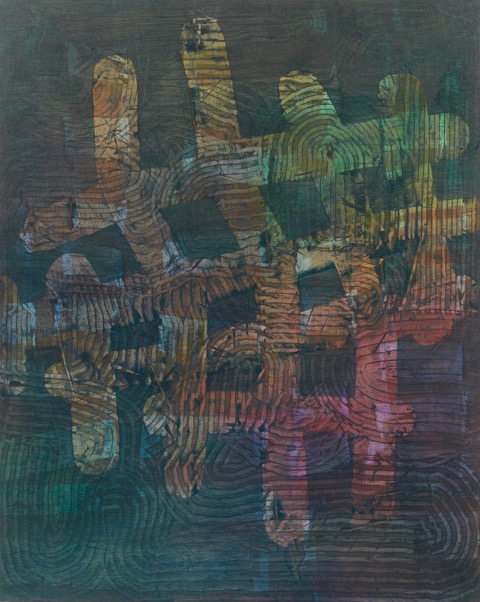
The other paintings are oil paint, and that’s sort of a different set of rules. I can use a brush. I still am using oil stick and spray paint, which I’m using in the earlier series, but part of my thing is to get lost and try to find my way out. Make order out of chaos. I want to be disruptive. I do want to insert things that throw you off, throw me off. I want to have an experience, surprise myself. The way I work is I do something and I react to it. Generally, my first thought is color. It needs a blue in that corner. What blue? How’s it going to be applied? I like getting away from a purity of means to sort of throw in different things, not just oil paint on canvas.
AUDIENCE MEMBER: So your work has to remain abstract?
RICK: Yeah, I’m thinking abstract. I did do two series of representational work called “Painter Man,” which was kind of my little (Philip) Guston period of self-deprecating humor about my day job.
JEAN: Rick, I see your work as kind of undermining a more easily recognizable sense of order, as opposed to Natasha’s, which I find structured in a way that is more understandable to me.
NATASHA: I usually start out with a specific idea, something lost long ago because I’m building in my head all these stories. These things all have characters and I’m building…then it’s awful and I scrape it all off. Then do that again and again. I go into a zone, almost like there are no words there, I’m intuitively working and like Rick said, oh, this needs a blue. But I don’t even know that, I’m just doing it. Maybe that’s why it’s so hard to write about! I fail many times. Then sometimes I think I get it right. Sometimes I’ve worked really hard on something that has come together, and I’m so happy. Every time you do something good, you think, I’m a genius. It’s great. Then you walk back in the morning and you’re like, Oh my god, I’m an idiot. There’s very little in between for me.
RICK: And failing is one of the best things that can happen to you while you’re painting, because that’s when things start to happen, right?!
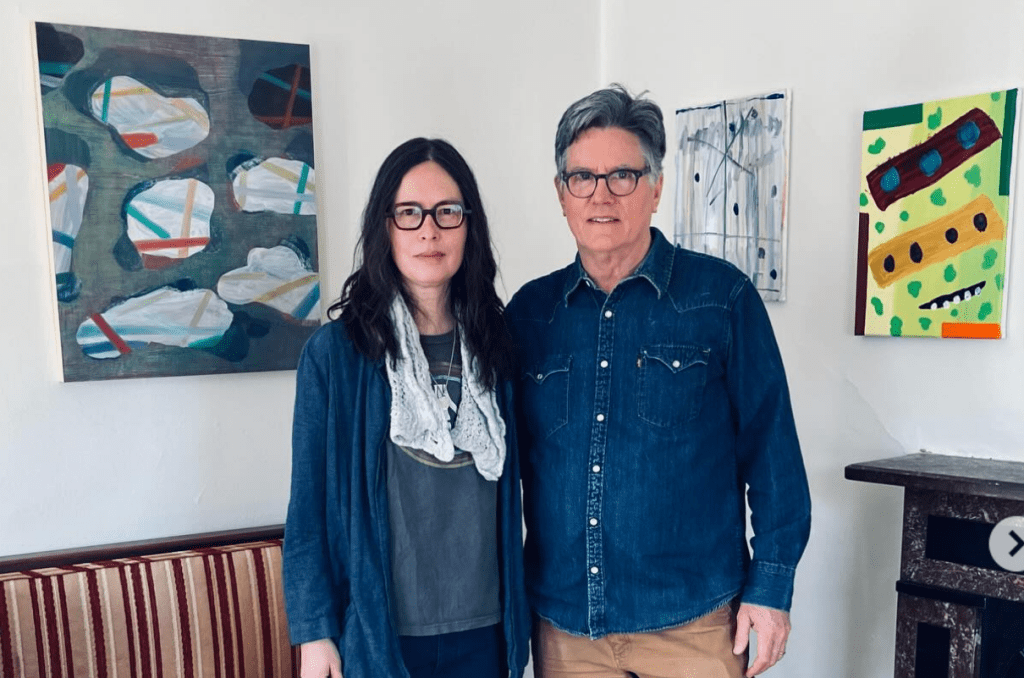
About the moderator: Hearne Pardee is a painter based in New York City and the Hudson Valley. His reviews appear in The Brooklyn Rail and other publications.
About the artists: Rick Briggs is an artist living and working in Brooklyn and the Hudson Valley. His reviews have appeared in Two Coats of Paint, Hyperallergic, and Culture Catch. Natasha Sweeten lives and works in Germantown, NY. Her latest writing, on the group show “Souvenir,”at RUTHANN in Catskill, was published in Two Coats of Pain











Great combination! Insightful…
Inspiring interview with two great poetic painter/writers.