Author: Two Coats Staff

Opinion

Canceling abstract art in Santa Barbara

Contributed by Laurie Fendrich / While there have always been easily discreditable philistines who dismiss abstract art as a fraud, many leaders in today’s art world marginalize it for other reasons. They see it as anachronistic, irrelevant, boring, or, most unforgivably of all, shackled to its white European origins. It’s not far-fetched to think that th

Solo Shows

The post-contemporary paintings of Jared Deery

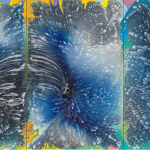
Contributed by Zach Seeger / Freight + Volume’s vaulted Tribeca showroom is the perfect amalgam of its previous spaces in Chelsea and the Lower East Side: a charming and spacious boutique, ideally suited to paintings. Jared Deery’s tightly curated solo show “A Liminal Light”, includes large, portrait-oriented canvases featuring magic-marker-inspired motifs of drips, loops, blobs, and streaks that conjure still-life flowers and their imagined domains. In entering the gallery, they appear as natural and seamless as a screensaver at an internet cafe waiting for a patron to connect to Netscape. They are simultaneously retro and futuristic, borrowing from 1990s cyberpunk and catapulting its very obsolescence into a commentary on physical gallery space.

Solo Shows

Carey Young’s visual jurisprudence

Contributed by Adam Simon / Carey Young’s exhibition “Appearance” at Paula Cooper is the latest installment of her more than 20-year artistic examination of the law as an institution. She is a leading progenitor of a growing cohort of artists who use research and analysis of institutions and systems in their work. In a video on the gallery website, Young states, “Law is too important to be left to lawyers… There are many ways to talk about it that haven’t been addressed.” Other reviews have focused on the information transmitted through the photos and video in the show. There remains the fundamental question of how, or if, an art exhibition can talk about a subject as prosaic as law in a constructively different way than a written or spoken medium. Does the language of visual art engage thought differently?

Group Shows

A gathering at Tappeto Volante

Contributed by Sharon Butler / Last week, “La Banda 2024” opened at Tapetto Volante, a gallery tucked into a group of Gowanus studio spaces, currently inhabited by artists Inna Babaeva and Lenora Loeb. The show features work by many of the stalwart artist-organizers in Brooklyn’s art community, who keep the outer-borough art conversation percolating despite the relative inattention of mainstream media that focus more on Chelsea, the Lower East Side, and Tribeca.

Solo Shows

Elizabeth Hazan: Playful visionary

Contributed by Patrick Neal / Elizabeth Hazan’s exhilarating oil paintings, on view at Hesse Flatow gallery in Chelsea, marry old-school color field abstraction and loopy, gestural shorthand. Her medium-sized and large-scale canvasses fluctuate between recognizable landscape formations and patchworks of chromatic passages. In a style that is seriously playful, elemental motifs like trees and lakes are rendered as simple squiggles and glyphs straddling blocks of heightened color combinations. The paintings feel worked but never labored, and unleash the uniquely expressive power of color, line, and scale.

Solo Shows

David Rhodes: Reconfiguring the authorship of a painting

Contributed by Adam Simon / One could be forgiven for mistaking the paintings of David Rhodes at High Noon Gallery for samples of high-end décor, with black fabric punctuated by parallel diagonal stripes stretched over variously sized frames. Whether or not Rhodes anticipates that his work might elicit this response, for me it provided a hurdle, a momentary deflection, suspending my usual mode of engaging with art. I’m glad I had this moment of puzzlement, wondering what in fact I was looking at, before the significance of Rhodes’ achievement sank in.

Gallery shows

NYC Selected Gallery Guide: February 2024

This month, make sure to double-check gallery addresses because some have changed locations. James Fuentes, Asya Geisberg, and Alexander Gray are moving to Tribeca. Almine Rech and Jack Shainman are down there, too. Nathalie Karg has moved to Elizabeth Street, and Kathryn Markel has a second location in Chelsea on Tenth Avenue. Head to the East Village for “Truth Be Told,” Kyle Staver’s solo at Half Gallery. We also recommend a trip to Henry Street, where all the small spaces are killing it. In Brooklyn, don’t miss “La Banda 2024,” which opens tonight at Tappeto Volante. Organized by Paola Gallio, this big small-work show features a slew of notable artists who want to support a formidable artist-run space. Note to adventurous art collectors: You won’t be disappointed.

Solo Shows

The sharp, solitary eye of Sonia Gechtoff

Contributed by Natasha Sweeten / The contemplative works of Ukrainian American artist Sonia Gechtoff (born in Philadelphia 1926, died in NYC 2018), now on view at Bortolami and Andrew Kreps Gallery, range from the 1960s to early 2000s, but for me they evoke the frontality of Russian iconography, the dynamism of Italian Futurism, and the fractal abstractions of Sonia Delaunay. Gechtoff was fond of muted primary colors and variations of white and black, and her palette is deliberate and often subdued. Delicate graphite hatch marks spill across painted areas, suggesting movement and depth while presenting isolated instances from curious vantage points.

Solo Shows

Andy Meerow, medium cool

Contributed by Jonathan Stevenson / In Haskell Wexler’s iconic 1969 counterculture film Medium Cool, John Cassellis, a cold-eyed TV photojournalist, has internalized the notion of television as a “cool” medium in the McLuhan-esque sense of requiring viewers to search for context in order to understand what they are seeing. When covering the shockingly violent 1968 Democratic National Convention in Chicago, though, he finds it increasingly hard to stay objectively aloof. If Cassellis succumbs to passion, Andy Meerow finds a more nuanced solution in the realm of painting – also a relatively cool medium – manifested in his gratifyingly quizzical work in “Slanted Andy” at Derosia. Meerow doesn’t either opt out or surrender; he just takes a sidelong view.

Out of Town Solo Shows

Mary Jones: Layered histories

Contributed by Katy Crowe / “Significant Properties,” the title of Mary Jones’s current exhibition at as-is.la and her first in Los Angeles in some years, aptly suggests real estate worth seeing. Los Angeles is rich in such properties, and the cinematic allusions in her paintings are also broadly resonant of Tinsel Town, where Jones lived, worked, and showed before she moved to New York.

Solo Shows

G. Peter Jemison: One fine painting

Contributed by Chunbum Park / In the seventeenth century, the English justified their North American conquests with the Roman concept of res nullius, whereby all people owned unoccupied land until it was put to some worldly use. The English philosopher John Locke suggested that the Europeans could disregard all indigenous forms of government and deny indigenous peoples sovereignty because Europeans, unlike the indigenous, valued and worked the land. G. Peter Jemison, a member of the Heron Clan of the Seneca Nation, makes paintings and drawings that encapsulate indigenous beliefs about the land, many now on display in his show “On the Right Path” at 47 Canal, quietly but firmly countering the colonialist narrative. 

Solo Shows

Joan Snyder’s brilliant command of chaos

Contributed by Abshalom Jac Lahav / “ComeClose,” Joan Snyder’s current exhibition at Canada, testifies to her enduring brilliance and evolving artistic language. Now 83, Snyder has been a trailblazer since the 1970s. With her “stroke paintings,” she disrupted the Minimalism that was then fashionable, left cold by its austerity and masculinity. Her rebellion made Snyder a feminist shaper of contemporary abstract art. The distinctive juxtaposition of vivid colors and earthy backdrops in her work reflects a lifelong determination to explore and push its boundaries. The exhibition’s title is an invitation to examine not just the art but also why we make it.

Ideas about Painting

A (mostly appreciative) response to Saul Ostrow

Contributed by Adam Simon / I was struck by the last two sentences of Saul Ostrow’s essay, “Painting simulacra: Brice Marden, David Reed, and Gerhard Richter.” He writes: “Marden, Reed, and Richter have sustained abstract painting’s aesthetic and cultural value as a mode of resistive thinking. In most cases, though, this has been misread or at least subsumed by its own model, thereby giving rise to the kind of acritical aestheticism and nostalgia that bolsters painters who promote gestural abstraction as a genre or motif rather than a mode of inquiry.” It took a minute to unpack this statement and allow it to sink in. Ostrow’s critique is dense, and appears to implicate most contemporary gestural abstract painters as well as contemporary criticism that dismisses the possibility of radical formalism.

Solo Shows

Jane Swavely and the Bowery tradition

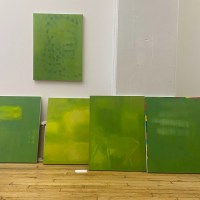
Contributed by Michael Brennan / Magenta Plains is located on the Bowery, just as it breaks left onto Canal Street, in Chinatown. Upon entering, viewers are immediately greeted by a washy terre verte Jane Swavely painting, OID #3 Green, hanging above the desk. It sets an organic tone and is indicative of the half-dozen paintings to follow, hanging in the first-floor main gallery. Swavely’s seven canvases are all vertical, and are mostly diptychs, internalized or externalized. They are loosely painted with a 2- to 2 ½-inch flat brush, heavy on the solvent, with some wiping away by hand. Much color mixing happens directly on the surface. Swavely favors flared, phosphorescent hues. She cleverly manipulates paint with rags to create the illusion of light emitting from the ground. Her work glows, appearing backlit.

Solo Shows

John O’Connor’s formidable pencil

Contributed by Riad Miah / John O’Connor’s tools are basic and everyday, materials that one might think a child would use for their initial foray into art making. For his works on paper, many now on display in his solo exhibition “Man Bites Dog Bites Man” by way of Pierogi and L’SPACE, he uses colored pencils and graphite. But behind the simple tools is a discerning mind.