
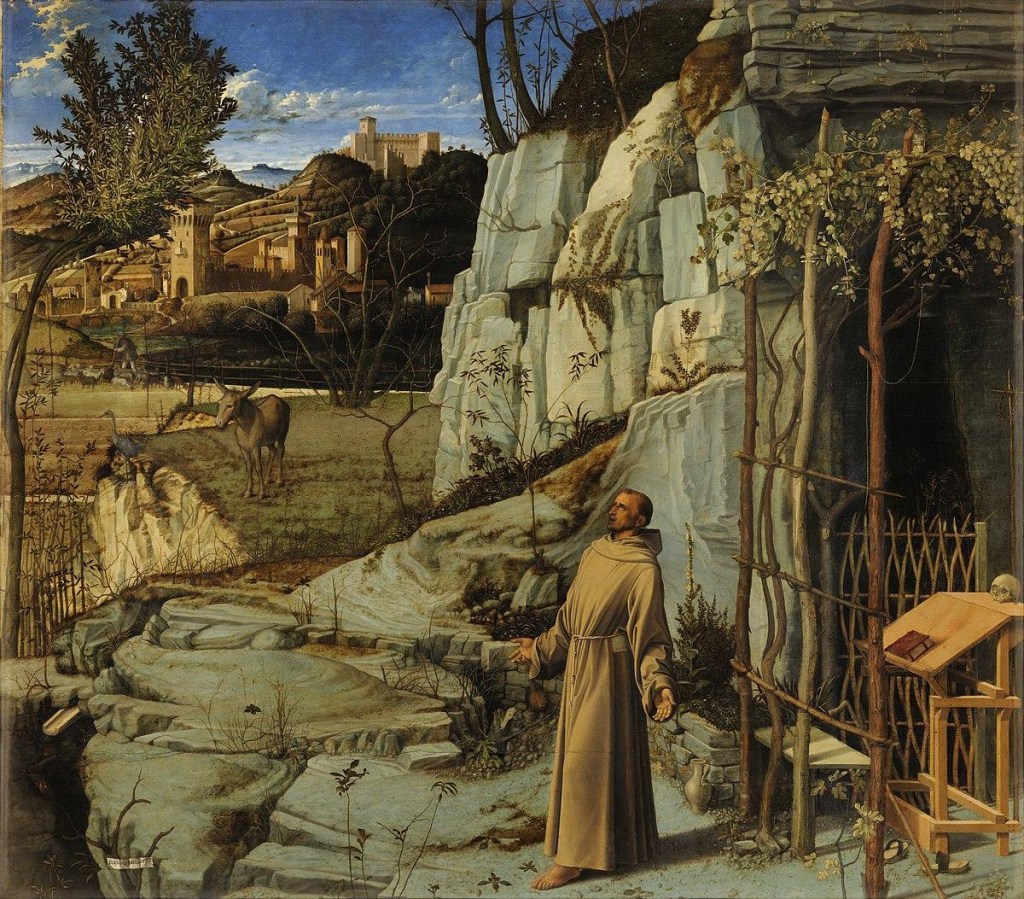
Contributed by Ken Buhler / There is an unsubstantiated claim in Catholic lore that the number of books written about St. Francis of Assisi (c. 1181–1226) is second only to the number written about Jesus. But keen interest in the life of St. Francis has been continuous. During his lifetime, his many followers had already established a religious order in his name. My particular interest began towards the end of the twentieth century, when my job in the Frick Collection afforded me many hours, essentially alone, in the galleries with Giovanni Bellini’s much-beloved St. Francis in the Desert, which depicts an ecstatic St. Francis in an idyllic landscape.
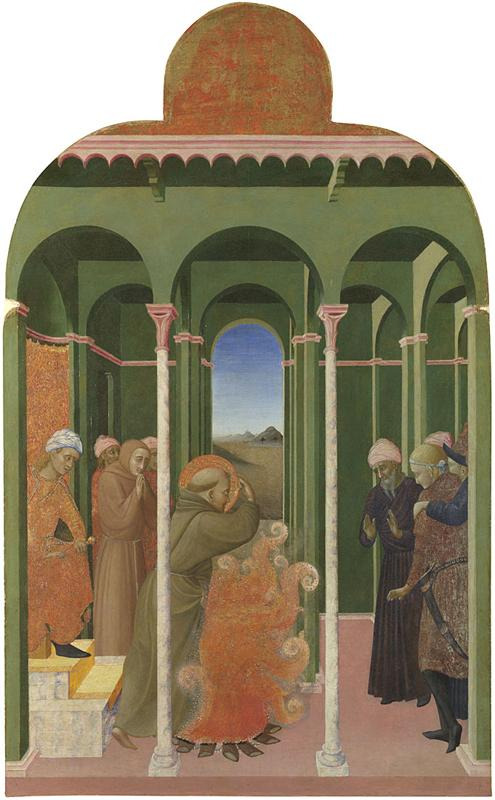
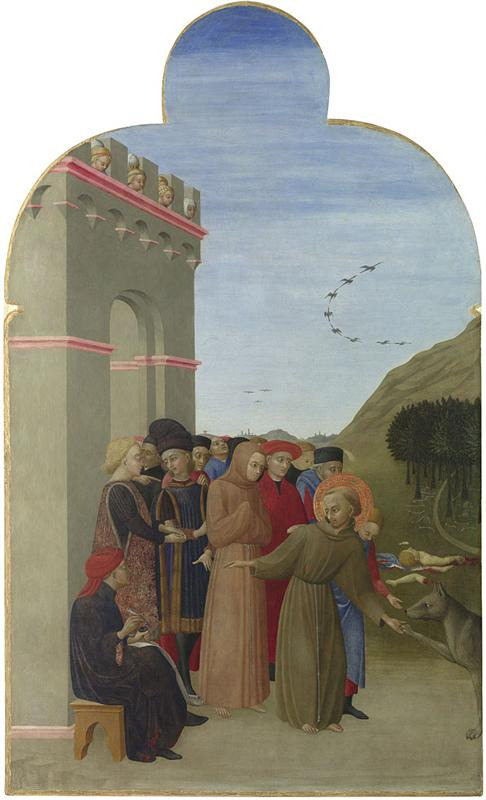
The lives of saints have been fertile ground for painters, providing tales of feats and martyrdom inspiring colorful imagery, spatial invention, and formal drama while strengthening the pull of Christianity. In the Basilica Assisi, Giottos painted only a few decades after St. Francis’s death reflect devotion to his stories – his sermon to the birds, his exorcism of demons, Pope Innocent’s dream of Francis holding up the Church – and they’re all magnificent works of art. Sassetta’s series of paintings made less than 200 years later presents his taming of the wolf and his offer to walk on fire before the Sultan, whom he wanted to convert. Like the Giottos, they are vividly narrative – appropriate for a saint who used storytelling, acting, and drama to convey his message. Both sets of paintings are presented in theater-like spaces. Their dreamlike settings, with scale distortions and stylized forms, suggest miracles in alternate universes.
Henry Clay Frick, who favored landscapes and portraits, was not particularly drawn to religious stories, and the Bellini painting, made between 1475 and 1480, is much less driven by narrative than some. Originally commissioned for a private residence, it focuses as much on the landscape as the figure of St. Francis. This seems appropriate for a saint who had equal regard for everything in nature – trees, flowers, birds, even a worm found on the road after a heavy rain – which to him all reflected God’s glory. The painting’s crystalline clarity and precisely articulated rocks and plants not only reveal the influence of Northern European painters – particularly Jan van Eyck – but also underscore the divinity in nature. Without the usual seraph, this painting depicts the moment St. Francis receives the stigmata, which is barely visible. The ecstasy, born of the beauty of light illuminating the perfection of everything in its place, is itself naturalistic. As St. Francis gazes towards the sky, Bellini gives us heaven on earth.
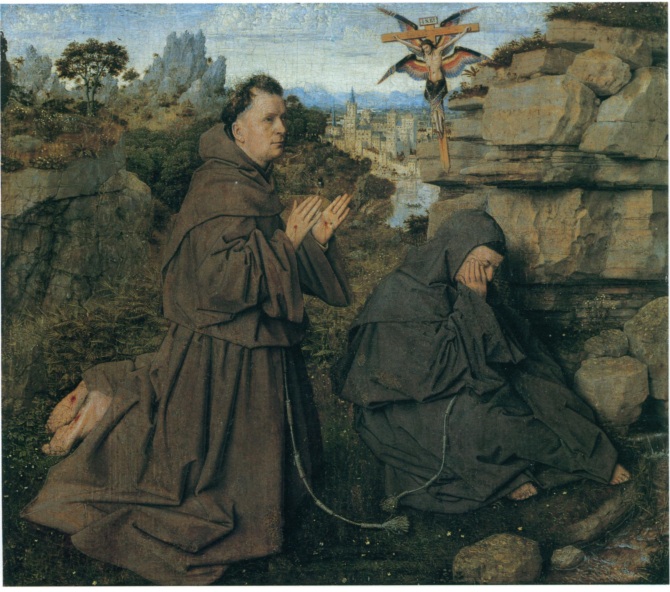
Despite the painting’s idyll, St. Francis’ life was an endless challenge. He was a tireless advocate for Christ and emulated him. The saint’s practice of poverty and humility was extreme, underscoring the extravagance of the Catholic Church. Though born into wealth, and a vain and arrogant youth, once converted, Francis relinquished all his earthly possessions; a moment depicted in many paintings. His yearning to transcend bodily desires in favor of spiritual clarity led to self-deprivation, often jeopardizing his own health. Yet his accomplishments were tremendous and his spiritual influence was vast, extending to the Pope and beyond. The Franciscan Order grew rapidly.
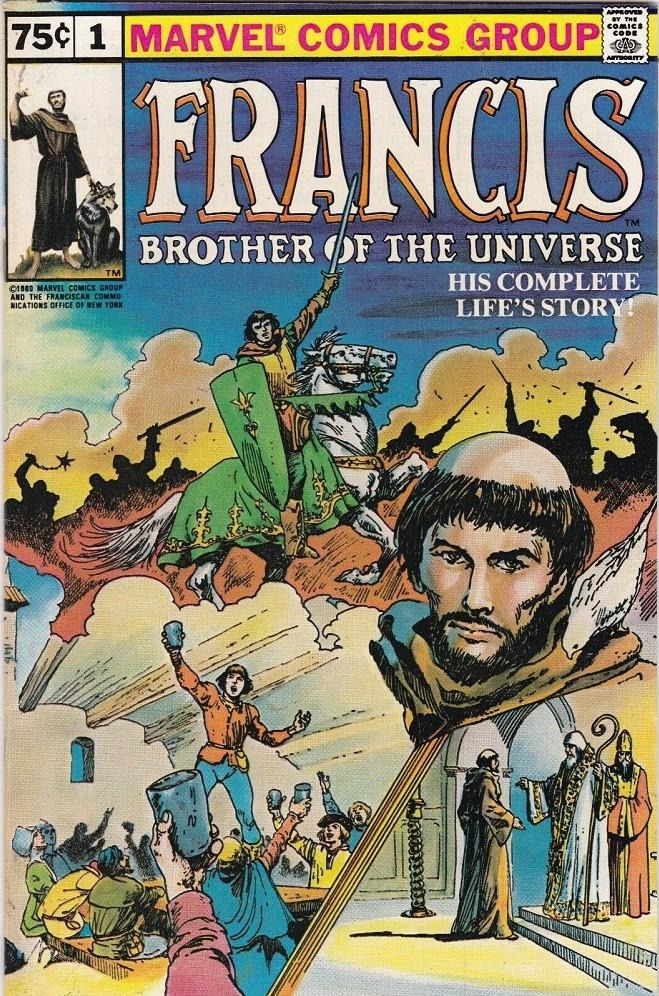
For my generation, the life of St. Francis resonated with protests against the Vietnam War, and his love of the natural world aligned with the rise of the counterculture, the back-to-nature movement, and environmentalism. Franco Zefferelli’s 1972 movie, Brother Sun, Sister Moon, scored by Donovan and based on a hagiography of St. Francis, has him shedding his clothing and other earthly belongings, as though he were a medieval flower child. He still moves artists to make work about him. In 2023, the exhibition “St. Francis of Assisi” at the National Gallery in London included John Buscema’s Francis, Brother of the Universe, a 1980s Marvel Comics version of his life.
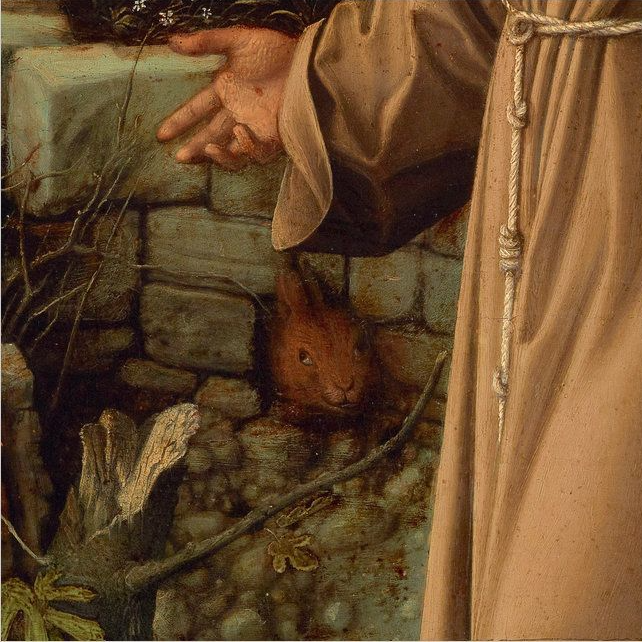
On a recent visit to the renovated Frick Collection, I was happy to see Bellini’s St. Francis back in place, radiating its serene beauty. I relished again all its gorgeous details — the otherworldly warm/cool illumination on the rocks, the curious rabbit looking up at St. Francis, the trickling spout of water, the alert crane — all forming a narrative that seems to change a little every time I see them. Like the work of Giotto and Sassetta, this painting creates a place where something of wonder just might happen.
About the author: Painter and printmaker Ken Buhler is Professor Emeritus in Studio Art at Bard College. He lives and works in Brooklyn and in Masonville, NY.







Wonderful writing on one of my favorite paintings also. I am envious of the extended time you have spent with this Bellini! Well done!
Ken, thank you for sharing this lovely bit of writing! It’s a wonderful Bellini, and great to be reminded of the two Sassetta gems in London.
The Bellini painting’s extreme detail is not something I’m normally attracted to, but in this case, it makes perfect sense as it captures a moment of transcendence for Francis beholding the majesty of God/Nature. Great overview of the history of Francis iconography, Ken!
As a practitioner of traditional hagiographic iconography, I find Bellini’s treatment of light fascinating. While Western masters like Bellini used ‘chiaroscuro’ to create 3D depth and atmospheric perspective, in hand-painted icons of St. Francis, we use ‘uncreated light.’ In our tradition, the light doesn’t come from a sun in the desert, but radiates from within the saint himself. It’s wonderful to see how Bellini bridges the gap between naturalism and the divine ‘stasis’ we strive for in liturgical art.