

Contributed by Bill Arning / Kathy Butterly’s largest survey to date could, in theory, be boring. Thirty-five years of work in the same medium – highly glazed porcelain and earthenware – always at conspicuously small-scale, from four to 14 inches, might sound stultifying. You could perhaps imagine some visitors, having glanced at a sea of colored dots arranged on three massive irregular platforms in roughly chronological order, anticipating a hard slog and a rapid escape. But Butterly has been a magician of immense charm for more than three decades. As with a sweet-salty snack, once you examine a single sculpture – study its curves, loops, splashes of color, beads, bumps, and bodily protrusions – the desire for more becomes irresistible. Far from academic or repetitive, the 45 works are little joy bombs of visual pleasure. At the Tang Museum – among the most artist-centered museums in America – visionary director Ian Berry has created a perfect venue for an artist as idiosyncratic as Butterly. The suggestively titled “Assume Yes,”is likely to land on many lists of the best museum shows of 2026.
The museum installed a classic triple-head sculpture by Robert Arneson outside the exhibition entrance, introducing the history of art ceramics. Butterly studied with Arneson at the University of California, Davis, and the differences between artist and mentor are instructive. Arneson often made things grotesquely, humorously gigantic. Butterly’s work can be just as funny, but her obsessive pursuit of small scale gives her sculptures a subtle poetry his rarely had. Arneson recognized that this intimacy was her gift. In her studio, he once noticed a piece the size of a human heart – made in response to a breakup – and encouraged her to pursue that intensely fertile inspiration.
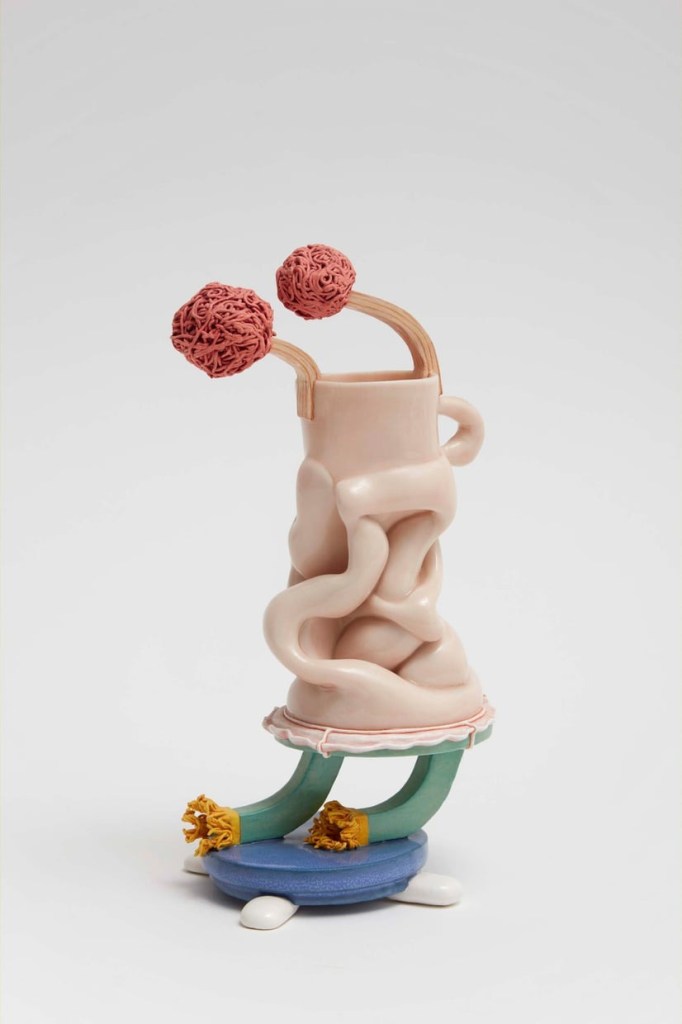
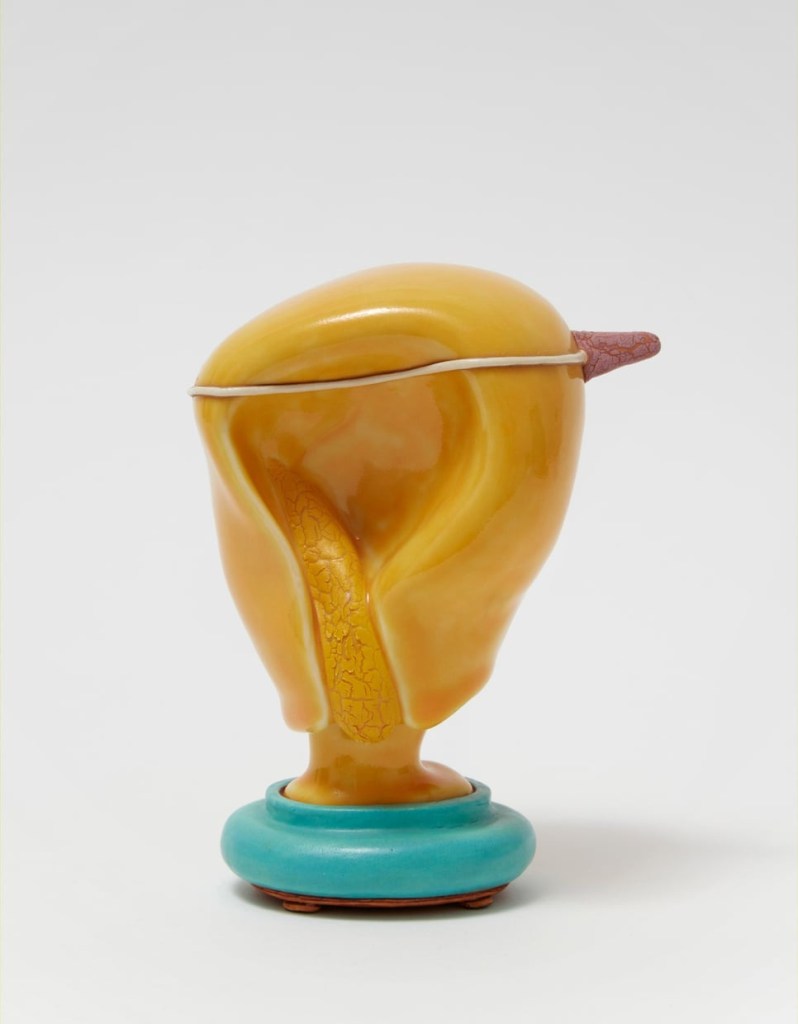
The smaller-scale ceramicists Butterly is often compared with include masters such as Ron Nagle and Ken Price, along with contemporaries like Annabeth Rosen, Judy Glantzman, Julie Evans, and Arlene Shechet. Yet perhaps her closest fellow traveler stands outside the contemporary art frame entirely: the eccentric George E. Ohr (1857–1918), the self-proclaimed “Mad Potter of Biloxi,” whose pots billow and ripple in ways uncannily reminiscent of Butterly’s.
Most in Butterly’s artistic circle – including her husband, Tom Burckhardt – are painters. Although glaze behaves very differently than wet paint, an attentive eye will spot colors familiar from painting history. One of her favored yellows, for instance, comes directly from a painting by Howard Hodgkin. And painterliness may be the most remarkable feature of these works. Butterly is known for firing and refiring her glazes dozens of times to achieve spectacular color and luminous surfaces. They bring to mind the hatchet-like slashes of intense pigment in Joan Mitchell paintings. Butterly’s colors atop bulbous, body-based forms feel kindred to Elizabeth Murray’s awkwardly luscious shaped canvases.
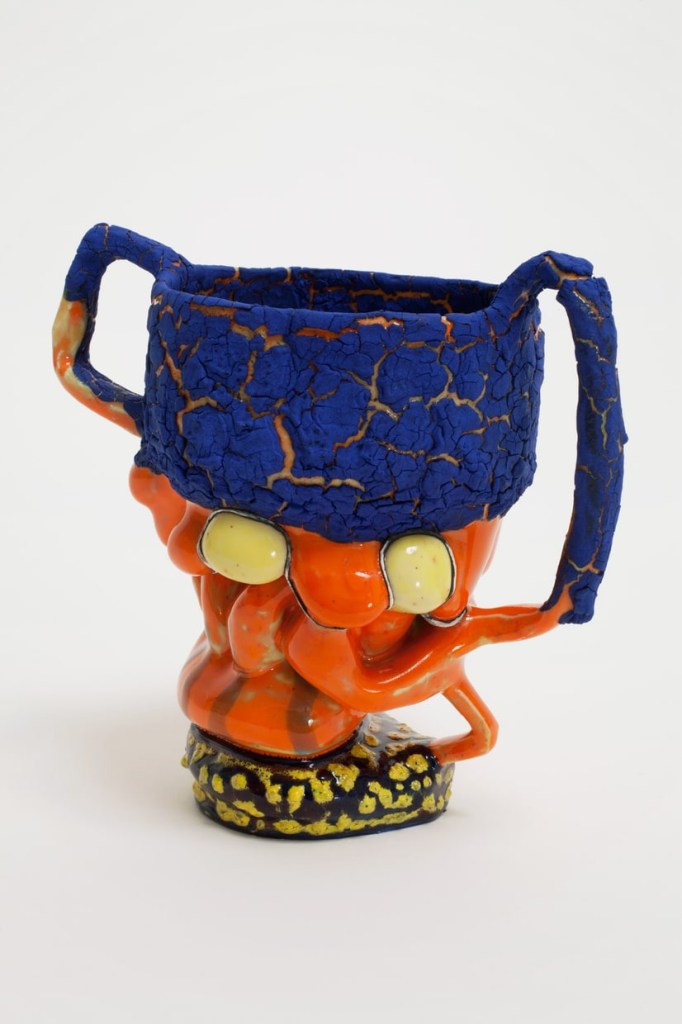
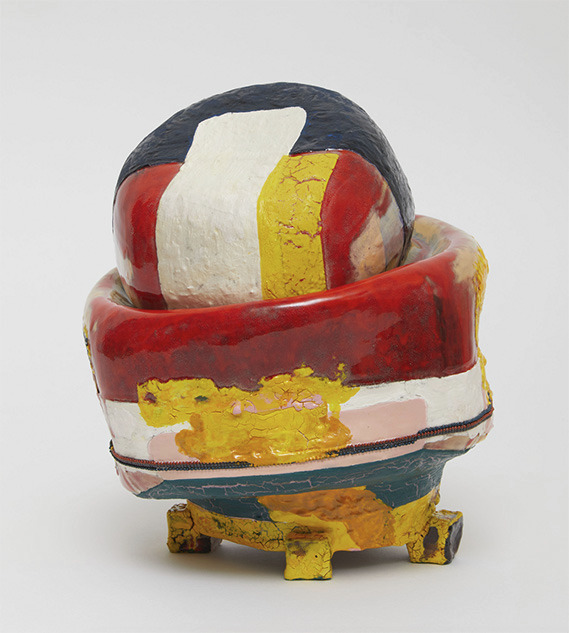
Butterly can work like a rigorous abstractionist, exploring near-monochromatic surfaces that focus attention on form alone; she can also overload decoration until the object feels like an Ottoman palace dissolving into sparkling complexity. Over time, the differences among the works become apparent. A heavier piece like Color Safe, with its bowler-hat patchwork top and thick legs, feels worlds apart from She Dynasty, in which porcelain droops like wavy fabric. Many works are deformed spheres perched on rectilinear bases – which Butterly insists are “podiums,” enabling the billowing shapes above them to speak their poetry more clearly. She often decorates the edges of these cubic forms with repeated bead-like dots, which she calls either “power pearls” or “worry beads,” depending on the news.
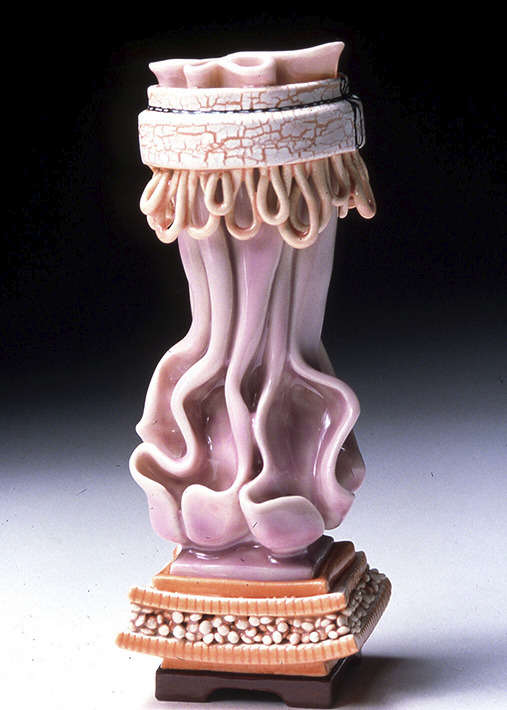
Ceramics and other craft mediums’ initial exclusion from and ultimate inclusion in the competitive realm of contemporary art has generated endless controversy. But the art world of 2026 is primed to see Butterly’s work as fully belonging. No serious viewer could discount her brilliance. Instead, art lovers will happily debate how her achievement simultaneously inhabits the histories of craft, sculpture, and painting. In a lyrical contribution to Butterly scholarship, poet Forrest Gander writes in the exhibition catalogue: “It’s as though she kneads decoration with distortion and out pops magnitude.” That wonderfully romantic line captures her askew relationship to balance and beauty. Both qualities are always present but twisted into unexpected forms that should leave any lover of complex beauty wildly satisfied.
“Kathy Butterly: Assume Yes,” Tang Teaching Museum and Art Gallery, Skidmore College, 815 North Broadway, Saratoga Springs, NY. Through July 26, 2026.
About the author: Bill Arning is a curator, critic, advisor, writer, and itinerant maker of pop-up shows based in Old Chatham, New York.






I have been delighted with Bill Arning’s responses to and writing about work. Keep it up!
Terrific review, thoughtful and deeply empathetic to the work.