Latest articles

Museum Exhibitions

What makes a good painting?

Contributed by David Carrier / What is the present state of painting? For as long as I have been writing art criticism, that question has been much discussed. Some critics have said painting was dead, perhaps to be replaced by Minimalist or conceptual art. Others have argued that because painting is an inherently bourgeois art form, it can continue only as long as it is politically tinged. The Milwaukee Art Museum’s show “50 Paintings” takes an essentially empirical approach to the question. Co-curators Margaret Andera and Michelle Grabner gathered mostly mid-sized recent paintings by artists well-known in the New York art world and demonstrated how varied and how good painting is today. There are abstractions by Peter Halley and Mary Heilmann, a landscape by April Gornik, and figurative paintings by Cecily Brown and Nicole Eisenman. It’s natural for a visiting critic to pick favorites. Mindful of the unhappy fate of Paris, whose judgment about which goddess was most beautiful triggered the Trojan War, I dare to name mine.

Solo Shows

Lee Maxey: Teasing out the uneasy

Contributed by Patrick Neal / Many years ago, I saw a strange and seductive specter on a cold winter night in Troy, New York, that has haunted me to this day. Through the glass windows of a gloomily defunct department store, a neon shock of orange letters hovered in the air spelling out the word EXIST. This enigma was the work of the artist Sharon Bates, part of an installation in which she cleverly riffed on the authority of an EXIT sign, transforming an everyday sight into a glowing spiritual command. I was reminded of Bates’s sculpture while taking in Lee Maxey’s new exhibition of paintings, titled “Wait Here,” at Olympia.

Solo Shows

Joan Thorne, painter and artist

Contributed by Vittorio Colaizzi / Some painters insist on calling themselves painters rather than artists, and it’s clear why. “Art” designates is a broad category that admits almost anything, while painting is a tradition centered on a medium. In his recent book, Duchamp’s Telegram, Thierry de Duve argues that, while Marcel Duchamp did not single-handedly invent art in general, he perceived and announced its arrival. Before that, art was inconceivable outside the context of specific media such as painting, sculpture, and architecture. Duchamp’s insight, of course, did not spell the end of painting, Rather, it gave painters the option of retreating into self-sustaining insularity or more expansively embracing how painting and other art overlapped in terms of image, touch, plane, color, space, and voice. Joan Thorne, whose recent paintings are now on view at David Richard Gallery, has taken the latter course, to impressive effect.

Solo Shows

Eileen O’Kane Kornreich: Embracing fluidity

Contributed by Chunbum Park / A man riding a lion. A canine barking at a red painting of men’s legs. Snow White eyeballing the private parts of a man holding onto a chair. A blue queer person’s reach for blankets and pillows arrayed like clouds of a night sky. “Pleasures of Duality,” Eileen O’Kane Kornreich’s solo exhibition at The Opening Gallery in Tribeca, depicts sensuous figures embracing both sides of their identity. It is an agreeably assertive and highly effective migration away from customary gender-based psychological and aesthetic orientations. 

Open Studios

Invitation: “BIG TOP” at Dumbo Open Studios, April 13 & 14, 2024, 1 – 6 pm

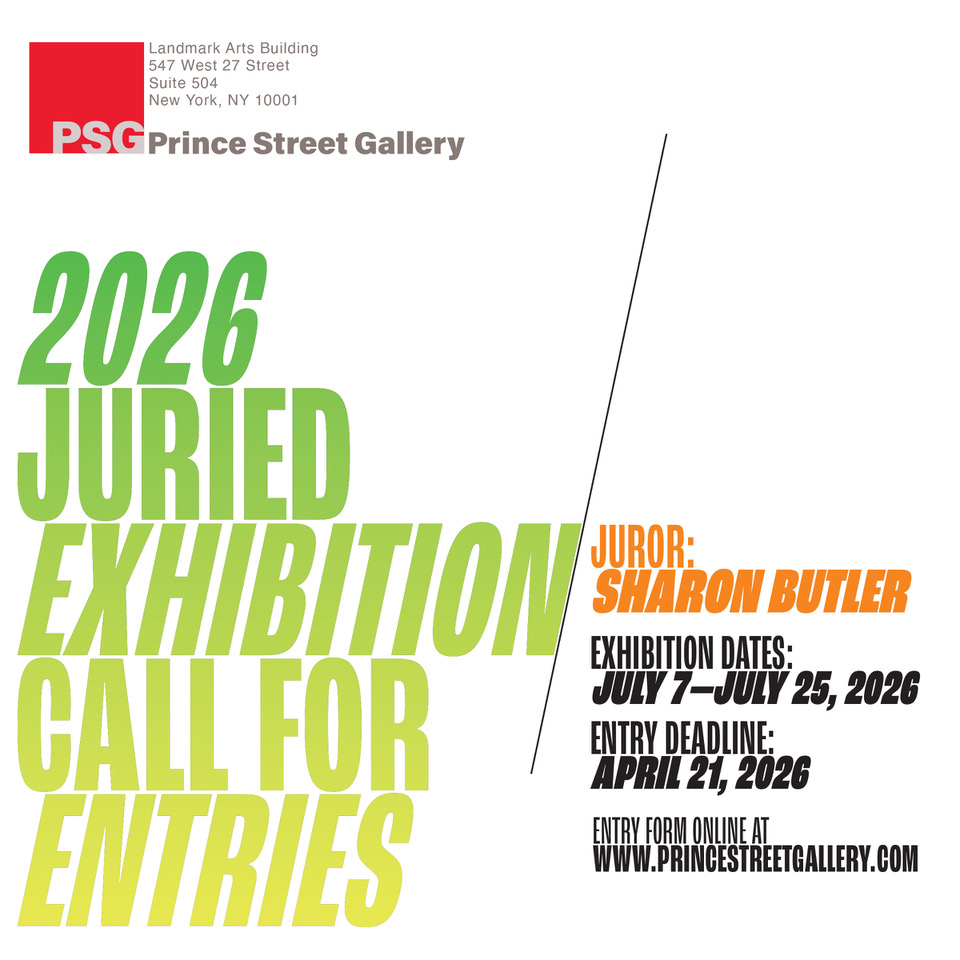
Please join us: The 2024 iteration of Dumbo Open Studios, takes place this weekend! Painter and Two Coats publisher Sharon Butler will have some new paintings on view at the Two Coats of Paint Project Space (20 Jay Street #308), and she has also organized “BIG TOP,” an exhibition of 13 talented young artists she met while teaching in the University of Connecticut’s MFA Program.

Solo Shows

Robert Moskowitz’s visual quartet

Contributed by Natasha Sweeten / One thought I had upon seeing Robert Moskowitz: Paintings and Drawings from Four Decades at Peter Freeman Inc. was that I could’ve been satisfied to encounter only the large wall of drawings. Arranged loosely yet thoughtfully, in a reconstruction of a wall from the artist’s studio, over sixty works of mostly oil or pastel on paper hang with a kind of majestic poise, each pinned by two thumbtacks in the top corners. Every drawing a vertical, together they present our city: here the finely ridged silhouette of the Empire State Building, there the graceful curve of the Flatiron Building, and, most engrossingly, the dense parallel bars of the World Trade Center from another lifetime ago. Pared down to their essential shapes, the buildings stand resolute in all seasons and moods, whether blue on blue or gray on fleshy pink or black on emerald. Occasionally a hazy ray of moonlight catches a cloud, a hint of atmosphere wafts nearby, or active fingerprints swarm across the paper. These quieter moments play off hard edges in a way that evokes walking home alone after a night out with friends, when New York is at its most still and you feel a flutter of wonder to live in it. What I mean to say is, the wall is a love song to the city.

Solo Shows

Janice Biala’s epochal studio

Contributed by Jonathan Stevenson / A striking feature of the paintings and works on paper of Janice Biala (1903–2000), now on view at Berry Campbell in a show craftily curated by Jason Andrew, is their seamless reconciliation of civilizational clutter and spatial order. Fixing that notion is the earliest painting, The Studio (1946), arraying the artist’s active workspace and establishing her intent to embrace the world through it. (Coincidentally, Vera Iliatova’s “The Drawing Room” at Nathalie Karg gamely recaptures and updates kindred impulses.) Biala’s work here, spanning the immediate postwar period almost to the end of the Cold War and blending the New York School and the School of Paris – she lived in both cities – also bears the considerable weight of twentieth-century history, art and otherwise, with extraordinary grace and weightless cohesion, free of the strain of obvious contrivance.

Gallery shows

NYC Selected Gallery Guide: April 2024

Welcome to the April edition of the Two Coats painting-centric guide to art exhibitions in Manhattan, Brooklyn, and Queens. We’ll be updating next week, so if you have shows opening in the middle or at the end of the month, and you want us to consider them for inclusion, shoot us a note at staff@twocoatsofpaint.com. Please put “NYC Guide” in the subject line.
Gallery shows

Hudson Valley (and vicinity) Selected Gallery Guide: April 2024

Contributed by Karlyn Benson / Turley Gallery in Hudson is moving to a new space on Warren Street and opening three new shows on April 6. Other notable April openings include Becca Lowry and Ashley Lyon at Headstone in Kingston, Debra Ramsay and Leslie Roberts at the Garrison Art Center, and Susan Still Scott and Pearl Cowan at LABspace in Hillsdale. I’m also looking forward to the opening of The Re Institute in Millerton for the season with a show of new work by the space’s founder Henry Klimowicz. At nearby Geary there are a few weeks left to see Will Hutnick’s solo exhibition and on April 20 the gallery will open a solo show of paintings by ransome. Finally, I’m excited to announce the opening of Talking Threads, an exhibition I curated at Susan Eley Fine Art in Hudson featuring seven artists working with textiles. The opening is Saturday, April 6. I hope to see you there!
Gallery shows

Provocative conversations at Platform

Contributed by Michael Brennan / Just over a dozen photographic works, mostly on paper, make up this rewardingly idiosyncratic three-person show “A Matter of Time” at Platform Project Space in Dumbo. Leslie Wayne, a well-regarded and unconventional abstract painter herself, has carefully selected and arranged mostly monochromatic works by Simone Douglas, Joy Episalla, and Beatrice Pediconi. All three artists are engaging with water, time, and photography, and challenging deeply entrenched ideas about how photography can be realized and presented.

Interviews

Massinissa Selmani: Outside the frame

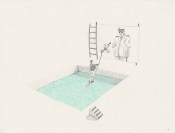
Contributed by Rebecca Chace / I met Massinissa Selmani at Civitella Ranieri, an artist residency in Umbria, Italy where we were part of the first group of artists they welcomed coming out of the pandemic in spring 2021. We became a very close-knit group and several collaborations have emerged from our time together. “A Fault in the Mirage,” Selmani’s first New York solo show, is on view at Jane Lombard Gallery through April 27. We spent time at the opening and followed up with a conversation about his work.

Museum Exhibitions Out of Town

Caroline Burton’s compelling in-betweenness

Contributed by Michael Brennan / I took the train to Trenton, New Jersey – TRENTON MAKES, THE WORLD TAKES, the old slogan goes – to see Caroline Burton’s painting exhibition “Way Finding” at the Riverside Gallery in the New Jersey State Museum, which also includes a freestanding library, planetarium, theater, a natural history exhibit, an indigenous peoples’ exhibit, and the obligatory outdoor Calder. The complex, originally designed by Frank Grad and Sons of Newark and constructed in 1965, is a classic example of the liberal utopian/modernist cultural center typically frowned upon these days. But I’m happy to report that the campus, self-contained like Lincoln Center, was teeming with visitors from all walks of life. It is very much a living museum, and ideal for Burton, a reconstructed modernist, who in fact depicts its architecture in some of the works on view.

Solo Shows

Vera Iliatova: Women in the studio, now and then

Contributed by Larissa Bates / Vera Iliatova’s solo show “The Drawing Lesson,” on view at Nathalie Karg Gallery, offers cinematic montages of female artists at work in a Brooklyn studio. The nine gestural oil paintings in warm greys and buttery mauves, with skirted figures moving indoors to backlit space, mark a departure from the haunted pastoral landscapes of Iliatova’s previous exhibitions. The dappled light, painterly marks, and muted pallet of the composite narrative interiors bring to mind Susan Lichtman as well as Manet. Gritty barges, a consistent motif of Iliatova’s, chug up the East River, glimpsed through single-paned industrial windows. These and concrete floors are reminders of the post-industrial spaces carved into the Brooklyn studios where Iliatova has spent decades working. As Dudley Andrew observes in the press release, she renders the place of rendering, depicting young women as simultaneously busy and solitary.

Solo Shows

Beatrice Caracciolo: Exquisitely stealthy

Contributed by David Carrier / What does it mean for a contemporary artist to be inspired by an older text or artwork? The Gospel of Matthew 15:14 says: “If the blind lead the blind, both shall fall into the ditch.” Moved by those words in 1568, Pieter Bruegel the Elder painted The Blind Leading the Blind, which hangs in Museo di Capodimonte in Naples. Now stirred by that picture, Beatrice Caracciolo, a young artist who grew up in that city, has drawn The Blind 16: one large image of the blind beggars and several smaller details also derived from the Bruegel. Between Matthew and Bruegel and then Bruegel and Caracciolo, there’s a kind of creative slippage whereby the meaning of the prior statement is transformed. At each stage, Matthew’s basic conception is partly preserved while something is added or subtracted. He doesn’t specify, for instance, that there are six blind men. Caracciolo shows his entire work, but without color, in grisaille. In smaller rectangular works on paper, she focuses on the trees and on some of the individual blind men.