Latest articles

Solo Shows

Elizabeth Flood’s numb sublime

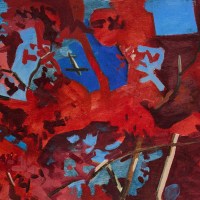
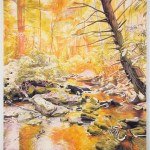
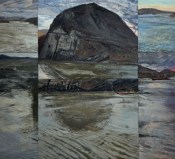
Contributed by Margaret McCann / Elizabeth Flood’s landscapes in “Lookout” at Storage Gallery included oil paintings that emphasize realism and expressionistic ink drawings. The latter express vigorous engagement with the outdoors. Gettysburg (Pickett’s Charge, October 9) channels the drama of that day. Stirring energy like that of George Nick’s alla prima work drives the eye deep into a field under a sensational sky. Conversely, mental distance accompanies Flood’s large polyptychs, whose combinations resemble photographic contact sheets, art website layouts, or bulletin board accruals. At their best, artifice is imbued with the existential doubt of Edwin Dickinson or Giacometti. Repetition and variance become metaphors for modern contingency and ambivalence. Multiple views rouse a mix of ennui, curiosity, taste, and choice, like that fueling our daily shuffle through cyberspace.
Solo Shows

Sedrick Chisom’s American monsters

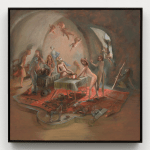
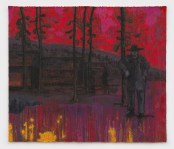
Contributed by Marcus Civin / The Philadelphia-born, New York-based painter Sedrick Chisom’s gothic, thematically inventive “…And 108 Prayers of Evil” at Clearing is his first solo show in New York. At the entrance to the gallery, a block of wall text sets the scene for Chisom’s mostly large-scale oil paintings and charcoal drawings. The action depicted occurs in the year 2210, when the Greek mythological figure Medusa is in trouble again. Almost comically, various political groups accuse her of listening to whispers in the forest and slipping gangsta rap lyrics to pious youth. A magmatic eruption threatens, and massacres have occurred in a place called Capital Citadel.

Solo Shows

Alessandro Twombly: Strikingly original, richly allusive

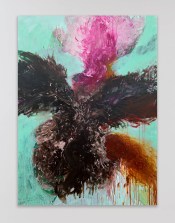
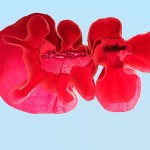
Contributed by David Carrier / Alessandro Twombly’s twelve large new paintings, now on view at Amanita Gallery, all employ one basic, immensely fruitful motif: knots of color resembling enlarged floral forms, depicted in high-pitched, gesturally painted oranges, pinks, reds, and blacks on bright turquoise backgrounds. An artist friend nicknamed these pictures ‘Tiepolo in the Sky,” which accurately describes them. Twombly’s abstract images look like drastically enlarged figures you might find in a work by the eighteenth-century Italian painter Giovanni Battista Tiepolo. They are strikingly original yet richly allusive. 

Ideas & Influences

Artist’s notebook: Nate Ethier

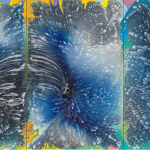
On the occasion of “Heavy Light,” Nate Ethier’s second solo show at David Richard Gallery, Two Coats of Paint invited him to share ten ideas and influences that inform his complex, pulsating abstractions. He is keenly interested in kinetic motion, precision, and repetition, and credits Agnes Martin for the sense of happiness and innocence that suffuses his paintings. Most importantly, he reveals a penchant for close looking: “You can learn a great deal about light and color from a slow walk in the woods.” The show includes twelve stunning paintings and is on view through June 27.

Group Shows

The family Abelow at Swanson Kuball

Contributed by Liz Scheer / “Shoot for the Stars,” on view at Swanson Kuball in Long Island City, surveys intergenerational works by members of the Abelow-Kirilloff family, which includes New York artists Joshua Abelow and Tisch Abelow. By presenting the work of siblings, spouses, grandparents, and children, gallery directors Laura Swanson and Greg Kuball raise fascinating questions about the relationship between family and art. Do the formal parameters of a family foster or impede an individual’s creativity? Is a family itself a means of artistic production? 

Drawing

Elizabeth Murray’s wildly imaginative, electrified mind

Contributed by Natasha Sweeten / Like a car with its engine left running, Elizabeth Murray (1940–2007) seemed poised to dart in any direction on short notice. On view at Gladstone 64, Drawings (1974-2006), curated by Kathy Halbreich, boasts over 60 works of mostly pen, marker, and/or colored pencil on notebook-size paper (and actual notebook paper). Several are studies for larger works, others are on pages ripped from a binding, most all are imbued with a casualness but also intention. This show offers an enchanting glimpse into Murray’s wildly imaginative, electrified mind. I dare you to see it and not smile.

Solo Shows

Jennifer Coates: Edgy indeed

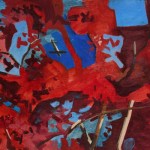
Contributed by Jonathan Stevenson / Several notable painters – Julie Heffernan, Jules de Balincourt, and Alexis Rockman, among them – have seized on the perils of climate change. In Jennifer Coates’s new solo show “Edge Effects,” jointly mounted at Chart Gallery and High Noon Gallery, she drills deeply into the subject and emerges with work that dazzles to engage, and vice-versa. The show’s title is an ecological term for what happens when one habitat impinges on another, which climate change is accelerating and amplifying. The phenomenon implies crowding, ergo potential conflict and trouble, and Coates’s canvases are appropriately busy and calculatedly unnerving. Bacchanal, a large painting, depicts the jangled co-location of lush plant life, bemused animals, and humans naked but often distressed. No doubt intentionally, it’s a far cry from Nicolas Poussin’s eponymous seventeenth-century study ingenuously celebrating sensuality. For Coates, the title sharply intimates collective hedonism gone awry. Touché.
Remembrance

The Wild Art of Barbara Westman

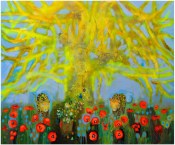
Contributed by David Carrier / Just to the left of my writing desk is a painting of a magnificent tree with bright orange blossoms. Below it is a now faded postcard of a drawing of Barbara Westman, who died earlier this year at age 95, and her husband Arthur Danto sitting on a sofa with their dogs Charlotte and Emilia. To the right, a work on paper shows Danto taking the dogs for a walk in Manhattan. These Westman pieces more than hold their own against the prints of old European master works, Japanese woodcut, and Bill Anthony drawings that surround them. Anytime I feel discouraged by the slow progress of my work or the political news, I need only look at them to be cheerful again. 

Solo Shows

Charlotte Zinsser: Fine deception at Haul

Contributed by Michael Brennan / Haul Gallery is in the light industrial section of Gowanus, an area typically defined by one- and two-story brick buildings faced with rolling metal gates. These house local non-chain businesses cast as, for instance, “Tool Rental,” “Collision Repair,” and “Switch Electric.” DOS Garbage Trucks, a surplus of Park Slope ambulances, and old-style levered voting machines are warehoused nearby. Big-box stores like Home Depot and Lowe’s are present, too. Uncharacteristic patches of big sky often appear above, bisected by a gargantuan elevated section of the BQE. In 2024, post-pandemic NYC, a truly adventurous art space, and perhaps an alternative model, has also emerged in the neighborhood. Premised on the defiantly alternative anti-manifesto of founders Erin Davis and Max C. Lee, the gallery awards residencies to artists who then use the space to present exhibitions. Currently featured there is Charlotte Zinsser’s first solo show. Zinsser’s aesthetic is distinctive, refreshingly peculiar, and not easily categorized. I think of her broadly as a conceptual collator of Americana in the tradition of artists like Walker Evans and William Christenberry. 

Solo Shows

Philemona Williamson’s threshold states 

Contributed by Riad Miah / Philemona Williamson’s paintings delve deeply into the concept of arrested development. For her, the term signifies a profound state of emotional or psychological stagnation, often linked to unresolved childhood issues. Yet her overall vision is expansive and not unhopeful. In her current exhibition of 15 large and small oil-on-canvas works at June Kelly Gallery, complex narratives inform her paintings and affect the very process of their creation while remaining purposefully unarticulated.

Gallery shows

Contemporary landscape: Reinvigorated and reinvented

Contributed by Patrick Neal / In New York City galleries, portraits, still lifes, interiors, and landscapes are everywhere, reinvigorated for the twenty-first century. With landscape painting in particular, innovation often arises through a seamless compounding of sources, where past and present, universal and specific, coexist. Three exemplary solo shows drive home the point. With varying degrees of naturalism and mediation, all three artists favor an authentic response to nature, and the titles of each exhibition suggest a phenomenological grounding.

Artist's Notebook

Sweet Art Alabama 

Contributed by Sharon Butler and Jonathan Stevenson / Hitting the road to Alabama for Sharon’s solo show “March” at the Sarah Moody Gallery at the University of Alabama in Tuscaloosa in late March, we knew from ongoing contact with gallery director and art professor William Dooley and his assistant Vicki Rial that a deftly curated presentation in a beautiful space and a warm reception from the Art Department were in store. The students and gallery patrons who attended Sharon’s artist’s talk were inquisitive, smart, and welcoming. What we did not expect was the prevalence of so many talented people in the wider art community spanning Tuscaloosa and Birmingham, which we discovered is rich with deeply engaged artists, curators, and gallerists.

Museum Exhibitions Out of Town

Christina Ramberg’s powerfully personal eroticism

Contributed by Laurie Fendrich / The erotically charged art of Chicago Imagist painter Christina Ramberg (1946–1995), whose retrospective is currently on view at the Art Institute of Chicago, aligns chronologically with the second-wave feminism of the 1970s and 80s. Today’s third-wave feminists (some say it’s now fourth-wave) frequently disparage that incarnation of the movement for privileging white women’s worries, and worse, for its obliviousness to institutional misogyny. Fortunately, Art Institute curators Mark Pascale and Thea Liberty Nichols don’t try to pigeonhole Ramberg’s work into that framework. Although she considered herself a feminist, an aggrieved one she was not. Her art was personal, not political, and it doesn’t fit neatly into standardized versions of feminism. Remarkably, the artist found a way to mix together sharp and provocative subject matter about women’s desires with a classical, pristine aesthetic.