
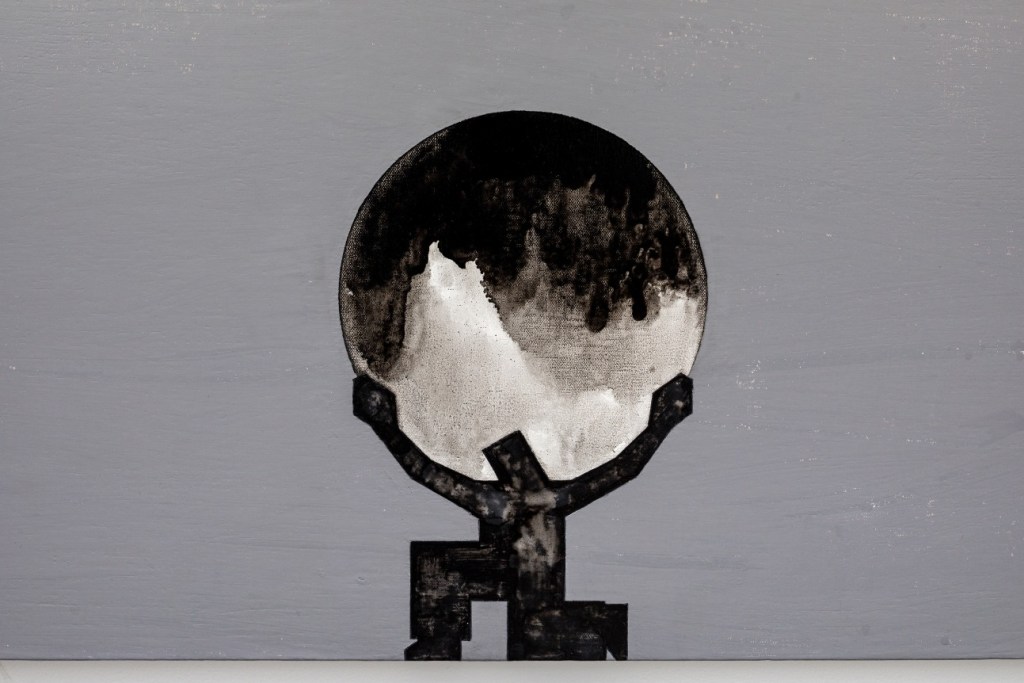
Contributed by Natasha Sweeten / One thought I had upon seeing Robert Moskowitz: Paintings and Drawings from Four Decades at Peter Freeman, Inc., was that I could’ve been satisfied to encounter only the large wall of drawings. Arranged loosely yet thoughtfully, in a reconstruction of a wall from the artist’s studio, over sixty works of mostly oil or pastel on paper hang with a kind of majestic poise, each pinned by two thumbtacks in the top corners. Every drawing a vertical, together they present our city: here the finely ridged silhouette of the Empire State Building, there the graceful curve of the Flatiron Building, and, most engrossingly, the dense parallel bars of the World Trade Center from another lifetime ago. Pared down to their essential shapes, the buildings stand resolute in all seasons and moods, whether blue on blue or gray on fleshy pink or black on emerald. Occasionally a hazy ray of moonlight catches a cloud, a hint of atmosphere wafts nearby, or active fingerprints swarm across the paper. These quieter moments play off hard edges in a way that evokes walking home alone after a night out with friends, when New York is at its most still and you feel a flutter of wonder to live in it. What I mean to say is, the wall is a love song to the city.
Curated by Dieter Schwarz, the exhibition covers the seventies, eighties, nineties, and early 2000s. It is a captivating survey of Moskowitz’s curiosity and concentration. A master of the reductive, his every composition is purposeful and remarkably exuberant. Wrigley Building (Chicago), a 1975 painting, features the eponymous structure tilted horizontally as the ground swallows up the right side. Facing downward, the building’s surfaces burn fire-engine red while the upward façades scream headlight white. Giorgio de Chirico haunts this landscape. Has the viewer fallen? Is it an image from a tossed magazine? A chocolatey sea of darkness swirls about, all but hiding ghosts of other structures, and a few splashes of white paint escape like lightning bugs near the bottom left corner. A thin yellow cross is unexpectedly suspended in the upper center of the painting, the horizontal line barely visible but the vertical one mysteriously confrontational. The painting seems to embrace contradictory vantage points, or perhaps it’s simply reminding us that this is, after all, a two-dimensional object.

latex and acrylic on canvas, 90 x 75 inches, (228.4 x 190.5 cm)

From the Eighties, two square paintings – Red Cross (Red on White) and Red Cross (White on Black) – depict a simple cross, but up close elicit different reads. In the first, the iconic red logo beams, seemingly in reassurance, against a smooth, milky-white background. The second is just as bold but brings out the imperfect weave of the canvas, its hushed field echoing the cross and giving it a worn and warmer feel, as if it’s been handled. Moskowitz built his surfaces with unvarying consideration and it’s easy to sense the pleasure he took in the process.

, (99 x 99 cm)
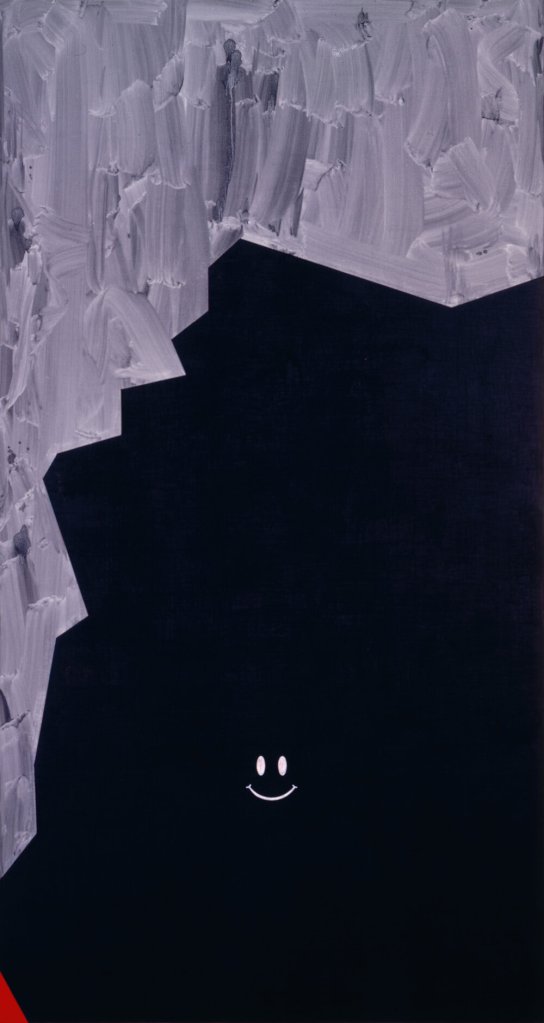
His humor is evident in Cave Painting, from 1993, with a hefty chunk of blackness meeting a washy gray via an irregularly jagged edge. The title suggests that we are staring into the mouth of a cave, and peeking out from the darkness is a generic smiley face painted in white, no circle for a head. In the bottom left corner rests a mischievously loud red triangle. Just like that, the artist has collapsed a span of nearly twenty millennia, merging Lascaux and contemporary popular culture.
Paintings from the 2000s depict lives in motion: an upside-down diver drifting off the picture plane; a bird, wings outstretched, floating across a yellow sky. These feel like moments the artist happened to witness and mentally note, imbuing the paintings with a sense of the fleeting so pronounced that it seems possible that, next time you look, the diver or bird will have disappeared.
The range of work here offers a rare and generous glimpse into Moskowitz’s world. Although his images are distilled and can initially appear conceptual, they reward prolonged viewing, as subtle histories and variations emerge. The artist’s contagious joy of painting may engulf you.
Note: After a long illness, Robert Moskowitz passed away, aged 88, during the second week of this show.
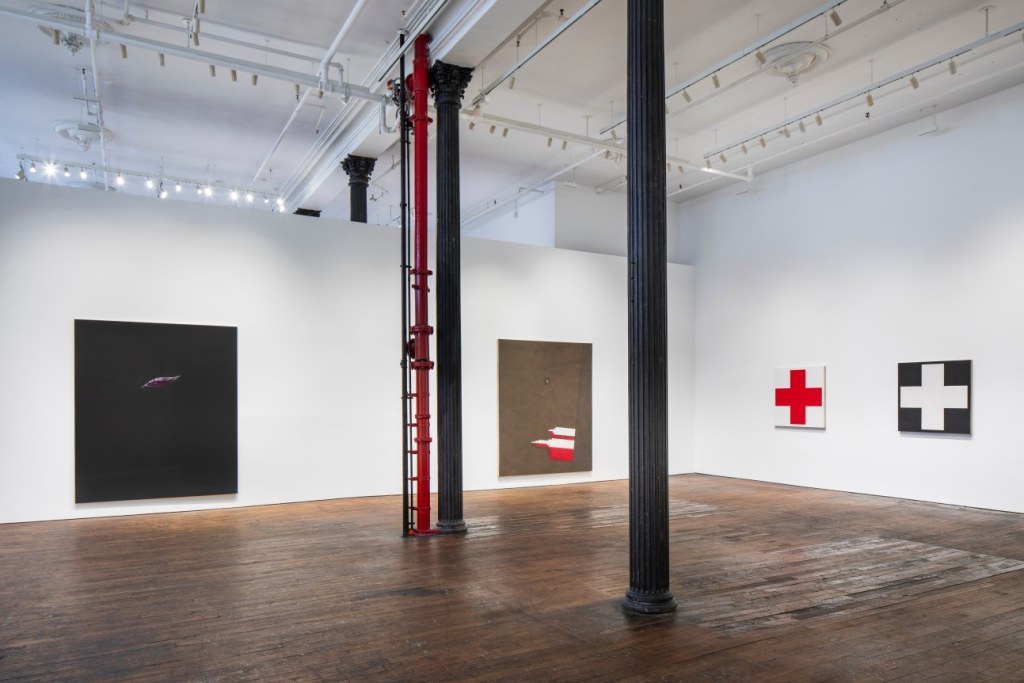
“Robert Moskowitz: Paintings and Drawings from Four Decades,” Peter Freeman, Inc., 140 Grand Street, New York, NY. Through May 16, 2024.
There are also a few of the artist’s works on view in “An Extended Family of Painters: Hermine Ford, Robert Moskowitz, Jack Tworkov, Janice Biala, and Daniel Brustlein,” JJ Murphy Gallery, 53 Stanton Street, New York, NY. Through April 13, 2024.
About the author: Natasha Sweeten is an artist living and working in Brooklyn and the Hudson Valley. In May, her paintings will be featured in a two-person show with sculptor David McDonald at Satchel Projects in New York City.





A beautifully written review.
It was smart, insightful (and also a lovely touch) to draw the references to Giorgio de Chirico. It gifts even more resonance to Moskowitz’s work. Thanks!
Natasha, beautifully seen and written……:)
Thank you for this! Beautifully written. Such an amazing show.