
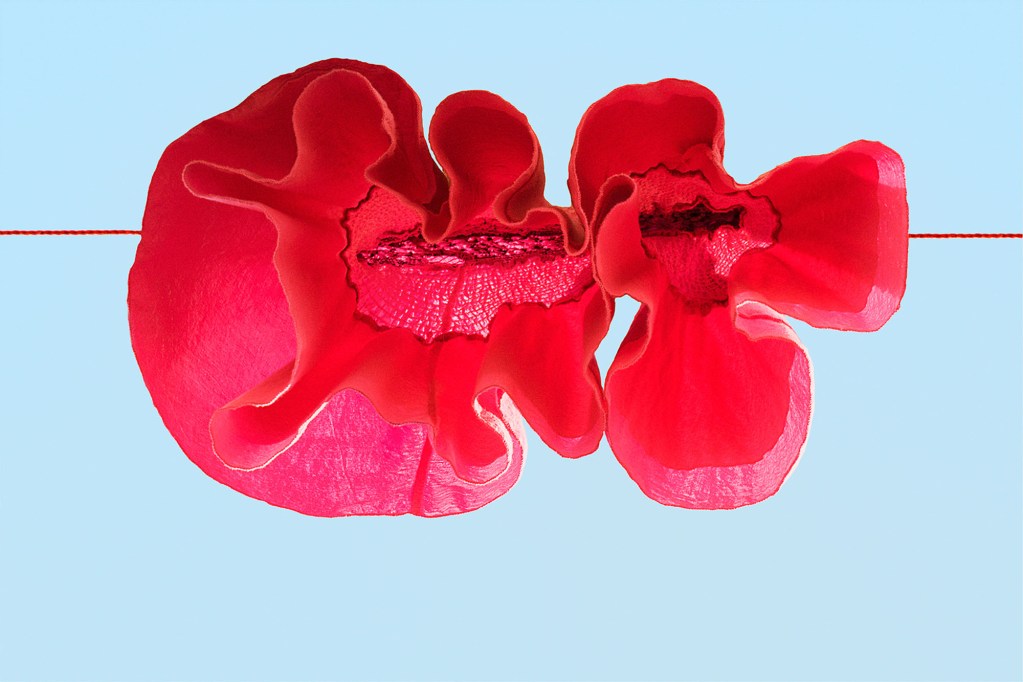
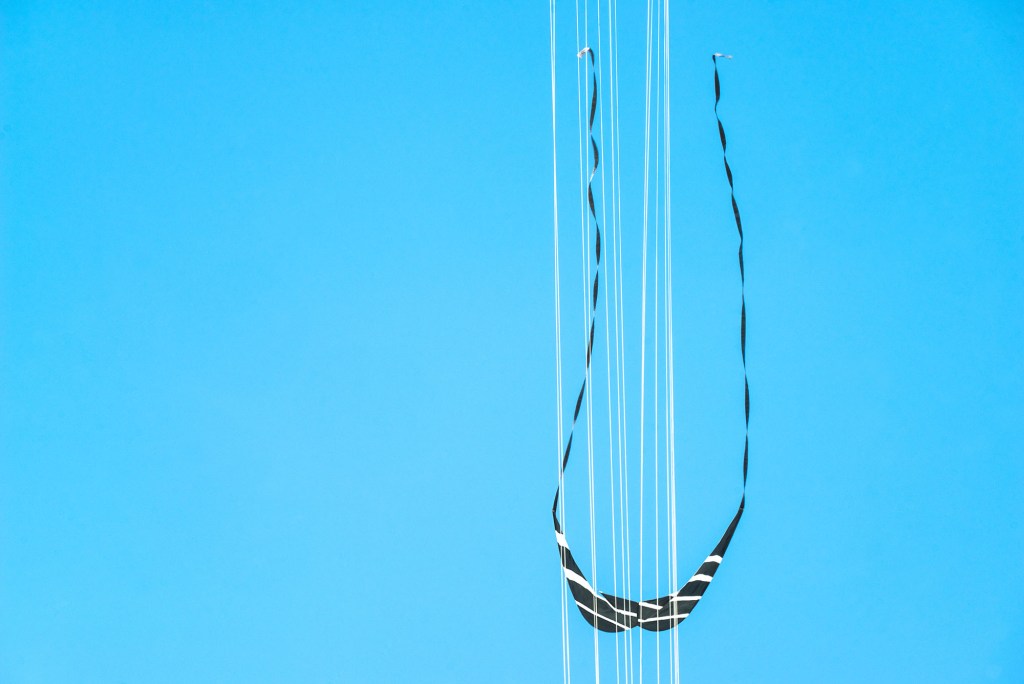
Contributed by Leslie Wayne / I recently had the pleasure of visiting the artist Sally Gall in her midtown studio on a cold and snowy day – a perfect opportunity to get out of my own head and into the mind and process of someone else. Gall is a photographer of natural phenomena, yet her images are otherworldly and hard to identify. They include close-up undersides of laundry hanging from clotheslines on a windy day, faraway kites, and rock faces that look like Franz Kline paintings. Her talent is not just in capturing the strange beauty of everyday objects but also in exploring the slippage between representation and abstraction by isolating the magic of the moment in which she recognizes their strangeness.
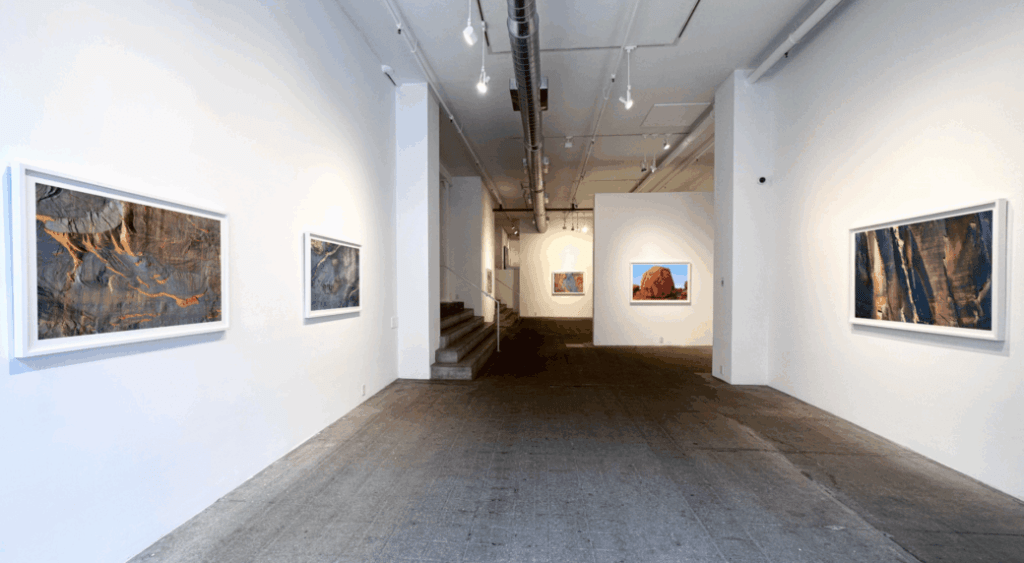
Gall’s ideas have customarily taken her to different locations around the world. Last year, her second solo exhibition at Winston Wachter Gallery presented a series of photographs taken during several trips to the Colorado Plateau. Recently, however, she has been traveling without any specific goals in mind, allowing inspiration to take hold unconstrained by prior intent. When I arrived, she had up on her wall a large group of photographs she had taken during her various travels abroad, loosely organized by subject matter – sky, water, and land. I kept glancing behind me at this inspiration wall, searching for recurring themes, and we did talk about the visual and conceptual threads that bound the photos together. We also discussed process, inspiration, influences and distractions, the Man Ray show at the Met, and the relationship between painting and photography.
Leslie Wayne: Sally, thank you so much for having me over to your studio the other day. When I first saw your work online I was struck by the clarity of your intention in harmony with the splendor of the image. It felt almost sui generis. In the past, photography was considered journalistic proof of veracity. But today of course it is as susceptible to manipulation as anything else and we are never sure if what we are looking at is real. This makes the strangeness of nature the perfect foil for photography. In painting it is often considered de rigueur to see the artist’s struggle embedded in its outcome. We want to know that it was hard won. In straightforward photography, however, this is not apparent. I feel as if your struggles in the past – to find the perfect location that would meet your goals – are not what you are facing now. Tell me about this new challenge.
Sally Gall: Leslie, thank you for your insightful comments about my work. I love your description of the “slippage” between representation and abstraction – it’s the perfect word to describe what I am after. My immediate challenge is to make sense of how the various photographs I have been making in disparate locations over the last few years speak to one another, and then to expand the vocabulary of this new body of work. In response to your comment about the photograph as “truth” vs. our current moment of massive photo manipulation, I am still after photographic veracity. I photograph with the idea that what is in front of the lens is true, and I am interested in that “slippage” whereby compositional choices, framing, format, playing with the lights and darks and the contrasts can challenge our assumptions about reality. I am interested in photographing how the natural world FEELS, not simply how it looks. I am drawn to the pulsating of the natural world; the wind in the grasses, the humidity in the air, the sensual experience of moving through nature. I am interested in watery worlds – how vapor, steam, clouds, fog, atmosphere, various ephemeral phenomena can be photographed. These are quotidian atmospheric qualities and not necessarily dramatic; therein lies the challenge.
LW: I completely relate to what you’re describing. For years I made abstract paintings that were based on the phenomenology of the natural world, using the paint to provide an analogous experience to being in nature, rather than creating a picture of it. In the end, though, you always knew it was just paint on canvas. With a photograph, however, the subterfuge is far more subtle.
In your most recent photographs, some of the images were immediately recognizable, even if also very abstract, like the photographs of water washing ashore. They’re gorgeous, and very akin in feeling to a large Frankenthaler painting, like the postcard of hers you have up on your wall. But there were a few others that were a complete mystery, where I had absolutely no idea what I was looking at. I sensed that these images were at the heart of an unknown intersection in your work, which of course is always scary but exhilarating. We touched a little on this in the studio, but can you tell me more about the struggle to push yourself and the work into new territory, while also remaining committed to veracity?
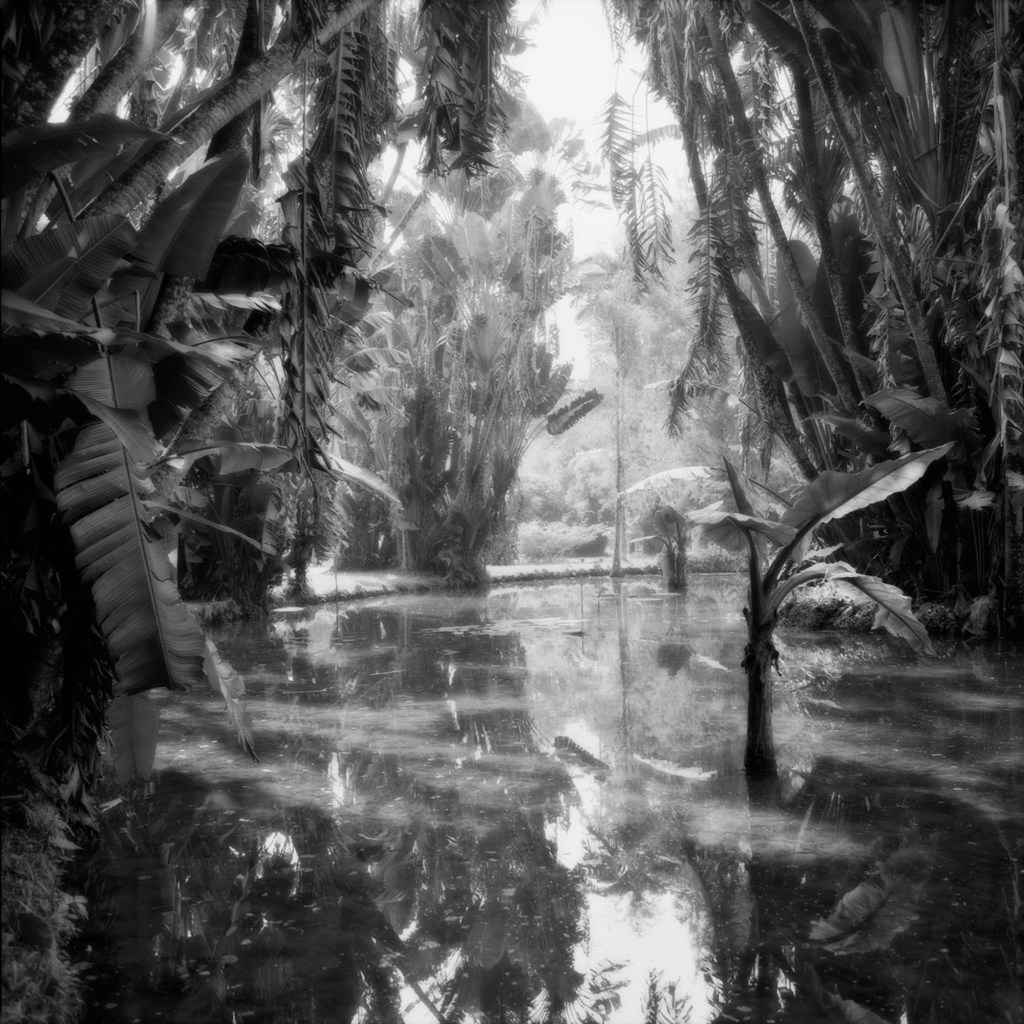
SG: It’s so easy to stay on a familiar path in one’s image making, but yes it can be exhilarating to break new ground (and scary too). I’m intrigued by the notion of making a photograph of something that is known, but because of its composition or point of view is only slowly comprehended by the viewer. A “what am I looking at?” scenario. I once made a photograph of a dark pond surrounded by vegetation, the pond’s surface full of reflections of the tropical foliage growing around it. The pond appears solid, as if it were firm ground instead of water. The photo invites the viewer to walk into the landscape, which of course would not be possible as the viewer would be submerged. I like this kind of play. To confound the viewer, while remaining a conventional image-maker (no Photoshop, no alterations, everything that exists in the photo was really there) is one way to entice someone into looking hard at something, to be contemplative.
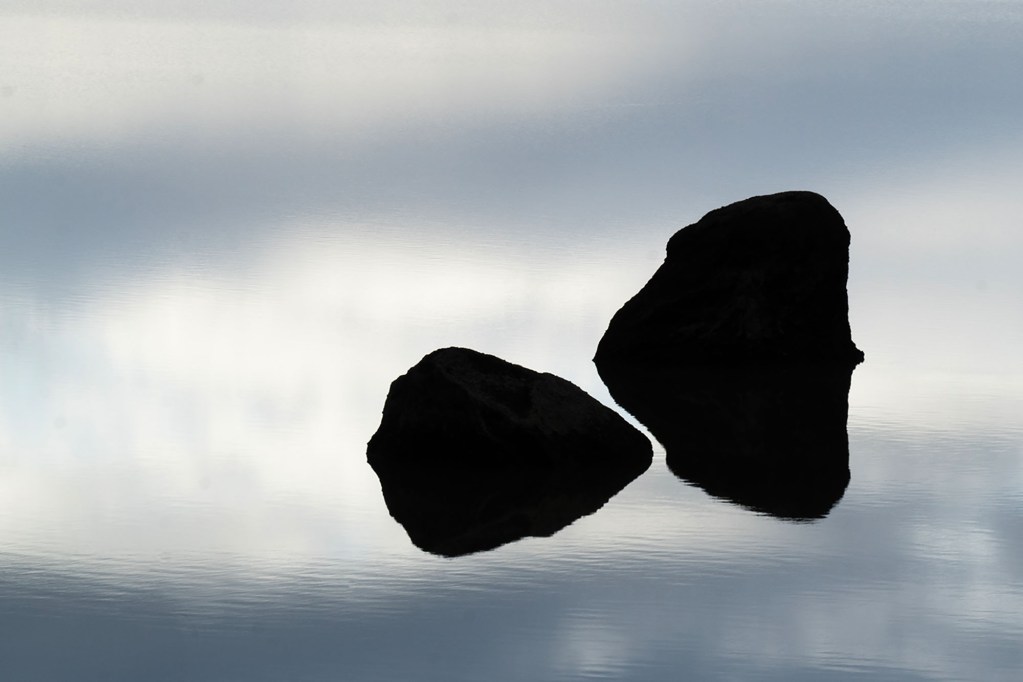
I find myself eliminating more and more information from my photographs, particularly information that gives a sense of three-dimensional space (the horizon line, shadows, and highlights), the goal being to discover what little I can keep in the frame and still have the photograph function as a compelling image. For one new photograph, I began taking photos of dark rocks in a still lake with a horizon of distant land and a sky full of clouds and light, and I ended up eliminating everything except a few rocks in the lake full of sky and cloud reflections. The crop got tighter, the information that would place you in a known physical space was abandoned, and what is left are dark shapes that appear to be anchored and un-anchored simultaneously – stationery and floating. I think there is a little “a-ha” moment, and at the same time I am trying to make it as if it’s never been seen before. There is power in creating something unrecognizable out of what are ordinarily recognizable objects.
LW: You definitely got that confounding quality with that photo of the dark rocks in the water I saw in your studio. I had no idea what I was looking at – UFOs? Flying rocks in the sky? It’s really a crazy image. So this is something you’ve been thinking about for a while, but clearly more now as you are deliberately forging your way into new territory. Your process of elimination is interesting. In painting, it’s a way of getting down to the essence of something. I sense you are looking for the essence of your subject while pushing recognition to the brink. I think being in that liminal space is where you find the poetry. But I want to go back to something you said earlier about not using Photoshop or any kind of what I assume you meant as digital alterations. In a sense, you are altering your photos in the dark room by playing with the contrasts and the lights and shadows. It’s not the same as someone like, say, Andreas Gursky, whose digital manipulations actually create fantasies that look absolutely real. You are taking an image of something real and making it look like a fantasy. Am I correct in that?
SG: Well, I never thought about it that way but yes, you are correct! I can make space advance or recede by altering the print’s lights and darks, I can make a highlight much brighter than it was in reality to direct the viewer’s eye to a certain area of the photo, and I can darken something to the point where you can’t see the details and it becomes a flat form rather than a three-dimensional object. So YES there is some alteration. It is never pure. A photo always lies a little! But the distinction is that I am not adding anything that wasn’t originally in front of the lens or subtracting anything that was – I’m subtly altering what exists, to achieve my goals and desires. If I alter lights/dark/contrasts, etc., too much, the photo looks unreal, the color shifts and there is a point at which it looks “wrong” and I don’t want that.
Black-and-white photography offers the opportunity for more extreme alterations as there is no issue about matching the color of the world. A black-and-white photograph is inherently abstract – it’s taking the world from color to shades of gray. As much as I love working in black and white, which I did for a long time, I’m finding that working with color and trying to achieve the same kind of abstraction to be a difficult but more interesting challenge. The blue sky in a black and white photograph becomes medium gray – if you lighten it or darken it for artistic reasons, it doesn’t (usually) look wrong. Working in color, if I put too much green into my blue sky it looks altered, wrong, even if the color works in other ways for the image. It doesn’t look like a sky anymore. The quest is to stay on the edge of being real before it falls into the state of being unbelievable.
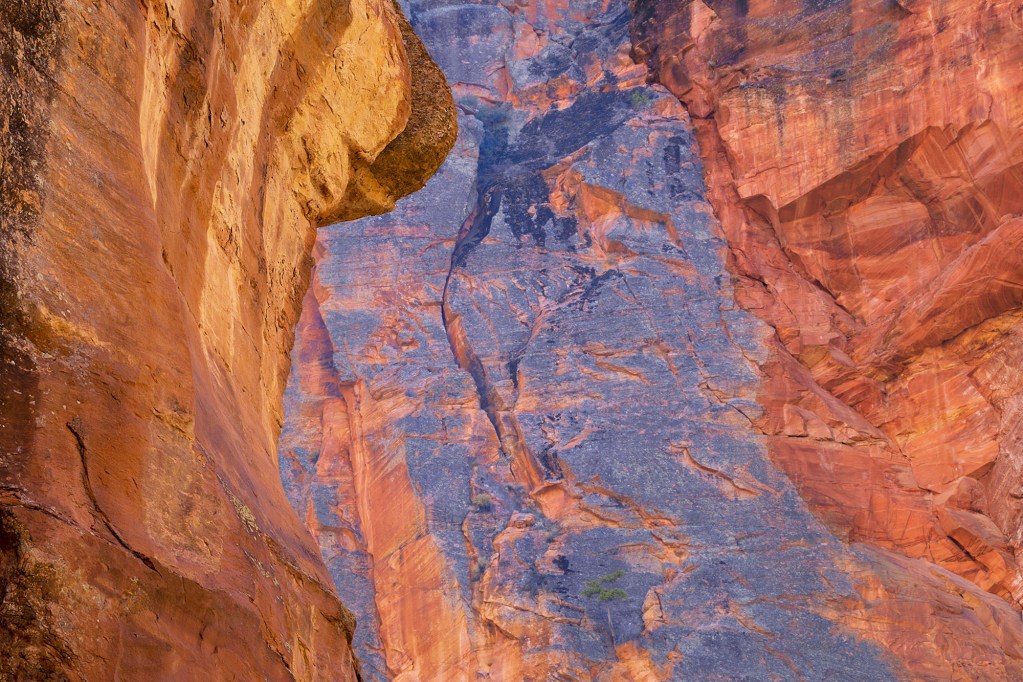
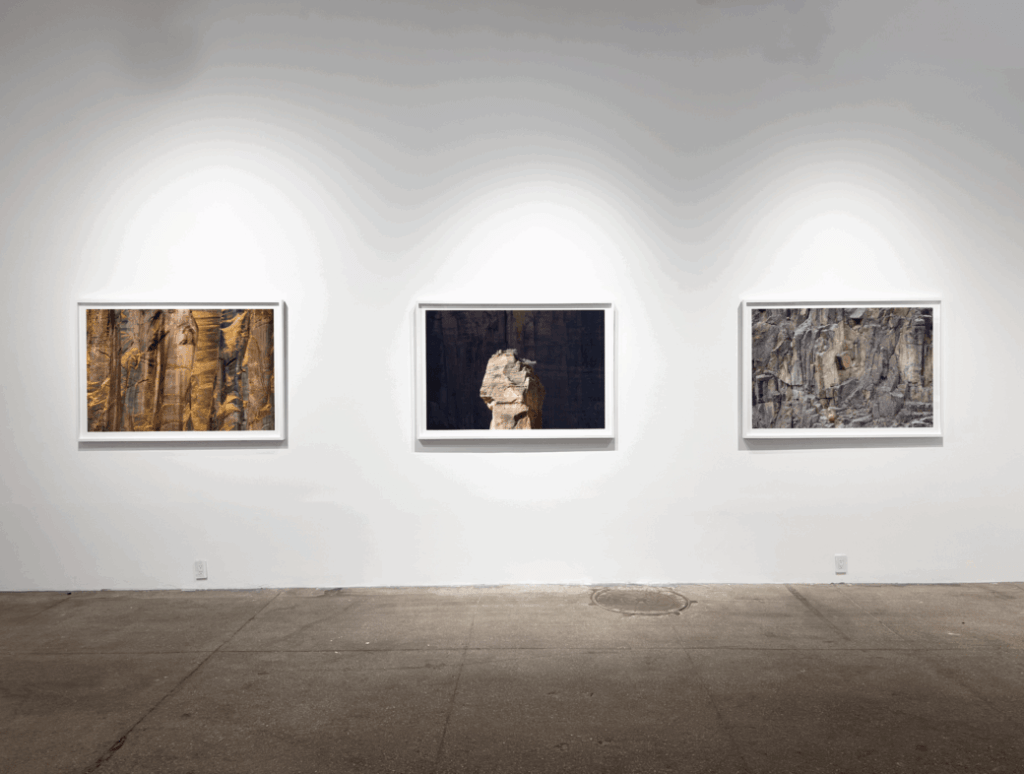
A wonderful painter came to my studio when I was just starting to work on my rock wall photos. I had some very rough proof prints up on my bulletin board that were “off” in their color – much too saturated, too harsh in their colors and contrast, lacking subtlety, too unreal, even though ironically those purples and oranges were absolutely true. Many viewers who have not been to red rock desert country can’t believe those colors actually exist. I was explaining to her that the color wasn’t right, that it was too “extreme” and she replied, “Oh no, I love it like it is, keep it extreme, make it more extreme.” So, on her suggestion, I messed around with doing so, but the images were starting to look like an alien fantasy world, and I backed off. I never quite understood my reasoning until you said what you said above – so thank you! To paraphrase you, I am looking for the essence of my subject while pushing recognition to the brink. Being in that liminal space is where I find the poetry.
LW: I’m glad I could articulate that for you! We often don’t know what we’re doing until we put language to it, right?
SG: Yes, it’s very helpful to put language to it. I live with a writer, and sometimes he will say the simplest thing about my work, which will open a whole new door to understanding. Like you, he is very articulate and succinct!
LW: Sometimes, finding the sweet spot lies in how you work with the particular properties of a material. There are lots of things one can do with photography, from darkroom manipulations to tearing the paper, lifting the emulsion, collaging, and drawing or painting on top of it. We talked about expanding your process and exploring new materials and you mentioned you had once been commissioned to do a large tapestry of one of your photographs. Is this something that you are interested in doing again? And would you approach it differently this time?
SG: I loved making that tapestry. I should say, the wonderful Magnolia Editions actually made the tapestry, not me. But it was an interesting process to see one of my images become cloth. The particular photograph we chose was of a skirt hanging on a clothesline, billowing in the wind against an intense blue sky, and it was a fun poetic turn to have the image of a textile become a textile.
LW: I love visual punning.
SG: I would love to do another tapestry, though this time I would make an image specifically for it, rather than use an existing image. The mechanics inherent to weaving offer interesting possibilities because you can’t make part of the image in a tapestry one color and another part another color – it’s a whole, so all the colors exist throughout in varying degrees. For example, that intense blue sky was woven with more than just blue thread – it had bits of green, white, and pink in it. All those colors can be accentuated or de-accentuated, which is also reminiscent of an Impressionist painting. This would be a way for me to tease out additional layers of abstraction in the tapestry.
LW: That sounds like a very generative exploration for you. I’ve seen lots of beautiful translations of artists’ work into textiles, from straightforward replicas of paintings into rugs, to most recently that spectacular tapestry by Otobong Nkanga at MoMA. I like how she also introduced sound, ceramics, and rope into the installation. It was amazing.
But in terms of your working within the confines of photography as your primary medium, are there other ways that you would approach the process?
SG: I’ve always been intrigued with Japanese Chigiri-e, the “art of torn paper collage,” whereby torn paper in various colors are used to create images of landscape and flowers, emulating watercolor painting (Chigiri-e translates to painting with paper). The American artist Jordan Belson worked in this tradition during the 1970s and I love what he did. I experimented with making torn paper collages out of my photographs at one time, making landscapes out of torn pieces of my landscape photographs. It was a lot of fun and definitely outside my usual working methods, but I ended up rejecting everything despite a rather enormous amount of time spent on it. The images felt too willed, too worked. Then, unexpectedly, on one of my trips to red rock country while wandering in Zion Canyon, Utah, I “saw” a torn paper collage landscape. I was facing an enormous wall of colored rock in the background with various rock ledges and pillars in the foreground, and there it was, a Chigiri-e, only already existing, so to speak, in real life! Of course I photographed it and titled it Chigiri-e. So, although I like to mess around with altering my process, like tapestry, or collaging and using alternative photographic processes, the thing I always come back to in the end is a straightforward photographic depiction of reality, no matter how abstract it may seem.
LW: Well, I always like to say that there’s nothing stranger than nature. You would be hard-pressed to come up with the shapes and forms and colors that exist in real life. You have more than you could possibly want for inspiration to work within the confines of photography. And if I may, I believe that the greater the restrictions there are to push against, often the deeper the discoveries. Thank you, Sally, for a wonderful conversation.
SG: Thank you as well. I enjoyed exploring these ideas together!
About the Author: New York artist Leslie Wayne is represented by Jack Shainman Gallery. Wayne is an occasional writer and curator, and has received numerous grants and awards, including a John Simon Guggenheim Foundation Fellowship. She was awarded a 2025 Art Omi Francis J. Greenburger Award, which honors established artists who have not been fully recognized by the public.







Thank you for letting me be a fly on the wall for an insightful conversation.