
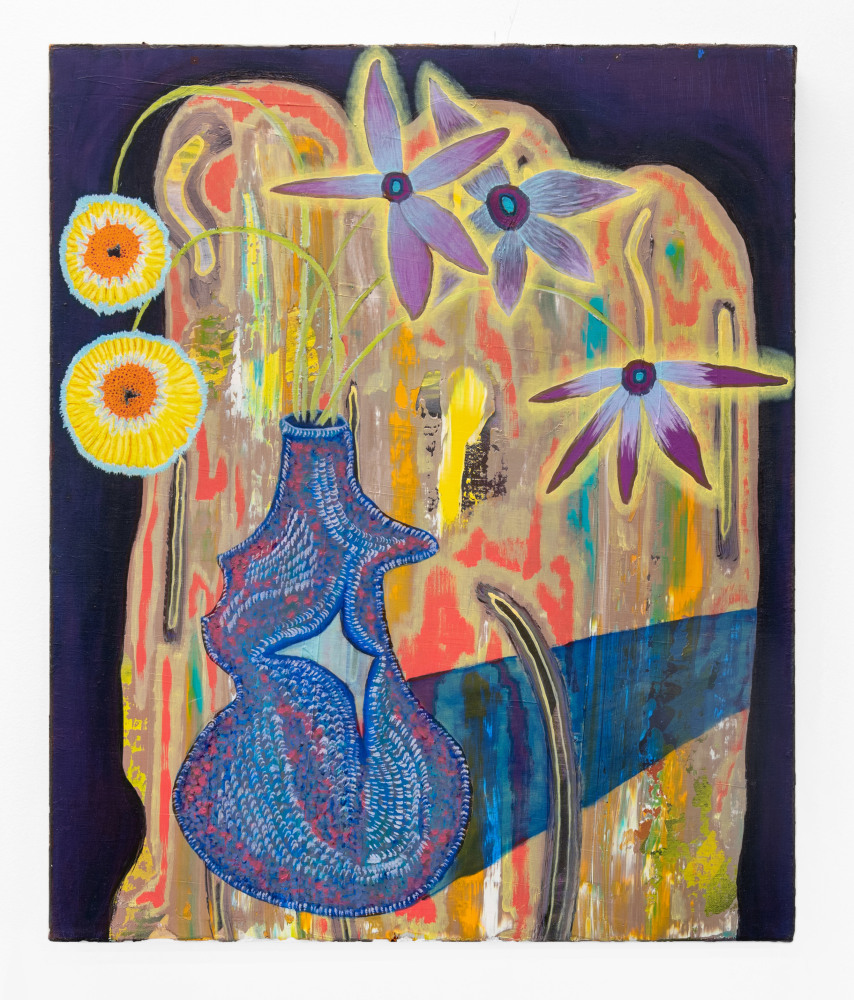
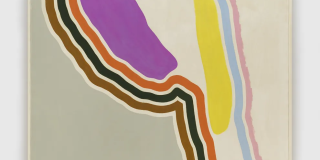
Contributed by Zach Seeger / Freight + Volume’s vaulted Tribeca showroom is the perfect amalgam of its previous spaces in Chelsea and the Lower East Side: a charming and spacious boutique, ideally suited to paintings. Jared Deery’s tightly curated solo show “A Liminal Light”, includes large, portrait-oriented canvases featuring magic-marker-inspired motifs of drips, loops, blobs, and streaks that conjure still-life flowers and their imagined domains. In entering the gallery, they appear as natural and seamless as a screensaver at an internet cafe waiting for a patron to connect to Netscape. They are simultaneously retro and futuristic, borrowing from 1990s cyberpunk and catapulting its very obsolescence into a commentary on physical gallery space.

The paintings are beautifully rendered with throbbing colors and patterns. Importantly, they lack a particular scale. This concept has been used in the recent past to comment on perceptions of gender (for instance, by Keltie Ferris) and painting materiality (say, by Robin F. Williams, in paintings meant to be viewed through a digital filter). But Deery’s rejection of scale seems aimed at underlining the the importance of context and gallery presentation. It’s as if he wants the mandala-esque paintings to defy Instagramability, insisting that you see the work in person, interacting with the physical space and the liminal light.

During the thick of the pandemic, some galleries sold out shows without collectors even seeing the work in person. Instead, they vetted their purchases through the algorithm, PDF checklists, and art consultants. As Kyle Chayka puts it in his new book Filterworld: How Algorithms Flattened Culture, “over the twentieth century, taste became less a philosophical concept concerning the quality of art than a parallel to industrial-era consumerism, a way to judge what to buy and judge others for what they buy in turn.” Against this grim reality, it seems hopeful that the New York art scene’s progression from peak Soho in the late 1990s, to peak Chelsea in the late aughts, to peak LES in the 2010s, to peak art fair as of 2020 has culminated in a congregation of galleries in Tribeca. The spaces there tend to have more heart than a vapidly polished white cube, and lend themselves to work, like Deery’s, that must be seen IRL.


The symbiosis that develops between the gallery space and Deery’s work ultimately favors the paintings. They deploy a dose of cosmic optimism, low-fi mumblecore vibrating toward a reimagined universal painting language. Each piece rebuilds trust in making through familiar tropes of flower pattern and decoration painting. Conjuring Robert Kushner, Art Nouveau, or Georgia O’Keefe, Deery’s paintings showcase a compositional eye that reflects pride in craft and the joy of making.
“Jared Deery: A Liminal Light,” Freight + Volume Gallery, 39 Lispenard Street, New York, NY. Through February 24, 2024.
About the author: Zach Seeger is a painter and writer based in Queens and upstate New York.











That last paragraph was a doozy.
Both Cyberpunk and Soho peaked in the 1980’s. Soho was on its last legs by 1994. Post-Contemporary, not defined, is an oxymoron.
The apotheosis of cyberpunk was arguably the movie “The Matrix,” which came out in 1999. Even the most earnest pedant should understand the term “post-contemporary” as lightly ironic; the very point is that it’s an oxymoron.
Ernie, I associate cyberpunk and its template with Blade Runner (1982) and Neuromancer (1984). You may be right about the popularity of The Matrix (1999), but that film, along with Robert Longo’s Johnny Mnemonic (1995), strike me as later iterations. My point about PoCo was that the headline wasn’t necessarily related to the article, but that was likely an editorial decision not Seeger’s, who doesn’t use the term in his article. Apologies for being earnestly pedantic. I like Deery’s paintings, and I don’t want to distract from that. Seeger’s article is game, I appreciate that too. I do think, despite being as ass, that declarations about historical eras and paradigms matter in criticism. The art world in Soho practically disappeared during the recession of 92-94. Greene Naftali opened one of the first galleries in Chelsea in 1995. I felt like the writer was a little fast and loose with his history.