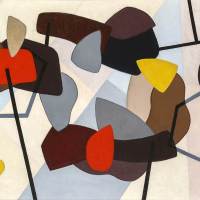
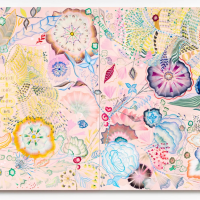
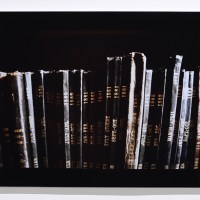
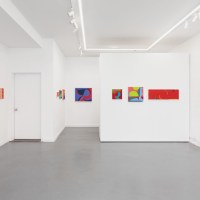
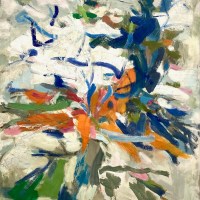
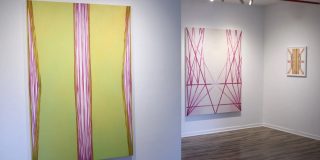
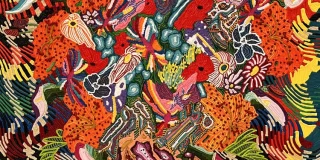
Contributed by Margaret McCann / In Clintel Steed’s show of paintings at Shrine Gallery, “Different Time Zones, Different Dimensions,” temporal experience is evoked through formal language as much as subject matter. In most, dynamic fragmentations of contemporaneity are fixed in static tessellations of paint. Richly varied shapes, packed in shallow space on dense surfaces, lead from abstraction to illusion.
Tag: Piet Mondrian
Peter Doig’s tropical opera
Contributed by David Carrier / Upon entering Peter Doig’s show at Serpentine South Gallery in London, you see Painting for Wall Painters (Prosperity P.o.S.), a vibrant depiction of a half-finished mural he photographed in the Port-of-Spain, Trinidad and Tobago’s capital city. If Henri Rousseau had actually gone to the tropics, and they had inspired him to intensify his pigments, he might have painted something like Doig’s three large-scale works, which feature sensuous, saturated colors depicting the Lion of Judah, a Rastafarian symbol, freed in the streets of the city.
Jack Whitten at MoMA: Indelible
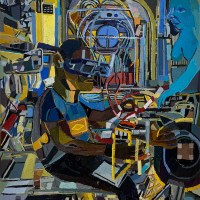
Contributed by Jonathan Stevenson / “The Messenger,” Jack Whitten’s momentous and flawlessly curated exhibition at the Museum of Modern Art, is a signal event not just in American art history but, arguably, in American history simpliciter. To be sure, it showcases an art polymath who broke and cultivated important ground across a broad swath of artistic endeavor. But its timing as a socio-political statement seems perhaps singularly important.
Rob de Oude: See what happens
Contributed by Jacob Cartwright / It is no contradiction to observe that Rob de Oude paintings in his solo show “Rhyme and Repeat” at McKenzie Fine Art are created with an exceedingly sober methodology, yet achieve intoxicating outcomes. To make something and to see something are two different things, and revealing the interrelationship between them— as de Oude’s do— is one of the greatest pleasures that paintings can offer. While it may seem inapt to call such an exacting technician an experimental painter, the designation fits. De Oude conducts his investigations in the controlled environment of his studio, where variables are adjusted with one goal in mind: to see what happens.
Theresa Daddezio: A pinball wizard’s aesthetic order
Contributed by Jason Andrew / In her new paintings in “Bloom” at DC Moore Gallery, Theresa Daddezio suggests an ornate elegance structured by a quirky sense of pinball-wizardry. Playful and lighthearted, each of the sixteen paintings in this packed show offers a vibrant world of color and fluid forms, simulating the visual experience of a flashy arcade. The paintings are spatially dense and lyrically conceived. Their all-over purity might tie her work to aesthetic movements like Neo-Plasticism. Indeed, her work, in Mondrian’s terms, expresses the “aesthetically purified” and ignores “the particulars of appearance.” Yet it also embodies a fantasized complexity that affords the paintings a dynamic arc. Daddezio has certainly found her cipher – an algorithm defined by petal-like structures, collaged color gradations, and zig-zagging linear forms.
Dannielle Tegeder’s freighted abstraction
Contributed by Riad Miah / Informed by early modernists such as Piet Mondrian, Kazimir Malevich, Wassily Kandinsky, and Stuart Davis, Dannielle Tegeder’s abstract paintings are in themselves traditional, painted with acrylic on stretched canvas. When displayed, however, their import extends beyond the canvas edges into wall paintings, immersive installations, and even musical collaborations, encouraging a searching and interactive viewing experience. Her solo show “Signals,” currently on view at Standard Space in Sharon, Connecticut, incorporates new elements into her visual vocabulary, including ladder mobiles, stained linen, and walnut panels, freshly drawing on other aspects of art history.
Martin Barré’s endless paintings
Contributed by David Rhodes / Matthew Marks’s current exhibition of Martin Barré’s paintings coincides with New York exhibitions of two other French painters: Alix Le Méléder at Zürcher Gallery and Simon Hantaï at Timothy Taylor Gallery. Together these shows furnish a good moment to consider the range and achievement of French postwar abstraction.
Piet in Pitt
If you’ve never been to the Stedelijk Museum in Amsterdam, you probably haven’t seen many of the Piet Mondrian paintings on view at the Andy […]