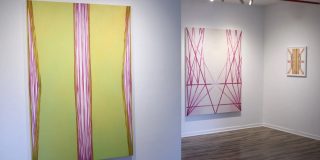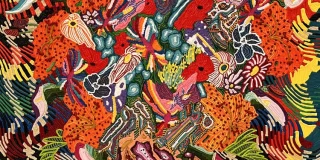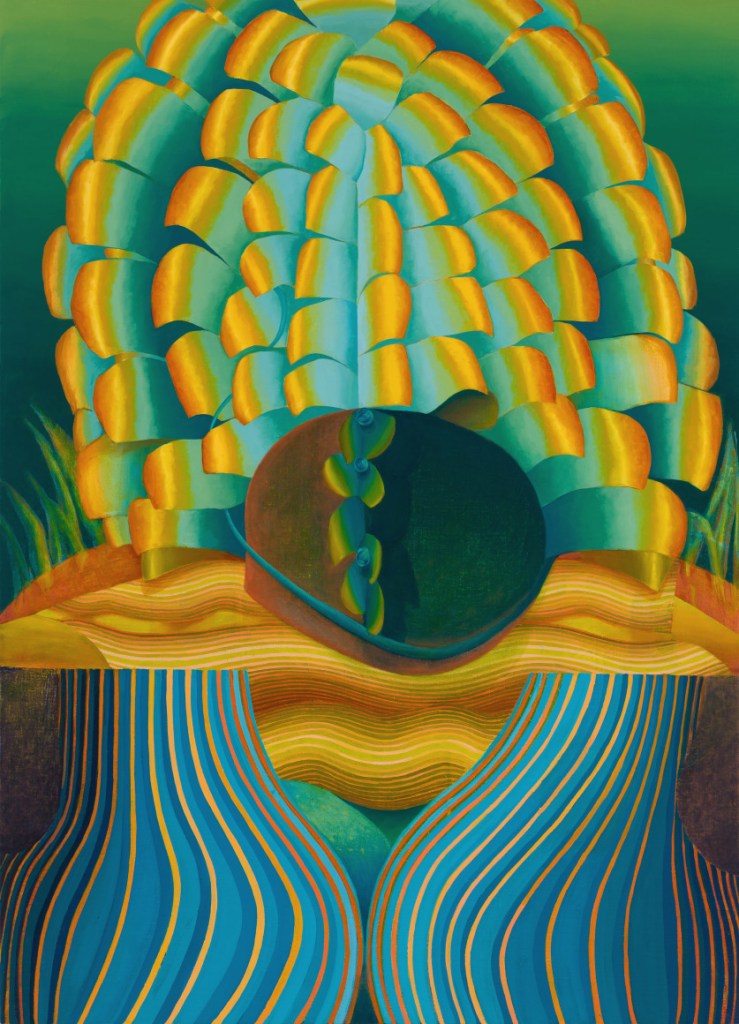
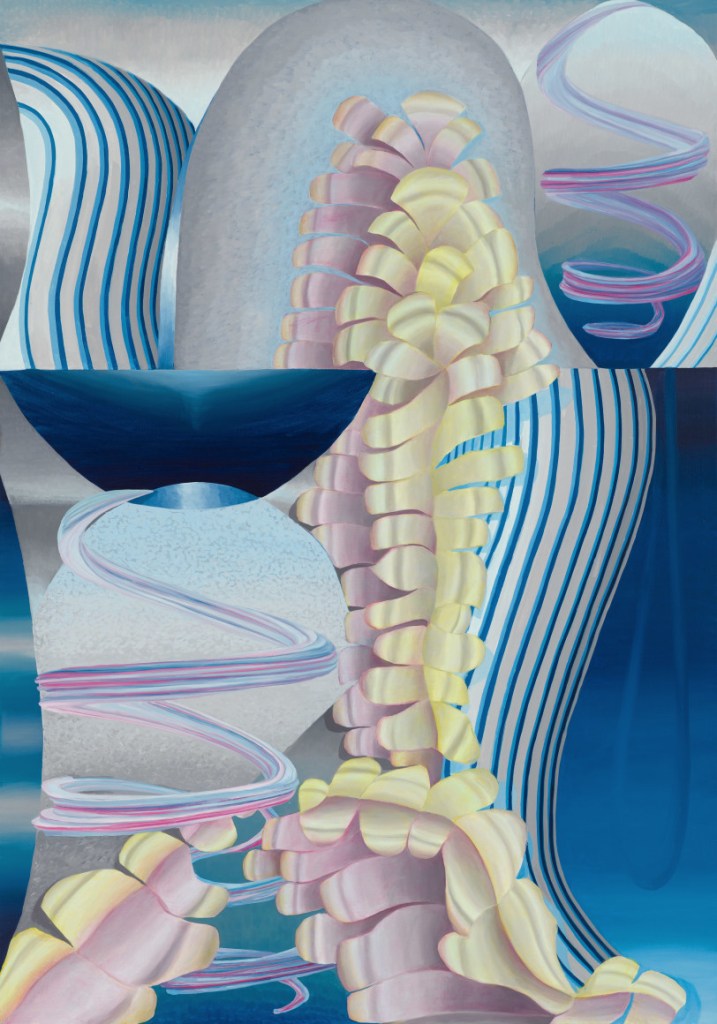
Contributed by Jason Andrew / In her new paintings in “Bloom” at DC Moore Gallery, Theresa Daddezio suggests an ornate elegance structured by a quirky sense of pinball-wizardry. Playful and lighthearted, each of the sixteen paintings in this packed show offers a vibrant world of color and fluid forms, simulating the visual experience of a flashy arcade. The paintings are spatially dense and lyrically conceived. Their all-over purity might tie her work to aesthetic movements like Neo-Plasticism. Indeed, her work, in Mondrian’s terms, expresses the “aesthetically purified” and ignores “the particulars of appearance.” Yet it also embodies a fantasized complexity that affords the paintings a dynamic arc. Daddezio has certainly found her cipher – an algorithm defined by petal-like structures, collaged color gradations, and zig-zagging linear forms.
I first encountered Daddezio’s work in the mid-2010s, and (full disclosure) I exhibited it in 2017. Then, as now, her work tracked a kind of spatial transcendentalism not unlike that of Agnes Pelton (1881–1961). Yet the more I see of her work, the more mathematical it feels, with a strong shot of gothic naturalism. At DC Moore, seven paintings feature constructions of crisp blooming masses. Some stack like bumper chakras, while others appear as decorative plumes atop faceless portraits.

Three motifs dominate the center plane in Lilith. The stacked flowering chakras offer a golden playing field for tantric meditation. Daddezio distinguishes body and cosmos by dividing the canvas into two sections connected by a pinball that spirals down a windy track. Seemingly primordial, the painting gives occultism, fantasy, horror, and erotica realness.

Daddezio explains “mystery and intimacy” – specifically from 14th-century Madonna-and-child paintings from St. Agnes Monastery in Prague – inspire this recent work. She has graphed spatial hierarchies from these medieval paintings “through a lens of the flattening and fragmenting of contemporary space.” In The Dove, Daddezio expressly revisits the imagery from Master of Grossgmain’s Coronation of the Virgin Mary (1480–1490), blending its rich symbolism with her own radiant interpretation of modern disconnection by reshaping the sacred into abstract futurist arrangements. This synthesis of past and present evokes a layered dialogue between history, spirituality, and personal iconography.
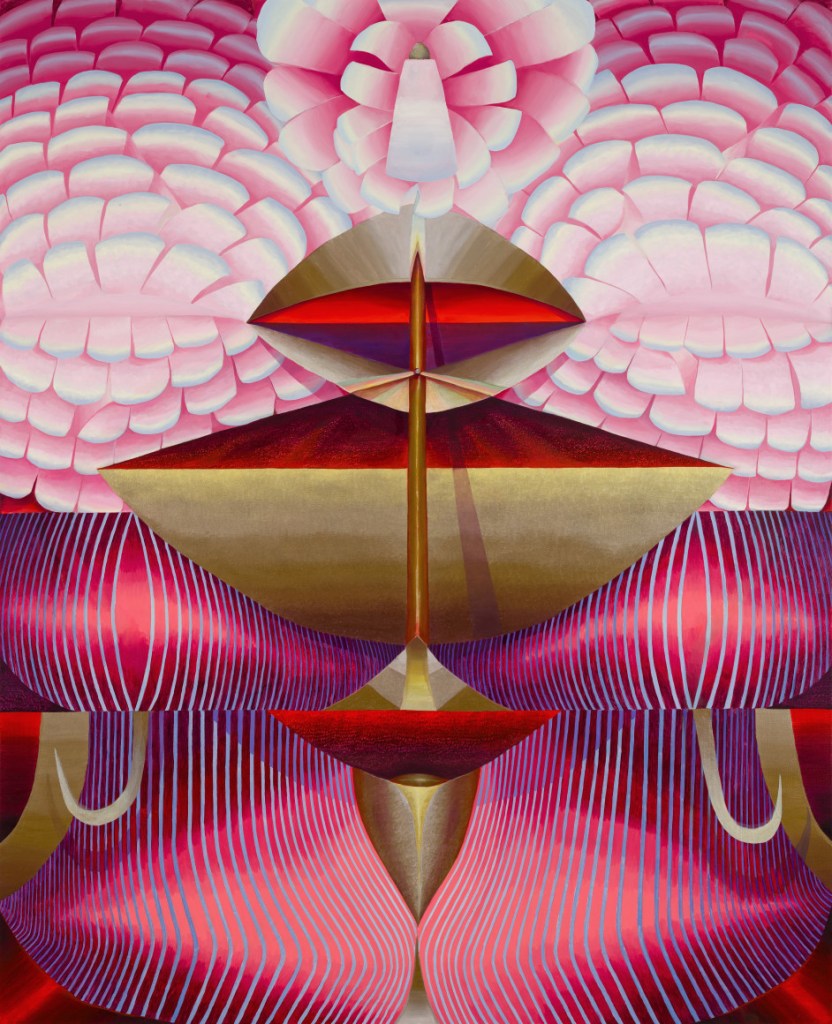
The Violet is composed in three parts – a flourishing field of pink pedals at the top, a pendulum anchoring the midline, and a baritone of linear waves at the bottom. It’s a towering piece, perhaps alluding to a trinity of creativity, balance, and interconnectedness.
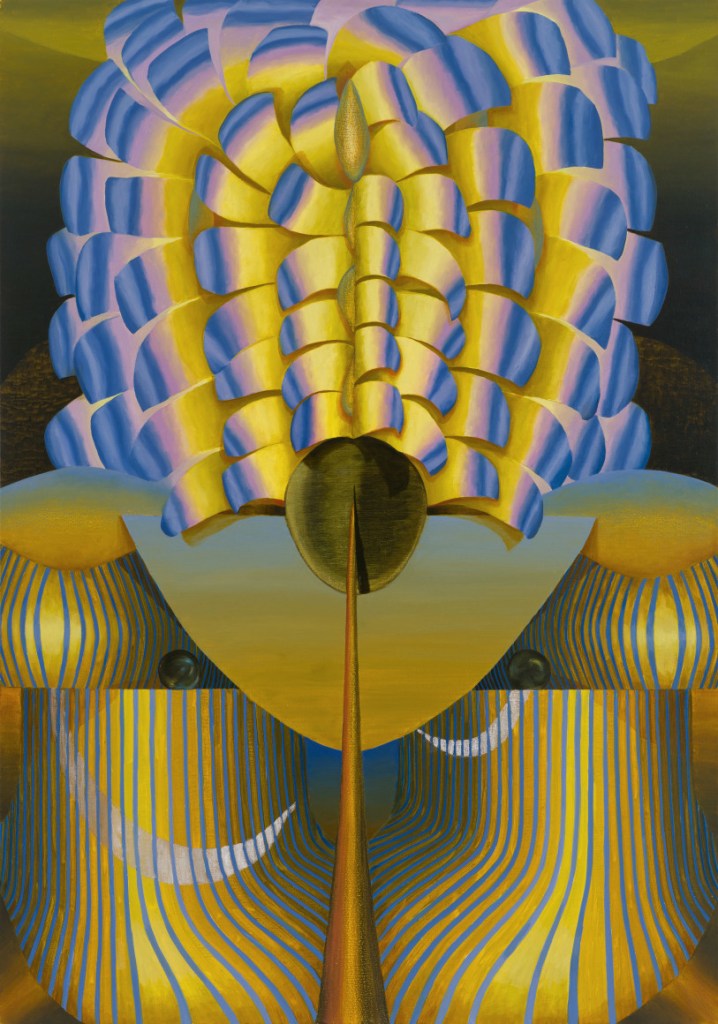
Presented like a portrait, Time Chamber features billowing peruke blooms atop a dark oval disc with stylized shoulder pads on either side. Two small silver gazing balls are suspended in a valance of linear couture. We feel transported to a future of power, wealth, and sophistication. At least two other paintings – Blue Thunder and Blue Amanita – share this quality.
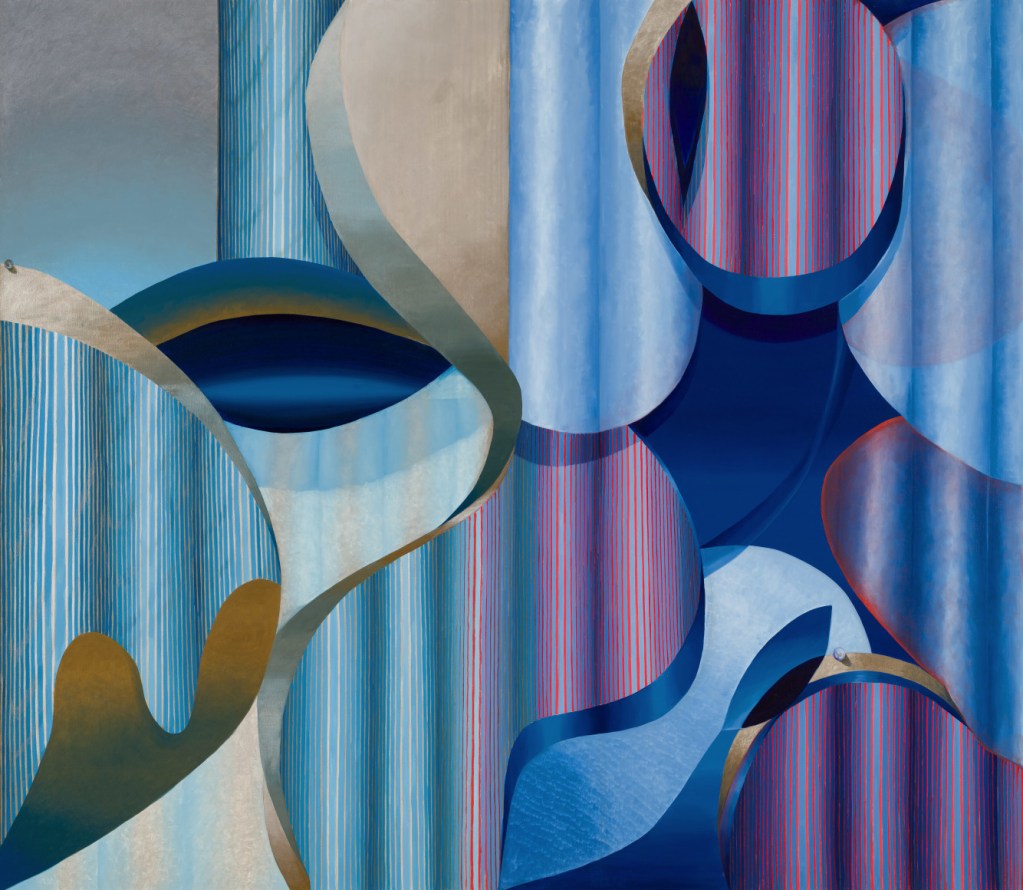
Awakening, the largest work, features large waves of ribbons flowing across a striped ground. Especially here, Daddezio’s varied brushwork creates shifts between layers, openings, and recesses within the plane of the painting, conveying movement and depth. An odd incoherence smothers any solid sense of rationality. Gravity and weight only seem to play out in two delicately painted pinballs placed on opposite ends of the painting; one senses the tension of a fall. If the painting was a pinball machine, you’d shake it from side to side to get the ball rolling again.
Several smaller paintings impart the same collaged incoherence, pushing – perhaps too emphatically – a resounding “more is more” aesthetic. Daddezio continues to ask the good questions, bumping against visual constraints and shooting for beauty. Her evolving aesthetic is proof she plays a mean pinball!
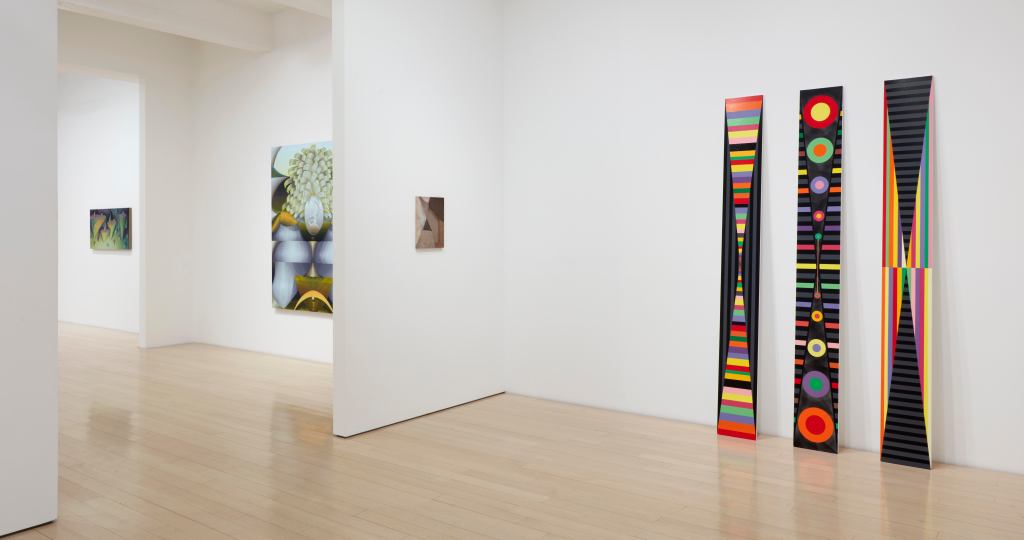
As an extension of her solo exhibition at the gallery, Daddezio has curated a group show involving artists who share her impulses. They include Alicia Adamerovich, Olive Diamond, Rico Gatson, Greg Lindquist, Amy Lincoln, Loren Munk, Roxy Paine, Hedda Sterne,and Martha Tuttle.
“Theresa Daddezio: Bloom,” DC Moore Gallery, 535 West 22nd Street, New York, NY. Through February 22, 2025.
About the author: Jason Andrew is an independent curator and writer based in Cypress Hills, Brooklyn. Follow him on Instagram: @jandrewarts