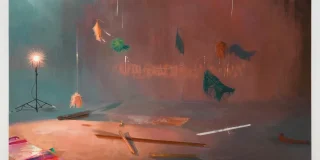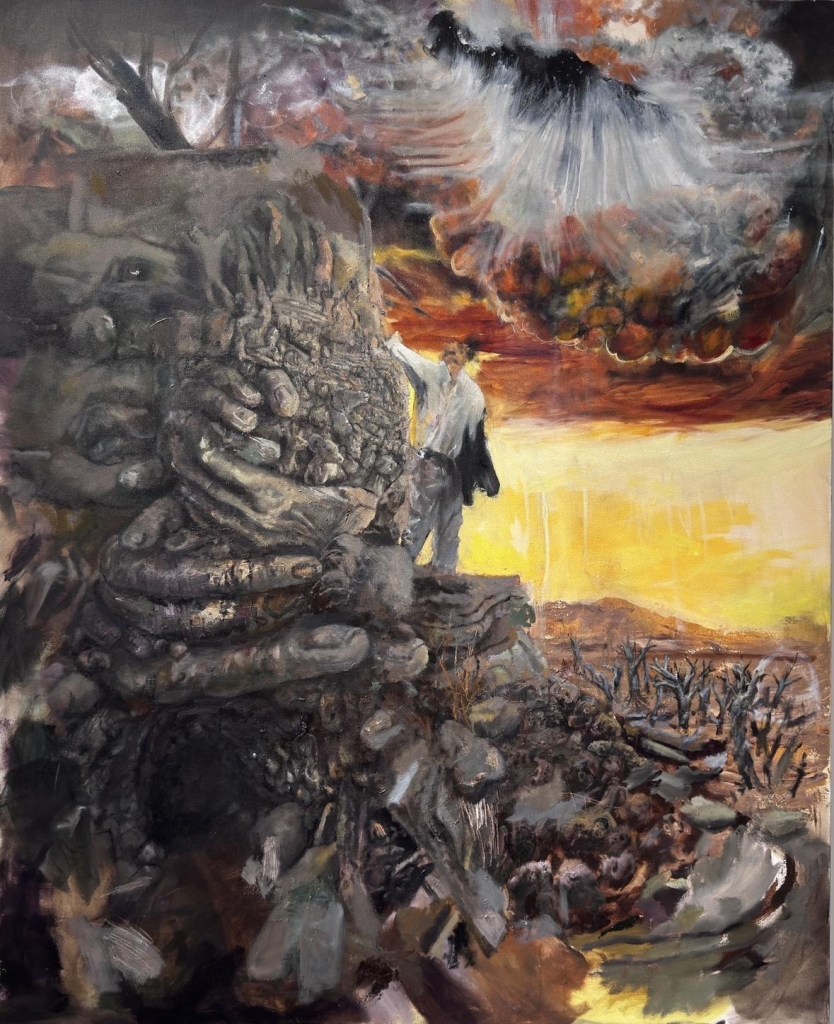
Contributed by Margaret McCann / Celeste Dupuy-Spencer (1979–2026) left too soon, but her candid, cynical expressions of Americana, angst, and injustice leave a powerful legacy. The poetically titled exhibition “Burning in the Eyes of the Maker” (Daniel Lanois lyrics) at Jeffrey Deitch Gallery has less of her colorful work. Even without the great Don’t You See That I Am Burning depicting January 6, the Trump zeitgeist is uncomfortably conjured and conjoined with (by the show’s timing and location) September 11 imagery. In the untitled painting above, nature is a wasteland through which Georg Baselitz’s itinerants, or the struggling painter, might stumble. “For me to paint,” Dupuy-Spencer admitted, “loneliness helps. Real, abject … a gaping maw.” An acrid yellow horizon yawns uneasily in the vast space. Like an unfinished painting, an inscrutable bas-relief gripped by giant hands withholds meaning from the lonely climber. White-collared, lost as the protagonist of the film Falling Down, he looks abandoned by past and future, like the exiled Dante. Disorientation replaces the faith guiding Friedrich’s wanderer, Coleridge’s optimist, Walt Whitman’s roamer.
32 x 42 inches
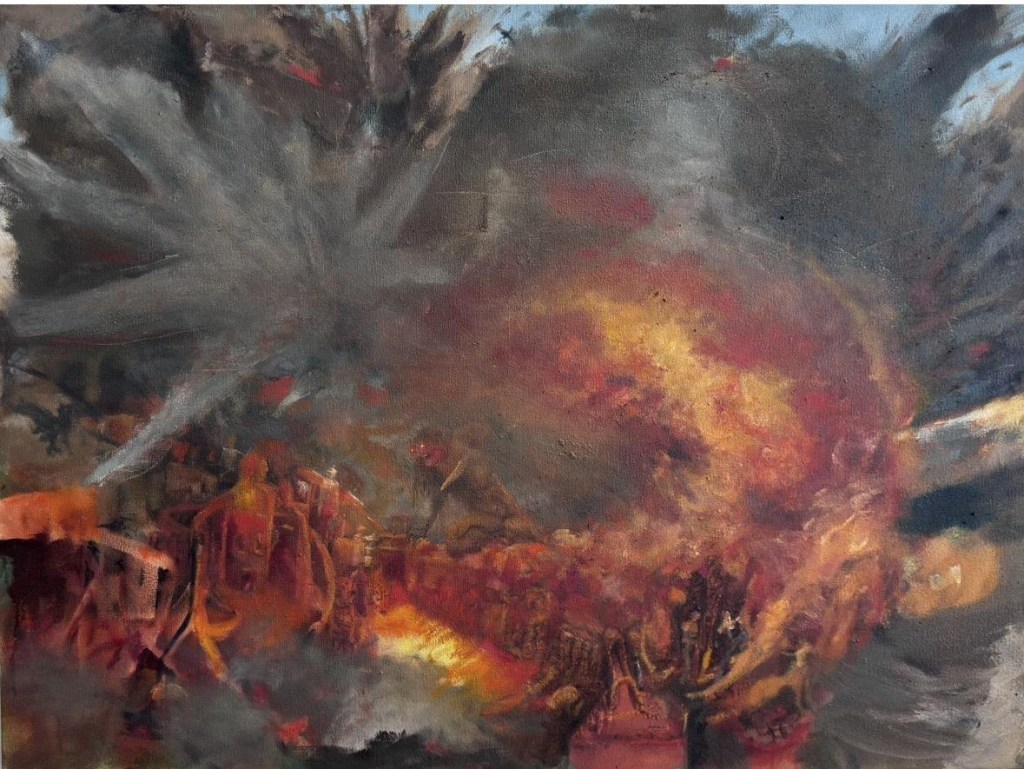
“Through painting, artists speak to one another across time, using fragments, gestures, and broken syntax,” Dupuy-Spencer attests in her compellingly written catalog introduction (her father authored the high intensity Endless Love). Engrossed in the studio over long hours, she incorporated AbEx methodology: “A mark was made. The painting answered, and I answered back.” In another untitled piece, she stopped as illusionism burgeoned. From a morass of color and texture begetting a gyre of smoke and fire, suffering figures emerge, like the soldiers fatefully overwhelmed in Albrecht Altdorfer’s Battle of Alexander.
oil on canvas, 42 x 32 inches
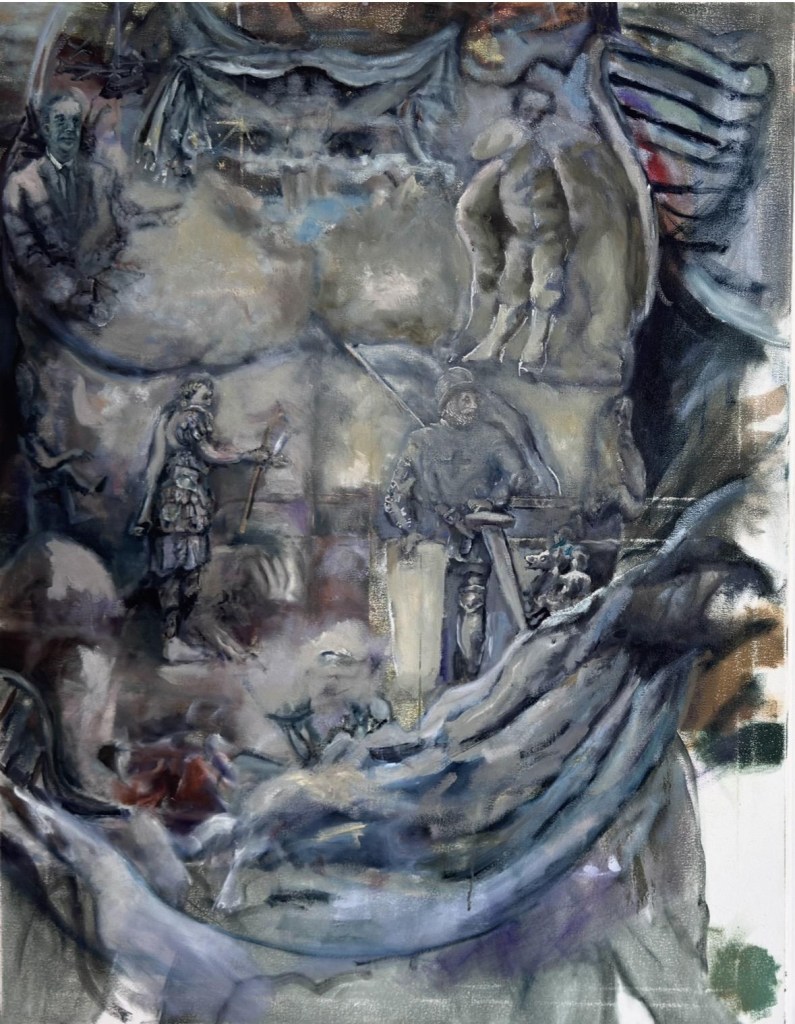
In Render Unto (the Long Chest of Empire), a knight, soldier, aristocrat, and academic strike poses or preside, adorning an armored classical torso like medals or tattoos, summoning Piranesi‘s wistful Roman visions, Mario Sironi’s fascist nostalgia, and de Chirico’s existentialist archeology. But the sarcasm of careless description tarnishes heraldry and subtle light. World-weary cynicism disparages humanism, verging on nihilism. A picture of pointless achievement, the eye scrolls top to bottom like an Instagram quest for significance, upwardly striving contenders all the way down.
2022, oil on linen, 114 7/8 x 210 1/4 inches
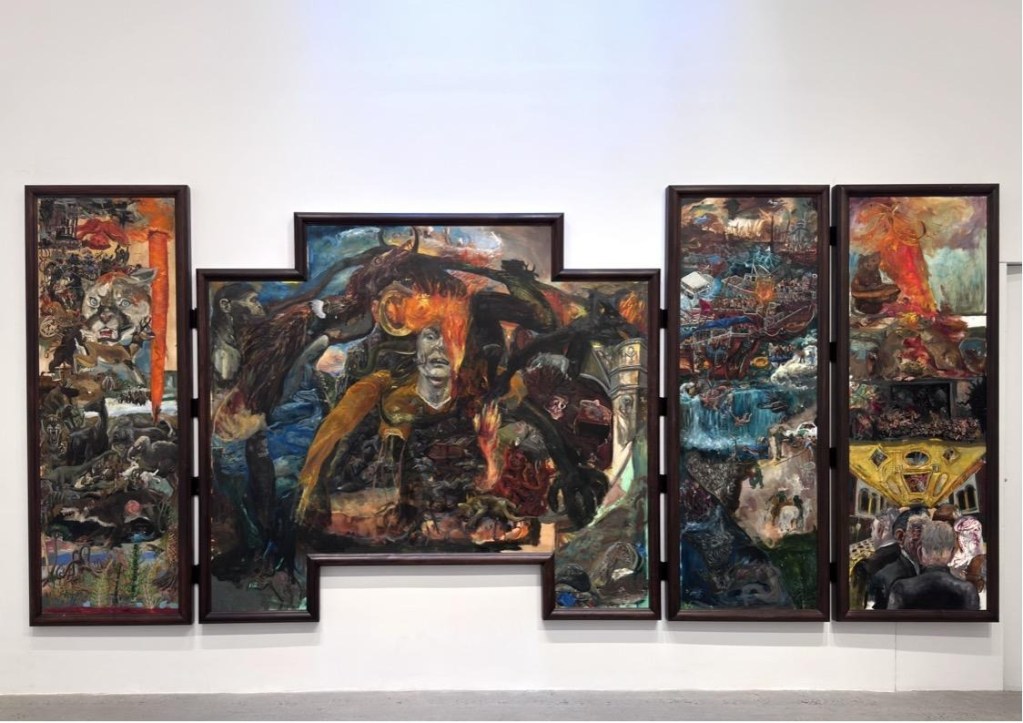
With the candor of Otto Dix, the large polyptych The Shape of the Rock That’s Hurtling Towards the Sea spans primordial conditions exploited by civilization to “rich men in their gold-plated bunkers.” Dupuy-Spencer found it “hard to be a Marxist in the art world,” bristling at her own success as her ideals fueled moral courage.
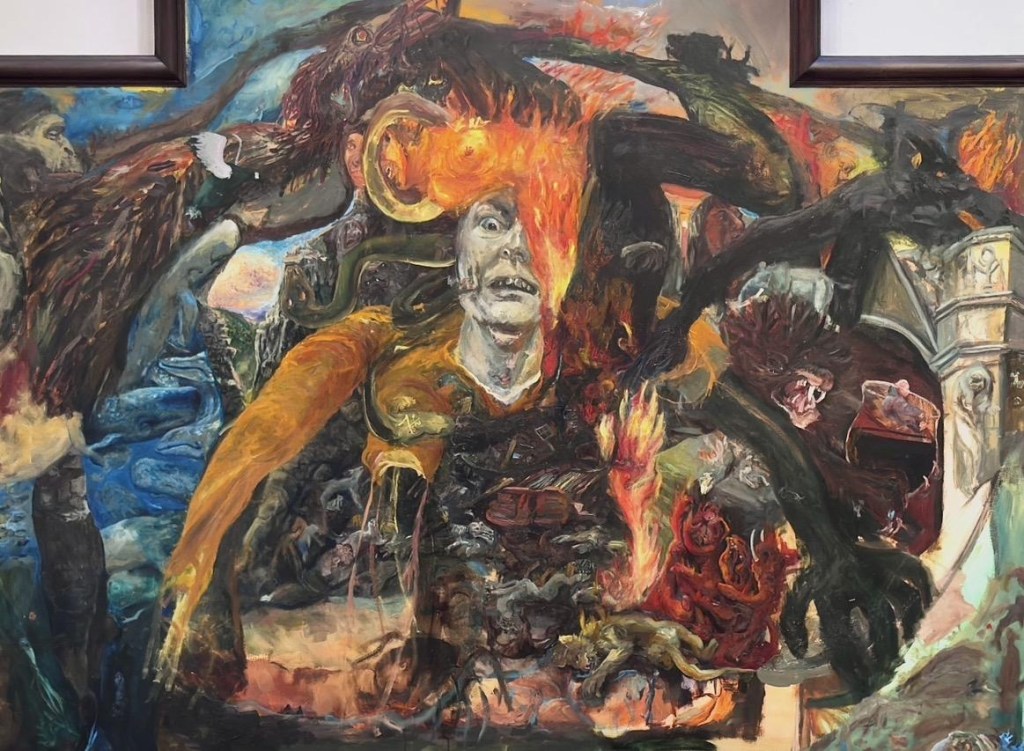
The central panel enshrines serial killer Eileen Wournos, a product of circumstances the painting argues, one of the “homeless daughters … with broken wings” the show’s title might imply. Her apocalyptic last words – “I’m sailing with the rock and I’ll be back like Independence Day with Jesus” – chime with Dupuy-Spencer’s biblical themes, pursued because “institutional distortion of religious imagery felt cleaner” than the art world. Dupuy-Spencer, who was trans but indifferent to pronouns, and atheist, was raised “culturally Jewish” – valuing critical inquiry and social justice. The incorruptible Jesus was her “ultimate rebel Jew.”
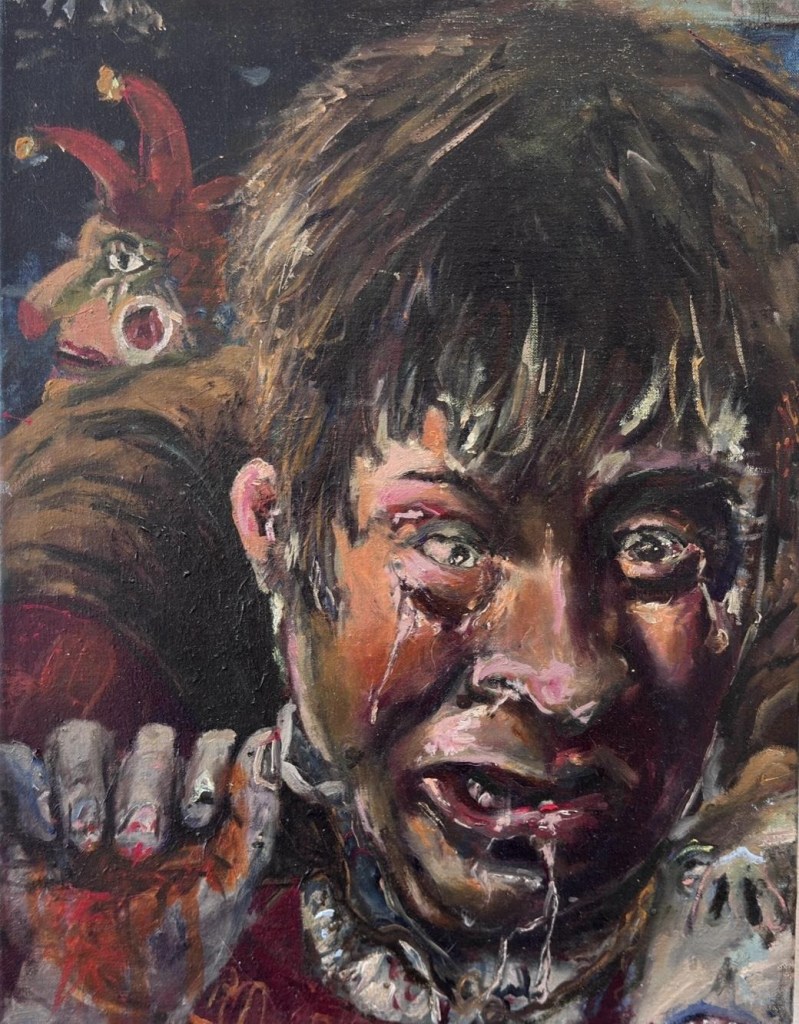
2023–25, oil on canvas, 18 x 14, inches
Mia Figlia!… Gilda! Mia Figlia! (Rigoletto) may be a self-portrait as masochistic Gilda, her foolish jester father unaware. Its execution is as crude as the opera’s narrative is painful. Rash brushwork and intrusive illusionism are ugly, raw, and out of control, but also empathic, honest, and vulnerable. Viewer sympathy and repulsion are guilefully made to contend. Like Pasolini, Dupuy-Spencer passed irony into opposition. Like the German Expressionists Dix, Ludwig Meidner, and Lovis Corinth, she dared us to look and feel. Yet tears and saliva gushing from the surface are also grotesquely amusing, like R. Crumb’s sad-sack humor.
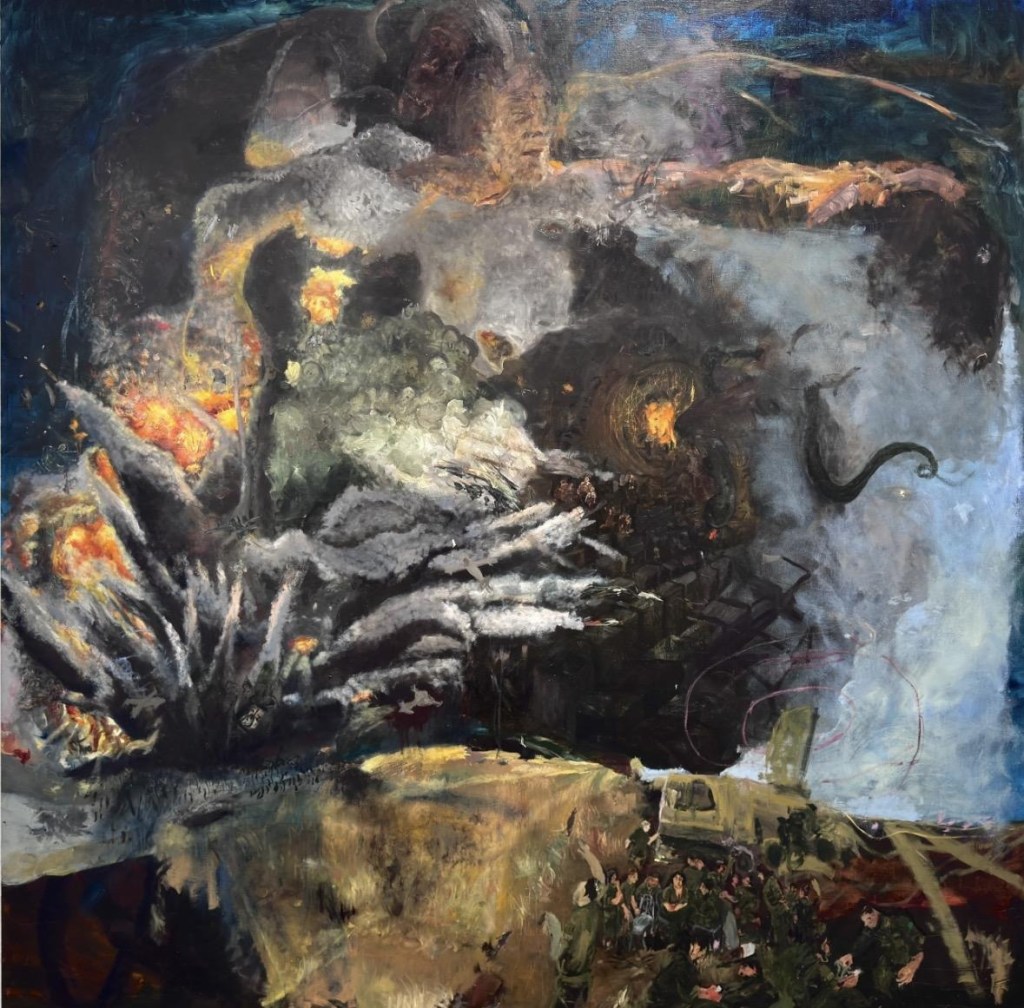
2024, oil on canvas, 85 x 85 inches
Dupuy-Spencer’s landscapes echo the modern sublime of Paul Nash’s battlefields. The title A Long Fracture Ruptured (Violation of Innocence) likely conveys her opposition to Israel’s heavy response to Hamas’s October 7, 2023 attack. Minuscule body parts explode from bursting bombs, survivors scramble below. Vague figures above may be inept masters of war or karmic ghosts. Thought and feeling pouring through paint, Dupuy-Spencer’s testaments aren’t sad retrospectives but, like Meidner’s, engagements with crisis.
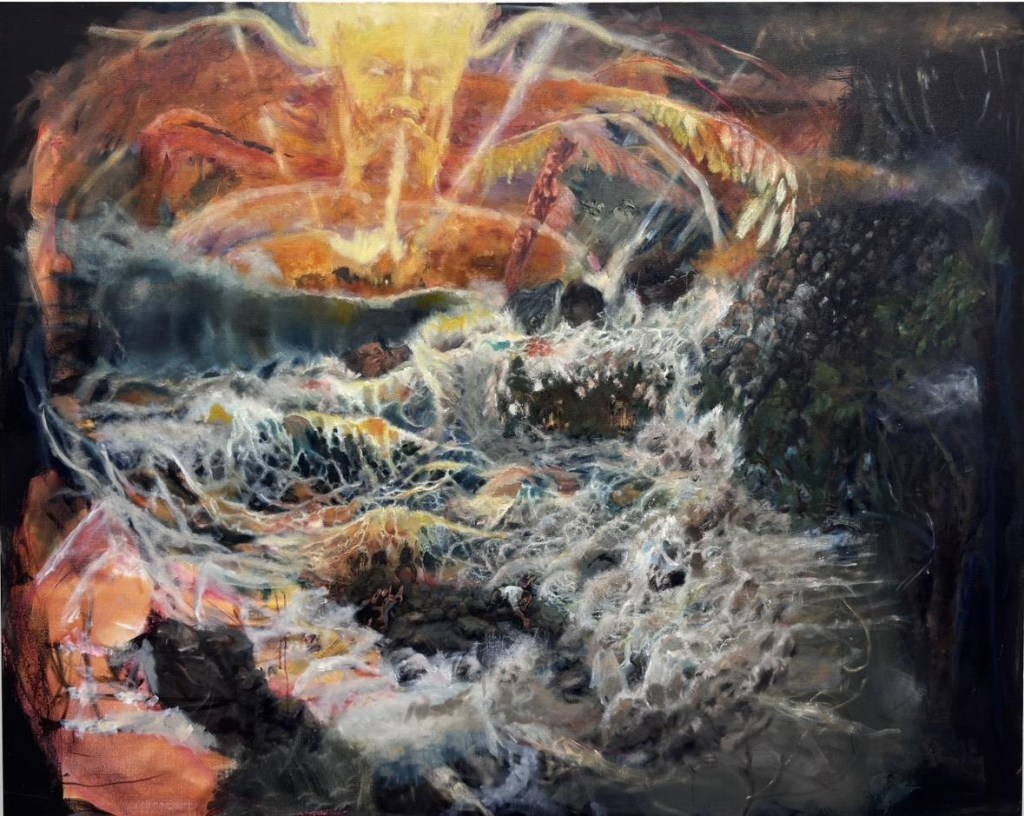
A cosmic untitled painting echoes Giovanni di Paolo‘s creation and Bosch-esque omniscience. Dupuy-Spencer exceeds Titian‘s unreachably backlit Maker of The Assumption, hers engulfed in fiery luminosity and huge in scale. Tiny, compliant figures look too close to the sun and lost at sea, facing a climactic end or final judgment. Is this monstrous supernova breathing fire into a new galaxy, or simply Satan or the Antichrist? Trumpian doom hovers. Terribilita is both frightening and glorious, and a metaphor for eternal regeneration – Nietzsche’s Zarathustra resetting the universe. Image and artist bring to mind Gerard Manley Hopkins’s poem That Nature is a Heraclitean Fire and of the Comfort of the Resurrection, which concludes:
Across my foundering deck shone
Fall to the residuary worm; | world’s wildfire, leave but ash:
A beacon, an eternal beam. | Flesh fade, and mortal trash
In a flash, at a trumpet crash,
I am all at once what Christ is, | since he was what I am, and
This Jack, joke, poor potsherd, | patch, matchwood, immortal diamond,
Is immortal diamond.
“Celeste Dupuy-Spencer: Burning in the Eyes of the Maker,” Jeffrey Deitch, 76 Grand Street, New York, NY. Through October 31, 2026.
About the author: Painter and art writer Margaret McCann teaches at the Art Students League. She has shown her work at Antonia Jannone in Milan and been reviewed in La Repubblica, Corriere della Sera, and the Huffington Post. She edited The Figure (Skira/Rizzoli, 2014) for the New York Academy of Art and has written reviews for Painters’ Table, Art New England, and Two Coats of Paint.