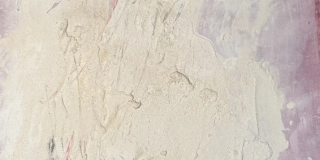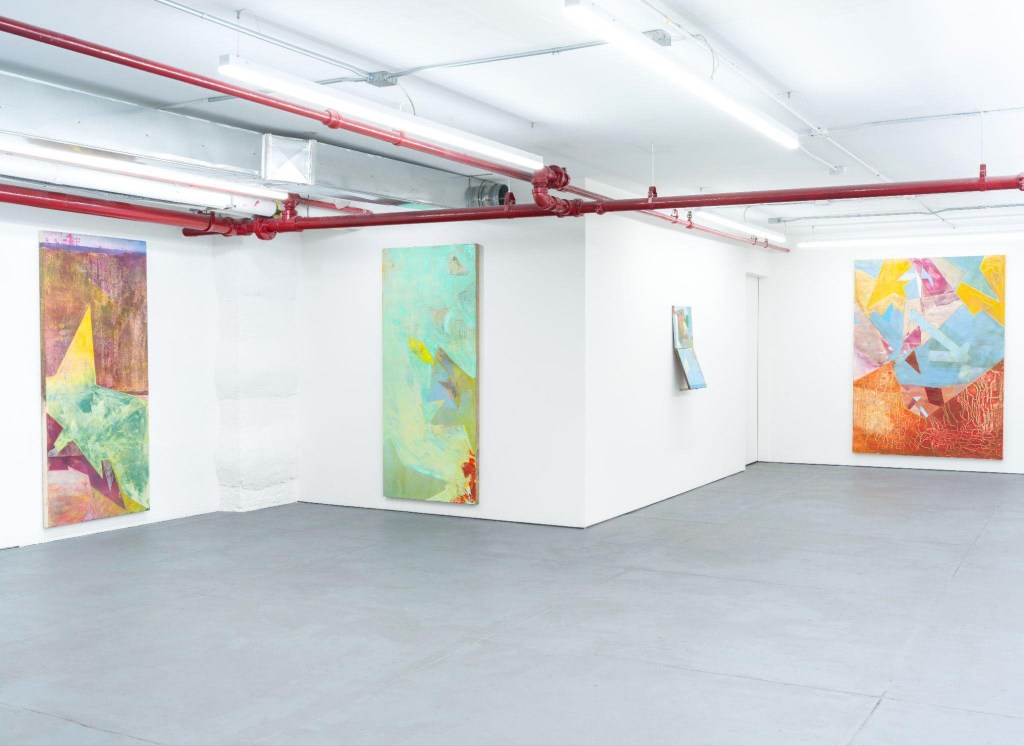
Contributed by Lucas Moran / Painting has died a thousand ersatz deaths, but artists are not immune to despair. Many of us are wondering what it’s all for. Nobody is buying art and we’re all grappling with media addiction. Through a haze of distress and distraction over political and cultural collapse, it’s tempting to dismiss traditional arguments for the importance of art even as a refuge from crisis. But that’s the attitude the billionaires and robots want us to adopt, wresting us so completely from joy and beauty that we remain glued to our tiny screens, held captive by reminders and notifications. Some of us keep trying to show anyone willing to look up that the world is a much bigger place. Rauschenberg achieved that kind of jolt in the 1950s with Monogram – a taxidermized Angora goat with a tire around its midsection, standing on a painted and collaged canvas laid horizontally on a platform. Perhaps to be an effective painter in the current existential mess, you need to show us your goat? In his solo show “Compression” at D.D.D.D. gallery, Jan Dickey valiantly tries. His new large-scale works made me want to yell about painting what Dr. Frankenstein yelled about his monster: “It’s alive!”
Dickey says, “I’m a painter – an American painter.” This suggests a willingness to move beyond the themes of alchemy and destabilization that characterized his earlier work and engage more directly with the longer history of American abstraction. Such efforts face plenty of potential pitfalls. Many established artists have undertaken them. If it’s trite and referential, it adds up to zombie formalism. If it’s colorful and compositionally witty, it’s design. If it’s purely painterly, it’s probably been done. Dickey, however, makes painting feel new because he’s both honest and tricky. These works operate as unabashedly dynamic, gestural abstractions, yet they’re composed of volatile materials including distemper, cochineal, black walnut, oil, acrylic, muslin, canvas, and linen, left to age and weather.
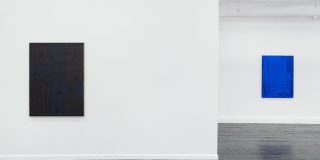
He sticks to fields of color, allows a drip to take on its own meaning, and renders the surfaces reminiscent of used cardboard, weathered storefronts, or faded exteriors from a bygone era. At the same time, they feel combustible. Shadow, for instance, embodies a raw canvas border that runs from the top right down its left side, only to be interrupted by a shape poking through at the top, balancing a jumbled arrangement of intersecting angles, awkwardly stacked and compressed. Building a sustainable composition with such extreme tension is an accomplishment, and there are moments of real brilliance. An avalanche of violet comes pouring in from the left border, only to meet a barrage of shapes, angles, and surfaces that trace the painting’s inner workings. Toggling between control and instability, contours wobble just out of step with hard edges.
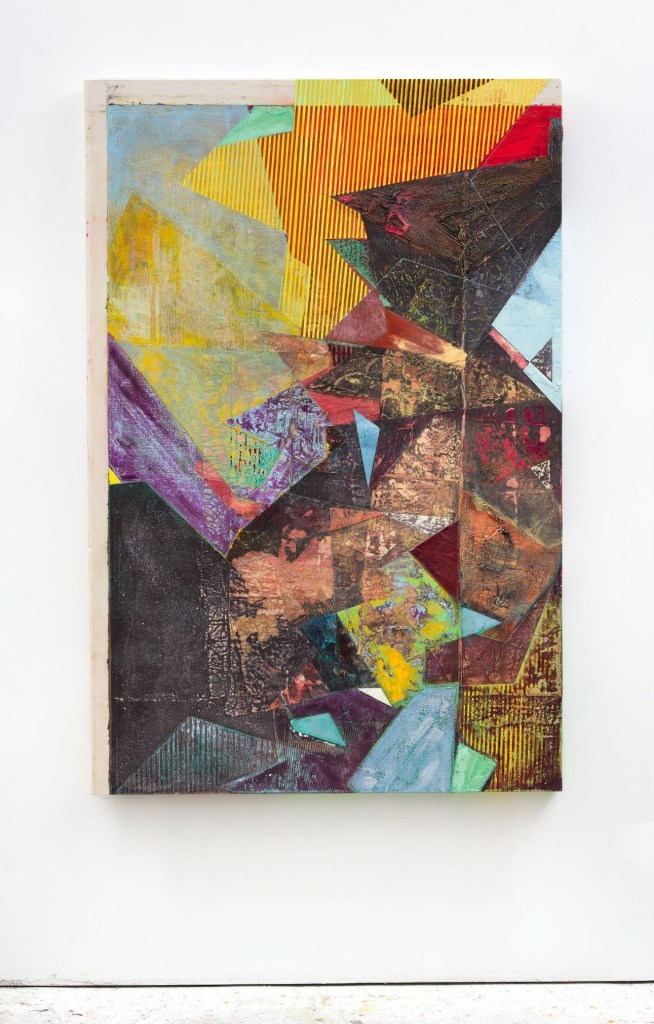
cochineal on relined muslin, 60 × 40 inches
Jungle Atlas might seem underdone at first blush. But part of its appeal is the way it invites you to search the surface for clues to its own history. A vertical painting in shades of impressionist teal, mint green, green gold, and Hansa yellow, it features a central shape that behaves like lightning, careening before striking the bottom-right corner in brilliant cadmium red. Underpainting emerges fleetingly, encouraging the eye to linger before registering the final red disturbance. Likewise, Catastrophic never quite feels settled, and that’s arguably a virtue. The palette is limited, featuring what is apparently black walnut stain with a crimson hue emerging at the center, flanked by three cream-colored stars that parade across the painting as they implode or ignite. A broad strip of raw canvas spans the top, interrupted only by small, faint stains that echo the crimson below. A wide yellow band runs along the bottom, just behind the largest and most impaired star. The painting, so economically generated, feels like a bold event.
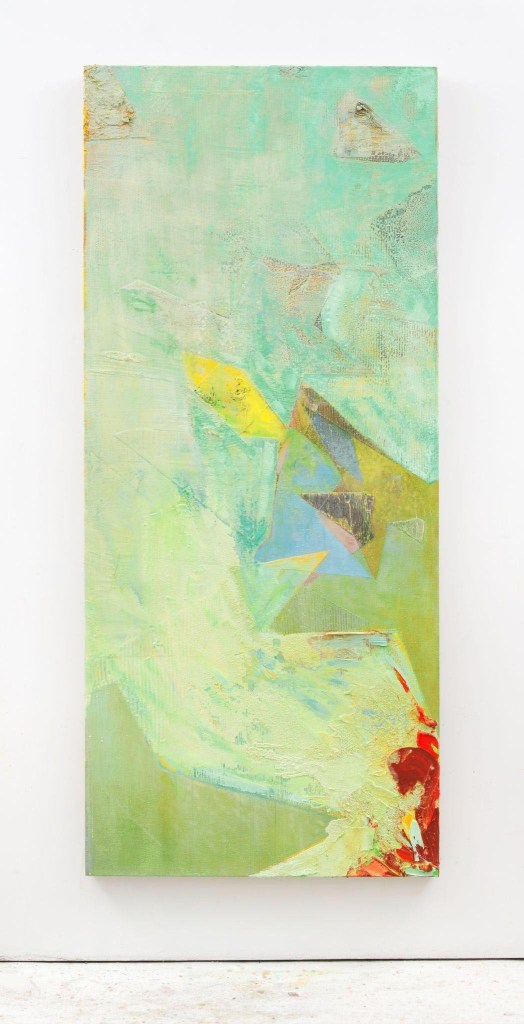
80 × 35 inches
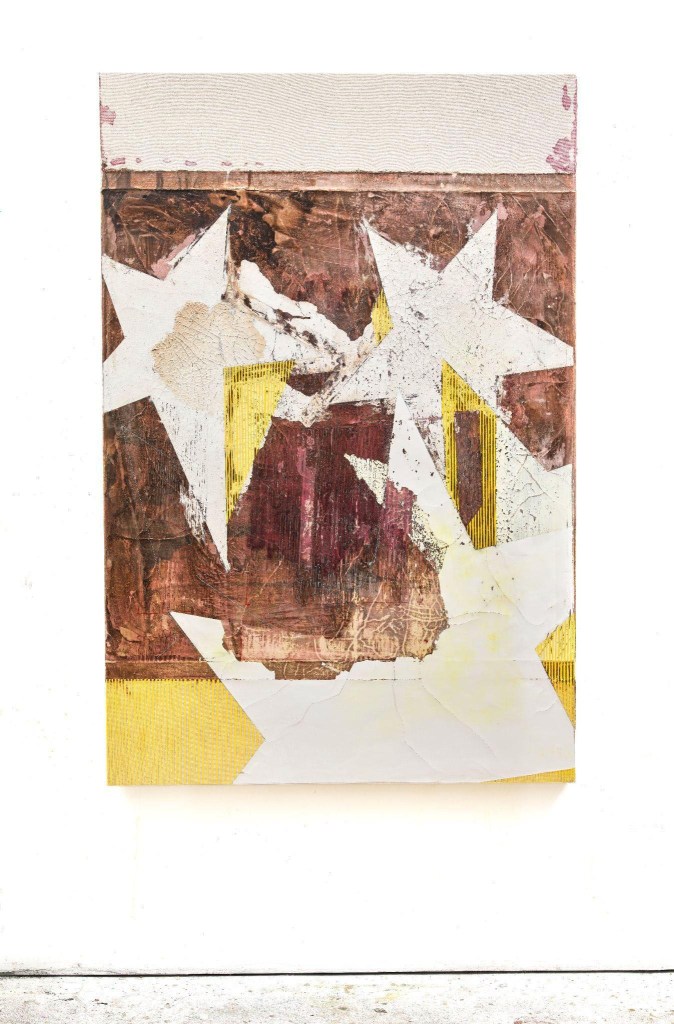
black walnut, cochineal on canvas, 60 × 40 inches
Border Lands and Border Towns feel safer, relying on the formal novelty of a diptych in which the bottom painting hinges outward from the wall, which Dickey has employed before. The idea is to nudge paintings towards the category of objects. In previous shows, he’s given viewers gloves so they could examine both sides of a canvas. Here, though, the device feels soft in comparison to the edgier work, in which Dickey moves closer to brandishing his goat.
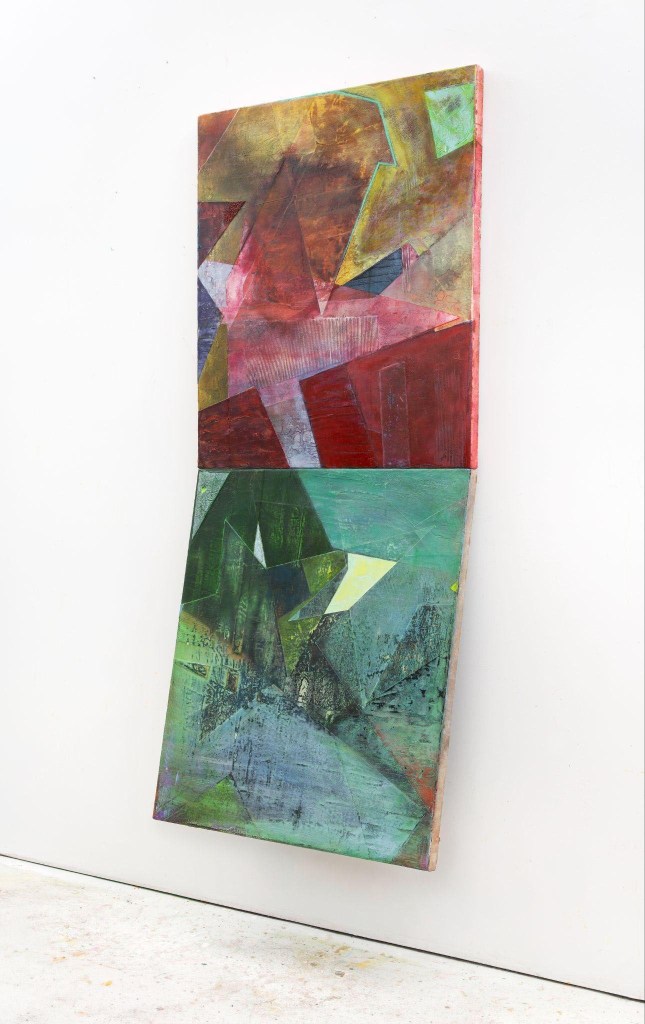
67 1/4 × 29 1/2 inches
“Jan Dickey: Compression,” D.D.D.D. Pictures, 79 Leonard Street, New York, NY. Through November 14, 2026.
About the author: Lucas Moran is an artist and writer based in Brooklyn. Moran’s paintings have been included in many shows in the United States and Canada, and he has had several solo shows in New York City.