
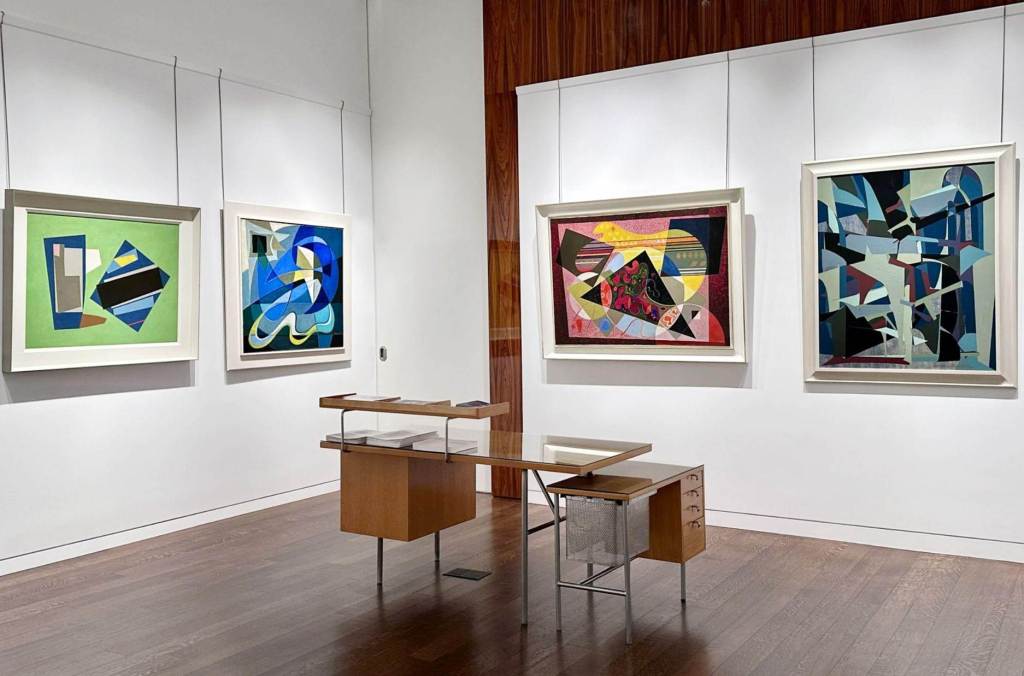
Contributed by Jacob Cartwright / In 1957, Clement Greenberg penned the essay “The Late Thirties in New York,” reflecting on years that were formative for both him and American art. He noted that during that decade “the big event, as I saw it, was the annual show of the American Abstract Artists group.” The artists who formed American Abstract Artists (AAA) first began meeting in 1936, in response to curators like MoMA director Alfred Barr, whose formulation of abstract art didn’t extend beyond the European continent. By 1937, AAA had begun organizing the regular New York City group shows that so impressed Greenberg. An exhibition at D. Wigmore Fine Art – devoted to AAA’s founding members and in observance of the group’s 90th anniversary – offers a fine opportunity to appraise these artists and the pivotal era they helped shape.
This is a generous exhibition; its scope and depth seem circumscribed only by the limits of the gallery’s wall space. Still, a few caveats are in order. Chiefly, key founding AAA artists – such as Josef Albers, Ibram Lassaw, and Ad Reinhardt – are missing, while Alice Trumbull Mason is represented only by a drawing. Consequently, the show makes no claim to being a definitive history. Similarly, although there are gems aplenty, this is an uptown gallery show rather than a major museum survey. Private collections have consigned these works for sale. For every top-shelf work, there is a charming piece by an artist whose most significant paintings reside in collections like the Whitney’s. That said, what the show lacks in authoritativeness it more than makes up for with the in-depth scholarship of gallery director Emily Lenz, who provides an opportunity to explore the era’s lesser-known corners.
In his essay, Greenberg offered his full-throated endorsement, and then qualified it in the next sentence, noting that the AAA’s ranks didn’t include key figures like Arshile Gorky, Willem de Kooning, and Hans Hofmann. The organization’s actual history is more nuanced than this implicit downgrading implies. Both Gorky and de Kooning participated in the meetings that led to the group’s formation; Gorky eventually stormed out after unsuccessfully trying to seize the reins of the collectivist-oriented group. Hofmann’s school – along with the Art Students League, where he also taught – served as a key crucible for many AAA members. Still, it was a group at the center, but not necessarily the forefront, of art history.
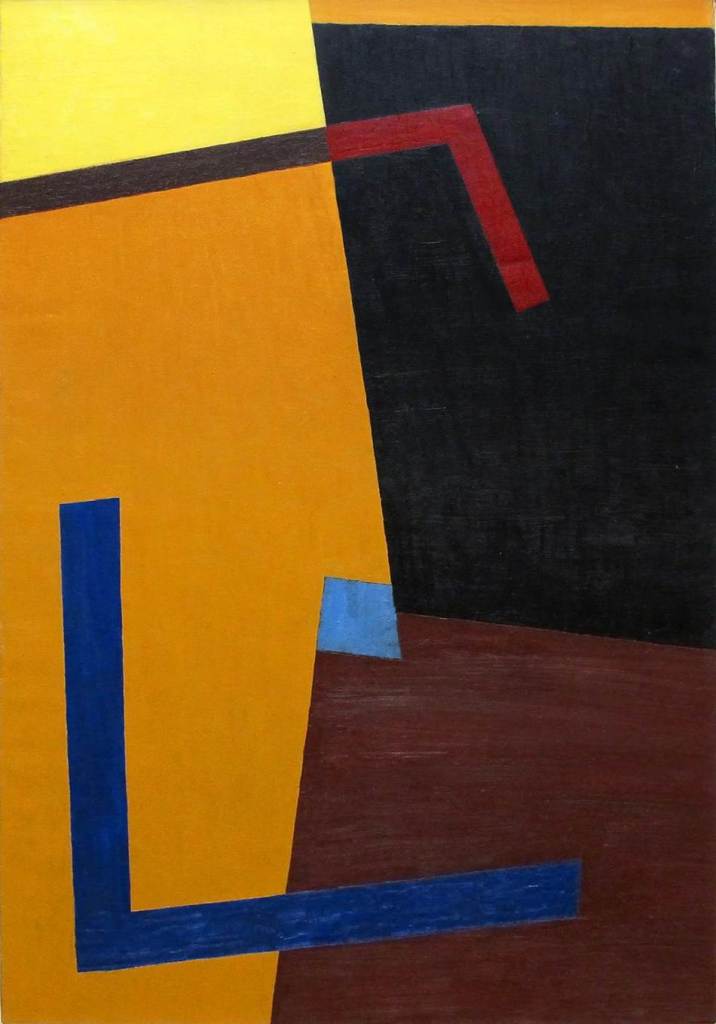
A stately work by Albert Eugene Gallatin is an ideal starting point for viewing the show. The painting epitomizes the charm of these artists during the period: a restrained yet jazzy composition that is fully aware of European modernism, yet aligned with the bold, energetic buzz of a young nation on the rise. Even the palette, with its mustardy orange, feels delightfully of its time. If I were a set designer for a film set in New York City in the 1940s, I’d put this painting in the background of a scene set in an Upper East Side study. By the same token, for all its appeal, the piece does feel learned and stage-directed rather than hard-earned and deeply felt.
The main reason I single out Gallatin is that his relevance extends well beyond his painting practice. Gallatin was one of New York’s most important collectors of contemporary art, and it’s hard to overstate the influence of the work that he assembled. Not only did he build a world-class collection of modern art, but he also, in 1927, opened the Gallery of Living Art at NYU, making it free to the public. When fellow AAA member Carl Holty remarked that “Mondrian had no effect on America during his lifetime that he didn’t have before he came here,” it was largely because Gallatin had exhibited Mondrian’s work, alongside strong examples of Cubism and Constructivism, at his gallery in Greenwich Village. European figures like Jean Hélion, Fernand Léger, and Mondrian, all later inducted into AAA, owed a great deal of their early exhibition history in the United States to Gallatin’s gallery.
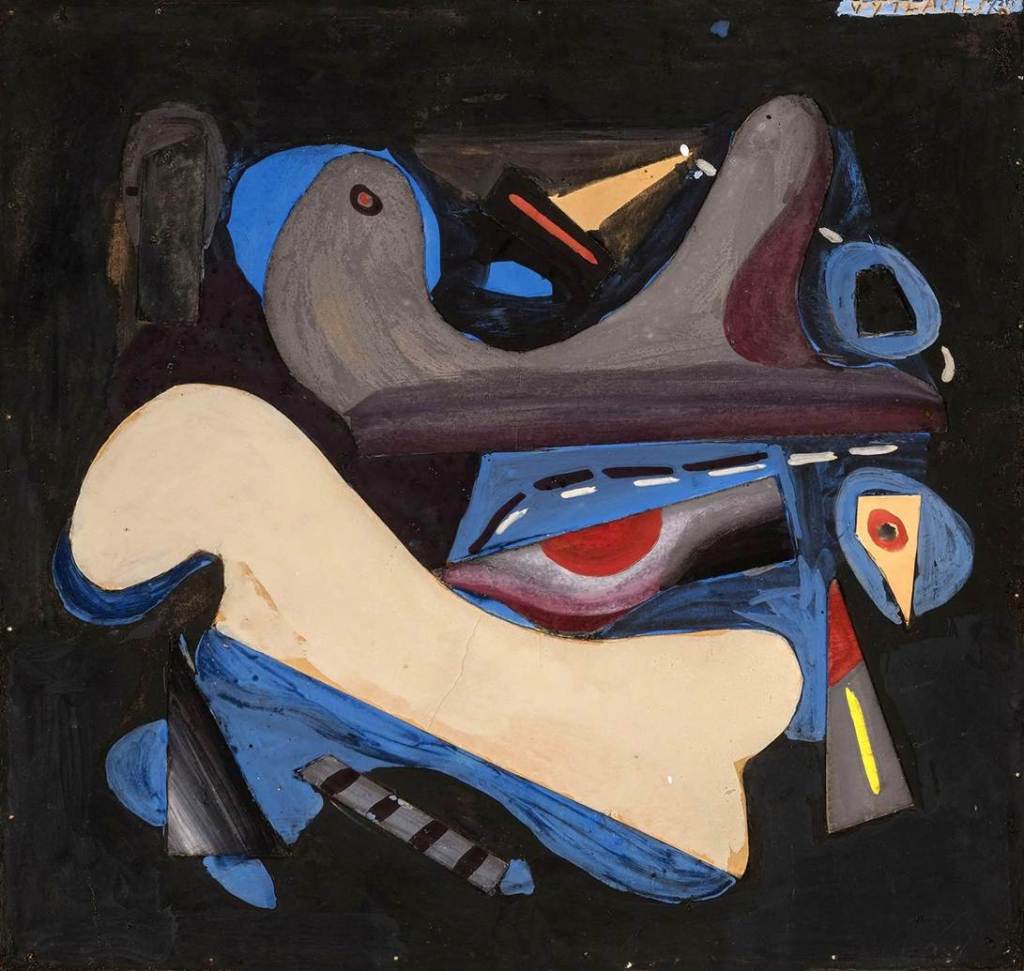
Gallatin and Albers, along with Vaclav Vytlacil, were doyens among the AAA’s founding members, representing the older generation of the group. Vytlacil taught at the Art Students League, where he was an early exponent of the tenets Hofmann, who began teaching in the United States in 1932, advanced there. Overall, then, the League served as a kind of Cubist incubator. It was the first meeting place for AAA members. Student shows were organized where young, plucky, and soon-to-be AAA members, like Burgoyne Diller, Harry Holtzman, and Albert Swinden, were positioned as “American Cubists.”
An undoubted strength of D. Wigmore’s exhibition is its account of young American artists absorbing the implications of Cubism, which by the 1930s had undergone transmutations that went well beyond the original Analytic and Synthetic varieties in France and included Vorticism, Futurism, and the additional “isms” from other countries. To get the latest reporting on trends in advanced European art, these artists had been reading Cahier’s d’Art, whose black-and-white illustrations, as Greenberg noted, left them free to develop their own color sensibility.
The show reveals a cohort of artists eagerly digesting the full range of European abstraction while at the same time attempting to take the next step. Collage and assemblage are the linchpins, even when they are merely bringing a collage-like sensibility to a painting. When observing these artists trying their hand at various pictorial strategies, it is helpful to recall their relative youth. When Ibram Lassaw hosted the first meeting of nine artists in his studio, he was only 23 years old. The youngest attendee, Rosalind Bengelsdorf, was 20; Albert Swinden, at 35, was the elder statesman. Despite the name they eventually adopted, they focused heavily on European artistic achievement and tended to marginalize their American predecessors. Stieglitz’s stable of American modernist painters – Georgia O’Keeffe, John Marin, Marsden Hartley, and Arthur Dove – scarcely seemed to factor in at all. Stuart Davis was the sole exception, and even Davis’ briskly delineated planar color is present only insofar as it is repurposed.
.
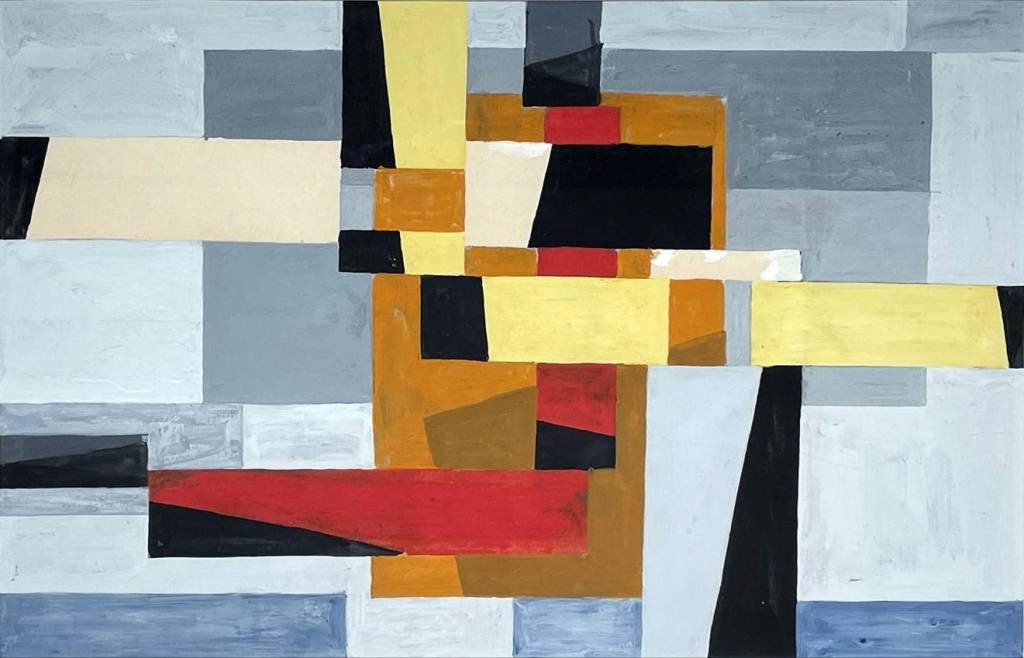
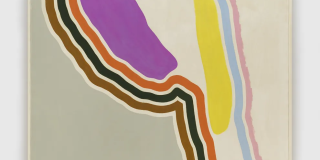
Based on these ingredients, I find Swinden’s work of the period to be particularly successful gumbo. Some pieces in the show suggest artists trying things on – a feeling that will be familiar to any student of art who has been compelled to navigate without a sure compass. Swinden’s paintings, however, reflect a degree of confidence that freed him to explore a rhythmic approach to composition that I’d rate nearly equal to Reinhardt’s contemporaneous work (Swinden can’t match Reinhardt’s instinct for color). D. Wigmore’s presentation offers two small but exquisite Swinden gouaches, and the Whitney has a painting on canvas where you can see his ideas blossom.
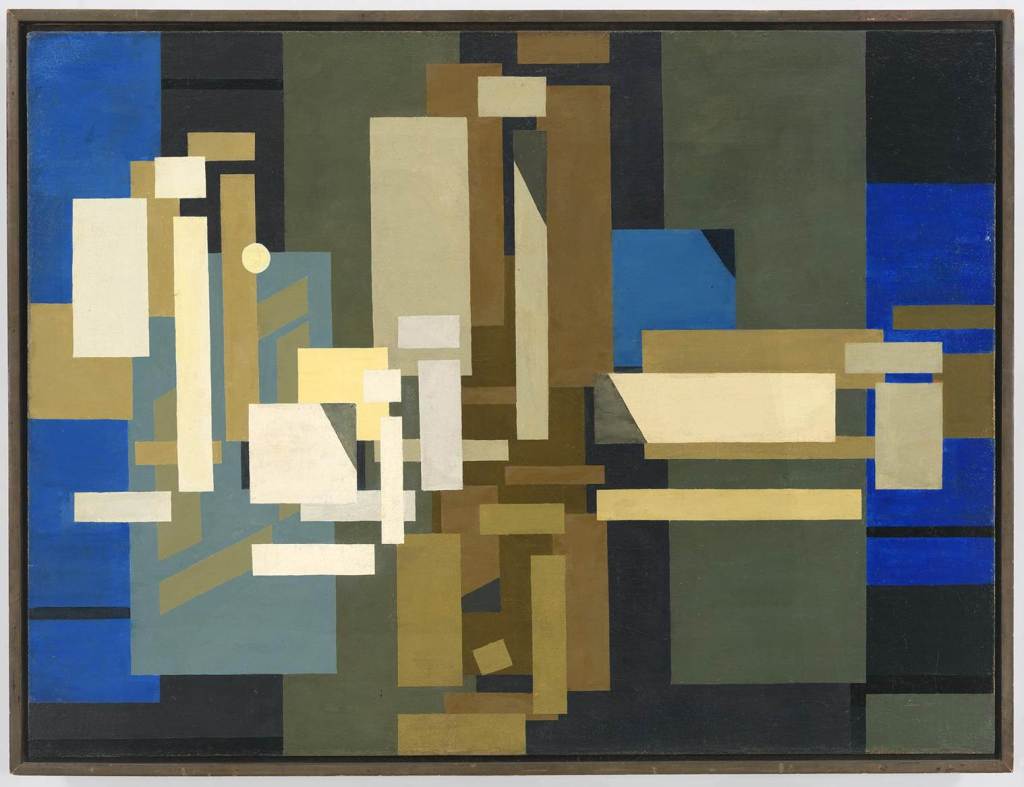
Courtesy of the Whitney Museum of American Art, New York, © Estate of Albert Swinden
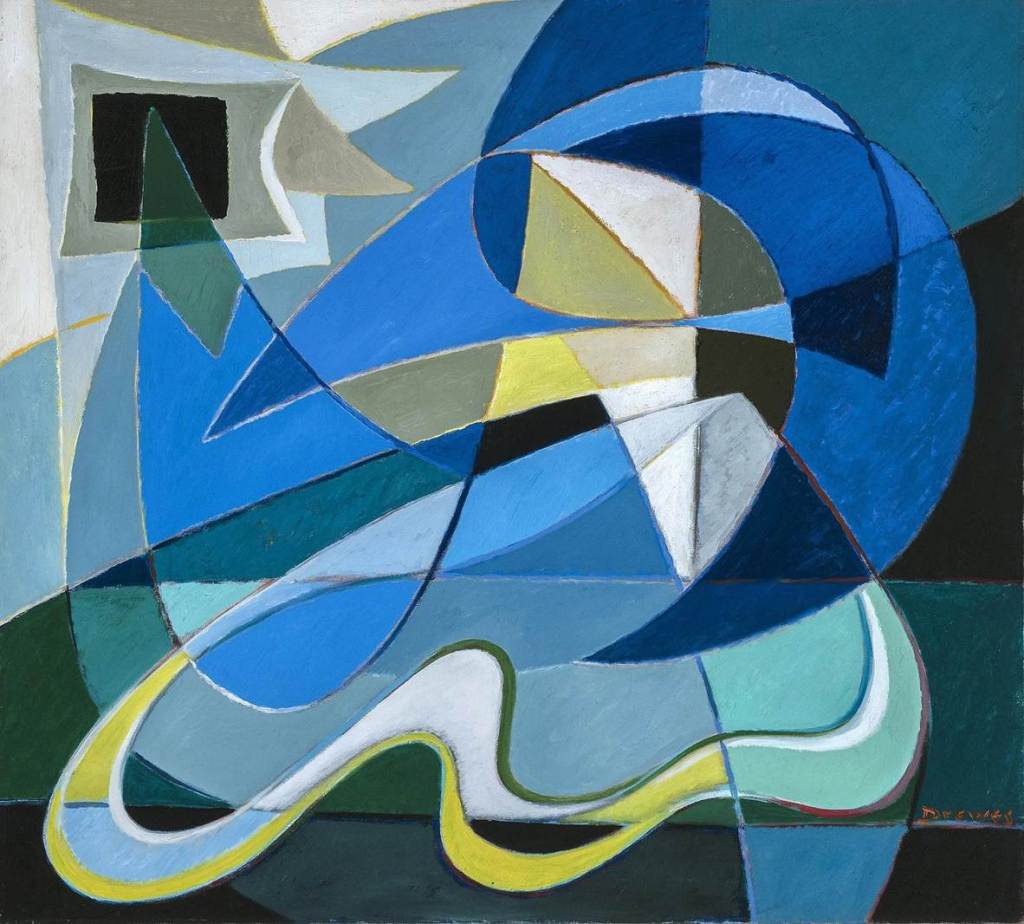
For me, one of the real showstoppers is a 1945 painting by Werner Drewes. A former student of Kandinsky’s at the Bauhaus, Drewes was among many artists who had arrived in America seeking refuge from fascism in Europe. Two of Drewes’s earlier paintings, from the 1930s, are included, and their kitchen-sink approach clearly reflects a debt to his former teacher. The later painting, though, breaks out of Kandinsky’s formal constraints and billows about the picture plane. It embraced scale and juicy impasto yet retained the breezy quality of an oil sketch.
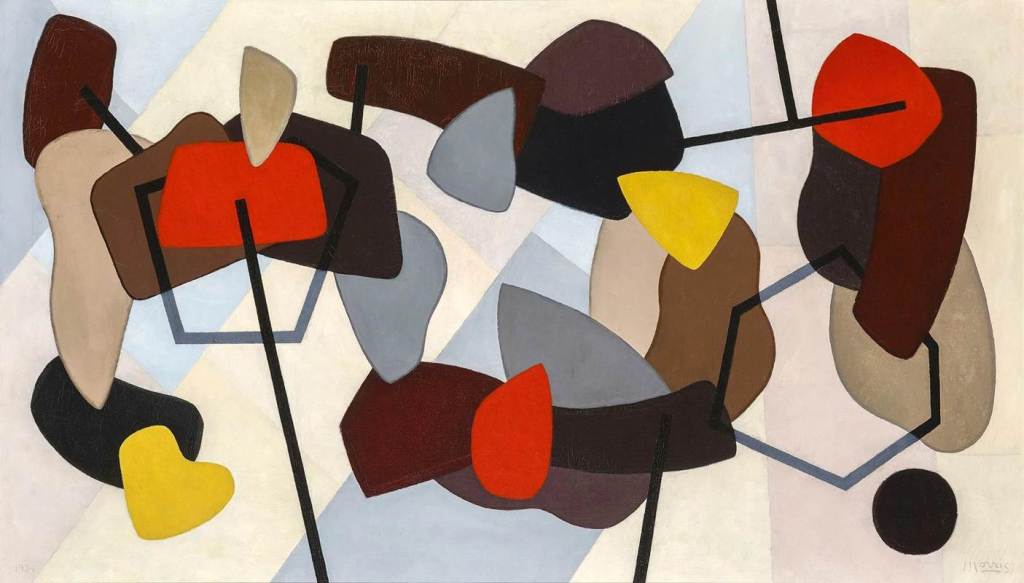
George L.K. Morris and Ilya Bolotowsky are two other AAA artists who demonstrate the best of what early AAA members offered. Bolotowsky always owed quite a bit to Miro’s biomorphic abstraction but had a color sensibility all his own, while Morris made some of the most convincing alloys of Surrealism and abstraction, a piece from 1934 being a fine example of a free-floating constellation of abstract form. A small, austere piece of his, featuring collaged birch bark, demonstrates the strides these artists made when they ceased being merely respectful students and placed their idiosyncrasies front and center.
It bears mentioning that some of the most trailblazing work produced by AAA artists of the period is necessarily absent from this show, and even from most museum collections. I’m referring to the numerous abstract murals painted as part of the Works Progress Administration’s Federal Art Project. AAA founding member Burgoyne Diller administered the WPA mural program in New York, embracing abstraction at a time when social realism was the favored approach for mural painting. The move from “easel painting” towards greater scale was one of the key innovations of the New York School, foreshadowed by WPA artists in this era even if they still adhered to the practice of making smaller works in their studios that often served as “studies” for the mural paintings they executed on-site. While the abstract WPA murals were hardly the sole source of the New York School’s embrace of large scale works – the approaches to attacking the picture plane are simply too different – the example and influence of these works, which were widely seen and groundbreaking in their time, cannot be dismissed.

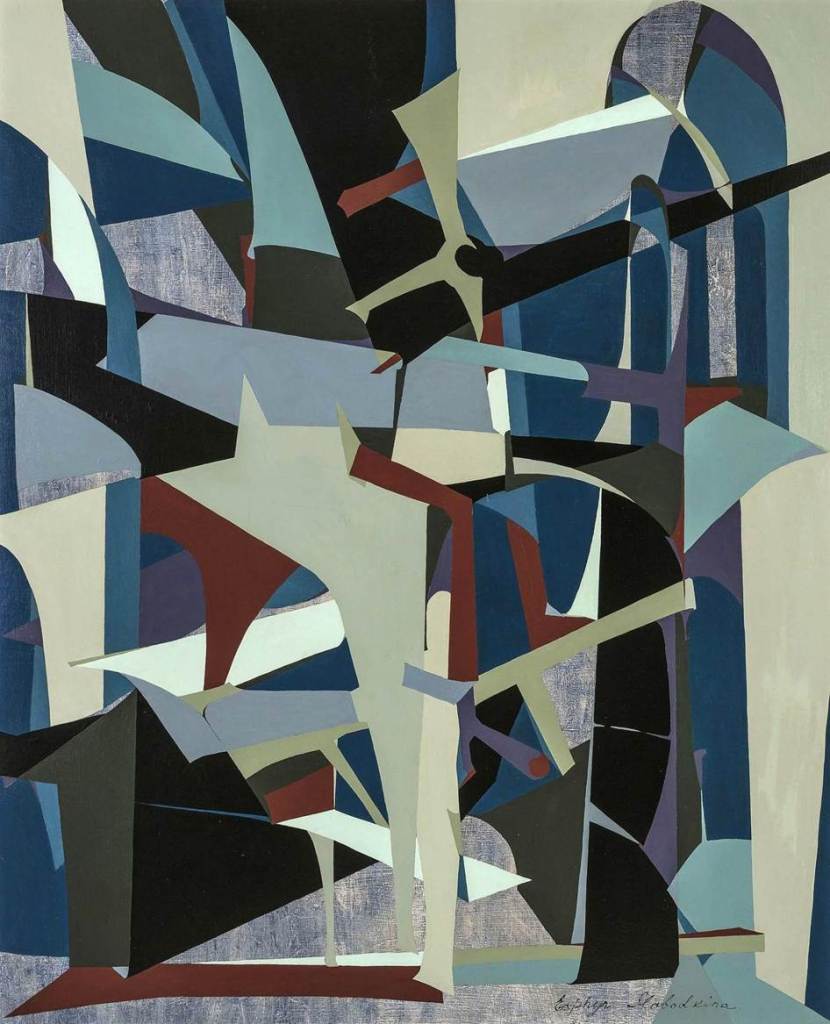
Finally, Eshpyr Slobodkina is well served in the selection, which includes one of her fascinating wood sculptures and a museum-quality painting. The painting, among the most gripping works in the show, is an uncharacteristically moody “nocturne” in which her typical palette of seafoam blue and dusty pinks deepens into shades of gunmetal blue and rust. Slobodkina was one of those artists who is recognizable from any single shape she painted, and in the work shown here she increases the density of her typically airy constructions in what feels like a mid-century riff on gothic architecture.
These artists, and this period, are nearly always considered part of a linear unfolding of American abstraction in the 20th century. In the 1940s, once Mondrian was living in the US and a member in the AAA, the influence of De Stijl took a firm hold on a cohort within the group, and thus became a de facto touchstone for curators, and even for some members themselves, looking to establish a lineage of geometric abstract painting in the period.
A handful of the early AAA cohort – Bolotowsky, Mason, Morris, and Slobodkina – all developed their own approach to easel-scaled abstract painting that acknowledged the history of the form but was steeped in their own peculiarities and thus freed from convention. Accordingly, from a strictly conventional standpoint, these artists might seem to have missed the boat. A decade later, American art distinguished itself with amped-up scale, mythic grandiosity, and a physical approach to painting closer to slapping paint on a barn than refining an easel picture. But I think a more distinguished narrative for the AAA is now viable. In the fullness of time, these artists, with their measured combination of rigor and inventive play, prefigure a formidable lineage of abstract artists who embraced a kind of affable intimacy – for example, Miyoko Ito, Shirley Jaffe, and Thomas Nozkowski.
Of course, this is a 90th anniversary show – AAA has been continuously active since 1936 – and anyone who cares to form an opinion on the full trajectory of the group has a unique opportunity to do so until the end of May, with the concurrent exhibition of contemporary AAA members’ work, curated by Saul Ostrow, at Art Cake in Brooklyn. It’s a reminder that art history is still being written.
“Founders of American Abstract Artists: 90th Anniversary Celebration,” D. Wigmore Fine Art, Inc., 152 West 57th Street, 3rd Floor, New York, NY. Through July 31, 2026. Note: Thursday, May 21 (TONIGHT), from 6–8 pm, AAA is hosting a catalog release event for the 90th Anniversary Exhibition at Art Cake. At 7 pm Emily Lenz, Director at D. Wigmore Fine Art, will present a slide talk “Founders of American Abstract Artists.”
About the author: Jacob Cartwright is an NYC-based painter and independent curator who writes about art. He is a member of American Abstract Artists.







This is an truly excellent piece of writing. Kudos to Jacob Cartwright for his colorful, informative thoughts on these works.
Thanks for a such an informative piece. I have a real jones for this kind of painting. I love that it couples clarity with the ambiguity of synthetic cubist space. I stumbled across it on my own, as my professors jumped over these artists, whom they considered “too French,” in order to plunge into the macho-big Abstract Expressionist artists.
Excellent commentary. My own introduction to the AAA was in 1957. That was the year of the publication of The World of Abstract Art which was a collection of essays plus a catalog of the 20th Annual Exhibition of AAA at Riverside Museum, NY. This remarkable book contextualized AAA artists’ work with worldwide contemporary abstract art in the later 1950s. had huge influence on my beginnings as an abstract artist.