Contributed by Lawre Stone / Lisa Sanditz paints landscapes that explore collisions between industry and the natural world. She has also addressed manufacturing hubs, industrial farms, and junk-food factories. In her solo show “Missing Mountain” at Alexandre, Sanditz turns to the impact of climate change on the Catskill Mountains, and with good reason. In the summer of 2023, the jet stream carried smoke from fossil-fuel-driven Canadian wildfires into the Hudson River Valley, turning the sky a dusty gray, dimming the sun to a hazy orange disk, and impeding views with airborne particles. Sanditz’s consternation inspired the three paintings that anchor this exhibition.
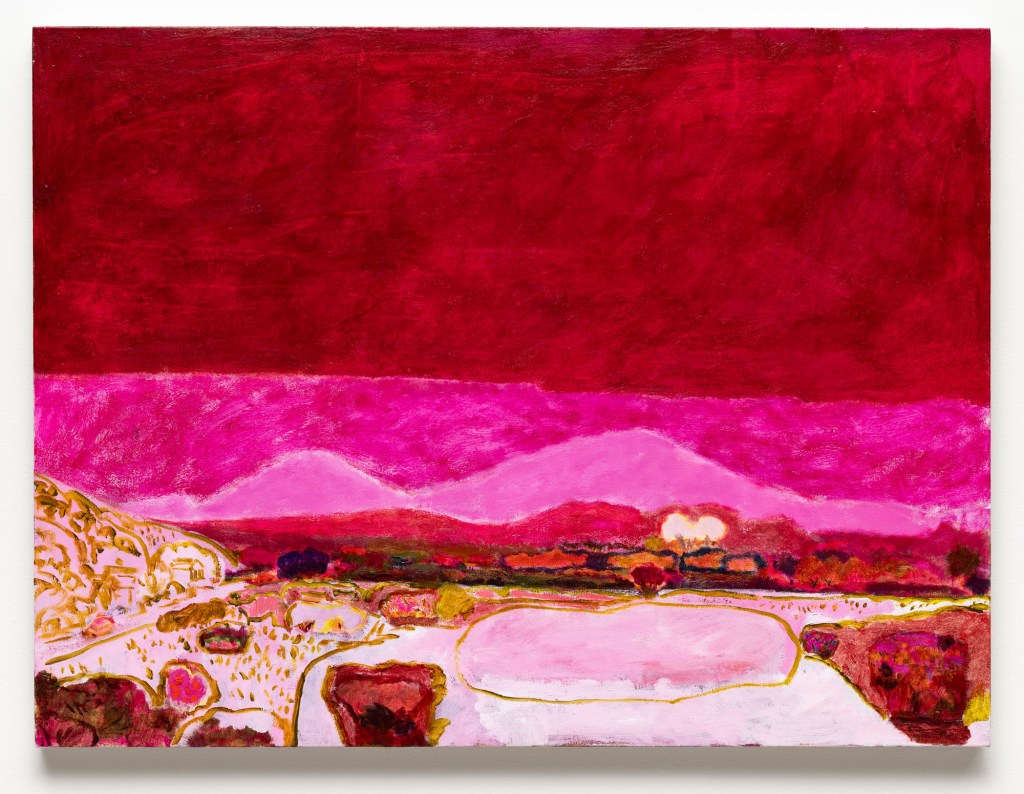
In Missing Mountain (Hot Pink), a horizontal band of fuchsia sweeps across the canvas, tinting the mountains a pale pink. Defined but loosely painted, familiar shapes of mountain and valley stretch across the canvas like old friends, while an envelope of dappled orange and red descends from above. The color is at once unreal, joyful, and disturbing, balancing beauty against unease. Missing Mountain (Eclipse) renders the same scene as a rare celestial event obscures the mountains. The sun, now in total eclipse, appears as a blue ball with a red tail that mimics the trajectory of an adjacent cloud formation and the lava-like cast of the mountainside. At ground level, human settlement is chiseled in distinctly unpastoral hot blues, reds, and pinks. The visionary landscapes of Charles Birchfield, Arthur Dove, and Georgia O’Keeffe come to mind. In Missing Mountain (Stewart’s Sherbet Sun), a giant adolescent boy lounges atop a lilliputian landscape, a bent knee covering the mountains behind. An orange sherbet cone in a “Stewart’s Shops” wrapper, exactly where the sun might have been, rests on his knee, dripping down his hand, while two pristine highlights cast fluorescent orange onto his cheekbones.
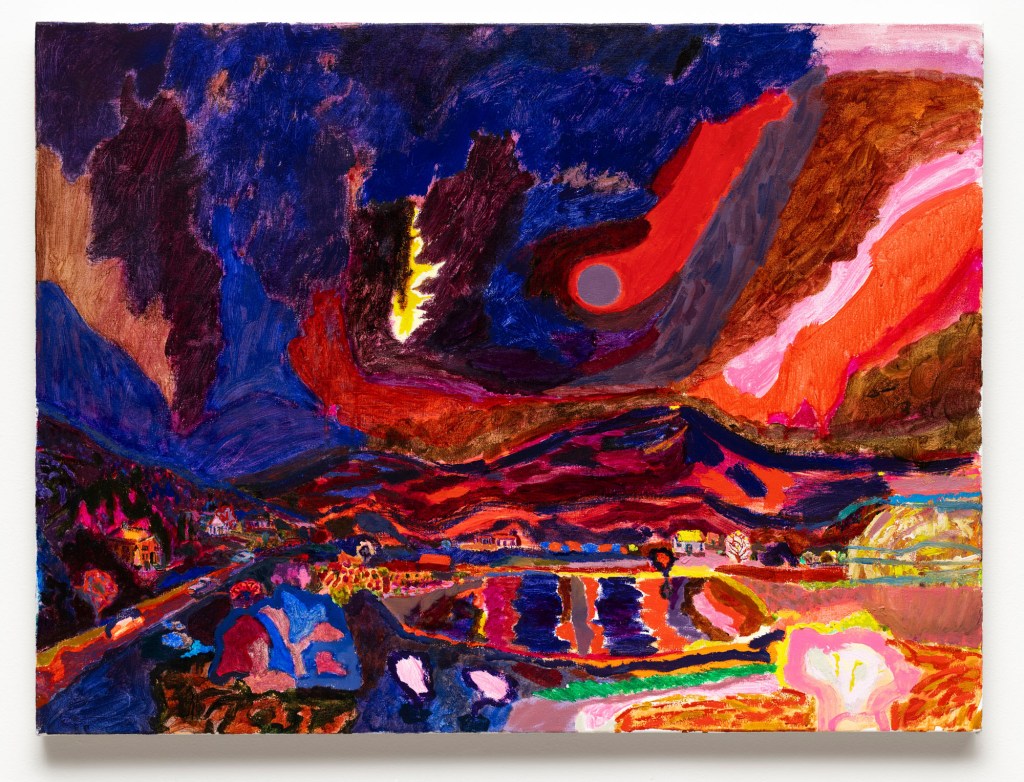
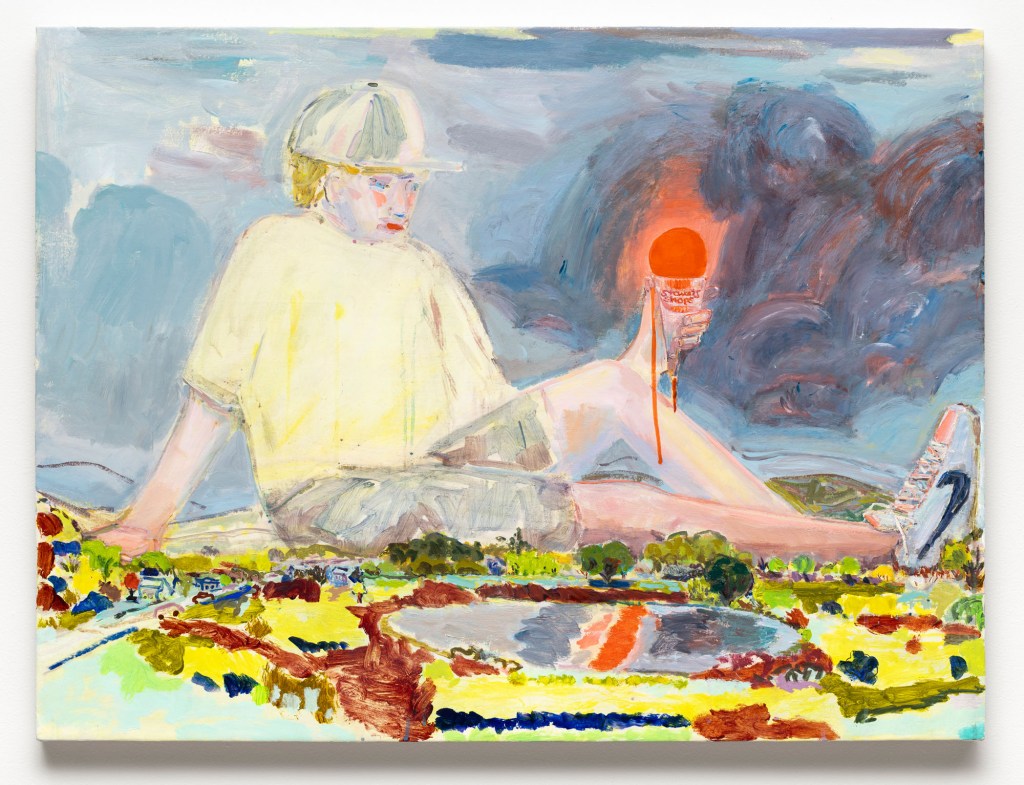
acrylic on canvas, 30 x 40 inches
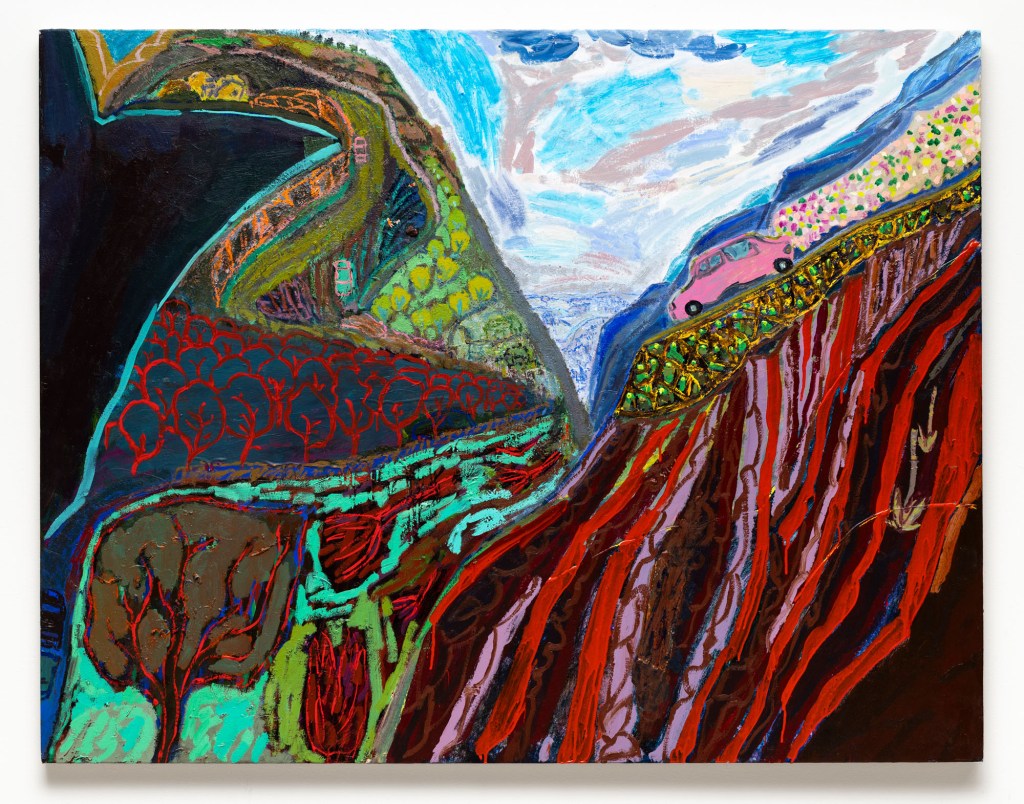
Tempering the implication of peril, Sanditz makes acrylic paint seem ancient. Paint passages transition from thin and translucent to dense and crusty. Delicate flowers grow against textured, mineral-like crags. The paint handling is emphatic, giving the pictures the feel of geological time. The content suggests otherwise. In Debris Flow, a cheery pink sedan drives gingerly towards a mountain pass. Sharp strokes of red paint define the angular slope below and the paint drips a bit, suggesting unstable ground. The same red appears across the canvas, now outlining a grove of trees as though in a child’s drawing. Sanditz distorts landscape logic, merging passages that can read as both volume and void. The car seems oblivious to the scene’s precarity as it verges closer to the mountain’s edge. The roadbed, in cutaway view, reveals manmade yellow and green geometric structures, as if to blithely reassure us. A wedge of cerulean and pale pink sky visits unexpected calm on a land turned on edge.
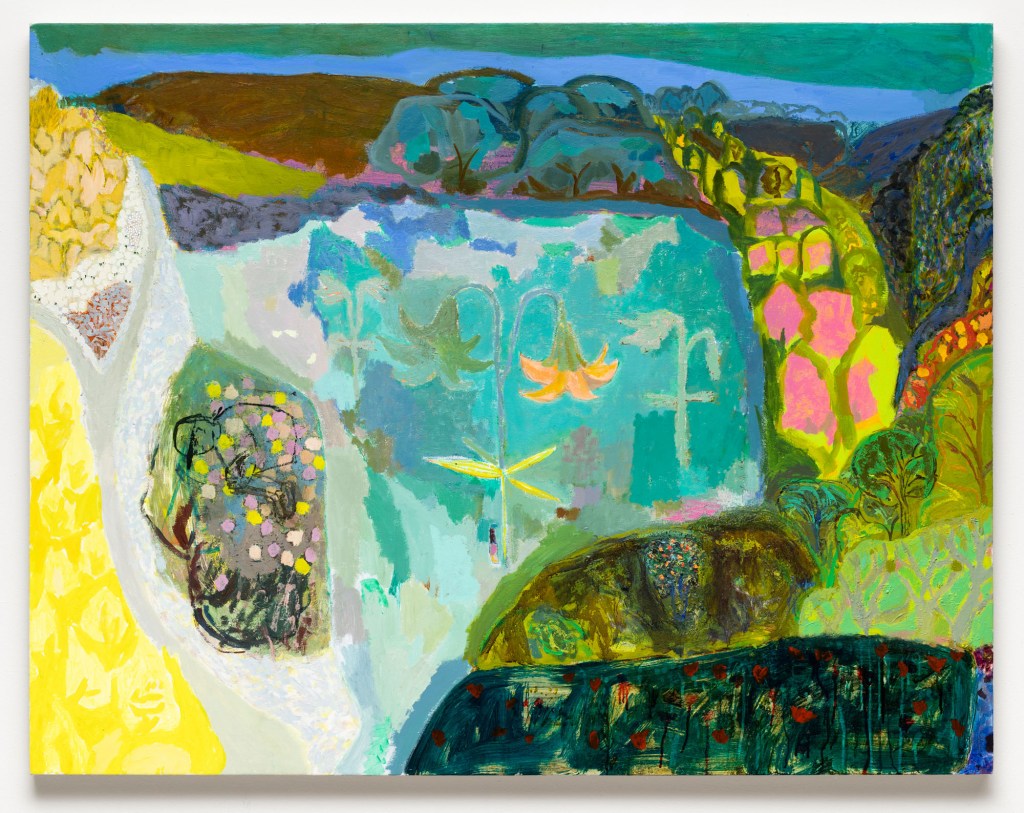
Sanditz’s missing mountain sighting almost certainly took place just a few miles from the homes of Frederic Church and Thomas Cole, famous Hudson River School painters who captured mountain vistas from studios on opposite banks of the Hudson River. Cole viewed nature as a sacred reflection of the divine and a source of spiritual renewal. Church took his focus farther, investing nature with spiritual awe via close observation, which Sanditz filters through climate and loss. For her, the sublime involves contact with a landscape that is at once beautiful and terrifying, reflecting all our cultural values, despicable as well as glorious. Susie M. Barstow, the most celebrated female Hudson River School painter, recalls a childhood visit to the Catskills: “As we saw them from the river on a hazy summer afternoon, they lay like a delicate cloud – so delicate and dreamlike that it seemed as if a breath would blow them away. I hardly dared to look away from them, fearing they might vanish.” If pondering a mountain gone missing provokes anxiety, witnessing it would be traumatic. Sanditz brings this possibility vividly and ominously alive, sounding a warning while holding onto hope.
“Lisa Sanditz: Missing Mountain,” Alexandre, 25 East 73rd Street, Second and Third Floors, Buzzer 3, New York, NY. Through November 7, 2026.
About the author: Lawre Stone is an artist based near Hudson, NY. She is a 2026 recipient of the Martha Porter Boschen grant of the Berkshire Taconic Foundation. Her paintings are currently on view in “Altered Landscapes, At Risk: Forest & Field” at the Muroff Kotler Gallery, SUNY Ulster, Stone Ridge, NY, curated by Kristin Flynn.