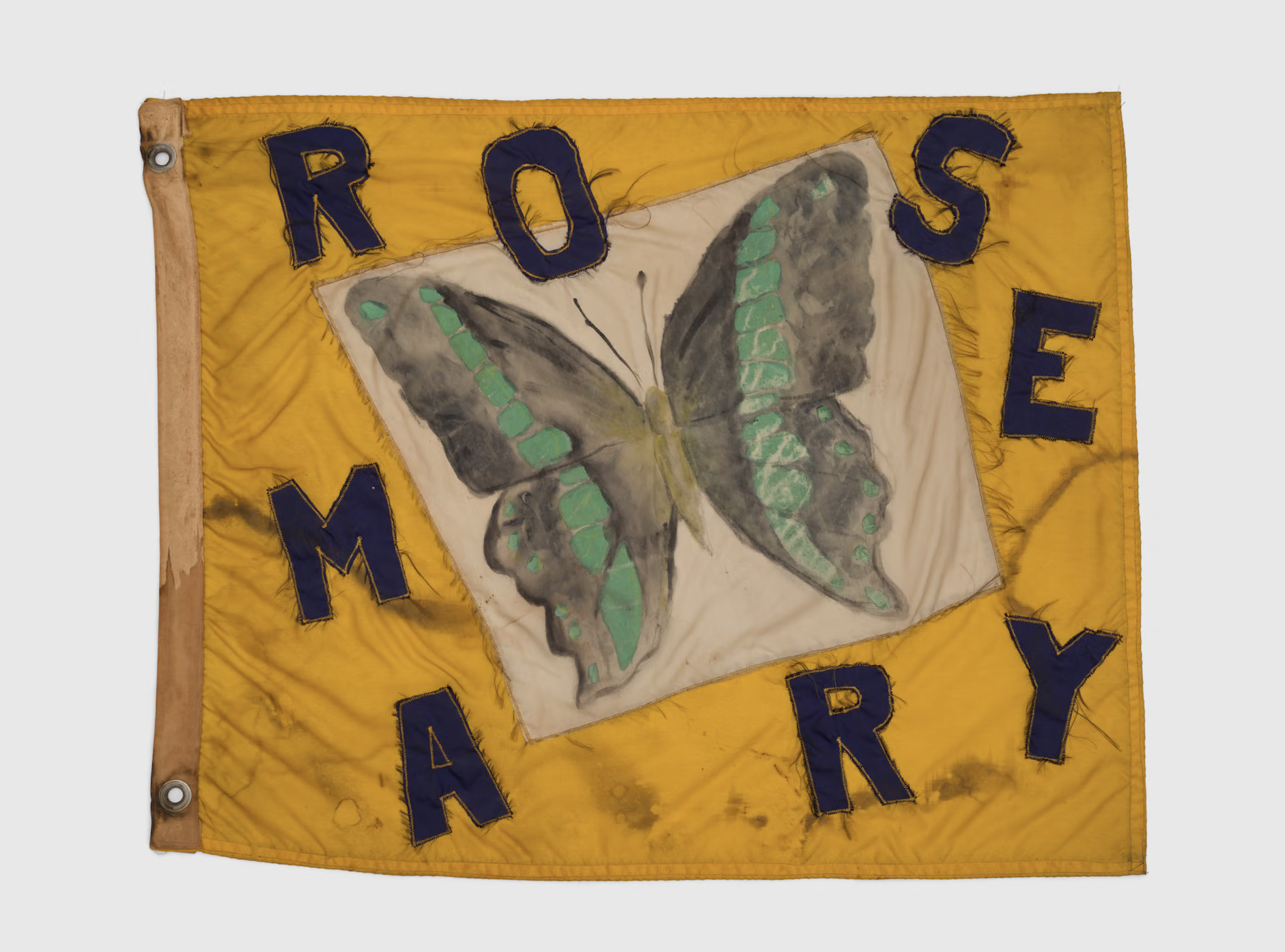
Contributed by Lila Gould / “Proserpina / Devil Chaser” at Gordon Robichaux brings together the work of Rosemary Mayer and Ree Morton for the first time, emphasizing their close friendship and uncovering the nuances, affinities and distinctions in their respective practices. At the outset, a piece from the 1975 installation Something in the Wind conveys their closeness. For this public artwork, Morton hand-sewed 100 flags and tied them on the sails of a boat docked at New York’s South Street Seaport. In an exhibition catalog, Morton explained, “I made a flag for each person in my life that I have good feelings for, or who I feel connected to in some way. It was a celebration for them and a means of identifying and locating myself in the world by naming the persons who surround me.” (1) Each flag was distinct and adorned with motifs, like birds, fans, and butterflies, that had to do with “being in the air.”(2) In a journal entry from 1974, Morton notes that Mayer had lent her a book on medieval heraldry, which inspired the emblems placed on the flags. (3) On the one featured here, dark blue fabric letters are cut up and collaged onto the flag to spell “Rosemary,” scattered in a circular pattern framing an illustration of a butterfly colored in with black and green felt-tip pens. Mounted onto the wall, just above eye level, Untitled (Rosemary’s flag) puckers and wafts gently from the breeze of a nearby fan.
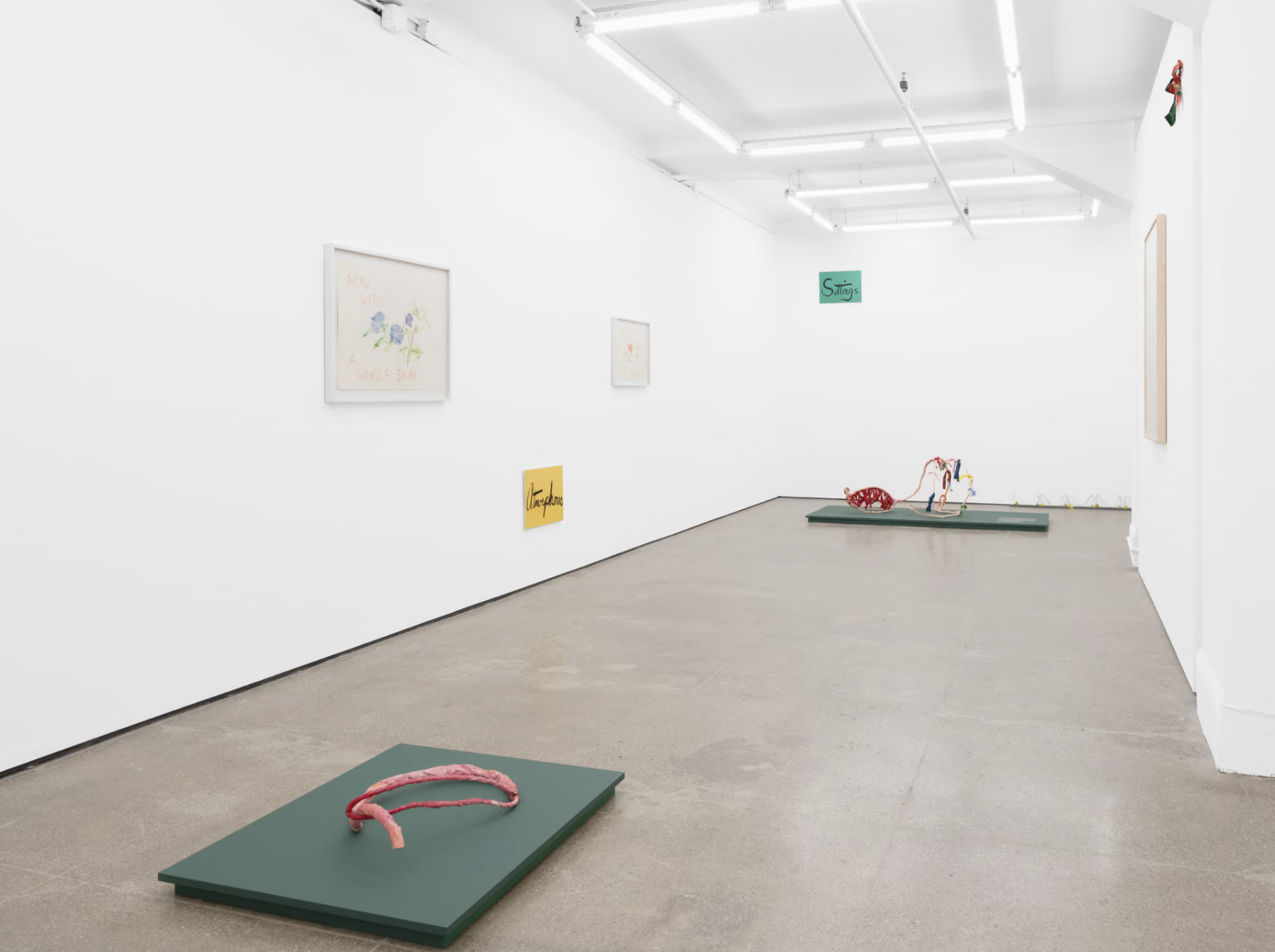
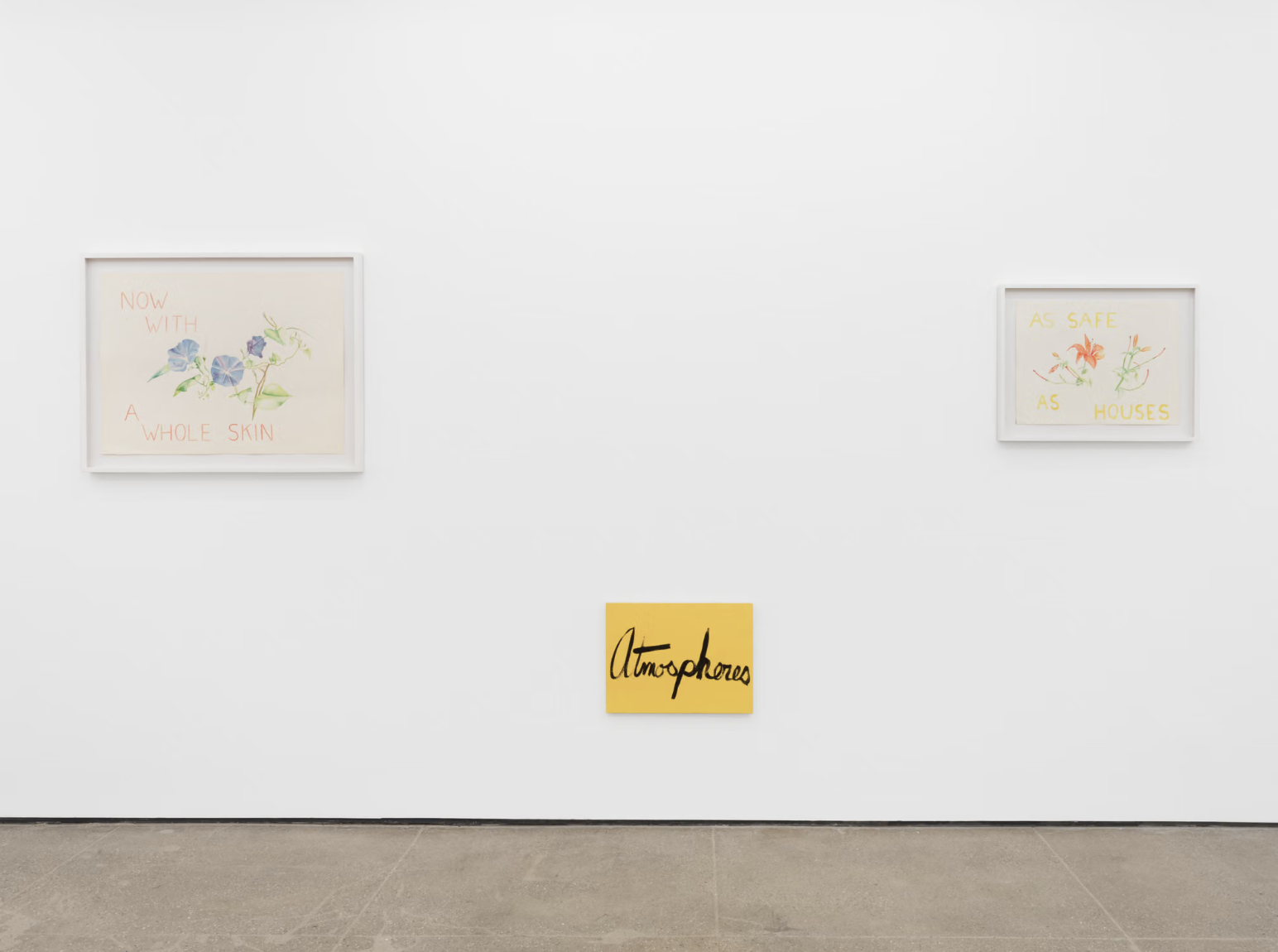
Playfully scaling the walls of the galleries, this show features a remarkable selection of framed watercolor and oil paintings. Both artists painted words or short phrases intertwined with delicately painted botanical scenes, thus cast as equal in importance. The works manifest a shared interest in flowers and plants, prompting viewers to consult wall labels to determine whose work is whose. Mayer’s watercolors of flowers include mildly enigmatic quotes like “NOW WITH A WHOLE NEW SKIN” (drawn from Don Quixote and meaning to escape a situation unharmed). Hung below Mayer’s watercolors at various heights are paintings from Morton’s series Atmosphere (Signs of Love) that each feature one word – gestures, settings, atmospheres – written in black cursive on a single plane of color. Morton’s selective use of lowercase letters to begin words suggests that they are meant to be placed in between other works on the gallery walls, as they are, like parts of a sentence.
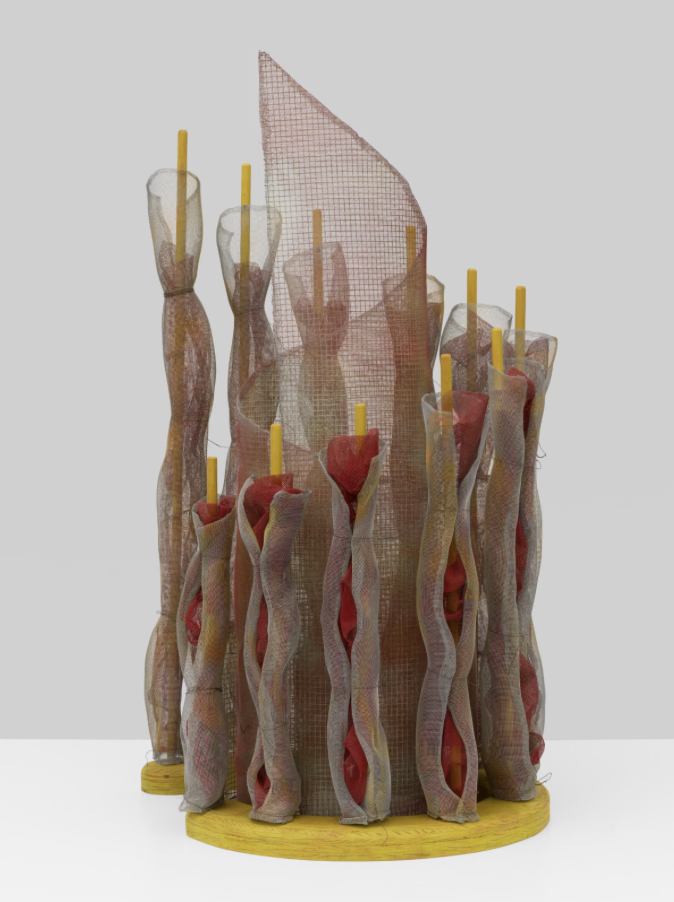
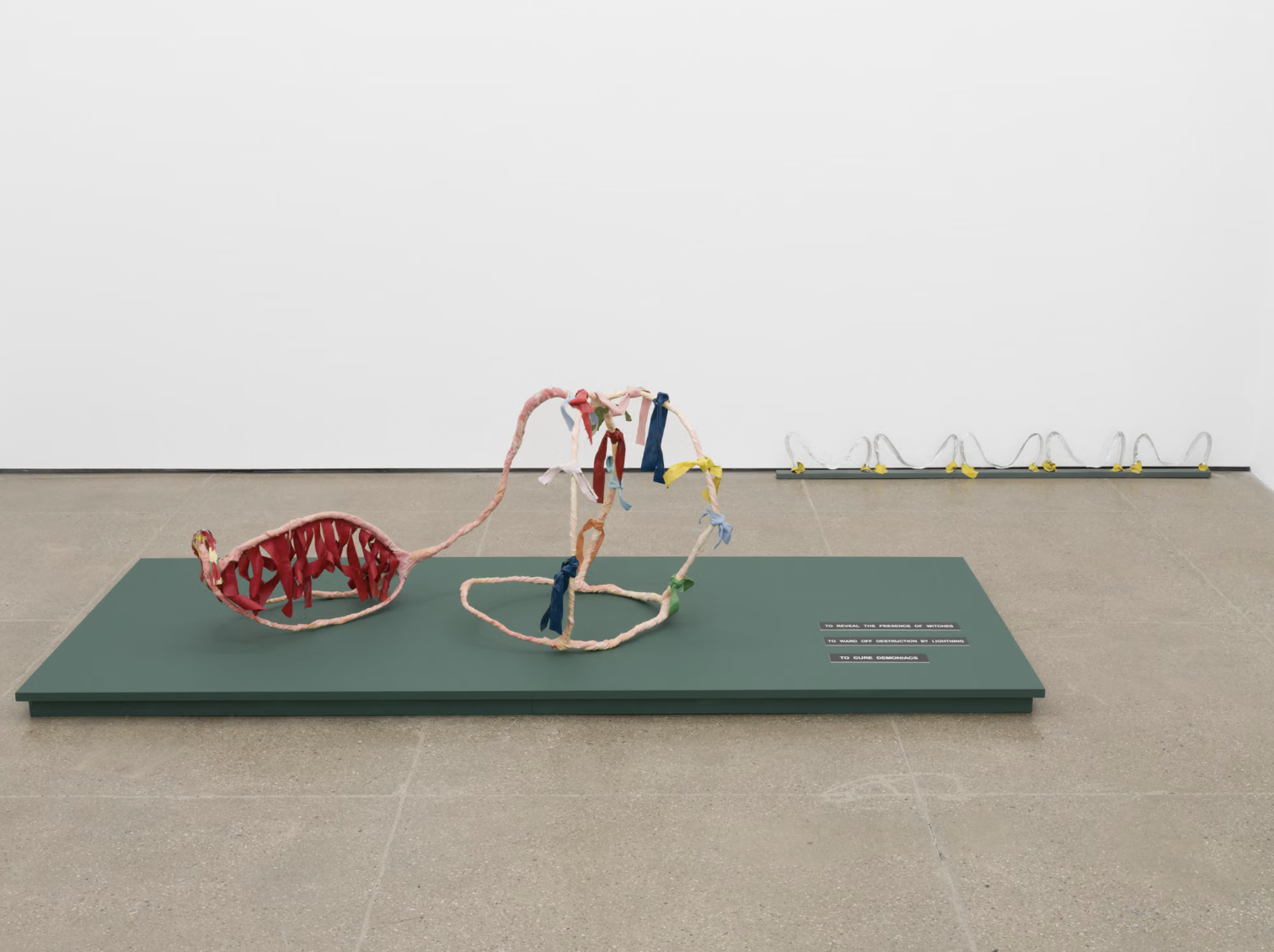
The exhibition takes its title from two rarely exhibited sculptures – Proserpina by Mayer and Devil Chaser by Morton – on view in different galleries. Proserpina consists of yellow rods of various heights placed on circular bases with aluminum mesh and fiberglass wrapping and contorting around the structure. Named after the Roman goddess of spring, it emulates regrowth and emergence from the underworld. Devil Chaser is made of wire and celastic – a malleable plastic material commonly used to mold props for theatrical productions and puppets – and placed on a dark green podium with an exhibition copy of a plaque that accompanied the sculpture in a mid-1970s show. It reads:
TO REVEAL THE PRESENCE OF WITCHES
TO WARD OFF DESTRUCTION BY LIGHTNING
TO CURE DEMONIACS
The phrase is borrowed from Neltje Blanchan’s 1917 book Wild Flowers Worth Knowing, a copy of which is included alongside the archival photographs in the first gallery. Amid all the paintings and sculptures, it is hard not to linger on the handwritten notes and drawings made by both Mayer and Morton when building their respective sculptures. Pages of details about process and execution drive home just how similarly Mayer and Morton approached artmaking. Proserpina / Devil Chaser eloquently and persuasively makes a case for the importance of viewing these works together and offers genuine insight into Mayer and Morton’s imaginative worlds.
“Rosemary Mayer and Ree Morton: Proserpina / Devil Chaser,” Gordon Robichaux, 41 Union Square West, #925 and #907. Through November 1, 2026.
About the author: Lila Gould is a curator and museum educator based in Brooklyn, New York.
Notes:
1. Sabine Folie. Ree Morton: Works 1971-1977. Generali Foundation ; Verlag Für Moderne Kunst, 2009. 133
2. Ibid, 133-134
3. Gillian Sneed and Rosemary Mayer. Temporary Monuments : Work by Rosemary Mayer, 1977-1982. Edited by Marie Warsh and Max Warsh. Chicago, IL: Soberscove Press, 2018. 11