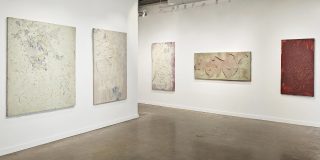
Contributed by Rebecca Allan / Just off rue de Jarente in the Marais, Galerie Pavec – which late last year presented “L’Esprit Français,” the first Paris solo show of the paintings of Janice Biala (1903–2000) in 38 years – is tucked into a gated courtyard, through an enfilade of terracotta containers holding leafless trees that stretch toward sunlight. On a crisp November day, they brought to mind William Carlos Williams’ “alphabet of trees … their crossing bars of thin letters that spell winter and the cold.” Panes of a mullioned window bent wavelengths of red-orange, robin’s egg blue, and emerald green. Inside, Biala’s paintings conveyed the experience of wandering through passageways, from the jostle of the street to the intimacy of a home.
Please click here to contribute to the Two Coats of Paint year-end fund drive
In 1913, Janice Tworkovsky emigrated from Russian-occupied Poland to a tenement on New York’s Lower East Side. Her father had worked as a tailor for the Russian army and, like many immigrant families, he brought his family to New York seeking better opportunities. He arrived first, followed by Biala’s mother and her brother (the artist) Jack Tworkov. The siblings took in Matisse and Cézanne at the Brooklyn Museum. Tworkov never forgot Cézanne, but his sister was enchanted by Matisse. “I’ve always had Matisse in my belly,” she said after his death in 1954. She studied at the Art Students League and the School of the National Academy of Design and hitchhiked to Provincetown to study with Edwin Dickinson. Having adopted the name Biala – the town of her birthplace – to distinguish herself from Jack, she sailed for France in 1930, accompanied by her friend, poet Eileen Lake.

At 27, Biala became the last romantic partner of the British novelist Ford Madox Ford. Their circle of friends included George Antheil, Constantine Brancusi, Ezra Pound, Gertrude Stein, and others who were shaping a new Modernism in Europe. Biala thrived, producing Modernist interpretations of landscapes, still lifes, and portraits of Ford. When he died in 1939, as war and occupation loomed, she fled to the United States with his manuscripts and as much of her own work as she could carry. She would return to Paris after the war with her husband, the painter and New Yorker cartoonist Daniel “Alain” Brustlein, settling permanently and, in gallery and museum exhibitions, forging a distinctive personal language informed by her love of the city.
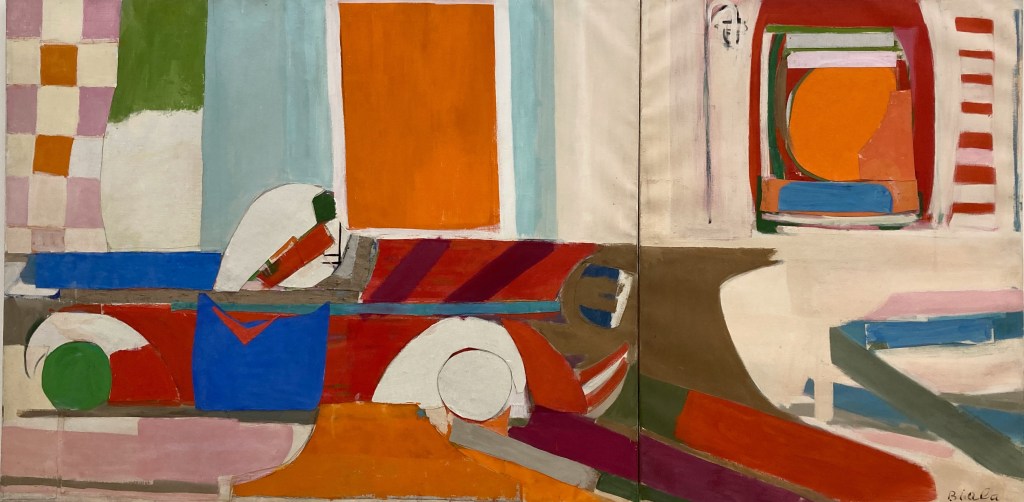
Its urban mosaic gave rise to works such as Les Autos, a diptych of two unequal-width canvases presenting a panorama of pulsating action in which fenders, portals, and streetlights jostle with one another by way of cut-canvas collage elements and swaths of brushed pigments. Standing before the painting, I looked both ways as if stepping off a curb. Switchback ribbons, stripes, and checkerboard patterns recall Abstract Expressionist works like Lee Krasner’s Palingenisis and Robert Motherwell’s Ninth Street Collage as well as Joan Miro’s surreal Carnaval d’Arlequin.
While Biala’s work reflects the influences of both the School of Paris and the New York School, the relationship of her work to the late, figurative paintings of the French-born Jean Hélion (1904–1987) is striking. A prisoner of war during World War II, Hélion too moved back and forth between France and the United States in the dislocations of conflict. In tone and composition, his acerbic and symbolically complex paintings of people sleeping on sidewalks, ghostly mannequins in shop windows, and decaying produce have a similar sense of abjectness.
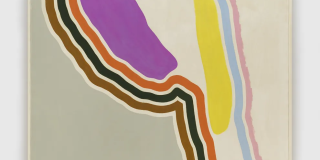
Biala’s paintings also incorporate the pearlescent light of Dickinson’s coastal New England landscapes and the intimiste familiarity of Pierre Bonnard’s tilted dining tables, strewn with the remnants of a meal. With bohemian furnishings, a treasured Spanish cabinet, and a black-and-white kitchen floor, its tiles ascending like piano keys, Intérieur (Abstrait: roses, violet, bleus, bandes orange) reveals the artist’s Paris home. The painting is a tour de force of gestural geometric abstraction, integrating Matisse and Mondrian in off-kilter rectangles and stabilized by a network of gypsum white ones.
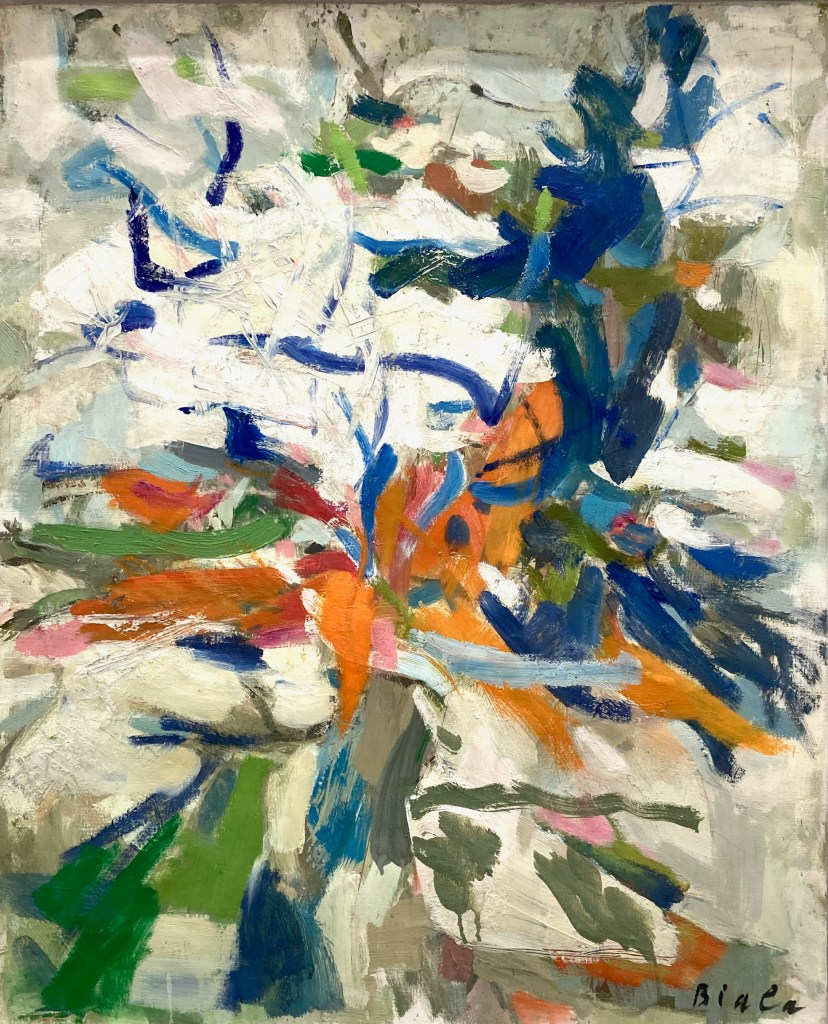
Capturing the growth of a tree in springtime, Biala’s Arbuste au Printemps situates us at ground level. White brushstrokes incised with sgraffito suggest wind or sky as limbs and leaves swirl and twist. This work has a cousin in Joan Mitchell’s monumental Hemlock. Mitchell and Biala were colleagues in Paris, but Biala retains the ground plane, with gravity anchoring her subject, whereas Mitchell’s “whiplash lines” become a purely abstract forcefield, independent of an earthly horizon.
In Still Life, black and gray surfaces have the weathered, zinc patina of Paris’s aging Mansard roofs. Silhouetted furnishings of the artist’s living room obfuscate detail, while bright wafers of white simulate windows. This restrained, cerebral work unites Biala’s exceptional variations of surface texture with her ability to elicit detail within a compressed range of seemingly monochromatic color. It’s an intriguing foil to the exuberant Les Autos on the opposite wall.

David Kermani, husband of the late poet John Ashbery, despaired of his incorrigible habit of leaving closet doors ajar. Apparently, Ashbery preferred to do so because it allowed him immediate access to his things, whether to retrieve, consider, or simply behold them. Biala’s paintings too reflect an engagement with openings and enclosures, especially apparent in this concentrated selection. Her work speaks to vision as a means of acclimation, and to our search for belonging no matter where we find home.
“Janice Biala: L’Esprit Français,” Galerie Pavec, 4 rue de Jarente, Paris. October 23–December 20, 2025.
About the author: Rebecca Allan is a New York-based visual artist.
Please click here to contribute to the Two Coats of Paint year-end fund drive