
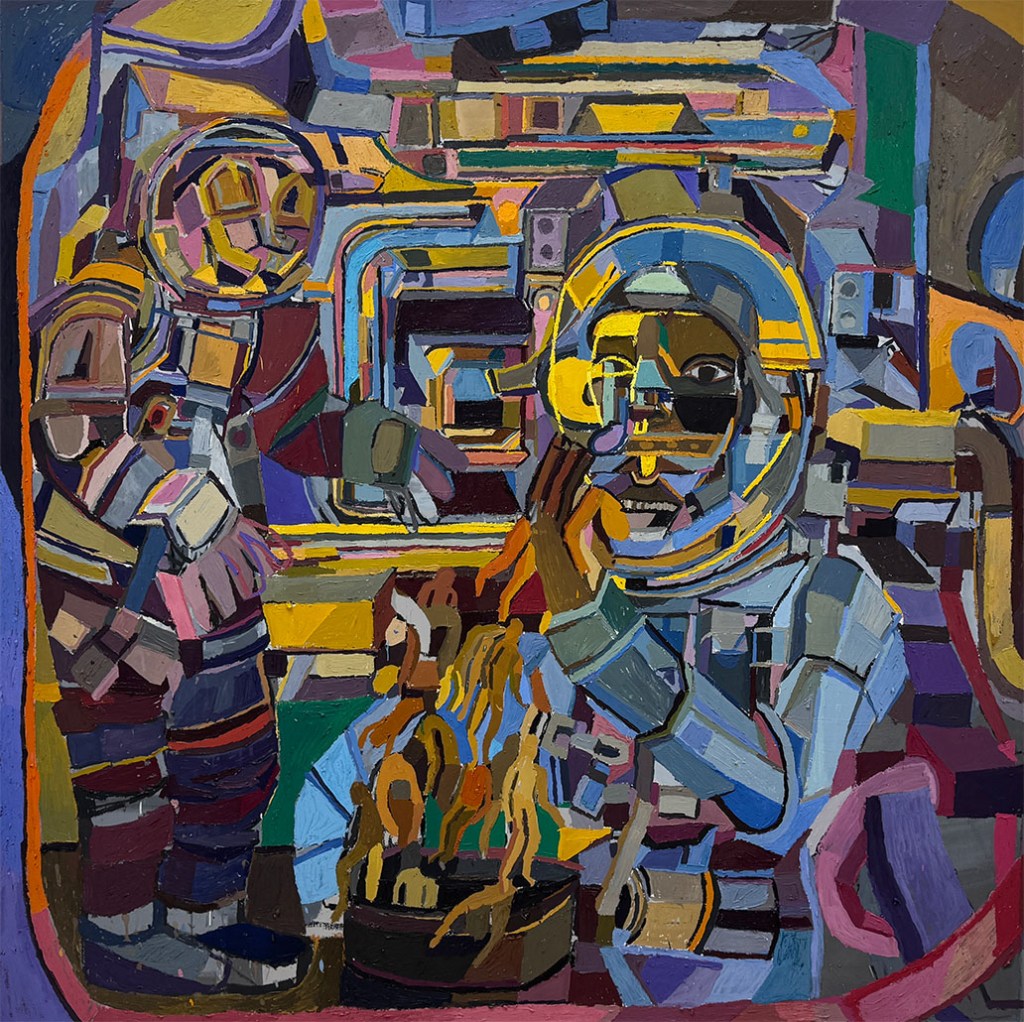
Contributed by Margaret McCann / In Clintel Steed’s show of paintings at Shrine Gallery, “Different Time Zones, Different Dimensions,” temporal experience is evoked through formal language as much as subject matter. In most, dynamic fragmentations of contemporaneity are fixed in static tessellations of paint. Richly varied shapes, packed in shallow space on dense surfaces, lead from abstraction to illusion. Two astronauts, presumably Dante with underworld guide Virgil, share a machined interior in Dante’s Inferno in Space. Steed’s explorer regards us self-consciously. Through his gloveless hand, flame-like forms – resembling Sandro Botticelli’s sinners in The Divine Comedy’s hellscape – issue from, or fall into, an opening below. As the Lee Bontecou-like gestalt balances centripetal and centrifugal forces, syncopated rhythms animating the surface join elegantly soothing color harmonies, rendering claustrophobia into cozy design.
Contribute to the Two Coats 2025 Year-end Fundraising Campaign!
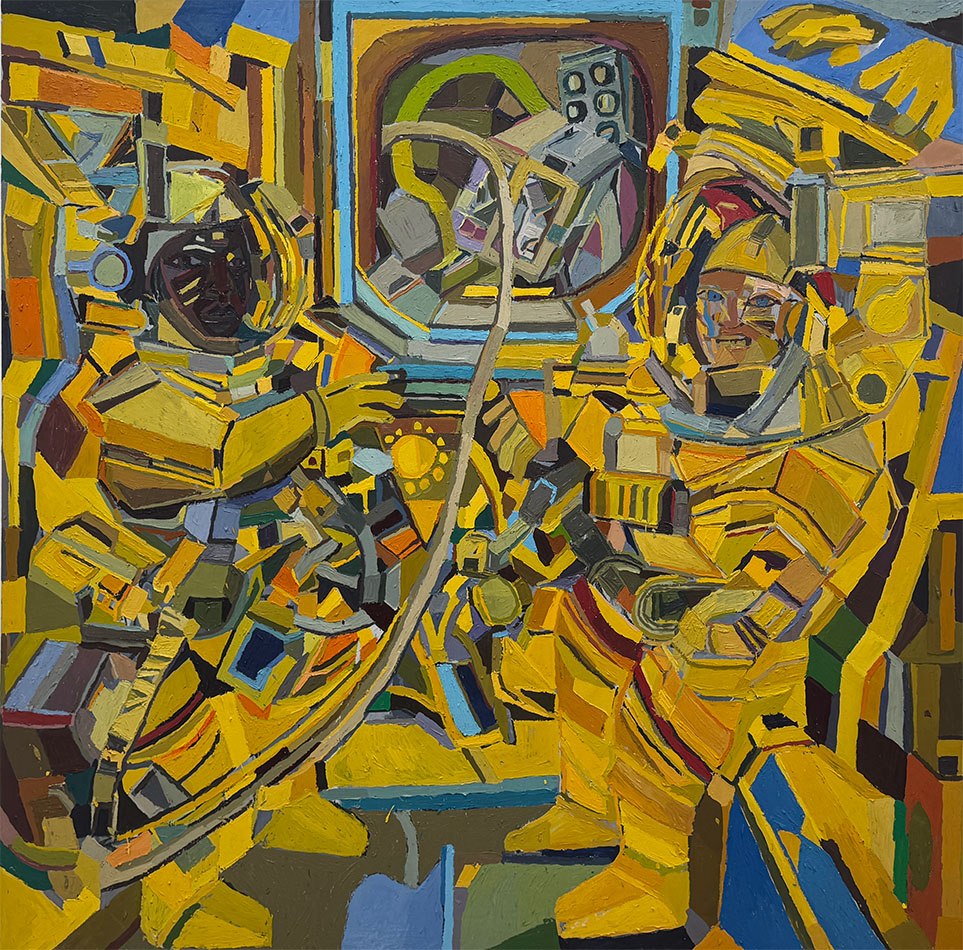
The Golden Orb Inside the Space Station references “arachnidnauts” Gladys and Esmerelda, spiders who in 2011 spun weightless webs in outer space, echoing idle hands caught in the World Wide Web. Radiant yellows make the tight space feel more extroverted than confined. Spreading from orange to green they hang literally on the picture plane, and figuratively in zero gravity. Steed’s ragged shapes convey informality, yet are enveloped within meticulous visual schemes. Room has been found for every little thing; the painted space a dense habitat like that of big-city apartment living. Compressed like temptation, expressionist zeal is held beneath blocky paint and rough edges, resonant with Robert Smithson’s depiction of the permeable wall Dante described, dividing Hell’s sin levels. Energy bubbles up from an exuberant matrix of motivation; Piet Mondrian‘s Broadway Boogie Woogie comes to mind. Futuristic optimism, like that of Fernand Leger‘s upbeat soldiers or Gino Severini‘s happy souvenirs, outshines dystopia.
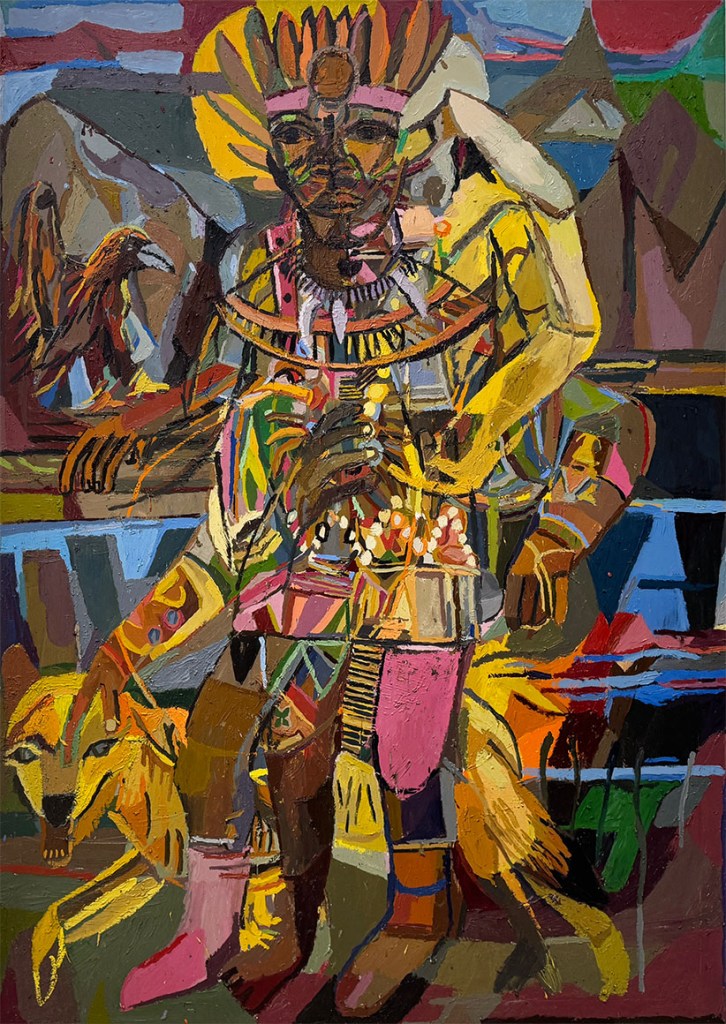
Spiritual Warrior instead stands on terra firma. The compound global hero, redolent of past and present African, Native American, Buddhist, or other dancers, communicates our shared earthbound reach into the spiritual. While dull, cooler hues deepen into distant mountains, the bright colors of warrior and animal companions broach the surface. Oblique symbolism – the yellow dog might imply cowardice, self-contempt, or need for space; the raven wisdom, transformation, and liminality – venerates mystery, recalling Max Beckmann. While looser structure and moving limbs summon Fauvist orgone, brashness like that of Neo-Expressionist Georg Baselitz defers to organization. The studied time travel of Cubism, as in the considered shifts and brushwork of Marcel Duchamp or Jean Metzinger, slows movement.
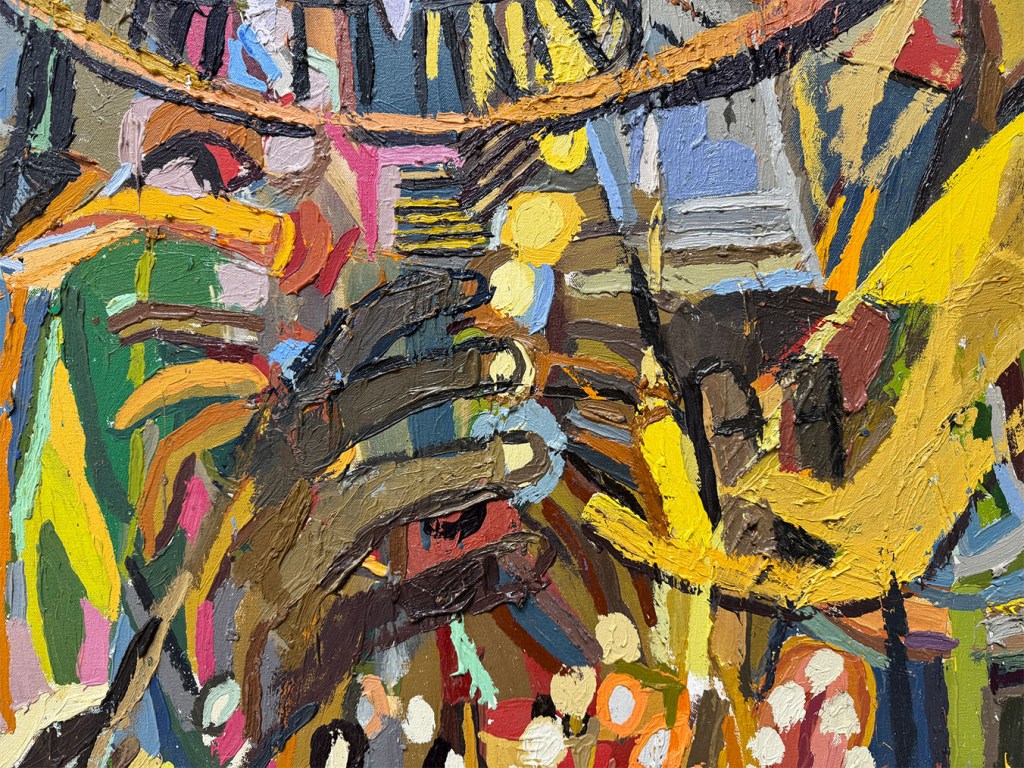
Brutalist texture also retards looking; layers of crudely hewn lines and awkward shapes echo the calibrated abandon of Terry Winters. Steed’s paintings feel more deliberated, perhaps transposed from collages, than actualized in time. Like energy sublimated into productive action, clumsiness accedes to orchestrated coherence – a compelling interaction of daring and care.

Instead of Steed’s gutsy Bruto-Futurism, weightless ethereality permeates the demure Celestial Beings #1. Pointillist dabs change slightly in size, as color evokes mood change from somber to enraptured, and outlines of a couple embracing slowly appear like a memory or desire. The quiet reveal engages, but the approach’s simplified vocabulary seems to unnecessarily restrain this painter’s strengths.
In the multivalent, Picasso-esque Inside the Goggles #2, the oddly private vastness of web surfing transforms what might have been a dreary basement into a fantasy space capsule. Despite its compactness, slight diagonals imply a deeper field of potential, like the paradoxical realm of a flat, blank canvas. The young man may be a passive voyeur caught in the painter’s web, or at the center of one, wielding Oz-like control. As creator he might envision the silhouetted cerulean blue female, perhaps an ideal like Dante’s idée fixe Beatrice, hovering upper right. Or perhaps his equally secretive and forthcoming maker has him unawares, suggesting a surprise from the future. Like Neytiri in the film Avatar, she may be here to see and fulfill our lonely or cyber-curious hero – or a muse to fuel operations, like that guiding the complex process of realizing intention on canvas. Possibilities mingle in the metaphorical work in progress, goggles underlining artful focus and subterfuge. Contained just below the surface mosaic of interlocking shapes in lush color chords, Steed melds tension between imagination and reality into exciting, satisfyingly cohesive paintings.

“Clintel Steed: Different Time Zones, Different Dimensions,” Shrine Gallery, 368 Broadway, New York, NY. Through December 6, 2025.
About the author: Painter and art writer Margaret McCann teaches at the Art Students League. She has shown her work at Antonia Jannone in Milan and been reviewed in La Repubblica, Corriere della Sera, and the Huffington Post. She edited The Figure (Skira/Rizzoli, 2014) for the New York Academy of Art and has written reviews for Painters’ Table, Art New England, and Two Coats of Paint.
Contribute to the Two Coats 2025 Year-end Fundraising Campaign!





%2523/media/File:Sandro_Botticelli_-_Inferno,_Canto_XVIII_-_WGA02854.jpg)
%2523/media/File:Stradano_Inferno_Map_Lower.jpg)

