Contributed by Peter Schroth / Some subjects are immune to age or aesthetic trends. Like the sprout that powers through the crack in the sidewalk, plant life in general and flowers in particular are irrepressible inspirations for art and have breached the territories of artists primarily known for other, more rigorous forms, from Piet Mondrian to Amy Sillman. Ruby Palmer’s show “Garden Theory” at Morgan Lehman Gallery demonstrates yet again that flowers are forever.
The paintings are in Flashe, acrylic, and acrylagouache on canvas or linen, ranging from 40 to 80 inches and alternating between vertical and horizontal orientation. Even the larger ones are comfortably scaled for viewer access. Palmer’s approach is to lay an overall field of varied plant forms in a hybrid eye-level and aerial view. She occasionally layers elements but most remain in their own place, keeping one another company on the same plane, as in a display case. Technically adept, these works have the tidy look of a “one go,” with no visible corrections or developmental history. Palmer samples different scales and orientations as well as value contrasts and color schemes: analogous versus complementary, warmer against cooler, opaque in contrast with transparent.
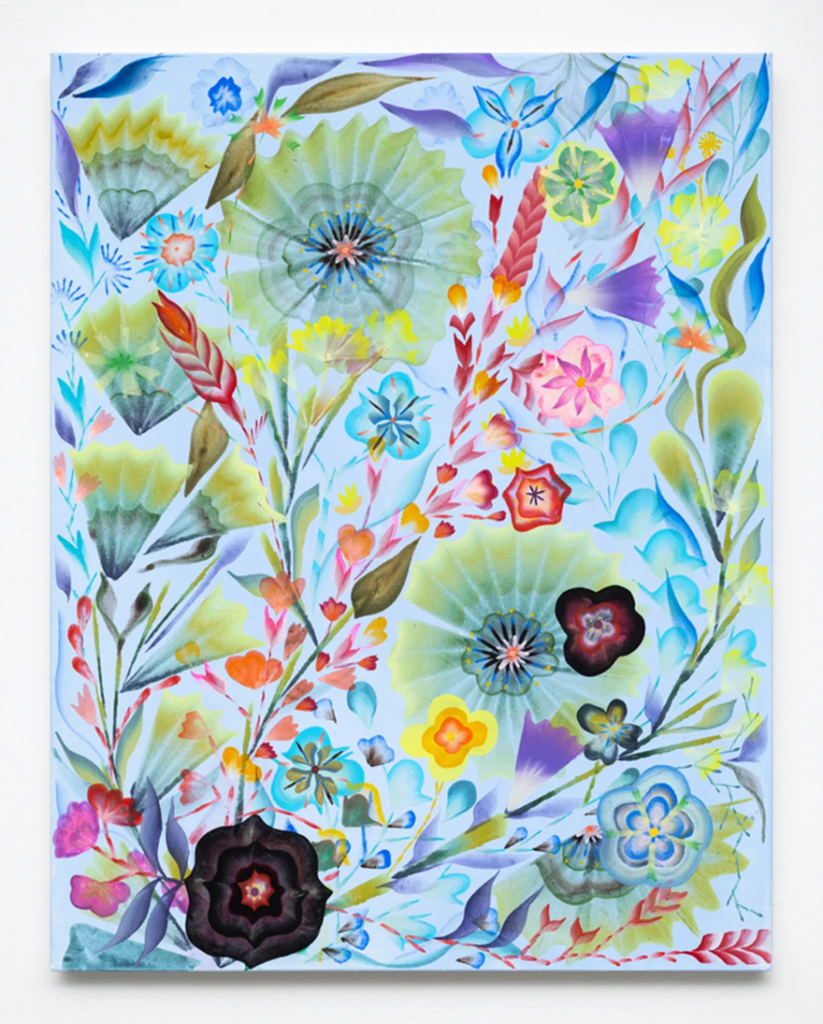
Negative space has no special character, painted in a single hue that complements the positive elements. It does not read as perfectly flat but as vaguely atmospheric by virtue of subtly spattered paint and nuanced color. This focuses attention on shapes, colors, and interior details. Even when flatter, the works can feel airy because there remains a sense of light, ergo space. Palmer’s light is all over, casting no shadows. While this feature reinforces the patterned look and references to floral design and gardens, the dominant impression is one of wildflowers over formal arrangements. She may also be recognizing that surface pattern in textiles or wallpaper is the form in which floral variety and abundance are often encountered. Palmer is less William Morris than William Kilburn, whose elegant images are of vividly imagined hybrids. Likewise, many of Palmer’s specimens are flower-like rather than actual representations. In its simultaneous indulgence of the decorative potential and quasi-spiritual aspect of nature, her work echoes that of Erich Haeckel.
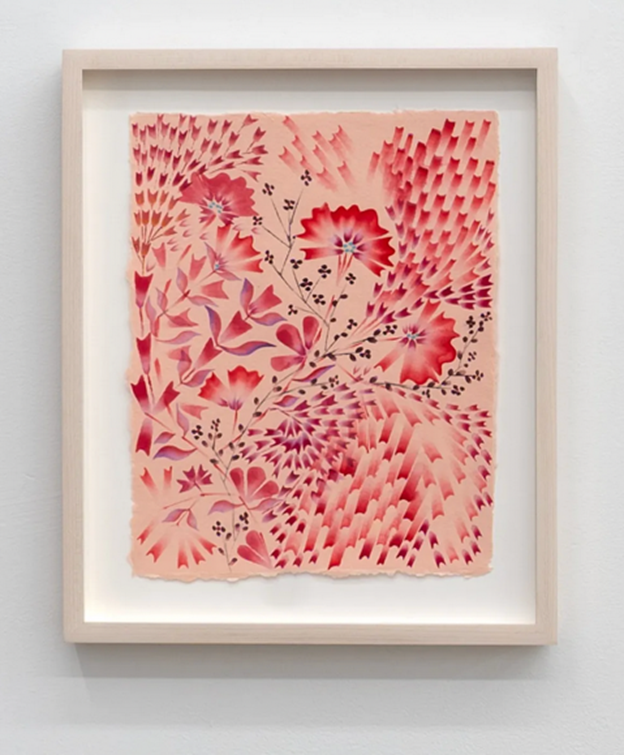
In monochrome gouaches on paper, Palmer stresses mark and shape, value over color. They may call to mind the fanciful aspects of Martín Ramírez’s work. Gardens occur in the sea as well as on land, confirmed by Deep Sea and Touching Bottom. Here some forms resemble Portuguese man o’ wars, recalling Ann McCoy’s undersea images from the 1970s. In Green Branch, patterned and textured protuberances splay and parade. Pink Garden may be the best example of the hybrid underwater garden, again akin to Kilburn, whose later works keyed more on aquatic plant life than the home garden. As in certain marine life, some shapes appear to possess an inner glow and generate their own light. Deep Sea, one the largest works, is the most overtly aquatic, though the artist’s touch is not quite as sure.
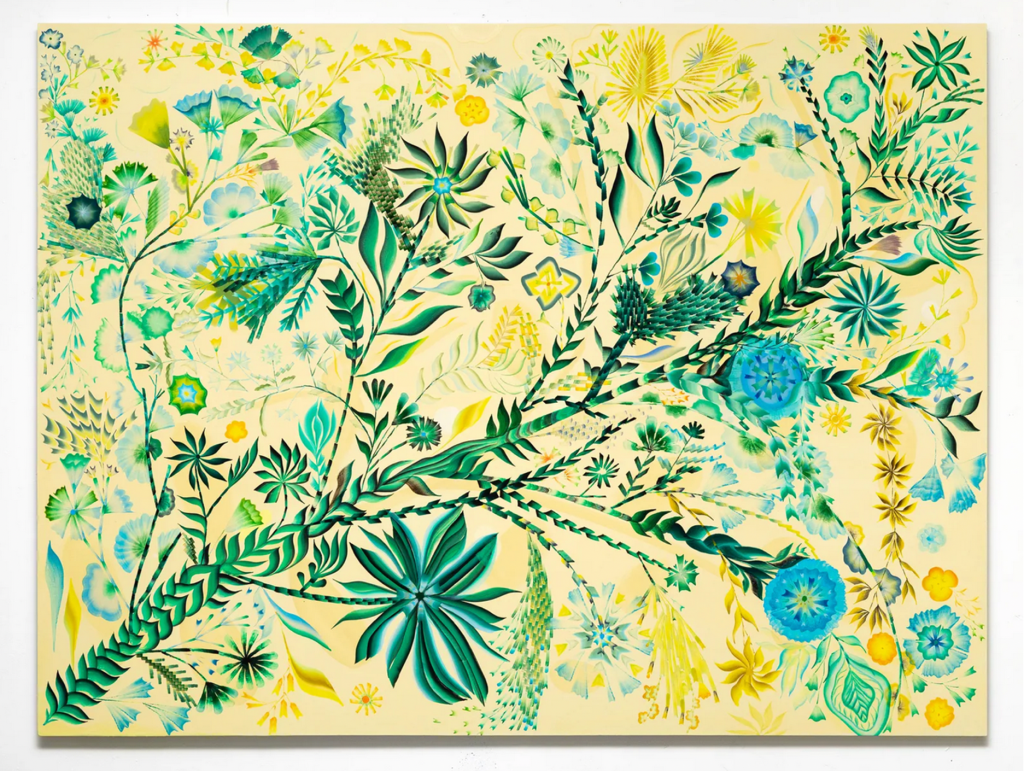
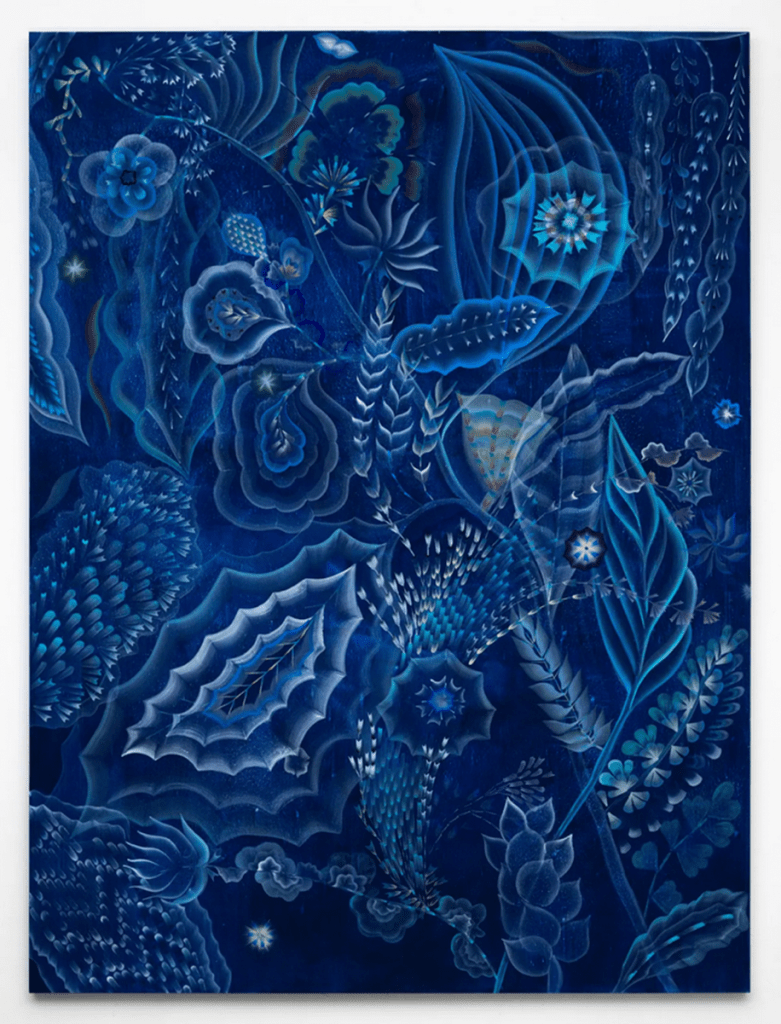
Palmer’s paintings may be most compelling when the compositions are tightly packed, but the variation across the exhibition is welcome. Her work is, by nature, optimistic. In her constructed world, all things are thriving, nothing is struggling. She expresses the quiet strength of the beautiful and the bountiful, offering something to hold onto. Ultimately, her subjects convey permanence: the idea that what was here before us and will remain after we are gone. Nature, of course, prevails over civilization.
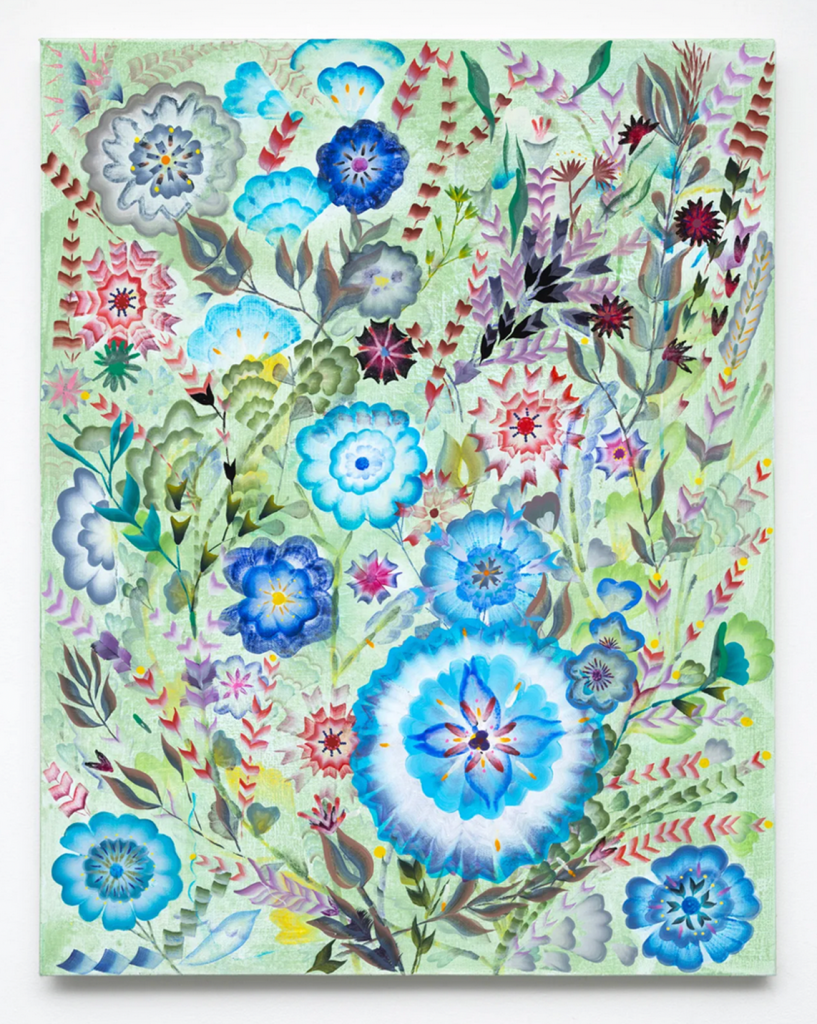
“Ruby Palmer: Garden Theory,” Morgan Lehman Gallery, 526 West 26th Street, Suite 410, New York, NY. Through April 18, 2026.
About the author: Peter Schroth is a Brooklyn-based painter.