
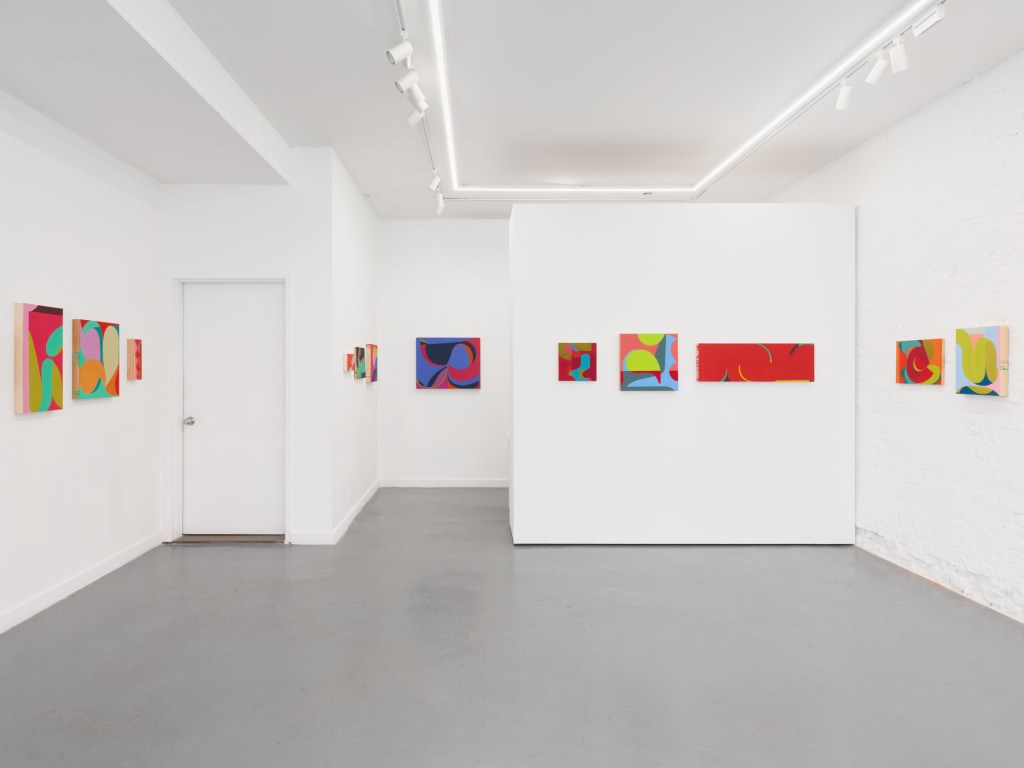
Contributed by Michael Brennan / A painter I once knew – a highly regarded abstractionist, modernist, and lover of Matisse as well as a popular professor – praised the work of a student during a critique. One of his colleagues, a postmodernist painter not so well regarded, said dismissively, “I don’t know, all I see are some colors on canvas.” The first painter replied hotly, “What the hell do you think painting is all about?” Another time, I invited a painter, now sadly sidelined, to join me at a survey of contemporary abstraction. There was a pregnant pause, “To see what exactly, Michael … shapes?” Many remain skeptical about the relevance, meaning, and remaining potential of manipulating shapes and colors. But Jane Haimes is still fruitfully exploring the possibilities. She understands that as long as there is painting, there will be shapes and colors, so we ought to make something of them.
Haimes’s vocabulary is familiar, but her work isn’t orthodox because she’s pressing shapes and colors into unusual recombinant configurations. Her approach is intuitive and revelatory. Maybe most importantly, her work is painted rather than made – an ongoing act of searching and discovery rather than the expedited creation of an image. She exploits uncommon exchanges between shapes and colors, producing a joyful tension that leads to surprises.


Jane Haimes, Ripple, 2016, flashe on panel, 11.5 x 11.5 inches
Ripple, its piercing, knife-like shapes set above and against an undulating sea of teal, is an example of what I’m talking about. It’s not merely the byproduct of stencils or projection, nor is it a predetermined image evidenced by telltale signs of sanding, dense layering, or fussy edge adjustment. Haimes’ lines are found. The painting might appear starkly graphic in digital reproduction, where most of its filmy glow and nuanced surface is lost, but in person its modulation and nuance fully emerge. I’ve included the painted brick face in the background here to provide a sense of the painting’s size and objecthood. The interior of Ripple is so complex – so rippling – that any downbeat notion about the static conventionality of the square vanishes. It’s hard to set a square in motion; Haimes does it.
Flashe and wood panel are her bread-and-butter. Flashe is a water-based vinyl paint, super-matte flat and known for its saturated color. Haimes achieves richly colored surfaces with this medium, paradoxically atmospheric on a hard surface. She is fully in control but not afraid to leave some errant drips of color on the side, leaving clues about the act of painting. None of these painting are as clean as they appear in reproduction, and, as with the best of geometric abstraction – say, Mondrian’s – there’s always a little edge chaos where color planes meet.

20 x 16 inches

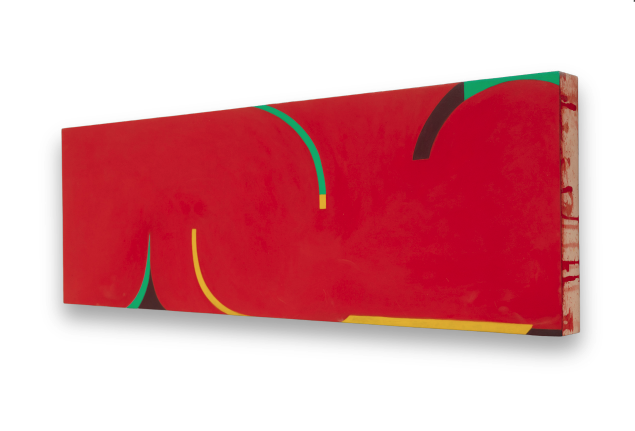
Predella is an outstanding painting, a horizontal narrative of contrasting curved and straight lines, embedded within and rearticulating a mass of red, capturing the legacy of modern French painting, centered on late Barbizon and the School of Paris. The title also reflects the artist’s interest in the pre-oil tradition of Italian quattrocento painting.
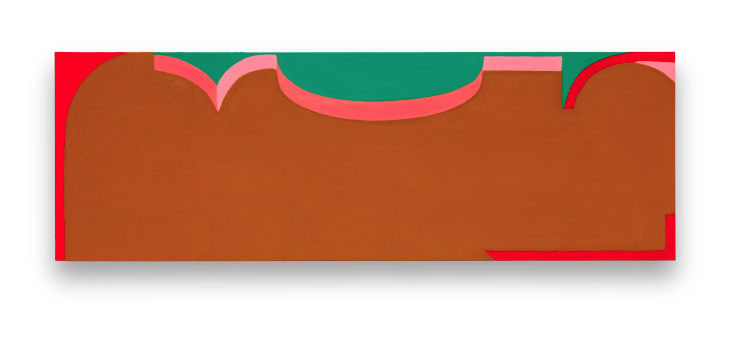
Pescia is a first cousin to Predella. I love its arcade-like volume, with scarlet bands popping out unexpectedly along the periphery. It’s not so easy to activate a field of ochre, but, again, Haimes manages. Her palette here is reminiscent of Sienese painting, prior to the Renaissance. Embodying far more than a formal dance of shapes and color, this painting has a memory.
The installation is tight, eye-level, and intensely salon-style, the paintings just a few inches apart. This compounds the effect of mostly smaller works, magnifying and heightening their differences. The presentation remains humane, open, and not overpowering, the halation of color warm and sensual. At the same time, Haimes uses beauty deceptively, as a discordant force, which renders her paintings stealthily relevant to the larger world. Morandi made still life matter in the Atomic Age. Picasso made French musketeers seem current as men walked on the moon. Now Haimes offers an elegant argument for geometric abstraction in a retrogressively messy era.
“Jane Haimes: Odd Poetry,” Trotter&Sholer, 168 Suffolk Street, New York, NY. Through January 31, 2026.
About the author: Michael Brennan is a Brooklyn-based abstract painter who writes on art.





Beautiful paintings!
Thrilling paintings!
Beautiful review bringing to light the many strengths of this important show!
Insightful review that truly entices with its nuanced perspective. Looking forward to seeing the show!
Really beautiful work. I could hang out with these for quite awhile. Ms. Haimes work rewards “watching,” not just seeing. Delicious and delightful.