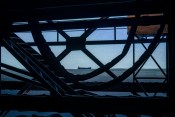
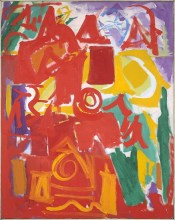
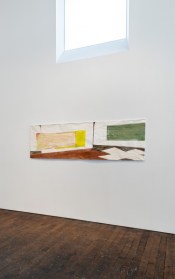
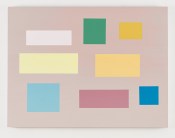
Contributed by Katy Crowe / “Significant Properties,” the title of Mary Jones’s current exhibition at as-is.la and her first in Los Angeles in some years, aptly suggests real estate worth seeing. Los Angeles is rich in such properties, and the cinematic allusions in her paintings are also broadly resonant of Tinsel Town, where Jones lived, worked, and showed before she moved to New York.
Solo Shows
G. Peter Jemison: One fine painting
Contributed by Chunbum Park / In the seventeenth century, the English justified their North American conquests with the Roman concept of res nullius, whereby all people owned unoccupied land until it was put to some worldly use. The English philosopher John Locke suggested that the Europeans could disregard all indigenous forms of government and deny indigenous peoples sovereignty because Europeans, unlike the indigenous, valued and worked the land. G. Peter Jemison, a member of the Heron Clan of the Seneca Nation, makes paintings and drawings that encapsulate indigenous beliefs about the land, many now on display in his show “On the Right Path” at 47 Canal, quietly but firmly countering the colonialist narrative.
Joan Snyder’s brilliant command of chaos
Contributed by Abshalom Jac Lahav / “ComeClose,” Joan Snyder’s current exhibition at Canada, testifies to her enduring brilliance and evolving artistic language. Now 83, Snyder has been a trailblazer since the 1970s. With her “stroke paintings,” she disrupted the Minimalism that was then fashionable, left cold by its austerity and masculinity. Her rebellion made Snyder a feminist shaper of contemporary abstract art. The distinctive juxtaposition of vivid colors and earthy backdrops in her work reflects a lifelong determination to explore and push its boundaries. The exhibition’s title is an invitation to examine not just the art but also why we make it.
Jane Swavely and the Bowery tradition
Contributed by Michael Brennan / Magenta Plains is located on the Bowery, just as it breaks left onto Canal Street, in Chinatown. Upon entering, viewers are immediately greeted by a washy terre verte Jane Swavely painting, OID #3 Green, hanging above the desk. It sets an organic tone and is indicative of the half-dozen paintings to follow, hanging in the first-floor main gallery. Swavely’s seven canvases are all vertical, and are mostly diptychs, internalized or externalized. They are loosely painted with a 2- to 2 ½-inch flat brush, heavy on the solvent, with some wiping away by hand. Much color mixing happens directly on the surface. Swavely favors flared, phosphorescent hues. She cleverly manipulates paint with rags to create the illusion of light emitting from the ground. Her work glows, appearing backlit.
John O’Connor’s formidable pencil
Contributed by Riad Miah / John O’Connor’s tools are basic and everyday, materials that one might think a child would use for their initial foray into art making. For his works on paper, many now on display in his solo exhibition “Man Bites Dog Bites Man” by way of Pierogi and L’SPACE, he uses colored pencils and graphite. But behind the simple tools is a discerning mind.
Cordy Ryman, maestro of the quotidian
Contributed by Sharon Butler / While nostalgia and the yearning it precipitates may be gripping the art world, Cordy Ryman’s gently dazzling painting installations, on view at Freight + Volume, are unapologetically about the here and now – that is, what’s happening in one place today. Titled “Monkey Mind Symphony,” the show captures the distractions we encounter day by day, minute by minute. What could be more apt for our time than a visual language comprising small objects? Logically, they are the physical manifestations of tweets or threads, crafted easily, sometimes beguilingly unfinished in the traditional sense of the word, and arranged so as to radiate Ryman’s idiosyncratic energy.
Maki Na Kamura: “Caspar David Friedrich plus Hokusai minus Romanticism minus Japonisme”
Contributed by David Carrier / Born in Japan, Maki Na Kamura was trained in Germany, where she now lives and works. In that light, it’s not too surprising that she describes her work as “Caspar David Friedrich plus Hokusai minus Romanticism minus Japonisme.” Identifying herself as both a traditional painter and a contemporary artist, she notes that she might, on the same canvas, use both tempera and oil paint– two materials traditionally used separately. Her paintings and charcoal-on-paper drawings are poised between figuration and abstraction. The paintings are often centered on figures, but it’s not usually clear what’s happening in the work on view at Michael Werner. It may be hard to tell just what we are looking at, but it is obvious that her central concern is visual pleasure.
The grit of Frank Auerbach
Contributed by Natasha Sweeten / As a young art student, I revered Frank Auerbach. His practice was a battle with inner demons, one of splayed brushstroke and open flesh that plunged deep into his psyche. The stories of him laboring countless hours on the same small portrait, painting and repainting, scraping it all off at day’s end – were they not the perfect embodiment of my own tortured soul? Were we not linked by artistic fury, the desire to express something frustratingly beyond our reach?
Eyal Danieli: Embracing history in abstraction
Contributed by Michael Brennan / Israeli-American artist Eyal Danieli passed away earlier this year. I met him a few times, but I didn’t know him. I was impressed by the force of his personality, or more specifically of his presence. It was not that he was intimidating. In fact, he struck me as a tender soul – a gentleman – but also a man weighted with a distinct and uncommon gravity. His painting, in its blunt sensitivity, is similar. Sadly, Danieli’s first exhibition with 57W57 Arts, solemnly called “Preoccupied,” is effectively a memorial show. But nothing can diminish the innate power of his small pieces.
Dana Schutz: Too big to fail?
Contributed by Peter Malone / The airplane-hangar dimensions of the top-tier commercial art gallery can be justified by the flexibility they offer both dealer and artist. In 2017, I watched David Zwirner adapt his Chelsea location on 19th Street to accommodate Alice Neel’s modestly sized portraits, then open it up to create the parking lot rug sale vibe that suited Josh Smith’s 2019 “Emo Jungle” bazaar. Those two events occupied my thoughts as I walked through the grandiose layout of Dana Schutz’s recent “Jupiter’s Lottery” exhibition.
Beyond time: Brice Marden’s last paintings
Contributed by Kim Uchiyama / The dreamtime, as understood in Aboriginal culture, is a fully integrated reality lived daily, a total experience that holds past, present, and future in balance. From this perspective, the late Brice Marden’s last paintings feel both old and new, evoking an ancient mindset while embodying a new sentience and haptic presence born of the vulnerability and fragile urgings that arose as he grappled with his aging body and the ravages of cancer. The show’s title, Let the painting make you, is apt. It is fundamental to Marden’s work that painting spoke through him from the inside out: although he always adhered to his own set of rules, he never imposed an intellectualized concept on his creations.
Patricia Satterlee and Fran Shalom: Heirs to Nozkowski
Contributed by Sharon Butler / Abstract painter Thomas Nozkowski was widely and deservedly recognized for making intimately scaled abstract paintings using an idiosyncratic visual language that was derived from the visual and emotional stimuli of everyday life. Since his death in 2019, I’ve often wondered who might be the next Nozkowski. Given the trend towards figuration, mixed-media surfaces, and massive scale, precious few painters seemed to be walking in his humble footsteps. Now we have Patricia Satterlee and Fran Shalom.
Brice Marden’s valedictory courage
Contributed by David Rhodes / Brice Marden died at the age of 84 in August 2023. His first exhibition was in 1966 at the Bykert Gallery, located on East 81st Street, only a few blocks northeast of his current exhibition at Gagosian. A long life, years in the studio, immeasurable time spent with other artists’ work, travel, and an abundance of courage led to the paintings he made at the end of his life.
Books and Maps and Getting Lost: Doug Beube at The Argosy Bookstore
Contributed by Rebecca Chace / There are two places you can still get lost if you choose to: the streets of New York City and the pages of a book. You love art and books, isn’t that why you moved here in the first place? But you may have forgotten how to get lost.
Louis Fratino’s happy equilibrium
Contributed by Margaret McCann / Louis Fratino’s paintings in “In bed and abroad” at Sikkema Jenkins depict varied social situations, from intimate scenes to foreign climes. Snapshots of memories, many from Italy, read like a travel diary. In Duomo, light seems to dissolve a church façade into a gossamer veil, like Monet’s series of Rouen. Milan’s iconic gothic cathedral is strikingly illuminated, as are most monuments in Italy at night. Silhouetted throngs of young people in front of it have gathered after their evening stroll to aid digestion, take in the sumptuous surroundings, and see what’s happening in the local piazza. This saunter or “passegiata” is also “a walk in the park,” and the painting’s mellifluous drama demonstrates Fratino’s impressive facility, as it captures the Italian relish of visual and other small pleasures, which Americans often mistake for sunny dispositions (see Fellini’s La Dolce Vita).