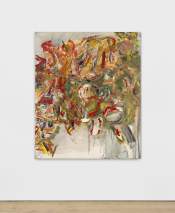
Contributed by Jonathan Stevenson / Simple and blithely inviting though they may seem at first, Amy Feldman’s new abstract paintings, on display in her solo […]
Solo Shows
Steve Greene’s crafty agitation
Contributed by Jonathan Stevenson / In an adventurous departure from drawing and collage, Steve Greene now offers intriguingly acerbic abstract paintings in his solo show “News From Nowhere,” on view at Frosch & Co. They are rich with sharply drawn shapes and robustly differentiated visual content, yet they require little deliberation to be appreciated. They penetrate immediately. This quality stems from the thematic cohesiveness produced by trenchant cultural and art-historical tropes distributed among the paintings. Judging by the fluidity of his marks and line, Greene generates these allusions intuitively, with minimal contrivance.
Nola Zirin and the march of abstraction
Contributed by Michael Brennan / It has sometimes been assumed that abstraction is unlimited in its possibilities. While that’s still broadly true, abstraction also has been exhaustively explored over the course of a century or more. All painting is organized around some kind of form. Abstraction is burdened with establishing form in the absence of figuration, the readiest and most natural source. There are only a few ways to define form without a figure – for instance, through geometry or gesture. It’s a limited playbook. Much of the success of Nola Zirin’s new paintings, on view at Mosaic Artspace in Long Island City, comes down to her bold expansion of the index of abstraction. Many are striking in their recombination of form and unusual mix of materials.
Leigh Behnke’s fluid sense of time
Contributed by Riad Miah / What’s a ghostly-looking ship doing in the city? Probably the same thing as the ethereal-looking figures passing through a similarly urban environment. In Leigh Behnke’s solo show “Time Travelers and Ghost Ships” at the School of Visual Arts’ Flatiron Project Space, enticing and mysterious paintings of such phenomena stimulate contemplation of the future as a manifestation of how we treat the present.
Elisa Soliven’s vessels of impeccable resistance
Contributed by Jonathan Stevenson / Elisa Soliven sees her dignified ceramic sculptures, now on display in a faultlessly curated solo show at LABspace in Hillsdale, as vessels containing the rich stuff of life – space, time, cultural tropes, history both grand and personal. Too eclectic and searching to be merely iconic, they are brimming with both old and new referents, and bear their weight with extraordinary grace.
Carol Bruns’s aesthetic moralism
Contributed by Gwenaël Kerlidou / Heart of Darkness, Joseph Conrad’s 1899 novella, is one of the first fictionalized accounts of the ravages of European colonialism in Africa. Marlow, the narrator, while surveying the grounds of an ivory collecting station on the Congo River, catches sight of a row of shriveled heads mounted on stakes. The episode segues to a deeper exploration of the psyche of Kurtz, a terminally ill but very successful ivory harvester working for the king of Belgium. His cryptic last words – “the horror, the horror” – sum up the situation. The title and content of Conrad’s novella reverberates through Carol Bruns’s current exhibition at White Columns of mostly monochromatic frontal sculptures, in which the human figure is omnipresent, either as hieratic totems or as ritual masks. Scattered in the gallery space, an unruly mob of chimeras and other nightmarish characters seems to be stoically harboring the scars, wrinkles, creases, and other traces of immemorable sufferings.
Kent O’Connor’s triumphant mundane
Contributed by Margaret McCann / Kent O’Connor’s “Everything All at Once” at Mendes Wood DM comprises small portraits, landscape studies, and several larger paintings, including still-lifes in shallow interiors, which he calls tabletops. The show’s evocative title, which relates to their multiplicity, may also be after a song or film. O’Connor’s description qualifies intense observation with the levity of comics.
Mark Bradford’s urgent abstraction
Contributed by Jonathan Stevenson / “You Don’t Have to Tell Me Twice,” Mark Bradford’s galvanizing tour de force at Hauser & Wirth, was a three-story exhibition of arresting coherence. His muscular paintings grab you by the lapels, pull you in, and visually immerse you to a point of satisfying comprehension.
Ester Petukhova’s cheerfully tragic key
Contributed by David Carrier / Born in Russia at the very start of this century, Ester Petukhova is a Pittsburgh resident. Her precocious new show includes seven small acrylic paintings, two of them with two parts, on shaped panels. Burgeoning Blue Screen shows a Russian at work on an old-fashioned computer. Indexed Landmarks 1 & 2 depicts a man, naked to the waist, holding a large fish. And Bread with Salt in the Wound presents a large loaf of bread, and is enhanced with glass beads. “It is a customary Slavic tradition,” the gallery label says, “to present bread with salt when welcoming a foreign nation or power.” Welcome, then, to the former Soviet Union.
Art and Film: Nora Griffin, Wes Anderson, and nostalgia’s virtues and limits
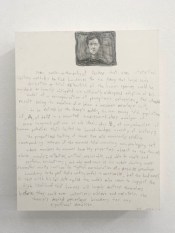
Contributed by Jonathan Stevenson / In 2000, The Onion published a durably wise wise-ass book called Our Dumb Century, chronicling with heavy satirical spin the endless follies of the twentieth one. Maybe a sense of relief lifted the editors. They could be forgiven for surmising, mistakenly, that centuries couldn’t get any stupider. That was the year before 9/11, when the world looked improbably rosy. It remains a moment that many look back on with special fondness. But there is dumb nostalgia and there is smart nostalgia. In “1999 NYC Tees,” a bracing four-day exhibition at Fierman on the Lower East Side, painter Nora Griffin zones in on this period and shows that the smart kind lives on the border “between kitsch and pathos.”
Bordo to Earth
Contributed by Jonathan Stevenson / Robert Bordo’s gently enveloping solo exhibition “Paint World,” now on view at Bortolami, is comprehensively seductive and sly, staking a claim to the attention of both the dreamer and the realist. Ultimately, he favors the latter. His subject is this rock we all live on. In depicting it impressionistically, from lunar vantage with small, nuanced brushstrokes, he achieves a paradoxically clued-up serenity of pastoral detachment and soft focus – not unlike that of, say, Monet’s waterlilies or, more abstractly, Günther Förg’s patches and crosshatches. But in literally facing the world, as it were, he also directly confronts its profound challenges and emphatically declines to turn his back on them. Thematically, then, this series escalates the existential worry of his earlier “Windshield” and “Crack-up” paintings – presumably planted in part by Guston, with whom Bordo studied – to global scale.
Ben Godward: Between repose and precariousness
Contributed by Jonathan Stevenson / Ben Godward is a grounded artist, dedicated for fifteen years to rendering zestful sculptures out of his Bushwick studio by way of poured resins that pop with bright color and radiate social and political awareness.
Nancy Powhida: At home in another world
Contributed by Jonathan Stevenson / Nancy Powhida, age 80, has just had her first solo exhibition in New York, curated by Kristen Jensen at Essex Flowers. Titled a deceptively straightforward “Oh Dear! Our Life was Like a Horror Show! (No Wonder You Had to Learn to be Resourceful),” the show comprised six graphite drawings and one oil painting, each piece an unnervingly moving revelation.
Don Voisine: Twilight of the Modern
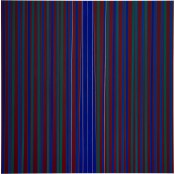
Contributed by Jacob Cartwright / Walking through an exhibition of Don Voisine’s paintings is like spending time with a laconic host who can still be relied upon for a gnomic phrase, or pithy observation. His reductive work has the forceful thrust of heraldic symbols or Russian icons, but the underlying quality is always one of intrigue, and he likes to throw in a few twists. In his current show at McKenzie Fine Art, he pushes this instinct further by tinkering thoughtfully within own lexicon, producing some of his strongest work in the last decade.
Seth Becker’s virtuoso weirdness
Contributed by Patrick Neal / There is a particular kind of thrill in trying to understand what is going on in Seth Becker’s paintings that involves separating what’s strange from what’s familiar. The subjects of his small oil paintings are peculiar, and so are the lenses through which he approaches a person, place, or thing. His solo show “Field Music” currently on view at Pamela Salisbury Gallery in Hudson, NY, occupying two floors and comprising around 40 small-scale oil paintings, embodies the painter’s slow-burn perversity.