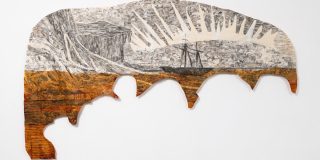
Contributed by Bill Arning / “Self Made: A Century of Inventing,” now on view at the American Folk Art Museum, asks a thorny question: Why does the descriptive term “self-taught” continue to resonate so strongly with dedicated fans of folk and outsider art? At its most basic, the term describes artists who did not attend traditional art schools. To be sure, these institutions embody uneasy contradictions. Tasked with encouraging free expression, they simultaneously prepare artists to attract patronage by targeting the moneyed class. But at their best, they embed young artists in an ongoing, object-based cultural conversation. So why are we so drawn to work that emerges outside their influence?
While the museum’s collection includes many dream-inducing works by artists who never knew an “art world” existed and still left us with unquestionably great works, the majority of artists in the show maintained some conscious relationship with that world. Accordingly, co-curators Valérie Rousseau and Suzie Oppenheimer have sensibly reframed the question around the impetus to make art simply when exhibitions, markets, and recognition are not central to the art-maker’s thinking. “Self-Made” brims with visual magic, but it is this nuanced curatorial framework that makes it essential viewing. Rousseau and Oppenheimer deftly brush aside the tired notion that objects become “art” only when discovered by inquisitive professionals. While the wall texts occasionally indulge a romantic notion of spontaneous, almost divine creation, Rousseau and Oppenheimer ground their claims in biographical details and, more importantly, push beyond them. They have organized the show around three motivations that feel convincingly universal: to make self-portraits, to construct alter egos, and to tell one’s own story. By focusing on motivation, and on telling details in the works themselves, the curators reveal the degree to which the artists understood themselves to be “artists” of cultural value.
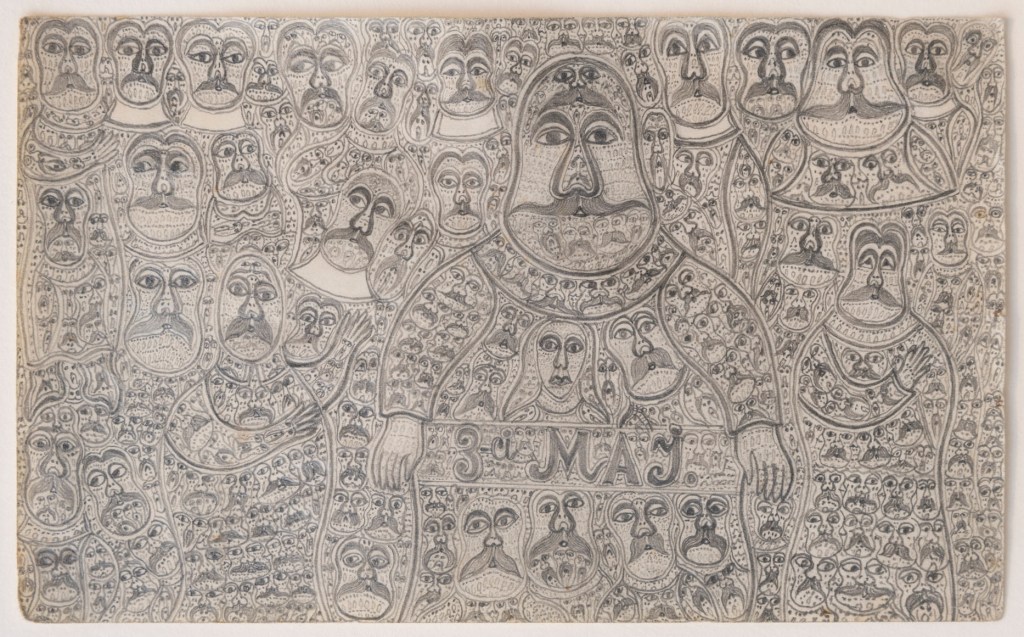
10 3/4 x 15 inches
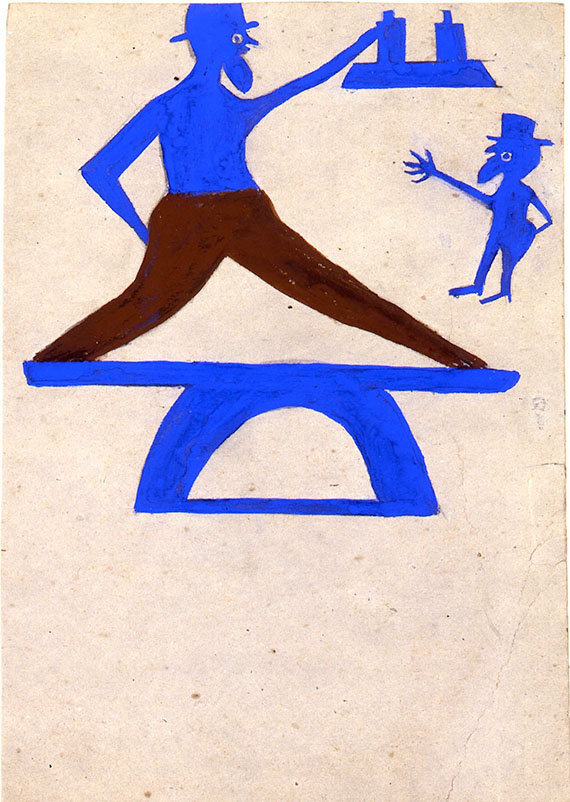
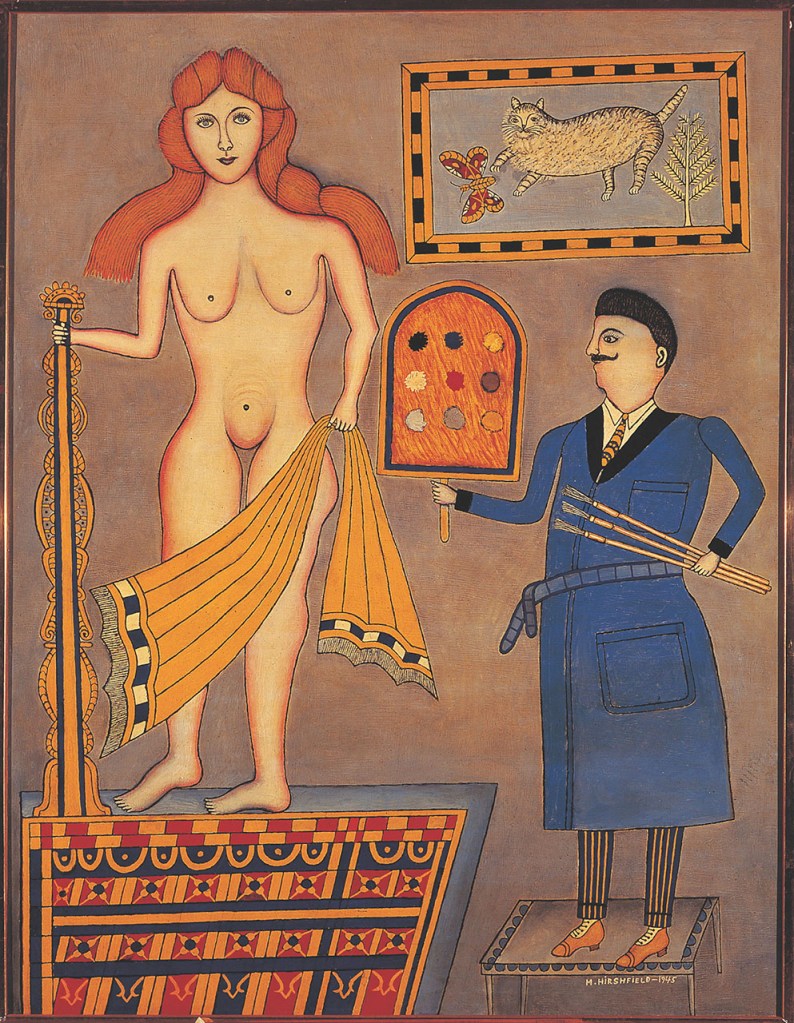
Bill Traylor (1854–1949), whose small body of extraordinary drawings of stylized human and animal forms are now widely celebrated – and even shown at Zwirner – occupied a prominent place in the bustle of downtown Montgomery, Alabama. There, he “took on a public identity in his sidewalk studio and positioned himself as a public commentator in an act of self-legitimation.” One of his recurring figures – a bearded man in a stylized cap – reads as a kind of self-portrait, suggesting that he embraced the role of artist. Similarly, Morris Hirshfield (1872–1946), who began making art only in retirement, in The Artist and His Model (1945) has himself proudly brandishing a palette while approaching a monumental nude. Though self-taught, Hirshfield was acutely aware of galleries and museums, of Picasso, of MoMA. The well-worn story of his painting over commercial posters and persistently courting dealers like Sidney Janis conjures the ultimate insider-outsider hybrid.
Categorization grows more complicated when extreme eccentricity comes into play. Lee Godie (1908–1994), who was frequently homeless, staged photographs of herself in bus-station photo booths, posing as a recognizable “artist type” with palette in hand, proclaiming herself “Chicago’s own French Impressionist.” She sold her work on the steps of the Art Institute of Chicago, often including these self-portraits as proof of artistic identity. The museum pairs one of her painted self-images with this photographic “documentation,” underscoring the extent to which she actively constructed her role. During her lifetime, the press cast her as Chicago’s most collected artist.
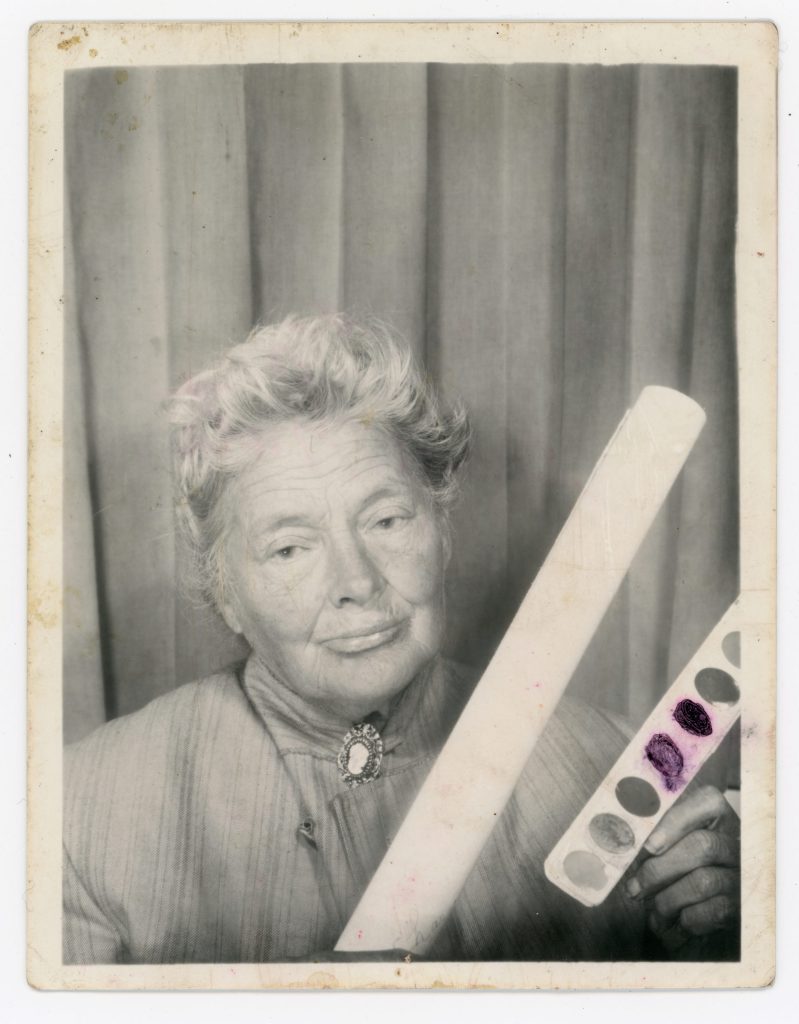
ballpoint pen on photograph, 5 x 3/4 inches
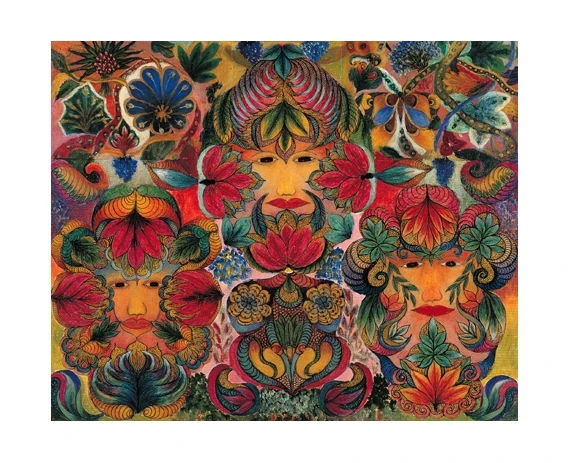
oil on canvas with collage, 20 x 24 inches
If the self-portrait section embraces variations on “this is me, please see me,” the autobiographical works shift toward “this is what happened to me.” Three Faces in a Lush Landscape (1959), a luminous collage by Minnie Evans (1892–1987), is psychedelically floral and rooted in her work at a botanical garden in Wilmington, North Carolina, where she sold her drawings to visitors. Buyers may have regarded them as souvenirs, but Evans understood them as vehicles for a kind of nature-based prayer.
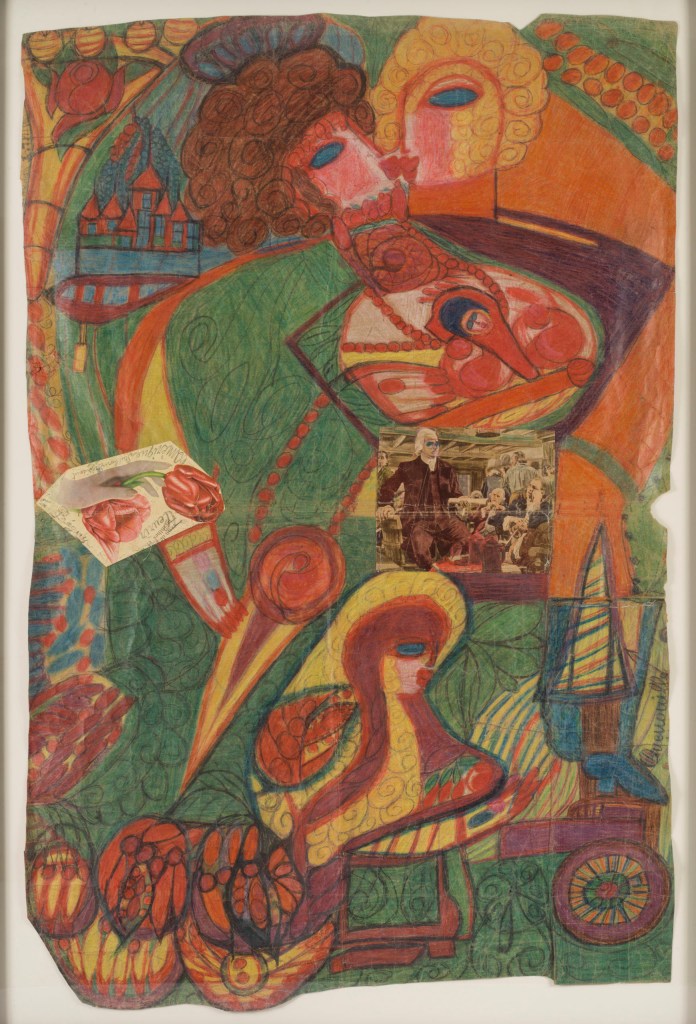
The third section, encompassing alter egos, is the most conceptually unstable, moving beyond direct communication into alternative realities. The wall texts emphasize acts of world-building at moments in times of crisis. Edmond Monsiel (1897–1962) made his densely worked, almost visionary drawing of a heart-shaped man supporting a woman–bird hybrid while he was in hiding during the Nazi occupation, after his family had been killed. He drew on whatever materials were available – here, the back of a cement bag. His work resists easy incorporation into the exhibition’s conceptual framework. Its proliferating, tightly packed forms read less as expression than as necessity – an attempt to maintain sanity under extreme duress. The alter ego here is not a performative extension of self but a survival mechanism. The function of the drawings precedes visibility: Monsiel never intended them to be seen. The existential pressure he faced poignantly spoils any easy celebration of the “self-made.”
Even without formal training, these artists understood, to varying degrees, that something like an art world existed – systems through which works might circulate and a role of “artist” might be inhabited, desired, and fulfilled. The exhibition proposes a continuum: from Godie and Hirshfield, knocking on the museum’s door, to Evans, sharing visionary experience with strangers, to Monsiel, creating private worlds in which an audience played no part. Locating each work along that spectrum is a rewardingly coherent mode of viewer engagement.
Art-world insiders often cite the American Folk Art Museum as their favorite New York institution. And artists deeply embedded in the contemporary art ecosystem are frequently among the most passionate collectors of folk and outsider work. Exhibitions like “Self-Made” tap into the corresponding desire for a pure, unmediated encounter with art, one unburdened by the machinery of mega-galleries and collectors. At the same time, they quietly expose the fantasy that such innocence exists. In doing so, the show becomes not just a fond and respectful tribute, but a subtle and edifying critique of the preconceptions that shape our own longing for the “self-made.”
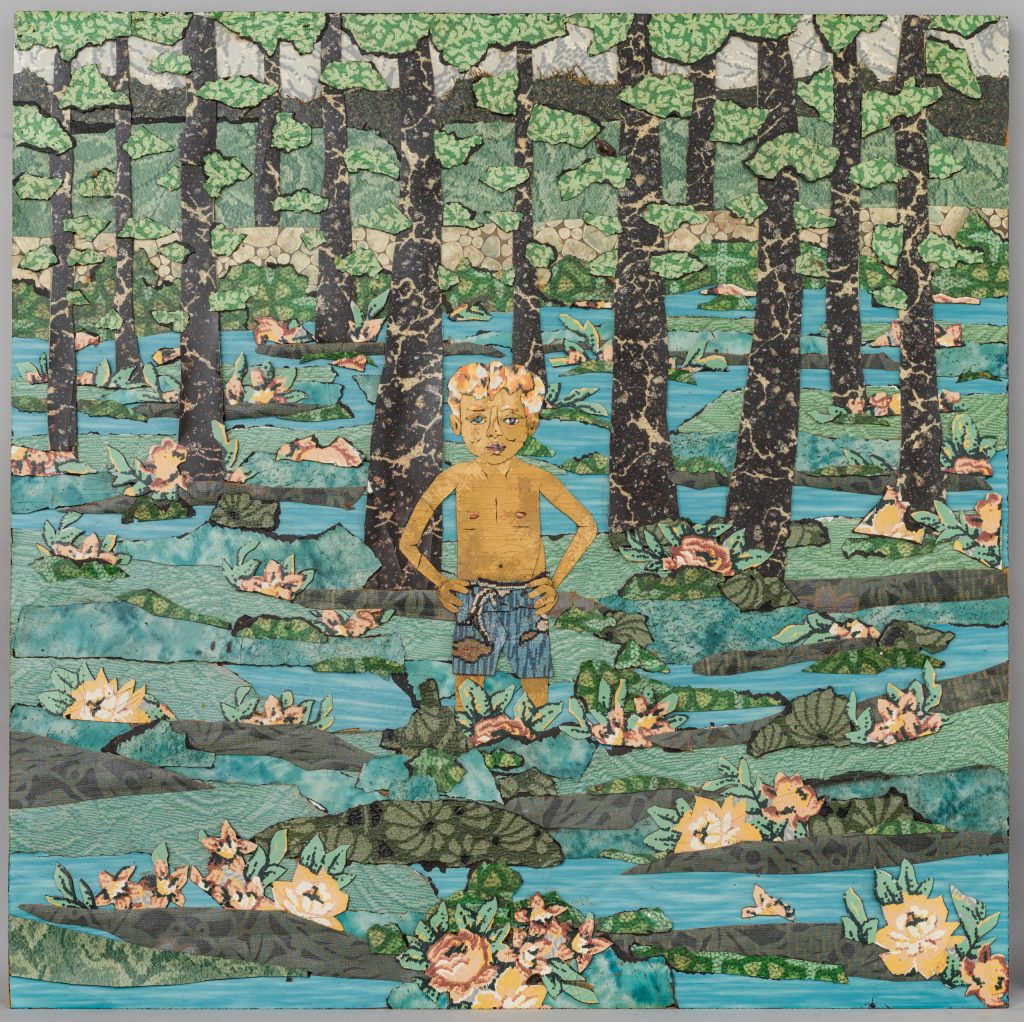
varnish on wood, 48 x 48 inches
“Self-Made: A Century of Inventing Artists,” co-curated by Valérie Rousseau and Suzie Oppenheimer. American Folk Art Museum, 2 Lincoln Square, New York, NY. Through September 13, 2026.
About the author: Bill Arning is a curator, critic, advisor, writer, and itinerant maker of pop-up shows based in Old Chatham, New York.