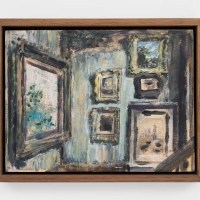
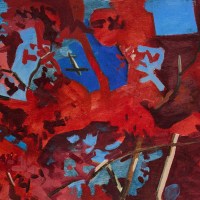
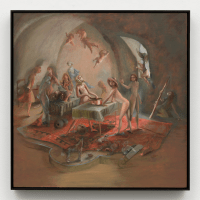
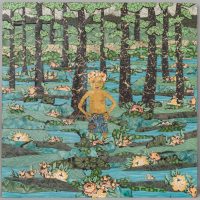
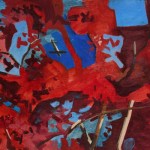
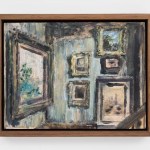
Contributed by Jonathan Stevenson / The title of Mitchell Kehe’s solo show at 15 Orient – “Bonded by the Spirit of Doubt” – encapsulates the ambiguity and contradiction in which he traffics. Doubt is fundamentally divisive and isolating, a fraught source of any bond in the sense of affection or solidarity. Maybe he means “bonded” in the sense of “certified,” the way American whiskey is, uncertainty and doubt being such pervasive phenomena that no work of art can claim validity or integrity without somehow imparting them. In his beguiling paintings, this idea is manifested in a casual tension
Solo Shows
Alex Kwartler: Open to the world
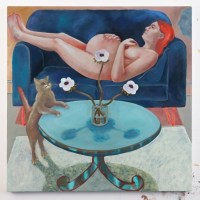
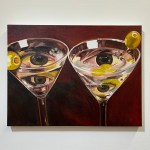
Contributed by Shirley Irons / In a dream, I asked Alex Kwartler if his work was about the unreliability of images. God no, he yelled. “Off-Peak,” his current show at Magenta Plains, presents modestly scaled paintings that read across the room like music, with beats and rests, highs and lows. Their subjects include tender representation, stark pop, painterly abstraction, tin can lids, dots, drains, and shipwrecks. They echo and repeat. Their consistency lies in his assured, skillful paint handling. When you can do anything with paint, why not just do it?
Choong Sup Lim: Eastern ode to a Western city
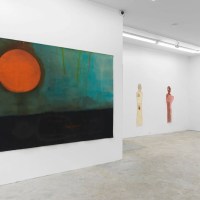
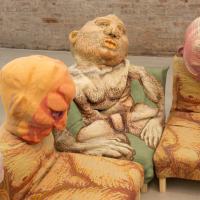
Contributed by Ben Godward / Choong Sup Lim says that he doesn’t paint his sculptures but rather finds the color in the city. This might be the most important aspect of his show “Yard” (Madang) at Shin Gallery. Color as form – in this case, linen and detritus from the city – yields a pallet of neutrals. Linen, the substrate of painting with a capital P, takes a star turn here. Much of the show consists of raw linen, and it is as important in the sculptures as it is in the paintings.
Hedda Sterne’s infinite space
Contributed by Jason Andrew / Hedda Sterne was the only woman made famous by Nina Leen’s photograph The Irascibles for Life magazine in 1951, and the group’s last surviving member when she died at 100 in 2011. While many of those featured in that iconic photograph achieved mythic status, Sterne was consigned to the margins of art history. “I am known more for that darn photo, than for 80 years of work,” she once remarked. Implausibly inventive and unwilling to adhere to a single style nor embrace prevailing aesthetic trends, Sterne didn’t cast herself in the heroic mold favored by the brooding boys associated with Abstract Expressionism.
Anne Russinof: More than a gesture
Contributed by Michael Brennan / Anne Russinof passed away a year ago at the age of 68. “Gestural Symphony” is a commanding memorial retrospective of her mostly large, emphatically gestural paintings. Posthumous exhibitions are by nature bittersweet, but Russinof’s resists melancholy because her work is so irrepressibly lively. Her signature outsize curves are sweeping and springy. They kick, bounce, and jump around.
Trisha Donnelly: The real thing strange
Contributed by Talia Shiroma / The drawings in Trisha Donnelly’s show at the Drawing Center are a succession of curving volumes with meticulous shading, depicting what are most aptly called not objects but “things.” They suggest sinew and bone, heavy metal aesthetics, and the errant, automatic doodling found on classroom desks or tucked away in notebooks. Neither representational nor abstract, some recall Jay DeFeo’s works from the seventies in their effects of translucency and particularized strangeness. Yet unlike DeFeo’s apparitional tripods and dental bridge, the things which Donnelly depicts rarely seem to coincide with physical reality, to mystifying and sometimes numinous effect.
John Kelly: The body is never abstract
Contributed by Bill Arning / In the mid-1980s, great art experiences of every conceivable stripe seemed to bloom prodigiously and organically from a single club on Avenue A called the Pyramid. Out of this dark, sticky-floored dive came a motley congregation of artists, musicians, drag queens, filmmakers, and poets who launched shockingly original cultural provocations that still reverberate globally, even though relatively few people witnessed them at the time.
Anne Wehrley Björk: Where sharks once thrived
Contributed by Jonathan Agin / Formed by erosion over millions of years, Chaco Canyon was the site of the Ancestral Puebloan people’s sprawling urban center. Buildings erected there in the eleventh century were among the tallest in North America until the nineteenth. These remote, enigmatic ruins, marked on early Spanish maps, were rediscovered in the modern era by US Army surveyors after the Mexican-American War. Today they are part of the Navajo Nation, which covers parts of Arizona, New Mexico, and Utah. When Anne Wehrley Björk was a child, her family used to take her camping there. As demonstrated in “Lost Canyon,” her new show of paintings at Margot Samel, she has never forgotten the landscape.
Laura Newman: Flatness and the illusion of depth
Contributed by Adam Simon / A photographer friend once asked me why painters are always talking about the space in a painting. He wanted to know what this term “space” meant. I talked about the different ways paint on a flat surface could be made to suggest depth, and how the challenge for modern painters was to create depth while also reaffirming the flatness of the support. I probably referred to the elusive concept of the “picture plane” and how simultaneously maintaining mutually exclusive ideas – flatness and depth – could produce a poetic or even a mystical dimension in visual art. Most abstract paintings present shallow space, keeping depth to a minimum. This type of painting is usually non-hierarchical; nothing feels more essential than anything else. The viewer’s eye tends to scan. If you want to both represent depth and reaffirm flatness, shallow space is going to be easier to handle than deep space.
Peter Plagens’ portals and vortexes
Contributed by Jonathan Stevenson / At Nancy Hoffman Gallery, Peter Plagens’ bracing new abstract paintings don’t so much as invite you in as dare you not to enter. Each canvas consists of three basic components: a painted frame of washy gray or brown; a pristinely rendered hard-edge shape, assertively opaque, centrally positioned, vertically symmetrical, and horizontally striated; and scattered, seemingly directional slashes. The second feature propels the paintings, but the other two steer them. The distinctly dilute vagueness of the frames might impart risk, the pesky shards impulse, and the vivid, intuitively color-coded ramps expansive fate – humble versions of Jacob’s Ladder, vouchsafing a future that need not be feared, at least distantly echoing one of Dave Hickey’s blithely peremptory and eminently arguable mantras: “Beauty is and always will be blue skies and open highway.”
Su-Mei Tse, composer and orchestrator
Contributed by Joe Fyfe / A large souvenir brochure accompanied Leonard Cohen’s “I’m Your Man” tour in the late 1980s. It included, among an assortment of photographs of him and reproductions of his sketches, a thousand-word essay titled “How To Speak Poetry” that has had a second life on the internet. In this singular artistic manifesto, Cohen admonishes singers that they are “among the people. Then be modest. Speak the words, convey the data, step aside.” On the next page, he tells them to “think of the words as science, not as art. They are a report.” If an audience appreciates the event, “it will be in the data and the quiet organization of your presence.” Su-Mei Tse’s current exhibition at Peter Blum Gallery seems to freshly embody Cohen’s abiding concern with presentation and how an artist must address an audience.
Jane Haimes: Rehabilitating geometric abstraction
Contributed by Michael Brennan / A painter I once knew – a highly regarded abstractionist, modernist, and lover of Matisse as well as a popular professor – praised the work of a student during a critique. One of his colleagues, a postmodernist painter not so well regarded, said dismissively, “I don’t know, all I see are some colors on canvas.” The first painter replied hotly, “What the hell do you think painting is all about?” Another time, I invited a painter, now sadly sidelined, to join me at a survey of contemporary abstraction. There was a pregnant pause, “To see what exactly, Michael … shapes?” Many remain skeptical about the relevance, meaning, and remaining potential of manipulating shapes and colors. But Jane Haimes is still fruitfully exploring the possibilities. She understands that as long as there is painting, there will be shapes and colors, so we ought to make something of them.
James Horner: Making of an American Dandy
Contributed by Nathan Storey / James Horner: Making of an American Dandy at Amos Eno Gallery looks back across forty years of the artist’s life and practice without tidying the record. The works in the retrospective are bruised and glamorous, horny and grieving, and above all, alive.
Ana Benaroya: Sexual politics burlesque
Contributed by Aaron Michael Skolnick / Ana Benaroya’s solo exhibition “Eternal Flame” at The FLAG Art Foundation is a joyously absurd exploration of the female body and masculinity. As a child of the ‘90’s making my way from room to room bouncing between fields of color and exotic scenarios, I can’t help but think about the burlesque quality of American Gladiators and the World Wrestling Federation’s images of women. But Benaroya is also serious about sexual politics.
A penchant for belonging: Biala’s Paris
Contributed by Rebecca Allan / Just off rue de Jarente in the Marais, Galerie Pavec – which late last year presented “L’Esprit Français,” the first […]