
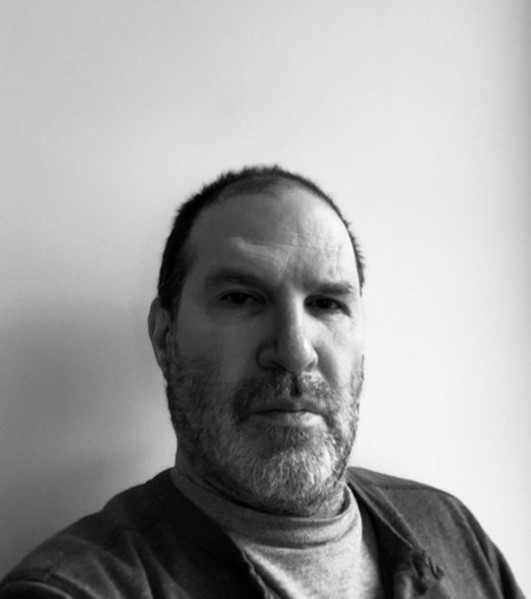
Contributed by Michael Brennan / Israeli-American artist Eyal Danieli passed away earlier this year. I met him a few times, but I didn’t know him. I was impressed by the force of his personality, or more specifically of his presence. It was not that he was intimidating. In fact, he struck me as a tender soul – a gentleman – but also a man weighted with a distinct and uncommon gravity. His painting, in its blunt sensitivity, is similar. Sadly, Danieli’s first exhibition with 57W57 Arts, solemnly called “Preoccupied,” is effectively a memorial show. But nothing can diminish the innate power of his small pieces.
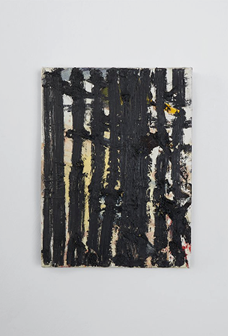
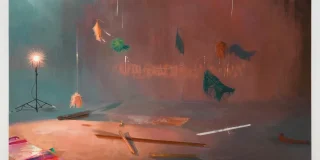
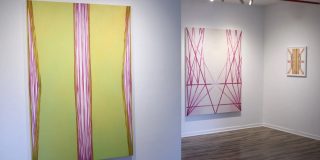
The exhibition includes 16 works of art, mostly painting, drawn from four bodies of work: “Scars & Stripes” (some vertical, some horizontal); “Tools of the Trade/What Remains” (a shelf-borne installation); “Holy Smoke;” and the wittily titled “Some Restrictions Apply.” Many of the paintings are on canvas or paper that has been remounted onto clean stretched canvas, like many late Rothkos. The paintings are all abstract, but not absolutely so. Danieli had previously made representational work that included silhouettes of pistols, bombers, helicopters, and Nazi salutes among other recognizable images, and he carries sublimated content forward. All of his work is both political and personal.
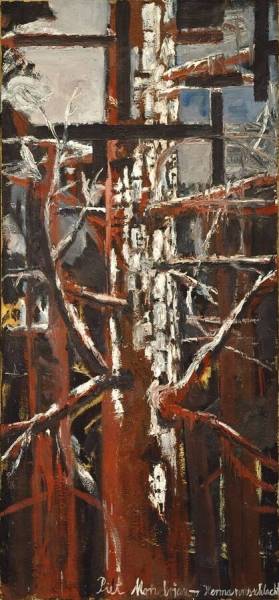
In Some Restrictions Apply 024, Danieli’s stripes appear as a copse of trees. Thematically, his work shares some of the twentieth-century preoccupations of Anselm Kiefer – no stranger to the woods himself – albeit from a different perspective, Kiefer being a German Christian and Danieli an American-born Israeli Jew. Both artists mix the pure and the impure. In Piet Mondrian – Battle of Arminius, Kiefer pointedly opposes Mondrian’s clean modernism in exploring the generational resonances of the Battle of the Teutoburg Forest, in which the Germanic tribes led by Arminius defeated the Romans in 9 AD, by way of a battle-damaged tree that could also have appeared at the Battle of the Huertgen Forest between German and American forces in the Second World War. Danieli’s historical scars are grounded more in materials, manifested as thickly encrusted stripes made with painting sticks.
History painting, of course, is something that abstraction is not supposed to be able to pull off. Yet Wladyslaw Strzeminski moved from geometric abstraction into visual commentary on the Holocaust, demonstrating the connection between the two.


Danieli’s blunt but sensitive instrumentation has something that the art historian Meyer Schapiro might have described as “uncanny finesse,” using organic forms to smuggle otherwise difficult social commentary into view.
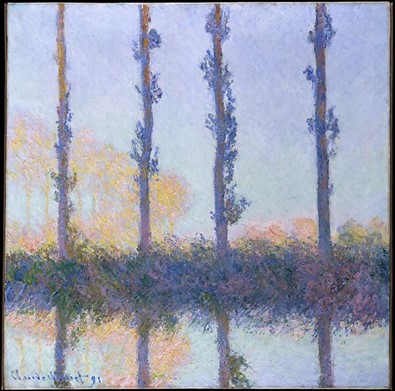
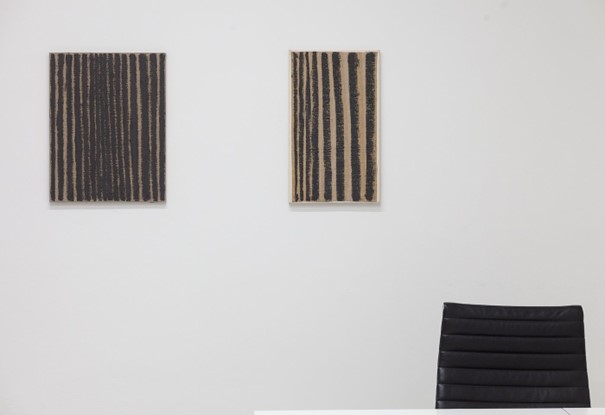


Danieli’s abstract paintings remain as a poignant form of witness to deeply troubled times.
“Eyal Danieli: Preoccupied,” 57W57 Arts, 501 Fifth Avenue, Suite 701, New York, NY. Through January 5, 2024. NOTE: In 2024, Elizabeth Harris Gallery will host the artist’s 5th solo show at the gallery, and the New York Studio School will host a memorial exhibition.
About the author: Michael Brennan is a Brooklyn-based painter who writes on art.
NOTE: The Two Coats of Paint 2023 Year-end Fundraising Campaign is in the final days, and our goal this year is to reach 100% reader and gallery participation. For contributions of $150 and above, we’ll send a gift — one of the new Two Coats of Paint coffee mugs. Please consider making a tax deductible contribution to support the project in 2024. Thank you for all your help keeping the conversation going.










Great that you included other art historical references to Eyal’s work. I like the established context. Thank you.
Great article. Very interesting artist, new to me. I’m an abstract artist and think of my work as narrative. His sensibility really resonates. Thank you for this thoughtful introduction.
Great review of his work. I couldn’t get to the show but have seen some of these paintings before. I don’t know if you felt this way in front of it, but I feel a heaviness in them as if he is struggling with a burden and it’s not because of the black thick paint sticks or the stripes, I think it’s cyclical in nature and one feels the weight of his past on the canvas/paper in whatever medium and/or abstract/representational. I find this weight to be at the core.
thanks, a terrific essay. Eric Holzman
I am very sorry to hear that Eyal has passed away. Along time ago, when his references to army stuff and planes were more boyishly painted, and in that sense apparently less serious, I was interested in broaching an artistic parallel with an American who I eventually lost track of. But now it is obvious that Eyal Danieli was, or rather is, much more meaningful than that. I only knew him a little: we had a few good talks, separated by years. Now I’m glad that I can at least remember that.
Joseph Masheck
Good article. Enjoyed learning about him.
To Eyal’s widow and daughter, I am late to learn and terribly sorry for your loss. As this fine review illustrates, Eyal’s passing is a loss to our arts community. We always laughed when we met, whether doing laundry at a friend’s during Covid or another happenstance. Eyal’s art, always serious, draws me in. A voice says, You think you’re looking at an image. Step back. He did that framing pictures, too, what is near and distant. Sincere condolence. ever S Again