
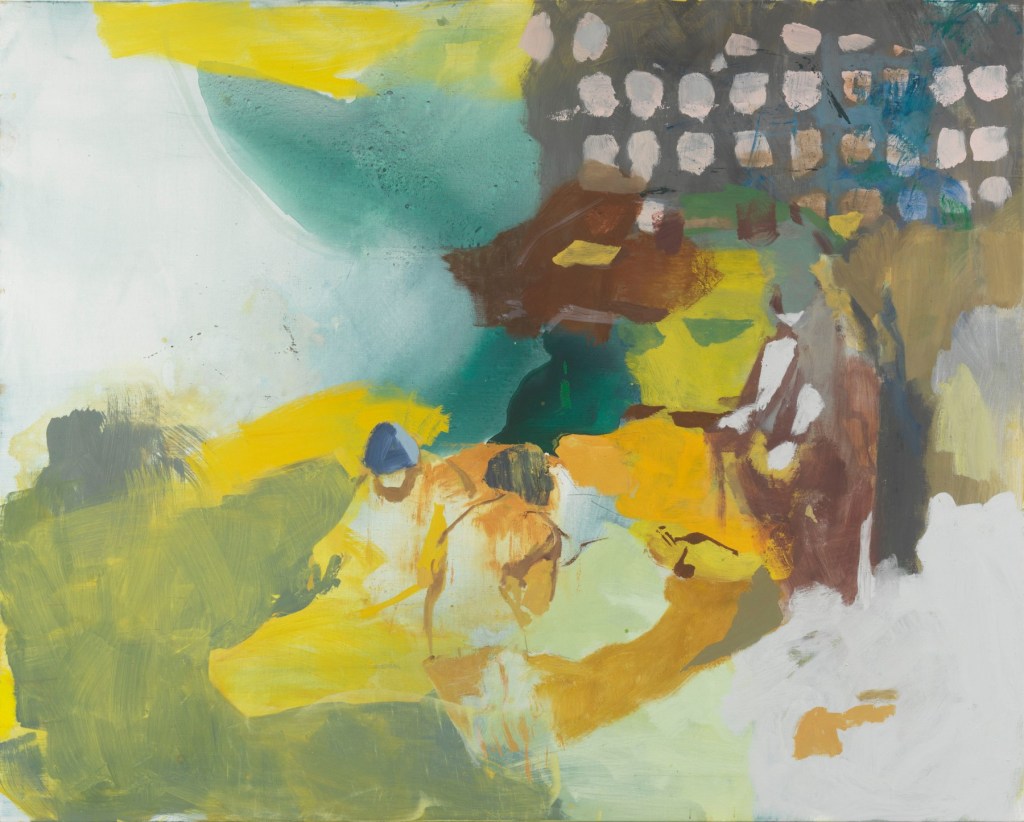
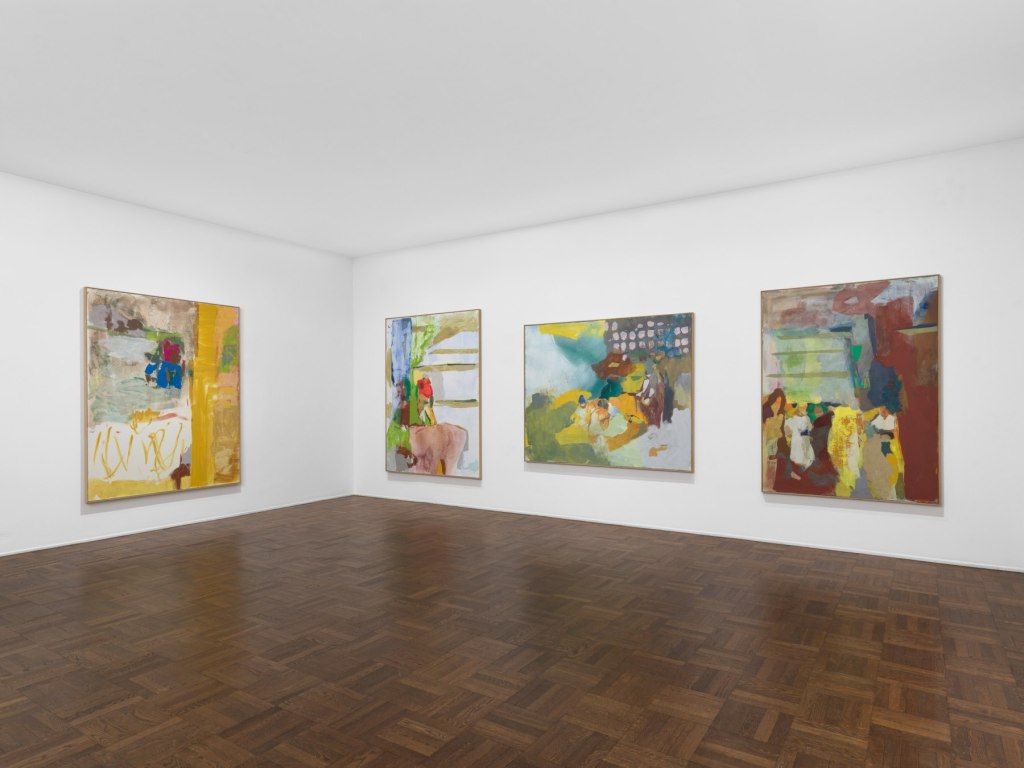
Contributed by David Carrier / Born in Japan, Maki Na Kamura was trained in Germany, where she now lives and works. In that light, it’s not too surprising that she describes her work as “Caspar David Friedrich plus Hokusai minus Romanticism minus Japonisme.” Identifying herself as both a traditional painter and a contemporary artist, she notes that she might, on the same canvas, use both tempera and oil paint– two materials traditionally used separately. Her paintings and charcoal-on-paper drawings are poised between figuration and abstraction. The paintings are often centered on figures, but it’s not usually clear what’s happening in the work on view at Michael Werner. It may be hard to tell just what we are looking at, but it is obvious that her central concern is visual pleasure.
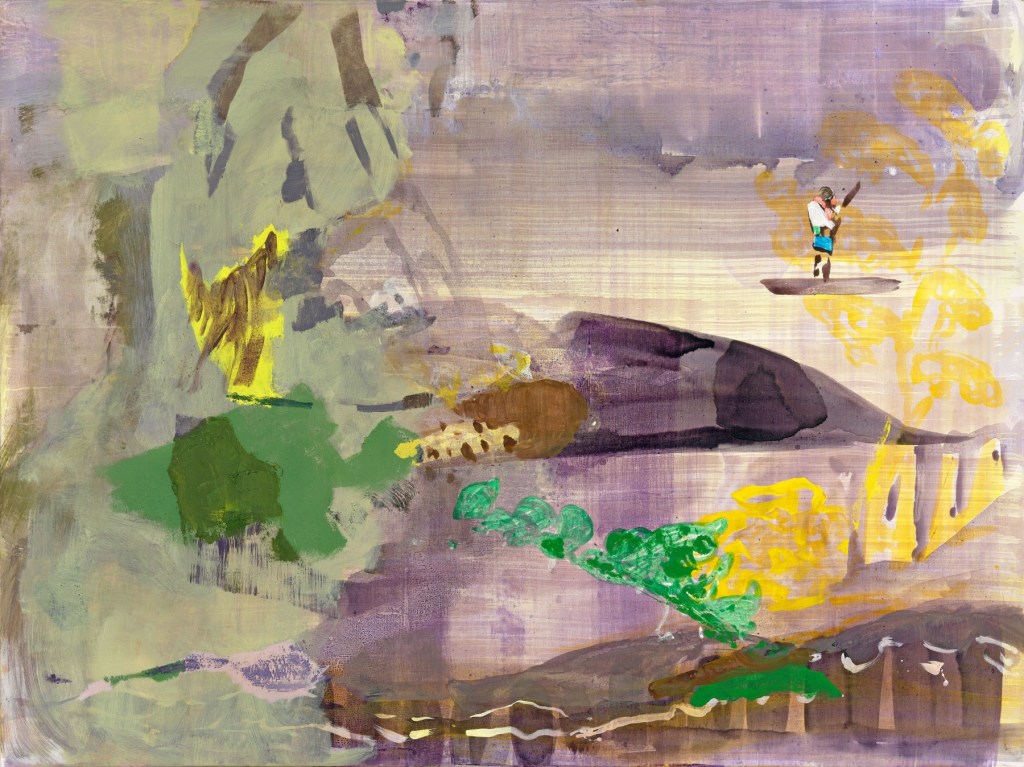
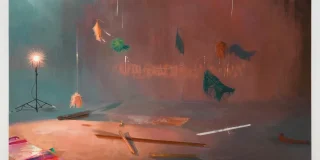
Consider, for example, Camp VIII. It’s easy to identify the two seated figures center to the left, but what of the enclosure behind them? Or look at the exquisite Shan Shui VI, where the small standing man at the upper right is submerged in a violet, yellow, and green landscape. As Richard Diebenkorn could transition from figuration to abstraction in successive paintings, Na Kamura can do so within a single work. What, then, holds it together? In a word, the answer may be color. Claim of Joseph I plays a large expanse of ocher against green, blue, and dark red in a stunning gestural composition. Unit VIII sets two shades of green against myriad colors, mostly dark.
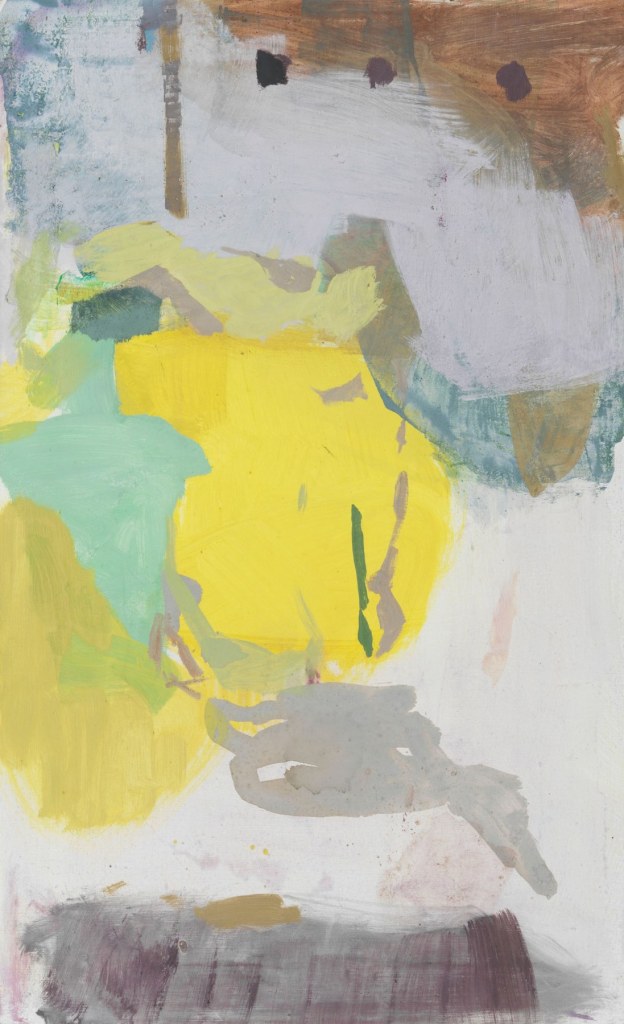
A signature Na Kamura device is the splotch of color: an irregularly shaped area that has some concrete reality without quite constituting a proper surface. In her work, color creates form, but what that form represents remains uncertain. Pierre Bonnard (1867–1947), whose palette was similar, turned landscapes and domestic interiors into abstract-like decorative fields. Like him, Na Kamura presents the viewed world as a kind of golden iridescent paradise. But whereas he started with representation and then verged on abstraction, Na Kamura works from the opposite direction, starting with abstraction and moving towards figuration, as if to gingerly conjure the French art world of a century ago.


Julian Bell, himself a gifted painter, writes that “French thinking about art in the nineteenth century had turned around the concepts of ‘Nature’ – more or less, the observed world – of the academic tradition, of the ideal of beauty and of the artist’s own vision.” He is referring to Bonnard. But Na Kamura shows that there is plenty of life left in that modernist way of thinking. She is among the best young artists I have encountered in recent years. Too compositionally complex to be merely decorative, her work is boundlessly inventive and richly allusive, and astonishing in its uncanny coloristic virtuosity. This is her first solo exhibition in New York, and assuredly not the last.
“Maki Na Kamura,” Michael Werner, 4 E. 77th Street, New York, NY. Through February 3, 2024.
About the author: David Carrier is a former professor at Carnegie Mellon University; Getty Scholar; and Clark Fellow. He has lectured in China, Europe, India, Japan, New Zealand, and North America. He has published catalogue essays for many museums and art criticism for Apollo, artcritical, Artforum, Artus, and Burlington Magazine. He has also been a guest editor for The Brooklyn Rail and is a regular contributor to Two Coats of Paint.






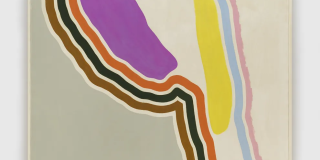

“Shan shui VI” Nice! Good review.
Beautiful writing. Can’t wait to see the show.