
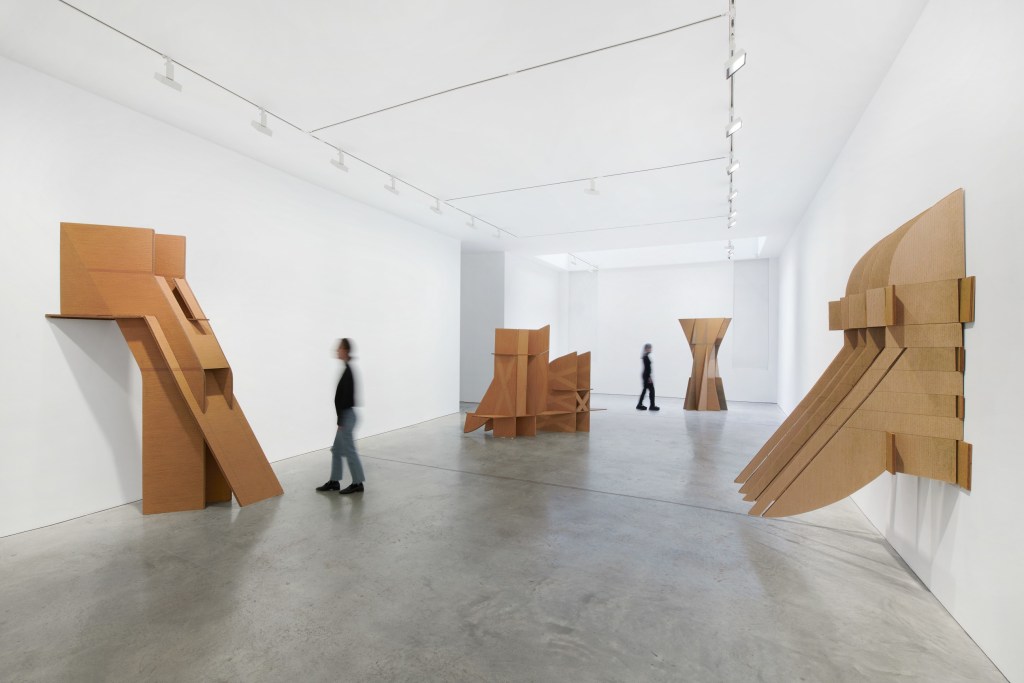
Contributed by Laurie Fendrich / While still in graduate school at the School of the Art Institute of Chicago in the late 1970s, the Chicago sculptor Diane Simpson (b. 1935) experienced a serendipitous moment. Through a store window, she caught sight of a child’s chair made from corrugated board. An array of little flutes connecting layers of liner board made the piece unbendable and weight-bearing while keeping it lightweight. Simpson went out and purchased some of the material and shifted from collagraph printmaking – a process that uses a plate with collaged materials – to sculpture. After learning to use a jigsaw to cut the board at a 45-degree angle, she made interlocking flat shapes of her own design, then assembled them into full-fledged sculptures.
Perhaps it’s the Second City curse. Simpson will turn 89 this year. Her long career includes multiple national and international museum and gallery exhibitions (including one at the now-shuttered JTT Gallery on the Lower East Side), and a veritable solo show, monopolizing the lobby gallery, within the 2019 Whitney Biennial. Yet Simpson remains a virtual unknown in the New York art world. Now she’s having her first true New York solo show at the James Cohan Gallery. Instead of predictably offering “recent work,” the gallery is boldly presenting eight of her very earliest works. It’s a smart move, for it demonstrates that the honed mix of the spare, the subtle, the elegant, and the witty in her current work was present from the very beginning.
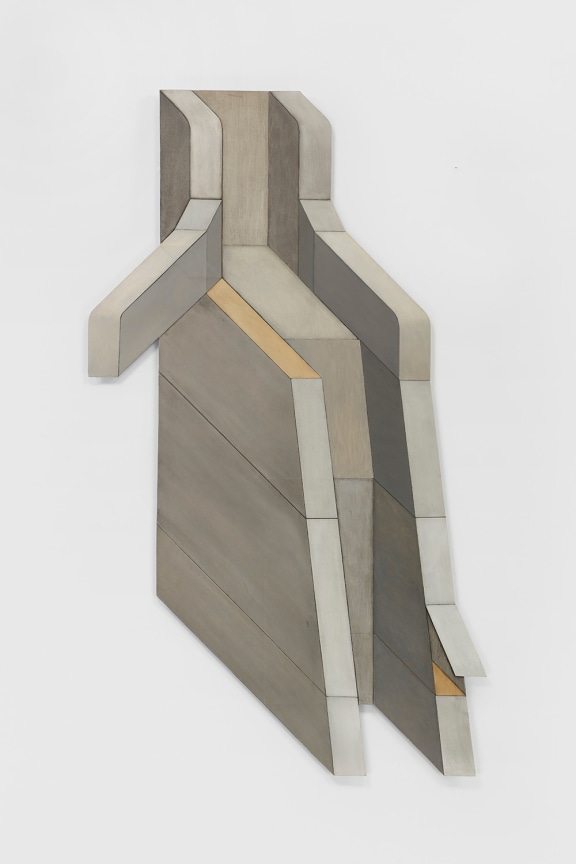
oil paint on paper on wood
64 x 37 in, 162.6 x 94 cm
The show includes two wall-mounted, oil-on-paper-on-wood pieces from 1977, made while the artist was still in graduate school, that mark her departure from printmaking. The focus, however, is on six large constructions made with pieces of the corrugated board that first captivated her. The installation is spatially generous, giving each sculpture air. Some pieces are freestanding, some held up by a wall. The power and beauty in Simpson’s “crudity of initial effort,” as Richard Serra would put it, stem from her uncanny use of the relatively inexpensive, readily accessible corrugated board, wood dowels, and, occasionally, colored pencil or crayon to incorporate bends, appendages, or tiny details while preserving overall clarity and precision.
Simpson starts her sculptures with drawings that employ axonometric projection, a schema permitting multiple sides of an object to be illustrated all at once on a flat plane so that the measurements of the imagined three-dimensional form are accurate. She says her most intense struggles take place while she’s drawing, amid modifying shapes that derive from a wide variety of sources including architecture, clothing, and furniture as well as Japanese prints. She often alters the original form to the point where it disappears. The finished sculptures consist of shaped planes slicing through space and intersecting one another such that they are perceived as a single object. Simpson has gone on to use materials other than corrugated board, such as linoleum and metal, but the essential pared-down, quirky aesthetic so apparent in this show remains a constant.
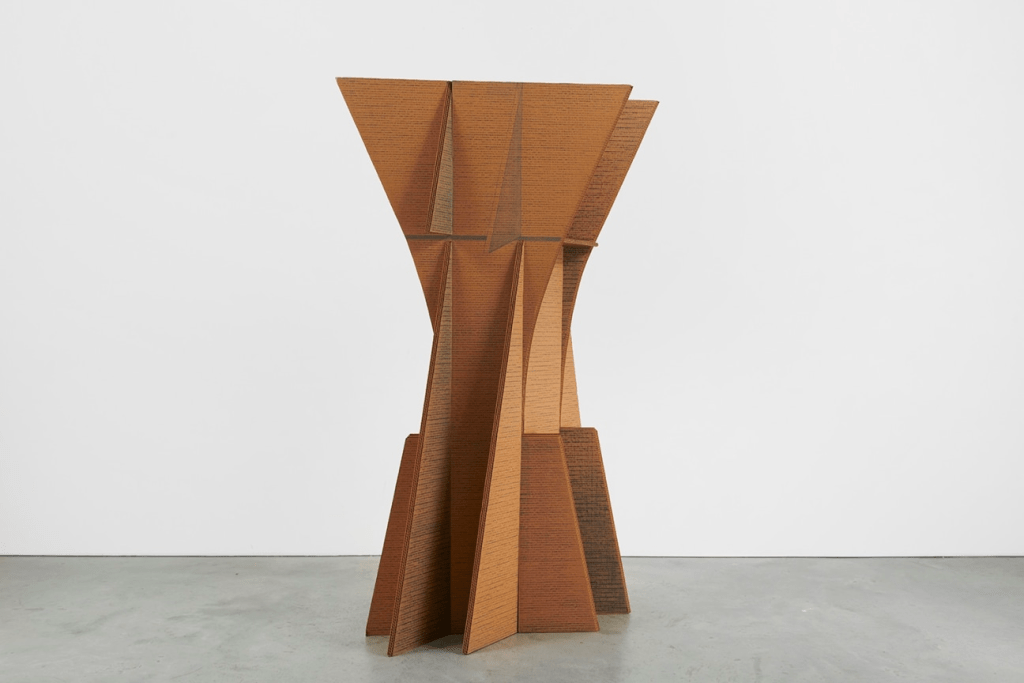
corrugated board, colored pencil, crayon
85 x 44 x 25 in, 215.9 x 111.8 x 63.5 cm
Although Simpson’s work is constructivist, Donald Judd’s minimalism hovers nearby. His work, of course, centers on fabricated multiples and eschews human touch, whereas Simpson’s is about lovingly tending to distinctive hand-made objects. Yet the main virtue of both artists is conciseness. Simpson is just less doctrinaire and more, well, aesthetic about it. Her sensibility includes humor. Those familiar with Chicago art from the mid-1960s may decipher a trace of the Chicago Imagists. While Leaning Lookout, for example, is a dignified, finely balanced sculpture almost nine feet high, it also evokes a semi-loony, maybe fantastical, object for a kid to crawl around in.
The gallery’s press release indicates the sources for the individual flat shapes used in this early work range from ordinary household objects, such as a meat grinder, to Bernd and Hilla Becher’s photographs. The objects are substantially abstract, but not fully so. Chaise looks like the chair indicated by the title, albeit lifted from Alice’s Wonderland, and Fold-Up resembles some half-familiar real-world thing – perhaps another chaise lounge or a sleigh – that can be folded up and put away.
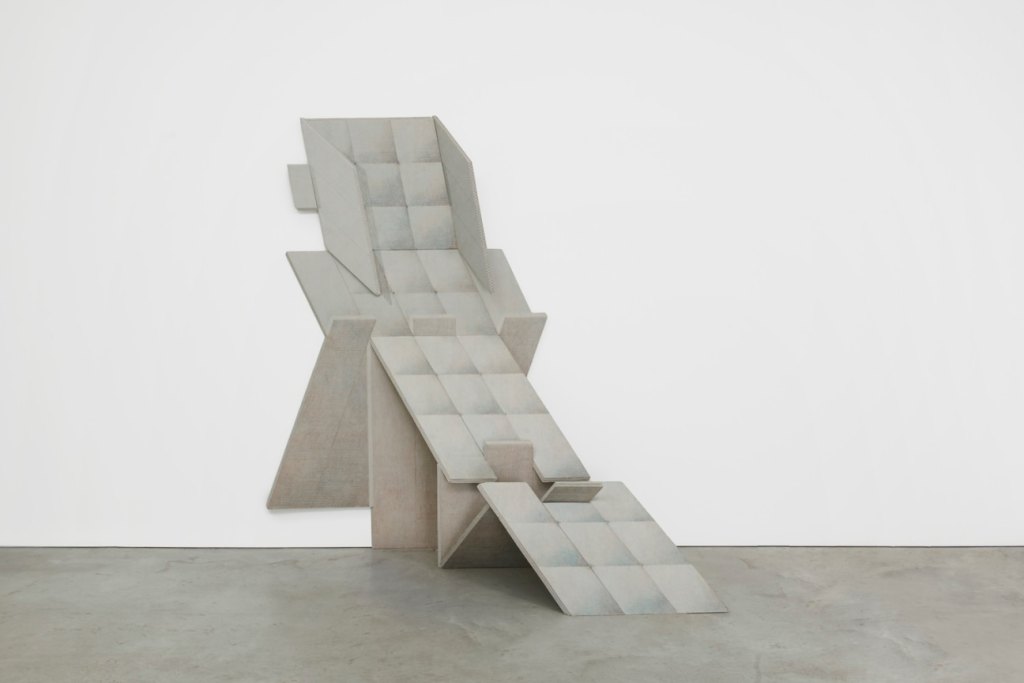
84 x 81 x 43 in, 213.4 x 205.7 x 109.2 cm
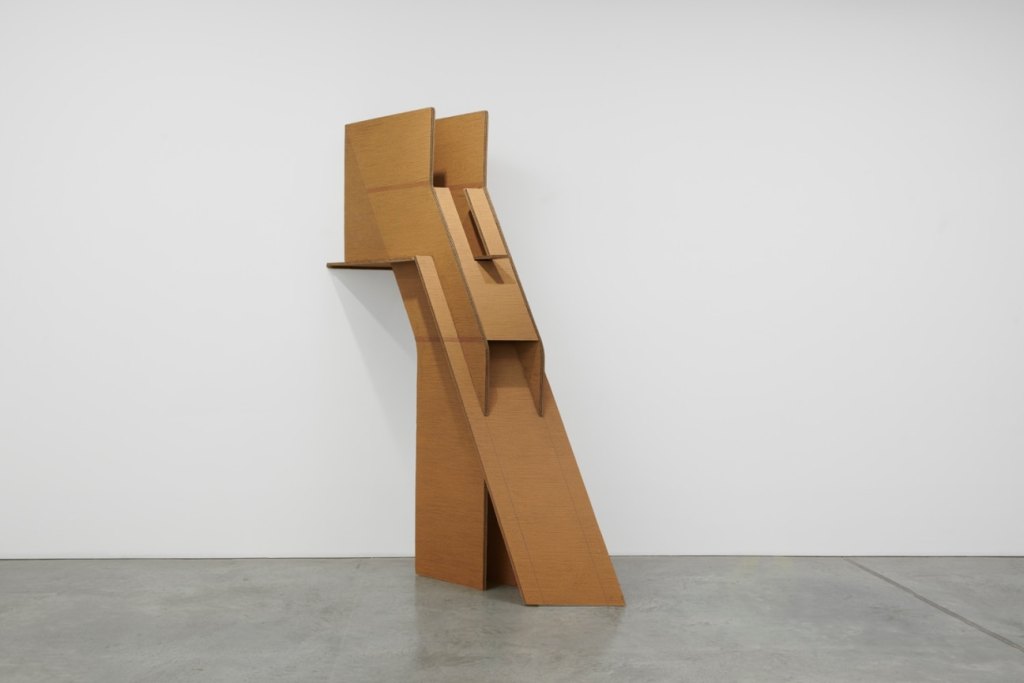
105 x 65 x 45 in, 266.7 x 165.1 x 114.3 cm
Atypically for a successful sculptor, Simpson works on her own, without the help of studio assistants. The perfectly fitted constructions in this show should appeal to anyone who still admires craft in art. As for those who are uninterested in contemporary art – or blanch at its supposed lack of craft – her work could change their minds. For the rest of us, the show is an impressive introduction to an artist we should have known better all along.
“Diane Simpson: 1977–1980,” James Cohan Gallery, 48 Walker Street, New York, NY. Through March 23, 2024.
About the author: Laurie Fendrich is professor emerita of fine arts at Hofstra University and a Guggenheim-award-winning painter who writes both art criticism and fiction. She is a member of the organization American Abstract Artists and is represented by Louis Stern Fine Arts in Los Angeles.










Diane showed with JT for several
Years with several amazing shows prior to James Cohan. The review is great to have to bring attention to this amazing artist!
To Michele Feder-Nadoff: Yes, sorry about that. That was an error that slipped through by accident.
Another brilliant review of Diane Simpson’s work. It is a joy to read such a thoughtful and insightful description. I have been privileged to have known Diane’s work from the beginning and am overjoyed to see these pieces come into the light again. Thank you Laurie for your writing and a big congratulations to Diane for saving this work so we can all enjoy it again.