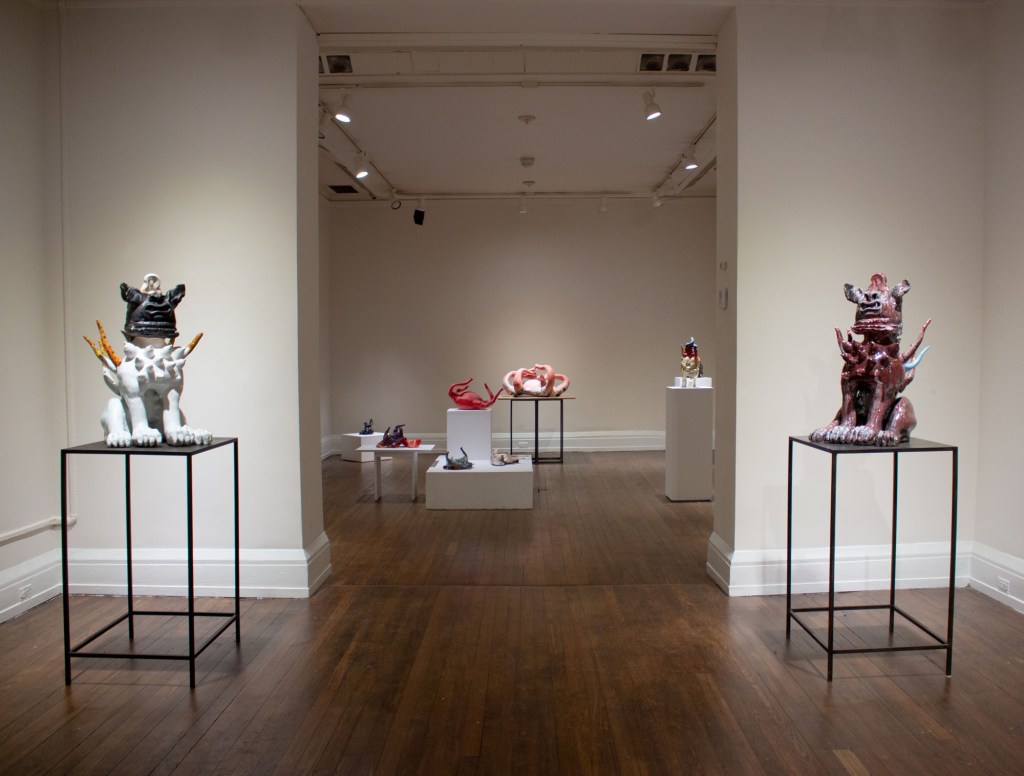
Contributed by Jason Andrew / At the New York Studio School Gallery, Jenny Lynn McNutt’s exhibition “Touch Me” reclaims figuration in ceramics as a matter of urgency rather than nostalgia. With an immediacy that heightens their corporeal impact, McNutt kneads together cultures and rituals embraced during her travels to West Africa, China, Eastern Europe, Ireland and Italy. The 20 sculptures representing a decade of work embody forms twisting, crouching, bracing, and blooming in what the artist aptly describes as “a nativity of squirms,” which captures both their generative vitality and their refusal of repose.
Born into a large family in Tennessee, McNutt was shaped by mountains, swamps, lakes, woods, and creeks. They instilled in her a sense of adventure, curiosity, imagination, and wonder. The urge to create a language around these discoveries, first in paintings and more recently in sculpture, has informed her practice, which aims to bridge gaps between ancient practices and modern identity. McNutt developed her recent works during residencies at the Taoxichuan Art Center in Jingdezhen, China, historically the heart of porcelain production. This lineage matters. For centuries, ceramic figuration has oscillated between devotional icon, funerary guardian, and domestic ornament. In China’s tomb figures and Europe’s Meissen figurines alike, the fired body has served as surrogate for the mortal one. McNutt harnesses this history without mimicking it, using its psychic charge to reanimate the ceramic figure as something feral and contemporary.
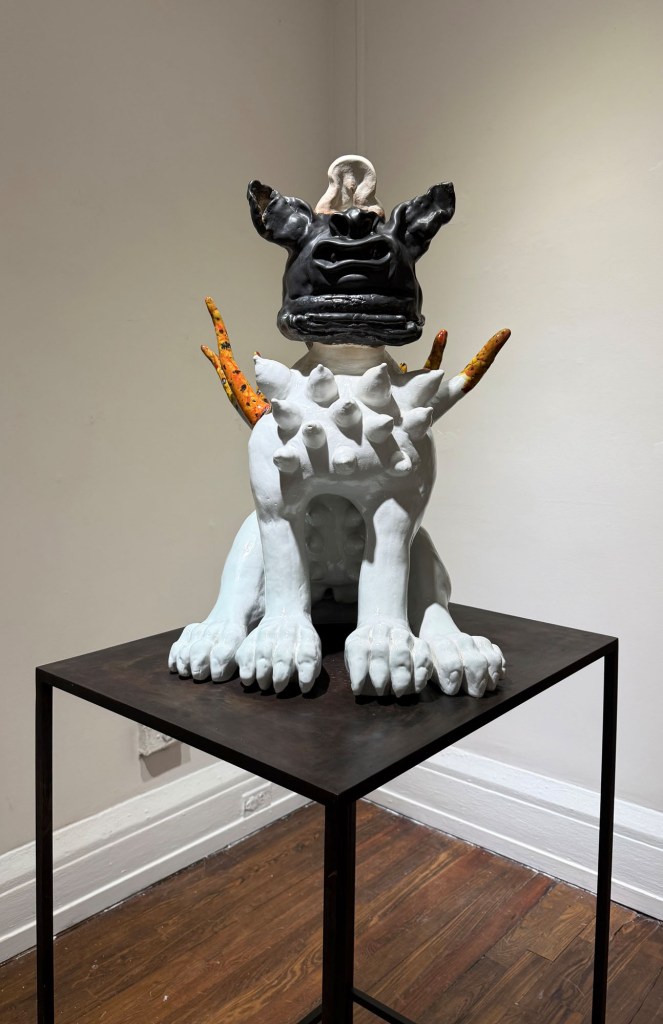
Two of the largest works evoke zhenmushou, the fierce tomb guardians. McNutt’s renditions are less sentinels of the dead than emissaries from an unstable and unpredictable world. In the crouching leonine figures, snouts flare, torsos ripple into vegetal protrusions, surfaces pucker and split. The boundary between human and animal, organism and environment, never holds. The exhibition’s title, “Touch Me,” is a daring invitation. Craft hierarchies and decorative expectations have often burdened figurative ceramics. McNutt’s s psychological intensity overrides them. Her figures, more experiential than strictly illustrative, convey what she calls the “elastic continuum of biological life,” establishing mutability as a sculptural principle.
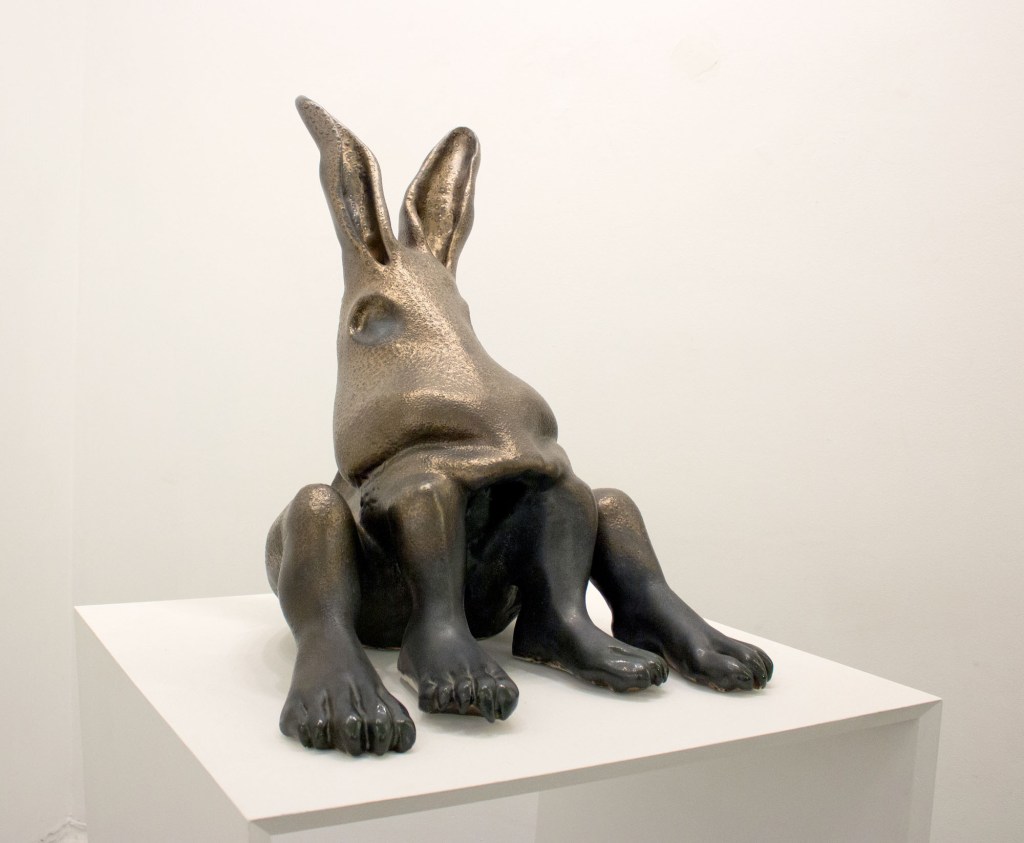
30 x 24 x 24 inches
The form of a giant hare appears in several works. Each iteration involves characteristically oversized ears, but Oracle with Bronze Glazes distinctively emphasizes the genitalia, linking eroticism with vulnerability and trauma as well as empowerment. Like the pioneering work of feminist Hannah Wilke, the focus is “personal as political.” Clay, with its capacity to register pressure, gouge, and caress, is an ideal medium. Finger marks remain visible; seams and joins read as scars or sutures. The fired surface holds memory, just as in the ponderous, folded and globular sculptures of Mary Frank do. McNutt’s paintings are notable for their cryptic, thickly painted surfaces and for eccentric textures animated by explosive dashes. Her ceramic works have a similar quality, several taking the form of squirming organs torn from a body or freshly birthed, their bloated bellies begging to be nourished.
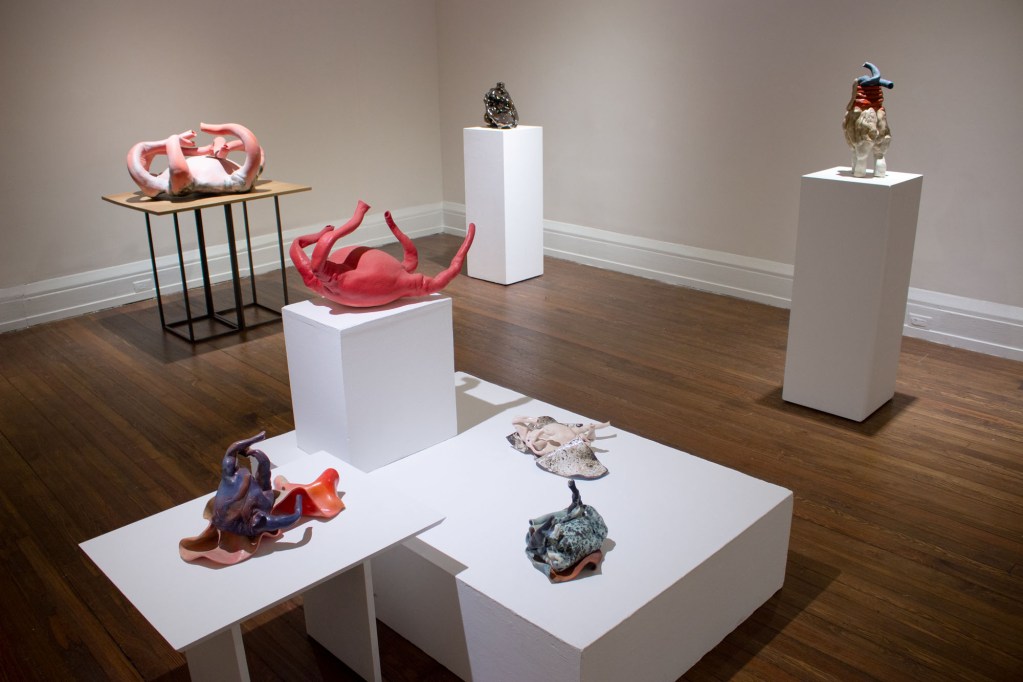
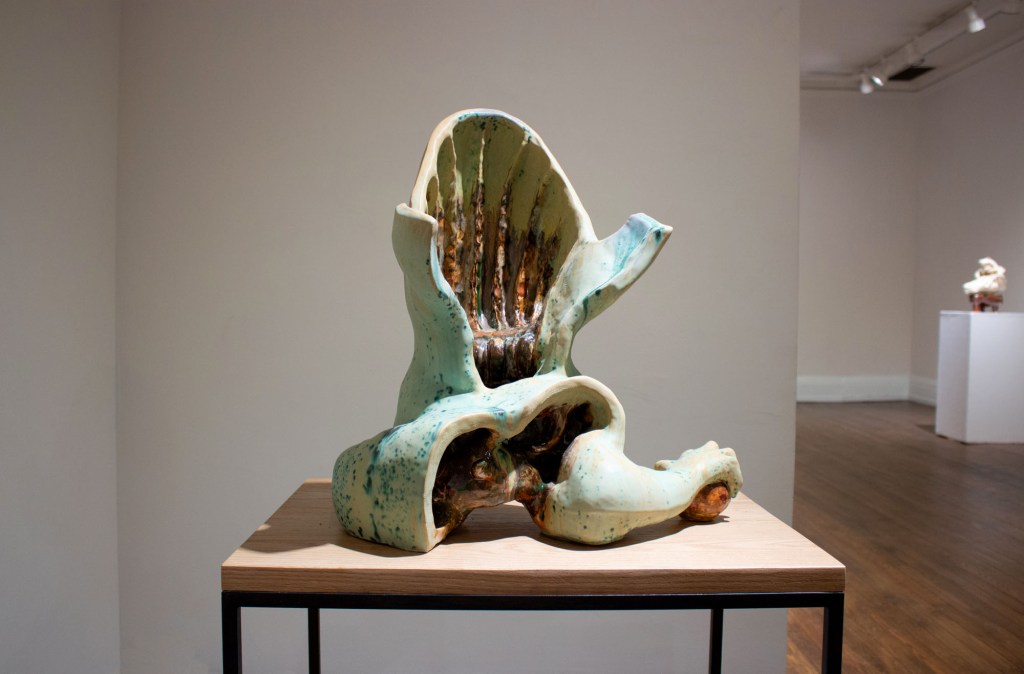
In Gravity and Grace and Gravity and Grace 2, McNutt exploits the seductive splay of a Venus fly trap. In these works, one surrenders to color, texture, and skin, which oscillate between opalescent sheen and matte bruise. Milky celadons pool in crevices; iron-rich slips bleed into smoky halos; flashes of iridescence suggest living membranes. Two clawing arms emerge from beneath. For McNutt, glazes do not decorate the form; they complete it, amplifying the sense that each sculpture has its own climate.
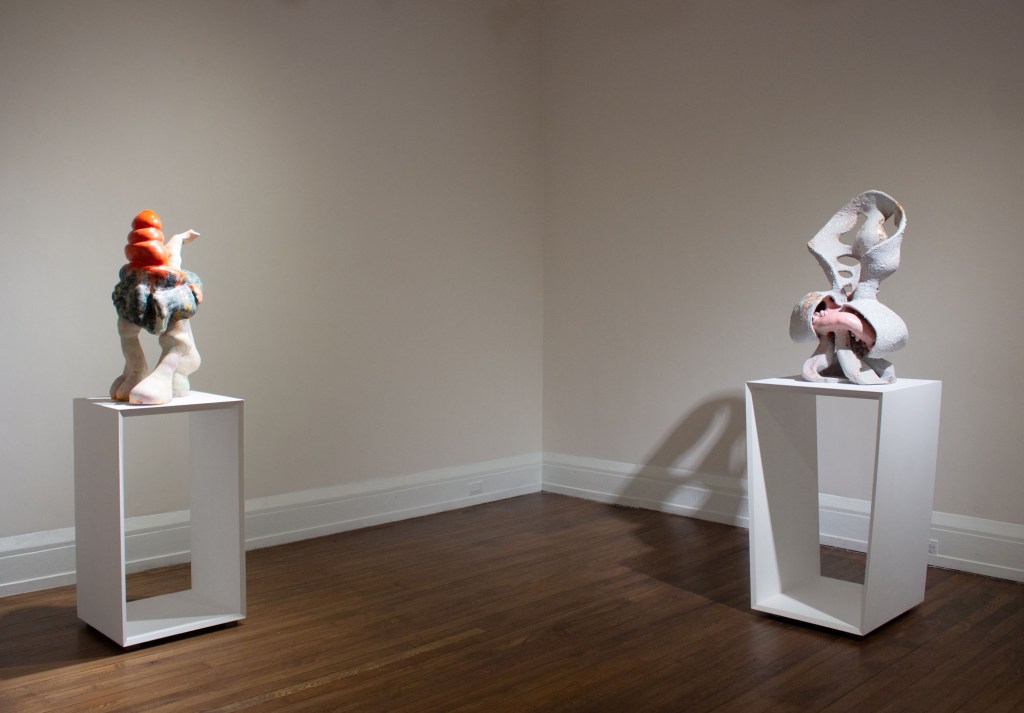
This show makes a compelling case for the renewed relevance of figuration in clay. Not unlike Beth Cavener, who articulates human psychology in animal forms stripped of rationalization, McNutt confronts the biological precarity of the present – owing to species interdependence and physical vulnerability – through hybrid forms that are at once historical and speculative. They feel like survivors that have borne witness to our brittle condition, connecting species and histories, viewer and object. Her sculptures ask us not simply to look but also to recognize ourselves in their contorted grace and to acknowledge the unstable continuum we share.
“Jenny Lynn McNutt: Touch Me,” New York Studio School Gallery, 8 West 8th Street, New York, NY. Through March 22, 2026.
About the author: Jason Andrew is an independent curator and writer based in Cypress Hills, Brooklyn. Follow him on Instagram: @jandrewarts