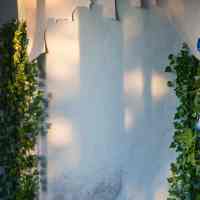
Contributed by Rachel Youens / The sculptures in Jim Osman’s show “Walnut 3,” now at McKenzie Fine Art, are both architectonic and playful. His constructions, placed on pedestals, are formalist balancing acts made of found lumber, some elements lightly reworked, that are stacked and arranged. Osman’s overall intention is to find a complex situation for entry, where forms assembled from Euclidean solids generate stability or dynamism through exquisitely contrasting proportions and scale. The experience of seeing unfolds in the extended time required to walk around each small free-standing work.
Author: Two Coats Staff
NYC Selected Gallery Guide, December 2024
This month, as many in the art world head to Miami for the fairs, most galleries have extended their exhibitions into December. If you missed a show you were hoping to catch, there’s good news—it’s likely still on view. But before you scroll down to see what’s in the galleries
Pierogi at 30: Revisiting the personal, peculiar, and droll
Contributed by Adam Simon / There have been group shows that represented cultural milestones – the Armory Show of 1913, the “‘Bad’ Painting” show at the New Museum in 1978, the Times Square Show of 1980. In the shadow of a foreboding US presidential election, “Pierogi 30” has that kind of historical weight.
Matthew Lusk: Offhand dystopia at Elijah Wheat
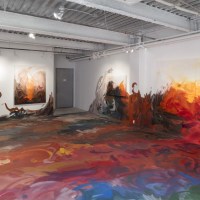
Contributed by Jonathan Stevenson / Located in rough-and-tumble Newburgh beyond the pale of riverfront commercial development on a piece of land just yards from the Hudson and insouciantly flush with its waterline, Carolina Wheat and Liz Nielsen’s grandly unvarnished Elijah Wheat Showroom has the Bunyanesque vibe of a frontier museum. Then it suavely wrongfoots its patrons with the fearlessly avant-garde attitude of 1970s Soho. Matthew Lusk’s deviously clever sculptures and installations exploit and reinforce both attributes…
Sylvia Plimack Mangold: Inside to outside
Contributed by David Carrier / As the title “Tapes, Fields, and Trees” indicates, the exhibition of ten works by Sylvia Plimack Mangold at Craig Starr Gallery draws on three bodies of her early work. In the mid-1970s, she made Minimalist paintings of tape measures. Pieces like Taped Over Twenty-Four-Inch Exact Rule on Light Floor, however, reveal a surprising poetry in seemingly prosaic subjects. Then she painted grids, like the one in Painted Graph Paper. Finally, in a remarkable transition, she drew a window looking out on a landscape….
NYC Selected Gallery Guide, November 2024
Contributed by Sharon Butler / This month, Marian Goodman has opened her new space in Tribeca—a thoughtfully renovated building at 385 Broadway. Just nearby, at 394 Broadway on the third floor, Pierogi Gallery, a longtime staple in Williamsburg, is marking its 30th anniversary with a pop-up exhibition. The show features works by numerous represented artists, along with selections…
Patricia Fabricant: Fear of empty spaces
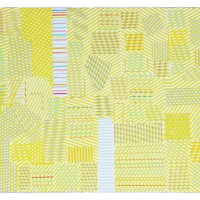
Contributed by Christopher Stout / Over the past 15 years, Patricia Fabricant has experimented with distinctive heroic elements within her work, some figurative and some that seem to be extracted from nature. “Horror Vacui,” her solo show at Equity Gallery, presents 26 inventively patterned gouache paintings that follow the conceptual approach the show’s title – meaning “fear of empty spaces” – suggests, filling the entire surface with detail and composition….
You Don’t Know Me: Trompe L’Oeil and artistic illusion
Contributed by Mark Wethli / On a small shelf in a quiet corner of Sarah Bouchard Gallery in Woolwich, Maine, sits a dog-eared paperback copy of Lewis Hyde’s Trickster Makes This World: Mischief, Myth, and Art. With a growing sense of delight, we soon realize that the book is itself a trick, a trompe l’oeil sculpture by Justin Richel, convincing in every detail from its vintage 1990s graphics to its well-worn cover….It is a fitting overture to “You Don’t Know Me,” the four-person show currently on view. The artists – Carly Glovinski, Rachel Grobstein, Duncan Hewitt, and Richel – present kindred explorations of parallel realities, producing conundrums and contradictions that give rise to visual enchantment and philosophical contemplation.
Eleanor Ray: The power of the small
Contributed by Michael Brennan / Many conceptualists, favoring the unconstrained and expansive, balk at the representation or framing of any experience as image. Long after he abandoned painting, the late installation artist Robert Irwin likened it to a mere “keyhole” of perception. In Zen and the Art of Motorcycle Maintenance, Robert Pirsig declared that compartmentalizing experience for viewing made you “a passive observer” for whom “it’s all moving by you boringly in a frame.” Yet surely not every living experience has to be as open-ended as a motorcycle racing across salt flats. While a painting can never capture the full immensity of life, with adequate perception and economy of means – say, Luke Howard’s vision of the sky realized in paper and watercolor – even a diminutive one can provide a meaningful distillation of experience. The paintings of Eleanor Ray, now on display in her third solo show at Nicelle Beauchene Gallery, constitute abundant evidence.
Whitney Claflin: Forever young
Contributed by Jonathan Stevenson / Whitney Claflin’s work, now on view in her solo exhibition “Pinky’s Where” at Derosia, is winningly deceptive, like the title’s double-entendre. Consider the paintings Emma in Tarzana and Mr. Triste. At first blush, they seem nonchalantly wise-ass and a little frustrating, the first an offhand quip about internet celebrity and influencer supreme Emma Chamberlain, and the second…
A garden grows – on AstroTurf – in Gowanus
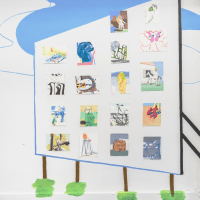
Contributed by Michael Brennan / On about 200 square feet of AstroTurf, artist-run Field of Play, which opened in 2022 in Gowanus, is a tiny gallery with big ambitions, staging adventurous exhibitions and offering health and wellness programs aimed at creative people and enterprises. “Bumper Crop,” curated by artist and gallery founder Matt Logsdon, includes work by artists carrie R, Estefania Velez Rodriguez, and Rachel Yanku. Timed to coincide with the autumnal equinox, she show’s theme is the garden – an intriguingly ironic premise, given that the gallery is located next to an EPA Superfund site, the Gowanus Canal.
Meet UConn’s MFA Studio Art, Class of 2027
Meet the University of Connecticut’s MFA Studio Art Class of 2027. Working in a broad range of art making, the five-student class features…
Alan Prazniak: Balancing the artisanal and the epicurean
Contributed by Tom McGlynn / Alan Prazniak’s paintings fall into productive intervals between landscape and still-life and between abstraction and representation. His most recent show at Geary comprises sixteen medium and small paintings (all from 2024) that are rigorously composed and wide-ranging in palette, bringing to mind the lyrical abstractions of Philip Guston and the quasi-landscape compositions of Nicolas de Staël. Prazniak has acknowledged as inspirations Arthur Dove and Marsden Hartley’s groundbreaking works, which embodied similarly massed shapes in bold, contrasting colors. The modernist tension…

Paula Modersohn-Becker’s modern women
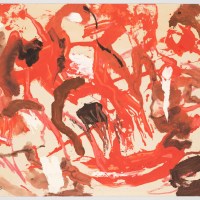
Contributed by Evangeline Riddiford Graham / It sounds suspiciously like Earth Mother art: big nudes, babies, and quite a lot of purple, all underpinned by the conviction that God is female and that the final, necessary stage in becoming a woman is to bear children. But something is off. The nudes are emotionally distant. Preoccupied by breastmilk, the babies show no sign of higher thought. The purple arrives as shadows that renders flesh regal and strange – the purple of 1906, not 1960. And the paintings are extremely good. “Ich Bin Ich / I Am Me,” now up at the Neue Galerie, is the first major US museum show of the paintings of Paula Modersohn-Becker (1876–1907).
Walter Robinson’s big question: What do they want?
Contributed by Sharon Butler / What happened to all the conceptual painters? I’m thinking of artists, like On Kawara, who were more interested in ideas and process than in developing traditional painterly chops, for whom painting was about more than basic human emotion and formalist exploration of color, line, and shape. By the 1990s, many of the painting-thinkers had stopped painting and moved into other disciplines – relational aesthetics, video, digital, and installation projects. For the relatively few who continued to paint, the starting point remained a proposition rather than a vague if compelling exploration of the subconscious. Walter Robinson, though disguised as a figurative painter, is one.