Contributed by Lore Heller / “MILK TEETH,” the title of Kate Hargrave’s show at Karma, implies both permanent loss and permanent gain. One gains milk teeth as a baby and loses them as adult teeth take their place. If children place them under their pillows, fairies might bring rewards. Losing milk teeth is losing childhood, developing permanent teeth coming of age – reminders to parents that time inexorably arcs life. Joni Mitchell observed that “we’re captive on the carousel of time,” and my grandmother’s lullaby, “toyland, toyland, beautiful boy and girl land,” reminds us that “once you cross its borders you may never return again.” Hargrave, who painted this work as she raised two children, captures this pervasively bittersweet quality.
Entering Hargrave’s paintings is like peering through a keyhole into another world where the eye can roam freely. No single viewpoint is imposed on the viewer. As my gaze wandered around the scene – as it might move around Bosch’s The Garden of Earthly Delights – I felt as if I was meandering through the artist’s mind. What unfolds seems both private and mythic: fragments of fairy tales or ancient stories of a dark arcadia. Each painting seems to function as a stage set. A cast of characters roves from one to another, like an acting troupe moving through changing scenery. They are also like dolls situated to enact dramas. Yet Hargrave is neither a theatre director nor a child. She is an artist armed with sophisticated techniques garnered from Old Masters , techniques upon which she cantilevers her imagination outward, giving material form to her psychic yearnings. I experience the paintings as an integrated world, real rather than imagined but revealed to the artist alone.
The compositions frequently rely on vertical tension. The eye is drawn upward towards peaceful, transcendent light, downward to darkening and steepening terrain, with figures clamoring to resist gravity or falling into water. Trees often grow upward along the sides, framing the scene like curtains. Figures bask in soft illumination, occasionally accented by red blankets, garments, talismans, or the flush of reflected crimson light on bare skin. Scale is freed from conventions of perspective; instead of establishing spatial logic, it asserts psychological hierarchy. Opacity reinforces the importance of some figures while diminishing that of others. Using transparent glazing techniques, Hargrave transforms cherubic figures into ghostly gargoyles, sinking them delicately into stone walls. Denser figures – at times partially clothed and accented with red – claim more attention.
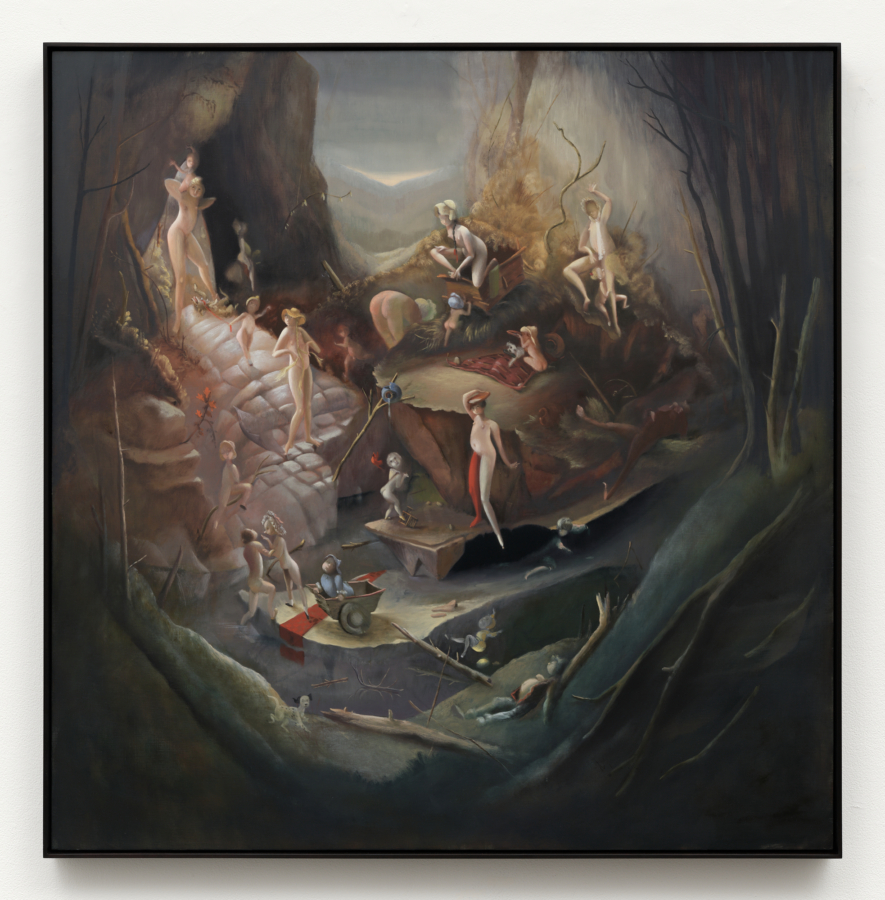

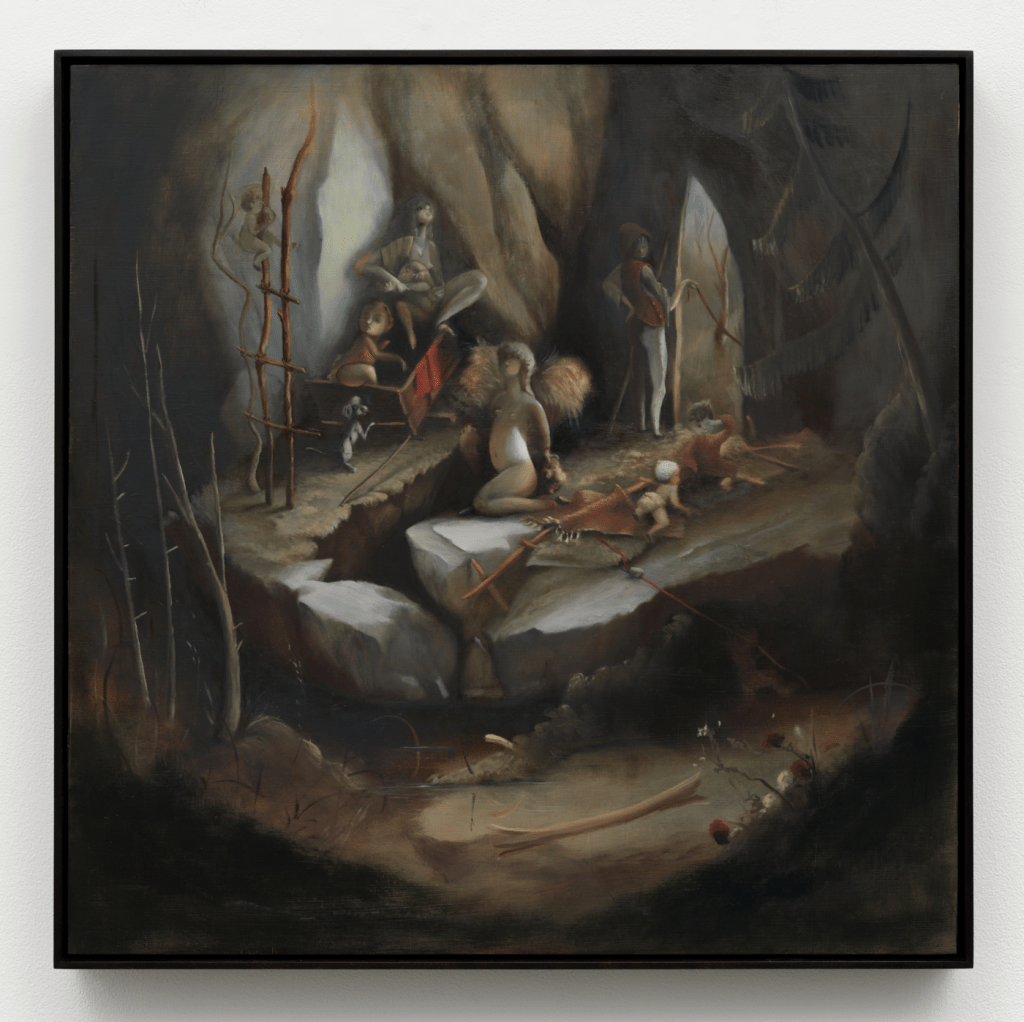
The depicted architecture – often a hybrid of interior and exterior, with stone arches opening to a da Vincian sky and slippery slopes descending into shadow – suggests a pagan arena. Nature appears carved, ancient, and worn, edges rounded by time. It’s a place of dreams constructed of romantic landscape motifs. Light defines form; a Renaissance palette lends temporal context. Hargrave uses color atmospherically rather than symbolically, except for her red. That particular color recalls the frescos of the Villa of the Mysteries, where a young woman’s initiation into adulthood unfolds in a series of murals bearing red backgrounds. Her expression after the ceremony reflects a heartbreaking awareness of powerlessness and the loss of innocence, but that emotional tenor is not evident in Hargrave’s paintings.
The figures themselves are often adolescent girls or young women, sometimes children, engaged in ambiguous rituals. Hands explore and cover budding breasts – clear references to awakening. Yet the figures resist objectification, their bodies remaining primarily sites of their own discovery. This is rare. Female bodies, particularly young ones, are seldom depicted nude with their agency intact. But here they are not sexualized. If the sweetness of their large-eyed, porcelain-like faces initially registers as cliché, it also coalesces the work thematically.
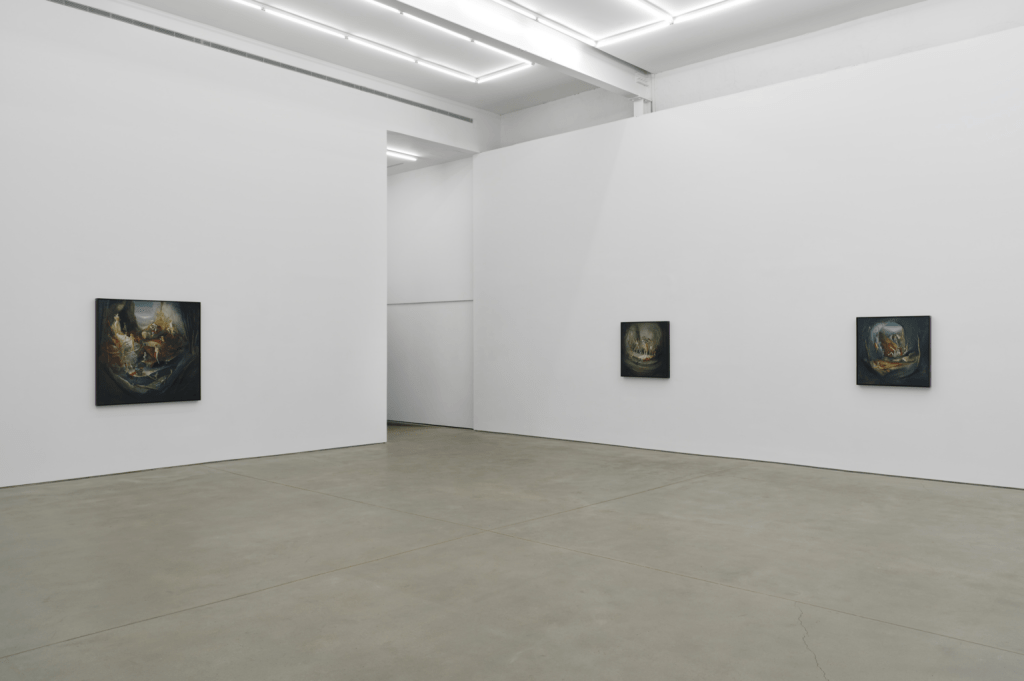
Karma’s press release cites Hargrave’s personal archive of inspirations, from early Renaissance madonnas to Holly Hobbie coloring books. She is a master at repurposing the familiar to create the unexpected. Looking at her work, I recognized a face from Goya, landscapes, and pink shadows from Titian. The tacky tchotchkes of garage sales – Hummel figurines – remind me of the toddlers and carts, while Lladro figurines resemble long-limbed adolescents. The juxtaposition of these tropes destabilizes them. The sentimental becomes strange, the decorative ritualistic, the familiar psychologically charged. In the shift from recognition to disorientation, cliché opens new perceptual space and forces us to reorganize our understanding.
Though Hargrave’s work is grounded in adolescence, she does not repress or categorize the child but instead examines prepubescent and early adolescent moments as sites of empowerment, where sensuality first registers as interior revelation. The compressed spaces, which feel interior even when presented as outdoors, intensify this effect. These are not landscapes as such but psychic terrains. This quality is what ultimately pulls the viewer in. The world feels wholly believed, inviting participation rather than doubt. When we thus enter a painting without reservation, suspending disbelief, we momentarily experience another person’s way of perceiving and imagining. The result is both unsettling and generous.
And what about the red wheels in many of the paintings? Do they refer to the spinning wheels of Rumpelstiltskin, whereby he ensnares a desperate young mother into trading her future newborn for gold spun from hay to sate a greedy king? Or do the wheels shade Bosch’s Haywain triptych, in which hay symbolizes earthly wealth and desire, and the wheel the rise and fall of human fortunes? Hargrave’s rich universe yields many such provocative conundrums.
“Kate Hargrave: MILK TEETH,” Karma, 22 East 2nd Street, New York, NY. Through March 28, 2026.
About the author: Lore Heller (aka Laurie Heller Marcus) is an artist and poet working in Long Island City. She has had online solo exhibitions with Jason McCoy Gallery and Planthouse Gallery.