Contributed by Joe Fyfe / Fergus Feehily, who is from Ireland but has lived in Berlin for years, is an unusual contemporary visual artist by virtue of his very careful degree of quiet obliquity. One almost hesitates to approach writing about him and, in this case, writing about his writing. It might be best to get the disclaimers over with: we share gallery representation in Köln, from Galerie Christian Lethert. He recommended me to the gallery, though at the time, long ago, I had never heard of him nor his work. I have since met him a few times. Once we had breakfast at Balthazar in New York and I remember how thoroughly he buttered and spread preserves on two sizable croissants. Feehily is somehow obscure but in plain sight, admired among an informed coterie of artists and collectors and an avid sharer. He does a lot of communicating. He posts on Instagram often, mostly very different kinds of artworks, though he appears to have something of a penchant for religious art. On his website are long year-end lists, an annī of enthusiasms for what he has read and listened to and looked at, whom he has met and spoken with.
Author: Two Coats Staff
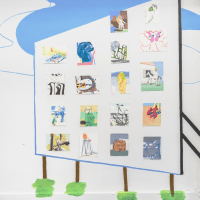
Drew Shiflett and Carter Hodgkin on the creative process
Contributed by Riad Miah / In conjunction with their two-person exhibition, The Shape of Things, at the John Molloy Gallery, I had the opportunity to engage in a conversation with artists Drew Shiflett and Carter Hodgkin about their materials and unusual creative processes. At first, their pairing seemed unexpected, as their visual languages appeared quite distinct. However, after seeing the exhibition firsthand, I came to appreciate the deep connections and underlying commonalities in their work.
Trevor Winkfield: From Leeds to eternity
Contributed by Elizabeth Hazan / During the night of election-related insomnia, I was thinking about how we find meaning in this crazy world and that reading personal histories can be life-affirming in a time of chaos. One of the delights of Mary Gabriel’s Ninth Street Women was learning how all these artists who were fixtures in the art world when I was a child came to New York to start making art in the first place. For a number of years, I shared a studio with the artist Trevor Winkfield. While he has done some long-form interviews, I think his lively storytelling deserves fresh attention.
Emily Berger: See Emily paint
Contributed by Peter Schroth / In “Spirit Level,” Emily Berger’s solo show at Starr Suites, she continues to expose the depths of a kind of abstract painting that she has intriguingly investigated and perfected over the past decade. Her minimal compositions are poised confidently between the formal and the lyrical. There is an almost primitive simplicity to what she reveals and purposefully little made of light, movement, and space in the ways we would typically anticipate.
Gary Stephan’s steadfast modernism
Contributed by Jonathan Stevenson / Gary Stephan has been an abstract painter for over fifty years. His command of that vocation – touch, line, color, concept – is duly acknowledged. But he is far from content. Stephan came of age at what was arguably the extended peak of modernism, when creative people across the board presumed to tackle existential problems for the ages.
A group apart at Springs Projects
Contributed by Jonathan Stevenson / There are a fair few viable organizing concepts for group art exhibitions. One particularly challenging one is to present viewers with a tour d’horizon of emotions and attitudes that seem to prevail at a given historical moment. The key to optimal execution, of course, is to avoid both the obvious and the obscure. In “Each Own” at Springs Projects, curators and gallery co-founders Cate Holt and Tommy White strike the right balance, strategically deploying the work of six exceptional…
Jim Osman: Multiplicities of balance
Contributed by Rachel Youens / The sculptures in Jim Osman’s show “Walnut 3,” now at McKenzie Fine Art, are both architectonic and playful. His constructions, placed on pedestals, are formalist balancing acts made of found lumber, some elements lightly reworked, that are stacked and arranged. Osman’s overall intention is to find a complex situation for entry, where forms assembled from Euclidean solids generate stability or dynamism through exquisitely contrasting proportions and scale. The experience of seeing unfolds in the extended time required to walk around each small free-standing work.
NYC Selected Gallery Guide, December 2024
This month, as many in the art world head to Miami for the fairs, most galleries have extended their exhibitions into December. If you missed a show you were hoping to catch, there’s good news—it’s likely still on view. But before you scroll down to see what’s in the galleries
Pierogi at 30: Revisiting the personal, peculiar, and droll
Contributed by Adam Simon / There have been group shows that represented cultural milestones – the Armory Show of 1913, the “‘Bad’ Painting” show at the New Museum in 1978, the Times Square Show of 1980. In the shadow of a foreboding US presidential election, “Pierogi 30” has that kind of historical weight.
Matthew Lusk: Offhand dystopia at Elijah Wheat
Contributed by Jonathan Stevenson / Located in rough-and-tumble Newburgh beyond the pale of riverfront commercial development on a piece of land just yards from the Hudson and insouciantly flush with its waterline, Carolina Wheat and Liz Nielsen’s grandly unvarnished Elijah Wheat Showroom has the Bunyanesque vibe of a frontier museum. Then it suavely wrongfoots its patrons with the fearlessly avant-garde attitude of 1970s Soho. Matthew Lusk’s deviously clever sculptures and installations exploit and reinforce both attributes…
Sylvia Plimack Mangold: Inside to outside
Contributed by David Carrier / As the title “Tapes, Fields, and Trees” indicates, the exhibition of ten works by Sylvia Plimack Mangold at Craig Starr Gallery draws on three bodies of her early work. In the mid-1970s, she made Minimalist paintings of tape measures. Pieces like Taped Over Twenty-Four-Inch Exact Rule on Light Floor, however, reveal a surprising poetry in seemingly prosaic subjects. Then she painted grids, like the one in Painted Graph Paper. Finally, in a remarkable transition, she drew a window looking out on a landscape….

NYC Selected Gallery Guide, November 2024
Contributed by Sharon Butler / This month, Marian Goodman has opened her new space in Tribeca—a thoughtfully renovated building at 385 Broadway. Just nearby, at 394 Broadway on the third floor, Pierogi Gallery, a longtime staple in Williamsburg, is marking its 30th anniversary with a pop-up exhibition. The show features works by numerous represented artists, along with selections…
Patricia Fabricant: Fear of empty spaces
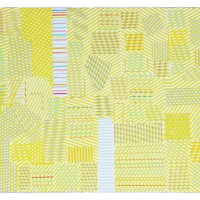
Contributed by Christopher Stout / Over the past 15 years, Patricia Fabricant has experimented with distinctive heroic elements within her work, some figurative and some that seem to be extracted from nature. “Horror Vacui,” her solo show at Equity Gallery, presents 26 inventively patterned gouache paintings that follow the conceptual approach the show’s title – meaning “fear of empty spaces” – suggests, filling the entire surface with detail and composition….
You Don’t Know Me: Trompe L’Oeil and artistic illusion
Contributed by Mark Wethli / On a small shelf in a quiet corner of Sarah Bouchard Gallery in Woolwich, Maine, sits a dog-eared paperback copy of Lewis Hyde’s Trickster Makes This World: Mischief, Myth, and Art. With a growing sense of delight, we soon realize that the book is itself a trick, a trompe l’oeil sculpture by Justin Richel, convincing in every detail from its vintage 1990s graphics to its well-worn cover….It is a fitting overture to “You Don’t Know Me,” the four-person show currently on view. The artists – Carly Glovinski, Rachel Grobstein, Duncan Hewitt, and Richel – present kindred explorations of parallel realities, producing conundrums and contradictions that give rise to visual enchantment and philosophical contemplation.
Eleanor Ray: The power of the small
Contributed by Michael Brennan / Many conceptualists, favoring the unconstrained and expansive, balk at the representation or framing of any experience as image. Long after he abandoned painting, the late installation artist Robert Irwin likened it to a mere “keyhole” of perception. In Zen and the Art of Motorcycle Maintenance, Robert Pirsig declared that compartmentalizing experience for viewing made you “a passive observer” for whom “it’s all moving by you boringly in a frame.” Yet surely not every living experience has to be as open-ended as a motorcycle racing across salt flats. While a painting can never capture the full immensity of life, with adequate perception and economy of means – say, Luke Howard’s vision of the sky realized in paper and watercolor – even a diminutive one can provide a meaningful distillation of experience. The paintings of Eleanor Ray, now on display in her third solo show at Nicelle Beauchene Gallery, constitute abundant evidence.