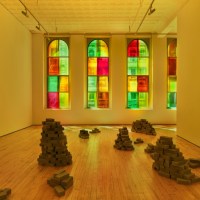
Contributed by David Carrier / Spencer Finch is fascinated by Japan, which he first visited some 50 years ago, when he was a teenager. “One Hundred Famous Views of New York City (After Hiroshige),” his current exhibition at James Cohan Gallery, includes four installations grounded in that experience. Fourteen Stones, inspired by a Japanese Zen garden and made with ordinary concrete bricks, encompasses simulacra of fifteenth-century garden stones. Even these banal objects, Finch suggests, warrant contemplation. For Moonlight (Reflected in a Pond), he has installed stained glass to evoke Japanese moon-viewing. Four LED sculptures present images that recast traditional Japanese haikus through lit color schemes. And Finch’s 42 watercolors reference Utagawa Hiroshige’s renowned One Hundred Famous Views of Edo, made in 1856–58, through present-day New York.
Tag: James Cohan Gallery
Ranti Bam’s sculpture: Abstract women talking
Contributed by Rosetta Marantz Cohen / “Anima,” the first New York show of Ranti Bam’s work, now on view at James Cohan, presents the British-Nigerian artist’s 15 mostly freestanding ceramic sculptures. They’re strategically deployed across two rooms, simulating a conversation among a lively group of women who are different in color and temperament but linked in some fundamental way. The longer you look at them, the more animated and female they seem.
Diane Simpson’s elegant quirkiness
Contributed by Laurie Fendrich / While still in graduate school at the School of the Art Institute of Chicago in the late 1970s, the Chicago sculptor Diane Simpson (b. 1935) experienced a serendipitous moment. Through a store window, she caught sight of a child’s chair made from corrugated board. An array of little flutes connecting layers of liner board made the piece unbendable and weight-bearing while keeping it lightweight. Simpson went out and purchased some of the material and shifted from collagraph printmaking – a process that uses a plate with collaged materials – to sculpture. After learning to use a jigsaw to cut the board at a 45-degree angle, she made interlocking flat shapes of her own design, then assembled them into full-fledged sculptures.