

Contributed by Rosetta Marantz Cohen / “Anima,” the first New York show of Ranti Bam’s work, now on view at James Cohan, presents the British-Nigerian artist’s 15 mostly freestanding ceramic sculptures. They’re strategically deployed across two rooms, simulating a conversation among a lively group of women who are different in color and temperament but linked in some fundamental way. The longer you look at them, the more animated and female they seem.
While they share an essential verticality, Bam’s clay vessels vary in quietly interesting ways. Some are slightly tilted or off-kilter. Others stand stiffly upright, anchored by sturdy legs like the ones on African senufu stools. Some have punctures or gashes in their sides, or flaps of thin clay peeling off their surfaces as shedding skin would. Color animates the vessels in ways that might read as feminine, appearing as it does in a motley arrangement of patterns pressed from paper surfaces. In the twelve glazed pieces, Bam’s palette is fairly subdued, bright colors muted as if by time and exposure. Most surfaces are matte, though several have glossy interiors: the slick insides of sun-baked bodies.

stoneware
40 1/2 x 15 x 16 inches
102.9 x 38.1 x 40.6 cm
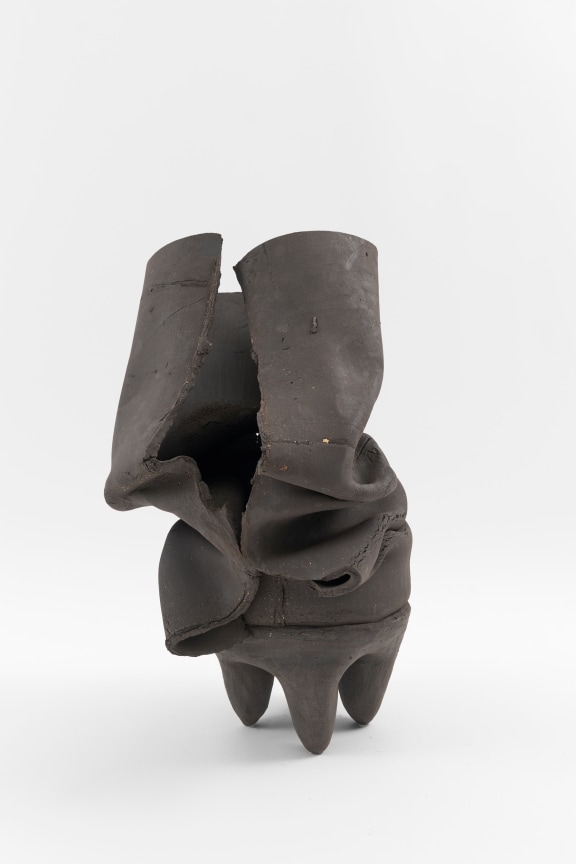
stoneware
27 x 18 x 16 inches
68.6 x 45.7 x 40.6 cm
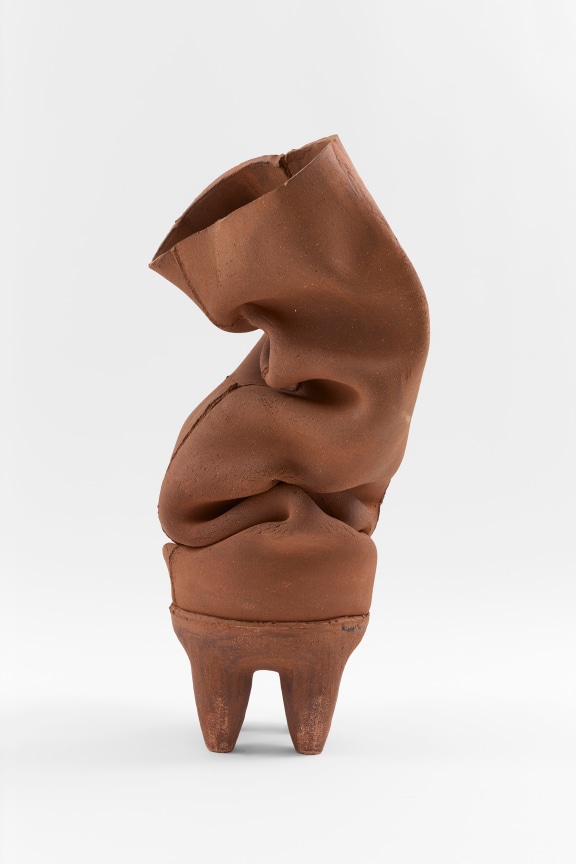
31 3/4 x 16 1/2 x 13 1/2 inches
80.6 x 41.9 x 34.3 cm
Interspersed among the glazed sculptures are four unglazed stoneware pieces, called ifas, that stand in some contrast to the others. Bam formed these sepia and deep-brown sculptures by pressing her own body against a funnel of clay, buckling the sides, and partly collapsing them under the force of her embrace. Ifa in Yoruba means both “divination” and “to pull close.” In their voluptuous states of collapse, these particular works convey a sensuality absent from the painted vessels and seem even more explicitly linked to the female body.

stoneware and wooden stool
Vessel: 22 x 19 1/2 x 20 1/2 inches
55.9 x 49.5 x 52.1 cm
Base: 35.5 x 16.25 x 16.25 inches
Bam titled her exhibition “Anima” because the word refers to the Jungian concept of the soul as a feminine spirit, embodying the qualities of care, empathy, and sensitivity. Fair enough, but an exclusively Jungian lens imposes limitations on Bam’s work in terms of what makes an abstract form “feminine.” For me, the vessels project a more expansive and complicated kind of feminine spirit – not just sensitivity but also power and stoicism; not only care but also the scars of ravagement, the toll on the body of work and weather. There may be empathy in the irregular surfaces of these sculptures, but there is also gentle irony.
I came to Bam’s exhibition right after viewing the new Cycladic installation at the Met. I found the two shows improbably and intriguingly complementary. The Cycladic figures are notable for their sameness and constitute elegant abstractions of the feminine. Bam’s vessels too are variations on a similar form, but they also invite us to pour meaning into them.
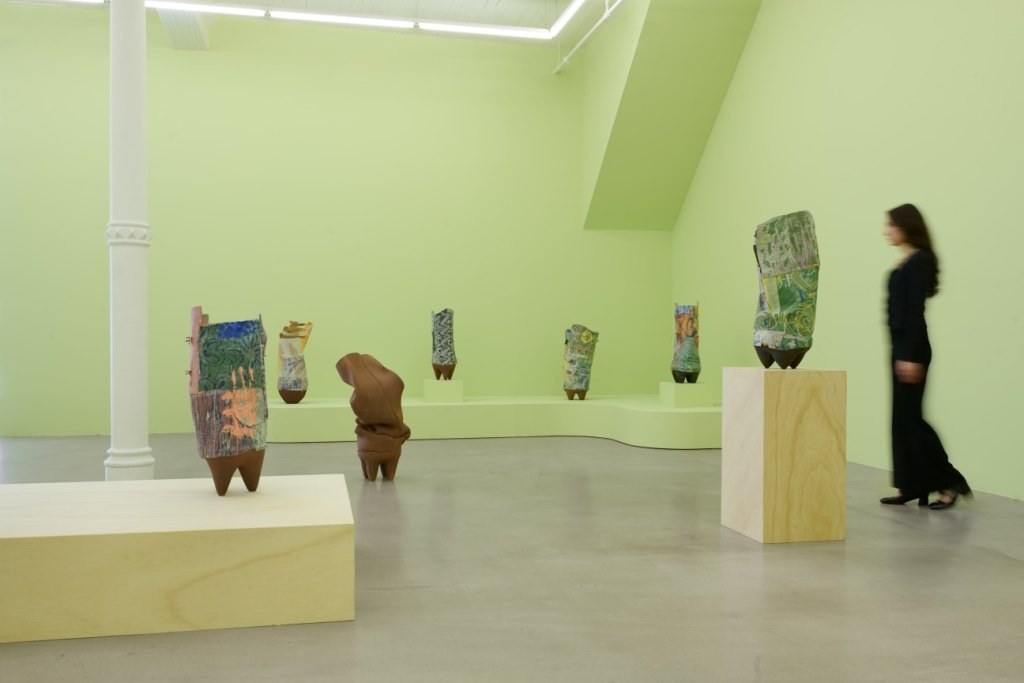
“Ranti Bam: Anima,” James Cohan, 291 Grand Street, New York, NY. Through July 26, 2024.
About the author: Rosetta Marantz Cohen is the Myra M. Sampson Professor Emerita at Smith College, and a painter.









Echos of Neri, Voulkos, DeStabler. Nice work.