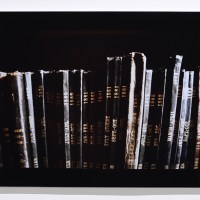
Contributed by Adam Simon / If I had walked into Kerry Schuss Gallery knowing nothing about the two artists on display, I would have thought the pairing unusual, elegant, and extremely interesting. One group of works consists of Michael Maul’s 11 x 8.5-inch ballpoint pen and colored pencil drawings on ledger paper depicting row after row of almost identical figures, rendered in a diagrammatic shorthand. Interspersed among these, are four 20 x 24-inch photographs of books taken by Tim Maul. The photographs are one of a kind Cibachromes, produced by printing directly from 35-millimeter slides; the method was discontinued in 2013. Cibachromes are long-lasting photographs of exceptionally vivid colors. All four of the photographs were shot in the 1990s but not printed until 2000. Two depict books open to what appear to be the blank pages preceding the title page. A third book is similarly splayed but face-down. The fourth photograph is of a shelf of books that appear to be journals or compiled records with dates on the spines ranging from 1859 to 1863, shot on commission at a library in Ireland.
Tag: Giorgio Morandi
Andrew Shea’s domestic enchantment
Contributed by Jonathan Agin / Andrew Shea’s work in recent years has evolved from geometric, high-contrast scenes of city bustle to impressionistic vignettes of home life where hues interact with considerably more freedom. Steeped in a quiet domesticity, the paintings in “Grocery Slips” at JJ Murphy Gallery seem idealized only at first glance…
Farrell Brickhouse: The beat goes on
Contributed by Jonathan Stevenson / Farrell Brickhouse’s recent paintings, on view at JJ Murphy Gallery, embody aging and stamina and the grungy inventiveness that comes with them. In these terms, perhaps the signature piece is Summers End II, tucked away all by itself in the gallery’s rear alcove. Just a foot-and-a-half square, it is a still life of Rauschenberg-grade grit that holds court, depicting what looks like a vase of motley flowers on a stand, waning but defiant in the face of time. Distressed as they are, they look not just alive but capable of aggression. The work is textured in the extreme, Brickhouse having affixed to the canvas the congealed detritus of students’ pigment and painted thickly around it. It’s as though Chaïm Soutine or Frank Auerbach had possessed Morandi and gone to town.
Performance project: Face painting
Twenty years of painting practice will finally be put to good use today when I paint kids’ faces during the fall festival at my daughter’s […]
Why painters keep painting
In the NY Times Holland Cotter explains why Giorgio Morandi kept painting, even after his hands became shaky and his eyesight started to fail. “You […]
Morandi: “I don’t ask for anything except for a bit of peace which is indispensable for me to work.”
The big Giorgio Morandi survey that opens this week at the Metropolitan Museum features over 100 paintings, drawings, watercolors and etchings. In the New Yorker […]
NY Mag’s fall painting picks
Giorgio Morandi: 1890–1964, Metropolitan Museum, New York, NY. Sept. 16–Dec. 14.“When the master of quiet still lifes died in 1964, he was unfashionable in New […]