
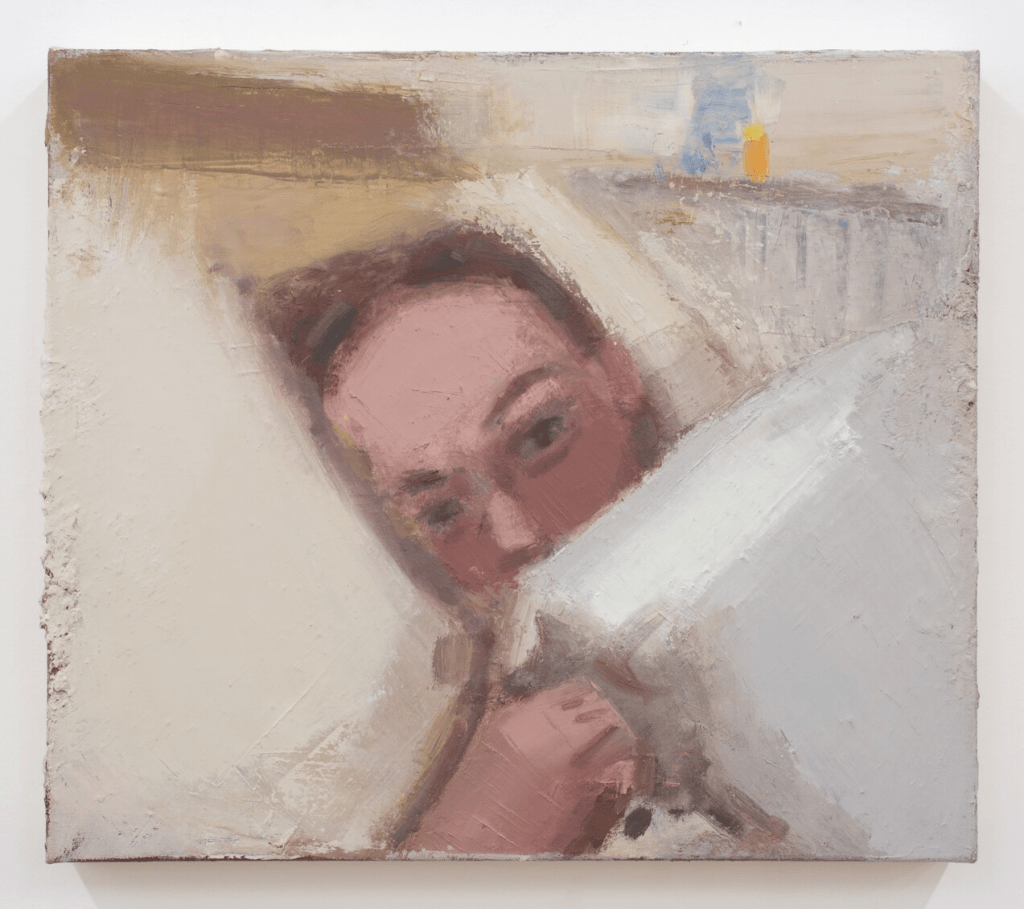
Contributed by Jonathan Agin / Andrew Shea’s work in recent years has evolved from geometric, high-contrast scenes of city bustle to impressionistic vignettes of home life where hues interact with considerably more freedom. Steeped in a quiet domesticity, the paintings in “Grocery Slips” at JJ Murphy Gallery seem idealized only at first glance.
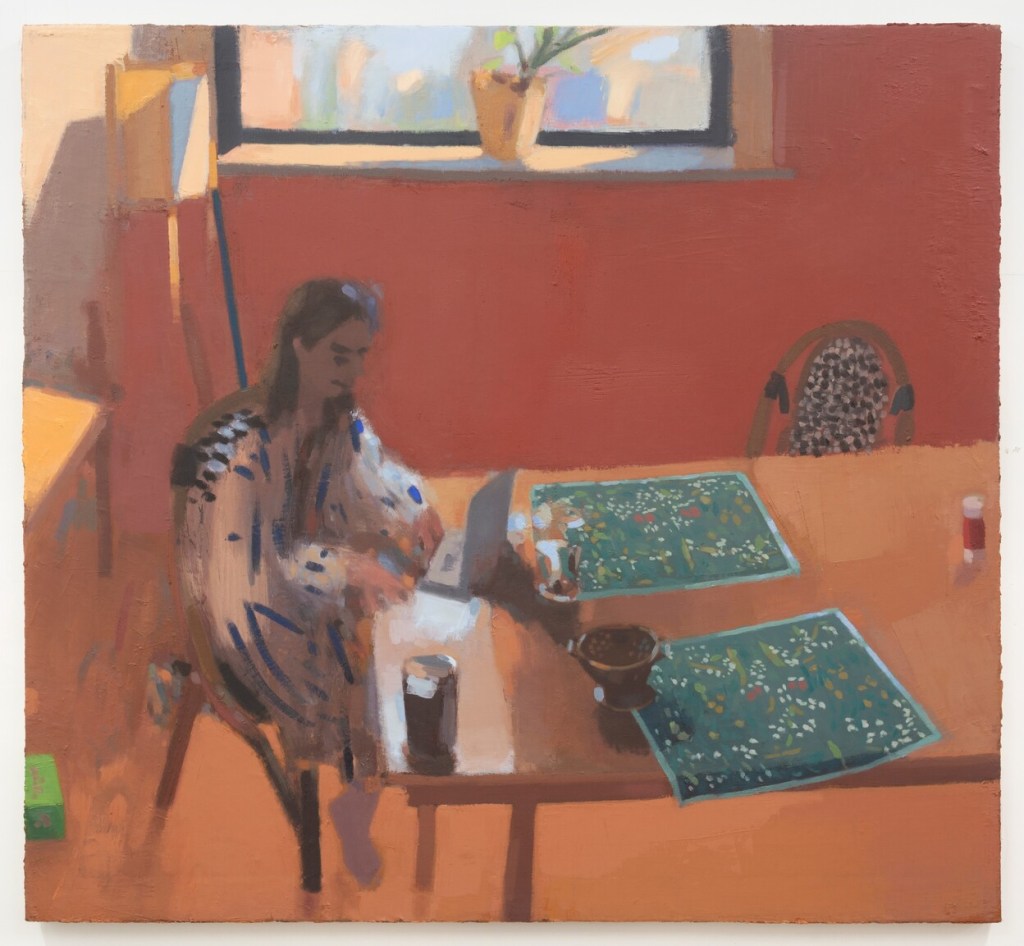
In the tidy and spacious rooms Shea paints, there isn’t much to distract one’s attention. The figure in Morning Coffee has time for a second cup. There is work to be done on her laptop, but it’s not pressing. Dominating the nearly four-foot-wide canvas is a clean red wall and large dining table with only a few things on it. The woven chair back and the woman’s flowing robe are rendered subtly, but Shea’s royal blue lines, thickly applied splotches, and constellations of forest greens and ochres on the placemats, suggesting a William Morris pattern, evoke refined style. Light beams are bright and focused. Yet a sense of flux haunts the painting. Raised marks from the painter’s knife and thick brush-produced impasto impart physicality and movement. The paint accumulated around the edges of the canvas lends it a delicate instability. Stillness is sought but unachieved.
Shea has a predilection for varying figuration-abstraction balance. Conversation (Green Tablecloth) is considerably more abstract than Morning Coffee, though both employ a blended approach, straddling the boundary. Several figures appear to be sitting at a dining table before a tablecloth the color of toothpaste. The object sitting on the table could be a bouquet but looks more like a food-colored ice cream cake, halfway melted into a puddle. Bright yellow and tangerine slicing across the top left of the canvas and burnt oranges along the right edge underscore the celebratory mood. Compromising it, though, is the high contrast of the tablecloth against a cool purple backdrop and the movement implied by heavy impasto and knife markings.


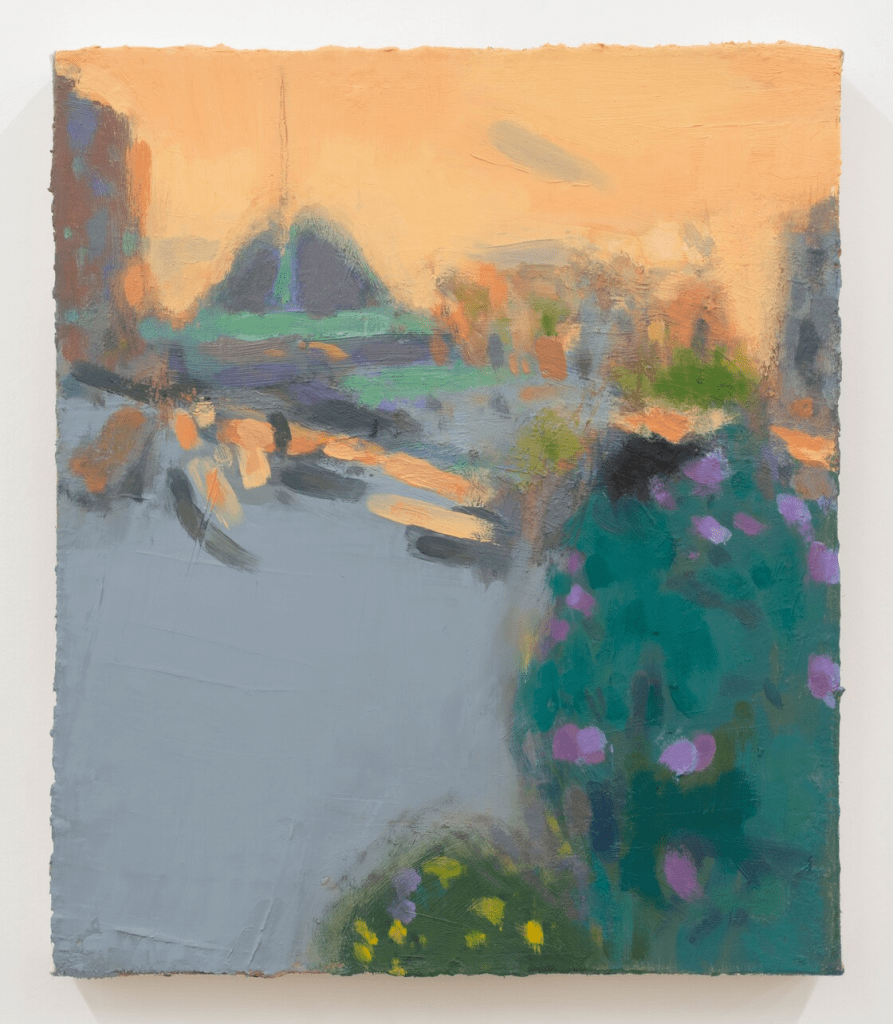
14 x 12 inches
Several still lifes are included in this show: artist supplies on a table, a plant by a window, clothes drying on a fold-out rack. The worlds Shea captures are mostly self-contained, with the subject centered on the canvas. The exception may be the most striking of the paintings. In Studio Mirror, Still Life, a rectangular mirror sits on a white wall. In the mirror – thus “behind” the viewer – is the opposite wall. Against it, on a table, is an assortment of artist’s supplies and materials. The matte white bottle sitting in the middle could be one of Morandi’s if not for the conspicuous black cap. A couple of small paintings stand at the back. Two more works hang high up, almost out of view, near a yellow polygon we can tell is a pair of gloves only from the shadows they cast on the wall. The mirror is truncated on one side by the edge of the canvas. The array suggests creative endeavor through steady routine, some of it cut off from view.
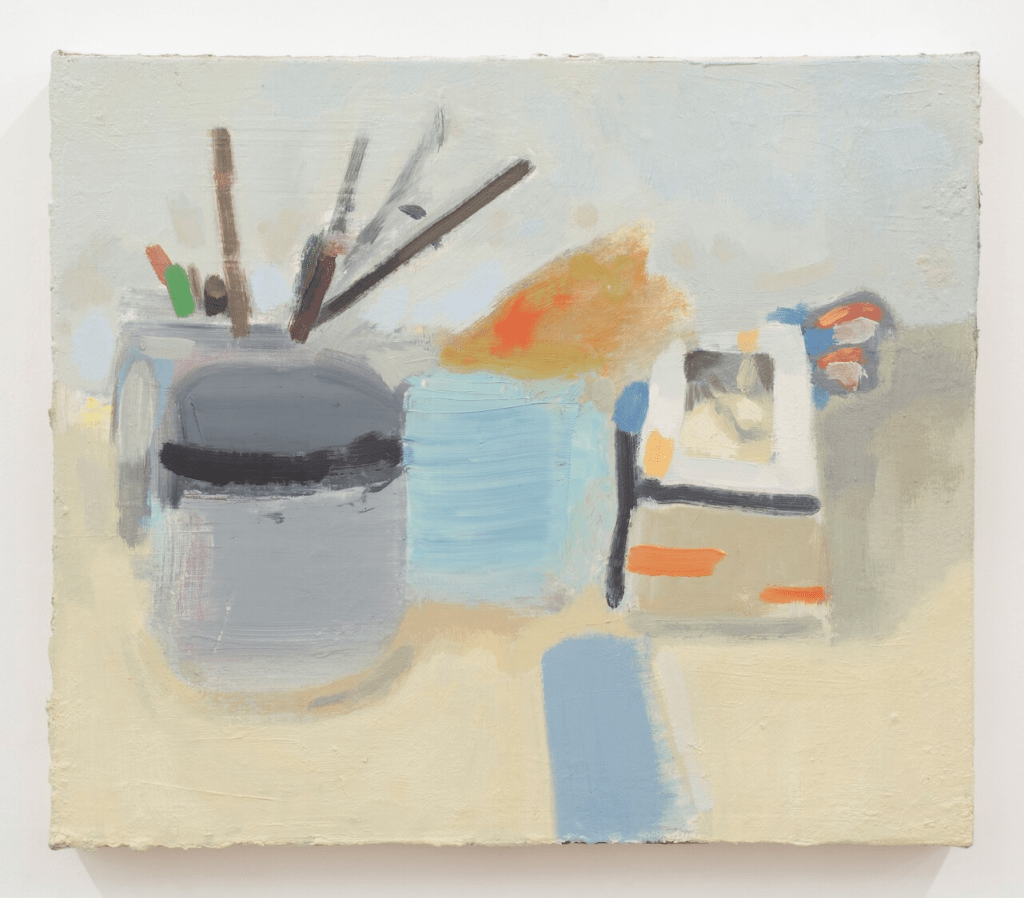
12 x 14 inches
The intense natural light that Shea brings into his rooms through highly saturated hues gives them an aura of enchantment. I think of his vignettes as aspirational. The pleasures of home, solitude, artistic labor, and the medium of oil painting itself are offered fleetingly and precariously, but it’s more than enough to inspire.
“Andrew Shea: Grocery Slips,” 53 Stanton Street, New York, NY. Through November 15, 2025.
About the author: Jonathan Agin is a New York-based literary agent.











Very nice work.